
Sign up to save your podcasts
Or



Patrick Madrid discusses how to explain and defend the choice to be Catholic, as well as how to answer difficult questions about the faith. He emphasizes the importance of maintaining perspective, pointing out that apologetics is the art of winning souls.
Patrick Madrid is an American Catholic author, radio host, apologist, the host of several EWTN television and radio series, and was the publisher of Envoy Magazine. He earned a Bachelor’s degree in business from the University of Phoenix, as well as a B.Phil. degree in philosophy and an M.A. degree in theology from the Pontifical College Josephinum in Columbus, Ohio. Patrick serves as an adjunct professor of theology at Holy Apostles College and Seminary and has also taught theology at Franciscan University of Steubenville and is a research fellow at the Saint Paul Center for Biblical Studies.
Professor McGuire tackles the topic of John Henry Newman, a colossal figure of the 19th century world. The prolific writings of John Henry Newman offers timely insights that can be applied to the New Evangelization.
Professor Brendan McGuire, Ph.D., is a Catholic historian specializing in the classical and medieval periods. He received his doctoral degree in medieval history from Saint Louis University, and in recent years has presented scholarly research on various historical topics at prestigious regional, national, and international conferences. He has taught both history and classical languages at the undergraduate level, and is currently a professor of history at Christendom College, his alma mater.
Closing the conference, popular EWTN host, author, and conference emcee Marcus Grodi gave practical advice to attendees on how to look at the science of conversion itself, and how to form a strategy of dialogue to help bring fallen-away Catholics, and Protestants, to the beauty of the Catholic Church.
“In my own journey, as I was growing closer to the Catholic Church, I realized that there was more than just being in Jesus. Christ calls us to abide, and the necessity of abiding will continue for the rest of our lives — this isn’t a one-time thing . . . if we’re not abiding, then we don’t produce the fruit. Intimacy with Jesus is more than just receiving Him in your heart — the way you abide in Christ is by receiving Him in the Eucharist. . . . We have a real treasure to share.”
Dr. R.J. Matava, who was previously a Liddon Fellow at Oxford’s Keble College, presented a talk titled “Conversion and Apologetics: Personal Vocation as a Key to the New Evangelization.” Positing that holiness of life is essential for apologetics, Matava treated the nature of apologetics through a theological and historical lens, looking at what it needs to be effective within the New Evangelization.
“While the original evangelization generally brought the Gospel to the pagan world, the ‘new evangelization’ must bring the Gospel to a world described by some as ‘post Christian,’ and not least to people who are baptized but lack faith,” said Matava. “What then is the most urgent task of a new apologetics for the new evangelization? I would suggest that it is to cultivate in others, so far as we are able, the necessary dispositions to earnestly consider the reasons for the faith.”
Professor Brendan McGuire, Ph.D., is a Catholic historian, specializing in the classical and medieval periods. He received his doctoral degree in medieval history from Saint Louis University, and in recent years has presented scholarly research on various historical topics at prestigious regional, national, and international conferences. He has taught both history and classical languages at the undergraduate level, and he is currently a professor of history at Christendom College, his alma mater.
Dr. Christopher Shannon, author of the highly acclaimed Bowery to Broadway, examined the historical approach of Jean Daniélou and Henri de Lubac. Shannon said that by placing the saints alongside the great political leaders of history, the saints, as types of Christ, would bring an organizing structure.
“[According to Daniélou and de Lubac,] what we should be looking for in history is Jesus Christ, particularly as we see Him in the saints,” Shannon said. “The saints are our guides to history.”
Dr. Thomas Madden, whose expertise has been sought by The New York Times, Washington Post, Wall Street Journal, USA Today, NPR, and The History Channel, delivered a talk entitled “Rethinking Holy War: The Crusades and Catholic Devotion in the Middle Ages.” Madden exposed many contemporary misunderstandings of the Crusades as uneducated and lacking in any real evidence. Madden posited that in order to understand the Crusades, one has to have an understanding of “Medieval piety.”
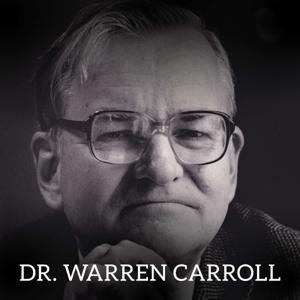
Dr. Timothy O’Donnell, the author of Heart of the Redeemer and Swords Around the Cross: The Nine Years War, presented a talk entitled “Why History?: The Church’s View.” O’Donnell explained the importance that the Church has placed on the study of history and how in recent years the field has suffered from “a crisis of faith.” In the second part of his talk, O’Donnell described the thought of Dr. Warren Carroll and how his historical works responded to this “crisis.”
“It was his goal in his work to tell the full historical story of Christian civilization,” O’Donnell said of Carroll. “From its preparation, birth, growth, climax, division, and its retreat, but always as Carroll said, ‘ready for its coming resurrection.’ Talk about a man of hope.”
Author and historian Dr. Brad S. Gregory discussed history as the “handmaiden of theology.” Gregory argued that while avoiding a Catholic confessional history, one might still serve a Catholic vision of history and reach those in academia who may be antagonistic toward Catholicism.
“Because people are not likely to change their basic commitments unless there is something the matter with their own, we have to trouble the waters,” he said. “We have to argue on the basis of evidence, to use reason in service to the Faith, without—if we want to have a chance of reaching those who do not share our views—presupposing anything that is substantively part of the Faith.”
On July 13, Christendom College hosted a one-day conference on Catholic history, featuring prominent historians from across the country. Over 230 attendees were given a Catholic perspective on topics that ranged from the Crusades to ecumenism with the Eastern churches.
From the publisher's feed

809 Listeners

2,614 Listeners
28 Listeners
11 Listeners
13 Listeners
5 Listeners
14 Listeners
0 Listeners
0 Listeners