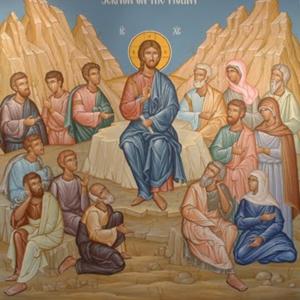
When Jesus was giving His famous Sermon on the Mount recorded in the Gospel of Matthew, He focused on three spiritual disciplines central to Jewish piety: prayer, fasting and almsgiving. The Orthodox Church has always considered these same three practices essential and integral to the Christian life. This is because only actions based on faith express true belief and a right relationship with God. Knowledge alone will never transform us, heal us, or make us one with God. St. James teaches, “Faith by itself, if it has no works, is dead. I by my works will show you my faith” (Js. 2:17, 18).
For this reason, Orthodox Christians fast. In fact, we are instructed to fast twice a week on Wednesdays and Fridays throughout the year. Every Wednesday, we remember Judas's betrayal of our Lord Jesus, and on Fridays, we remember Christ's crucifixion. In addition, the Church invites us to fast on a more extensive basis during four different preparatory seasons: Great Lent before Holy Week and Pascha, the Nativity Fast before Christmas, the Apostles Fast before the feast of Sts. Peter and Paul, and this current fast before the feast of the Dormition of the Theotokos.
It should therefore be no surprise that today's Gospel recounts the deliverance of a young boy from demonic possession. Because the Apostles were unable to help the boy, the father turned to Jesus Who successfully freed the tortured boy. Later, when asked by His disciples why they were unable to cast out the demon, Jesus replied that this type of demon could only be cast out by “prayer and fasting.”
Orthodox fasting guidelines invite the faithful to abstain from all meats, fish, dairy, wine and oil. The goal of a fast is to train the will toward obedience to Christ and the Church's teachings, to align our human will with God's divine will. By abstaining from everyday foods, which are a part of the regular human routine, a fasting person is constantly reminded to remember God, to remember and prepare for the upcoming Church Feast, and to remember the soul and its spiritual faculties over the body. Fasting should never be reduced to a food-centered diet but should always be accompanied by prayer—both personal and corporate. Prayer should give wings to fasting and vice versa. Fasting, as an ascetic practice, is not seen as an end but a means toward drawing closer to God. It is too easy in our fallen society to become materialists, focusing on this temporal world, the things that pertain to the body and the senses, while forgetting about the soul, the kingdom of heaven, and eternal and ultimate things. Fasting provides us the opportunity to rightly orient ourselves toward God and our intended citizenship in His eternal kingdom.
May this current Fast help us to draw closer to our Lord and Savior, help us to remember the life of the greatest Saint, the Holy Theotokos, and realign our own weak wills with our Lord's perfect will.