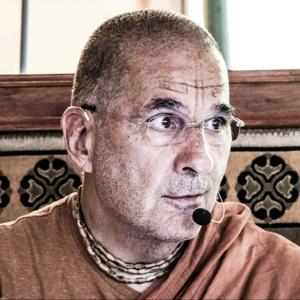
Questions on today's Swami call:
In Circle of Friends, on page 301, Krsna is absent from Vraja, appearing as if a *sphurti - a hallucination. it is written that Yasoda’s experience of Krsna in dreams while separated was actual. “Indeed, he said he was eating her cooking daily” meaning that in the dreams he was eating it. Is this the same way a Murti of Sri Krsna eats Mahaprasadam?
What does the 'Sri' in 'Sri Guru' refer to?
I have recently translated the Sanga "Santa -Rasa in Vraja" (from April 2nd 2006). In the last paragraph of the text, you write: "Great devotees view the world through the lens of their bhava, and this may afford them different angles of vision at different times. Furthermore, some of Sri Krishna’s devotees experience the suddha-rati known as svaccha (transparent), in which they taste the rati of those with whom they associate, moving between santa, dasya, sakhya, and madhurya". My question is: "Is svaccha then included in one's sthayi bhava, being somehow akin to empathy? Or is it a separate sthayi-bhava itself like sakhya, vatsalya or madhurya?" Thank you.
Is svaccha-rati like rati-abhasa?
Is there anything like ekadasa-bhava initiation for sakhya-rasa?
Did Sri Uddharana Datta Thakura live with the realization of his svarupa from the time that Nityananda Prabhu blessed him?
Why is it important to chant the holy names of God in Sanskrit? Does this language have any special significance in the transcendental realm?
Sanskrit has a certain explanatory power, but Krishna's name is said to be one with him. Are those Sanskrit words (Sri Krishna's names and the names of his associates) something more than just explanatory?
If I understand correctly, Sri Krishna's human-like pastimes are always taking place in some universe. Does this mean that in every universe there is a planet equivalent to Earth, with similar characteristics and even beings similar to those we know here, so that the līlā remains the same in essence and form? Or can the details of each universe vary?
How do you approach your own worship of Sri Giriraja Maharaja?
Did Srila Prabhupada say that we cannot worship Giriraja?
Could we understand then that the Sanskrit names of Krishna and the siddha devotees are the translation of their names from the lila's language of love?
How does one overcome the demon of duplicity? An example in my own life would be trying to become logically coherent and persuasive in my arguments absolute atheism and monism, then when people are drawn to me I try to orient them to Yourself and the Saintly people of our lineage. How do I stop putting myself "first" and infront of orienting others toward the revealed knowledge? Do I just present you and others plainly? by just imitation of your words I feel like parrot is that enough to progress and earn your grace?
How can regain taste in hearing and chanting?