
Sign up to save your podcasts
Or

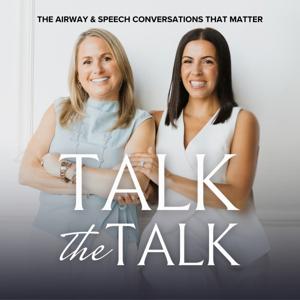


Toni-Ann Antoniato and Janine Stiene, speech-language pathologists and co-owners of Long Island Speech, built their myofunctional therapy practice from a single basement office into nine locations across Long Island, New York. In this solo episode, Toni-Ann shares how it happened, how Spot Pal was born, and why Talk the Talk is getting a fresh look.
In this episode, Toni-Ann covers:
Spot Pal: https://spotpal.com/
Long Island Speech: https://lispeech.com/
Connect with us on Instagram
Toni-Ann sits down with Dr. Suraj Vatish, dentist and tongue tie specialist based in London, for a conversation about why the release is only one piece of the puzzle and why snoring should never be brushed off as normal.
In this episode, Toni-Ann and Dr. Vatish cover:
If you've ever been told your child would "just outgrow" the snoring or mouth breathing, this episode is for you.
Connect with Dr. Suraj Vatish
Resources
Connect With Us
Most babies are capable of so much more than we give them credit for, and the window to build those skills is shorter than parents realize. This week, Toni-Ann sits down with Jill Rabin, a pediatric speech-language pathologist and international board-certified lactation consultant with 39 years of experience, to talk about why self-feeding isn't just about food, it's about building the oral motor foundation that shapes development for years to come.
In this episode, Toni-Ann and Jill cover:
If you've ever watched a baby struggle with texture and wondered what you could have done earlier, this episode is for you.
Connect with Jill:
Resources Mentioned:
Connect With Us
Dr. Kristen Geist is an airway-focused dentist who saw six doctors before anyone thought to check her sleep. She joins Toni-Ann to share her own UARS diagnosis, how she built her collaborative practice from scratch, and what she's learned treating adult patients that the medical system keeps missing.
In this episode, Toni-Ann and Dr. Geist cover:
If you've ever felt dismissed by a provider, or you're a clinician trying to piece together why your patient isn't getting better, this one's for you.
Connect with Dr. Geist
Connect With Us
What if the best palatal expander isn't an appliance at all?
Dr. German Ramírez-Yañez is a pediatric dentist, researcher, and airway-focused orthodontic educator known for his work on early malocclusion, craniofacial growth, and the connection between oral function and pediatric sleep-disordered breathing. His philosophy challenges the conventional idea that orthodontics is simply about aligning teeth — instead, it's about growth, breathing, function, and early intervention.
In this conversation, Dr. Ramírez-Yañez explains why structure and function must be treated together, how the tongue is the most powerful tool for palatal development, and why skipping myofunctional therapy after expansion almost guarantees relapse. He also shares why "waiting for the age of braces" could mean missing the most critical window for guiding craniofacial growth.
If you're a parent who's been told to "wait and see" — or a provider frustrated by relapse cases — this episode will change how you think about early orthodontics.
Key Takeaways:
The tongue is the best bilateral expander — every swallow pushes the maxilla to develop
Palatal expansion without tongue retraining leads to collapse and relapse
Crowded baby teeth signal a transverse development problem, not just a cosmetic issue
Mouth breathing dries the nasal mucosa and creates a cycle of congestion
Mastication patterns (vertical vs. lateral chewing) directly impact jaw growth
Developing the maxilla simultaneously develops the airway
Early intervention is about guiding growth, not aligning teeth
Collaboration between dentists, myofunctional therapists, and ENTs produces the best outcomes
Timestamps:
01:30 Early Intervention Journey
05:00 Structure Meets Function
07:30 Teeth Bone Muscle Connection
10:00 When to Start Treatment
14:00 The Mouth as Gateway
17:30 Tongue as Palatal Expander
22:00 Mastication and Jaw Growth
27:00 Braces vs. Health Goals
32:00 Why Expanders Relapse
39:00 Nasal Breathing Training
42:00 Nasal Hygiene Strategies
45:00 Tonsils Adenoids and Airway
47:00 ENT Myo Collaboration Gap
52:00 Future of Orthodontics
56:30 Toronto Course Info
Connect with Dr. German Ramírez-Yañez:
Connect With Us
Tamara Thomas needed braces three times before discovering the real problem: undiagnosed tongue dysfunction no one had ever looked at.
Now a registered dental hygienist, owner of Facial Physique Orofacial Myofunctional Therapy, and 2026 President of the National Network of Healthcare Hygienists, Tamara is on a mission to integrate dental hygienists into hospitals and bridge the gap between oral and systemic health. She's a STAR Course speaker, instructor for the Oral Systemic Educator Course, and former Airway Circle mentor.
In this episode, she reveals how she built an airway-focused team from scratch in San Diego and the muscle memory truth about tongue tie releases and palatal expansion that no one talks about.
For dental professionals bridging the gap to medicine, therapists building referral networks, and parents navigating treatment decisions.
Key Takeaways
Timestamps
02:26 Braces Relapse Mystery
02:43 Discovering Myofunctional Therapy
11:20 Leading Healthcare Hygienists
14:52 Oral Care in Hospitals
17:13 Building Airway Referral Teams
25:33 Palatal Expansion Cases
28:24 Pediatric Myo Pathways
32:42 Tongue Tie Referral Flow
37:15 Muscle Memory After Surgery
Connect with Tamara Thomas
Connect With Us
Most orthodontists won't see your 5-year-old. They'll tell you to come back when they've lost more teeth, when they're "ready," when the problem is worse. But what if your child is mouth breathing, snoring, and struggling to focus right now?
Dr. Mike DeLuke, board-certified orthodontist and founder of DeLuke Orthodontic Coaching, reveals why the orthodontic system is designed to wait, what that delay costs kids, and how early airway-focused treatment is changing lives before teeth even become the problem.
Perfect for parents who've been told "wait and see" one too many times, SLPs and myofunctional therapists trying to find orthodontists who actually get it, and any provider who suspects we're missing something by waiting until age 12.
Key Takeaways
Timestamps
03:00 - Dr. DeLuke's family dental dynasty and why he started his own practice
08:00 - The accidental discovery: CBCT scans that changed everything
26:00 - Why the insurance system discourages early treatment
40:00 - The behavioral management challenge: treating 5-year-olds vs. teenagers
54:00 - The extraction debate: what the research actually shows
1:06:00 - Why pediatric sleep studies are deeply flawed
1:09:00 - The ADHD and sleep connection every parent should know
Connect with Dr. Mike DeLuke
Resources Mentioned
Connect With Us
If you've ever felt dismissed by a pediatrician, shut down by a specialist, or told your child's chronic health issues are "just genetic," this episode will change everything.
Beth Lambert, founder of Documenting Hope, pulls back the curtain on why the conventional healthcare system wasn't designed to heal children with autism, ADHD, speech delays, autoimmune conditions, and other chronic health issues. She reveals the environmental factors driving childhood illness and shares the root cause approach helping thousands of families reverse their children's conditions.
Essential listening for SLPs, myofunctional therapists, airway-focused providers, and parents who know something is wrong but can't get answers.
Key Takeaways
Timestamps
01:30 - Beth's background in pharmaceutical consulting and discovering the healthcare system prioritizes profit over healing
09:30 - Why modern culture (food, toxins, indoor living) is making our kids sick
14:00 - Founding Documenting Hope: research and education to prove conditions are preventable and reversible
22:00 - Nervous system regulation as the foundation before all other therapies
30:00 - The total load concept: cumulative stressors preventing development
43:00 - Why insurance covers ABA but not root cause approaches
47:00 - Parent advocacy as the most powerful tool for cultural change
Connect with Documenting Hope
Resources
Connect With Us
Episode 26 | Talk the Talk PodcastHosts Janine Stiene and Toni-Ann Antoniato sit down with Kevin Simmons, better known as The Singing SLP, to explore how music can unlock communication, confidence, and connection in speech therapy. Kevin shares his journey from exercise science to speech-language pathology, how he built a thriving pediatric therapy practice, and how his creative use of songs helps children find their voices. He also dives into his unique work as a sensory-friendly barber for children with autism and sensory needs — helping families redefine progress one small win at a time.If you’re an SLP, CF, grad student, or parent, this episode is filled with insights on:✅ Building rapport through music and fun✅ Supporting sensory needs in therapy and daily life✅ Setting healthy professional boundaries✅ Embracing mistakes and lifelong learning as a therapistWatch, learn, and be inspired to bring more creativity and joy to your sessions!Timestamps00:00 Intro – Meet Kevin Simmons, The Singing SLP02:15 Kevin’s journey into speech therapy07:30 Using music to connect with kids in speech sessions14:45 Building trust and rapport through song21:10 The sensory barber: helping kids with autism through haircuts30:50 Small wins and celebrating progress38:00 Advice for grad students and clinical fellows47:00 The future of the SLP field and Kevin’s hopes for growth
Join Janine Stiene and Toni-Ann Antoniato on Talk the Talk as they welcome Dr. Neel Bulchandani—holistic chiropractor, bodyworker, movement teacher, podcaster, and philosopher.
Dr. Neel shares his expertise on optimizing nervous system function, his innovative Floor of the Mouth Protocol, and how collaboration among healthcare professionals can transform patient care. He also opens up about teaching both patients and practitioners online and in person across multiple cities.
Tune in for a deep dive into holistic health, movement, and bodywork strategies that truly make a difference! Link in bio for full episode.
DISCLAIMER: All content, details, as well as education shared on this podcast are the opinions of the speaker and are for informational purposes only. Please consult with a certified medical professional regarding any questions or concerns, as this podcast should not serve as a diagnosis or replace the information received from a healthcare provider.
From the publisher's feed