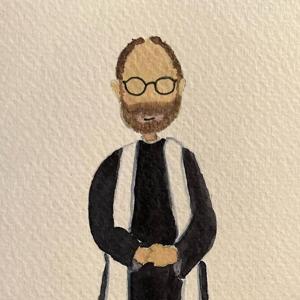
Taylor Mertins

Taylor Mertins

By Taylor MertinsReligion & Spirituality
Download on the App Store

Taylor Mertins episodes

  • Forever
    Karl Barth once said that “To clasp our hands in prayer is a beginning of an uprising against the disorder of the world.” When Jesus enters the holy city the crowds sing their prayer, much like we sing and pray before we come to the Table: Blessed is the One who comes in the name of the Lord. Hosanna in the highest.
    Do you know what that word means? Hosanna?
    It means “Save us!”
    The crowds call for salvation, for Jesus to save them and, by the end of the week, that’s exactly what he does...
    17 min
  • We're All In The Same Boat
    That Jesus teaches us how to pray is the wild declaration that God wants us to speak up, to voice our opinion, to ask for God’s intervention. And the claim of prayer is far more astonishing than we make it out to be as we mumble our way through the Lord's Prayer every week - the author of the cosmos listens and acts according to our prayers!
    Therefore, let us boldly pray prayers that are big enough that only God can bring them to fruition.
    17 min
  • The Currency of the Kingdom
    It’s one thing to pray, “Forgive us our trespasses,” and another thing entirely to add, “As we forgive those who trespass against us.”
    Forgiveness always comes at a cost - it’s not cheap and it isn’t easy. The hurt we experience is consequential. Therefore, when Jesus teaches us to pray this way, he’s not implying that we should shrug things off as if they don’t mean anything. It’s just that Jesus, through his life, death, and resurrection, refuses to let sin be the first and last word in our story.
    Instead, the first word and the last word is forgiveness.
    17 min
  • We Are What We Eat
    We’ve said the Lord’s Prayer so many times in so many places with so many people that we often no longer think about what we say when we pray. And I think a similar sentiment is true of the Lord’s Supper. How many times have we come forward with our hands outstretched? How many times have we received the grace of God through food and drink?
    Enough that we know what we’re doing when we do so?
    The truth of the matter is that we do not know what we are doing. Not even the most theologically sophisticated among us knows what we’re doing. And that’s actually Good News. The disciples surely had no idea what they were getting into, and what was getting into them, when Jesus said, "This is my body and this is my blood."
    In the Eucharist we are confronted with a reality that confounds our speech. These things are more real than real. They cannot be contained by our words because they are the grace of God.
    Which is another way of saying: our most important business as a church happens at the table.
    19 min
  • Leaning Into The Future
    To pray “Your kingdom come” is to be willing to become part of a rather weird gathering of motley, mediocre, and messy people who were once considered outsiders but who have discovered their insiderness in Jesus.
    And yet, we pray for God’s kingdom to come because it is not yet here in its fullness. It’s the whole “already but not yet” thing. To be Christian is to be unsatisfied with the status quo, with how things are.
    We are unsatisfied because our faith is eschatological. That is, we are a people who insist on leaning into God’s future.
    15 min
  • Cut To The Heart
    Jesus’ rebuke against practicing our piety publicly, particularly as we enter the season of Lent, it cuts straight to the heart. But sometimes that’s exactly what we need. Our hard-heartedness often renders us convinced that we have to earn our ticket to heaven whereas the crosses on our foreheads reminds us that heaven has already come to us.
    In the end, we are not called to be good, or virtuous, or even pious. We are called to be disciples. And discipleship is often nothing more than following Jesus toward the cross.
    The cross reminds us that we can’t fix ourselves. In any other place and any other institution that is unmitigated bad news. But here, in the church, it’s the Gospel. It’s good news because nobody, not the devil, not the world, not even ourselves can take us away from the love that refuses to let us go.
    9 min
  • A Better Hope
    For some reason, we (that is preachers) like to take this miracle, and instead of focusing on it, we focus on Peter. We make our theology into anthropology. Focusing on Peter makes this extraordinary story ordinary, which undermines the miracle that is the Transfiguration!
    The Gospel isn’t found in Peter cowering on the mountain, and it’s certainly not in the idea of doing good works (which we all know we’re supposed to do whether or not we know the Christ on the mountaintop).
    The Gospel is Jesus Christ and him Transfigured.
    17 min
  • Everyone Has A But
    The Law functions to drive us out of our propensity toward sinful self-sufficiency. That’s why Jesus preaches his offensive sermon. Otherwise, we are doomed to remain exactly as we are. And the Lord doesn’t arrive to keep things the same - the Lord arrives to make all things new. Including us.
    But there is no resurrection without crucifixion. Hence the expression: The Gospel can only make alive those whom the Law has killed.
    14 min
  • A Theory of Change
    The Gospel does not promise the possible - it deliver the impossible.
    The Gospel gives what the law demands.
    That’s why the love of God is strong enough to change things, even us.
    Or, as Luther put it: God accepts none except the abandoned, makes no one healthy but the sick, gives sight to none but the blind, brings life to none but the dead, and makes no one righteous except sinners.
    19 min
  • The Declaration of Dependence
    Blessed are those whose anxieties overwhelm, who can barely muster the strength to make it through a day, for only those in need of help will be helped.
    Blessed are those who know not is as it should be and who yearn for things not yet seen, for that yearning is what we call hope, and hope does not disappoint.
    Blessed are those who don’t insist on getting what they deserve, otherwise they just might get it.
    Blessed are those who refuse to condemn others for what they do or leave undone, because they understand the parable of the publican and the Pharisee.
    Blessed are those who suffer for the sake of peace, for they already live according to the terms of the kingdom of heaven.
    Blessed are those who are mocked, hated, belittled, and beleaguered for the sake of their faith, for they rest in the shadow of the cross.

    13 min

About Taylor Mertins

From the publisher's feed

thirty something pastor, podcast host, and fan of parables