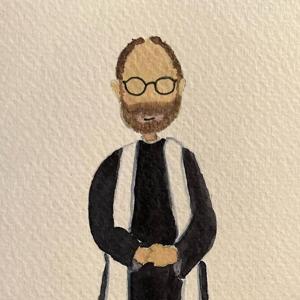
Taylor Mertins

Taylor Mertins

By Taylor MertinsReligion & Spirituality
Download on the App Store

Taylor Mertins episodes

  • Graves Into Gardens
    God works in ways seen and unseen. The psalmist can only sing this song as one who has made it to the other side and is able to look back and see how God was in the business of deliverance. Maybe you’re able to look back and see the same. But if you’re in the pit right now, hear me when I say, it’s okay to not be okay, and this isn’t the end...
    18 min
  • Today Is The Only Day There Is
    Good music, and I mean good in the true and beautiful sense, good music has a magic to it. It hits us, brings forth from us feelings we didn’t know we had. Music can travel us through time, backward and forward. Music moves.
    And its not always entirely clear how music does to us what it does. We can take a song that has shaped us, play it for someone else expecting similar magic, only to have them look back at us as if to say, “That’s it?”
    But that’s also the beauty behind the bands and artists that make the magic we call music. Even though the songs, melodies, and words stay the same, we all receive them differently.
    Just as music has a magic to it, so does scripture. It might not appear as such, hidden away under the dust covered Bibles of our sanctuary or living rooms. But, if you take out the Bible, and flip near the middle, it’s like finding an old mixed tape or CD.
    The psalter is a playlist of the prayers of God’s people.
    15 min
  • But
    Matthew tells of an angel who comes like lightning to roll back the stone. Mark recalls the women waking up early to go anoint Jesus’ body, John starts with Mary running back to tell the disciples about the empty tomb.
    But when Luke is finally ready to describe the power of Easter, he begins with the word “but.” The previous chapter ends with Joseph of Arimathea wrapping up Jesus dead and forsaken body and leaving it in a tomb.
    “But” Luke begins, “on the first day of the week, at dawn, the women came to the tomb and found it empty.” But, yet, however, nevertheless. These are the words that signal a sacred intrusion into reality.
    The gospel always turns on a great but...
    14 min
  • The Liturgy of Love
    If you don’t have one already, Holy Week will give you a low anthropology. It shows us at our worst. It’s not just the story of good vs. evil. It’s also the result of such human sentiments. Disagreements, jealousy, moral posturing, denial, betrayal.
    It’s not an easy thing to reckon with, that when God in the flesh comes to spend time among us, we nail God to the cross.
    Hence the great Lenten prayer of confession: Lord, we have erred and strayed from thy ways like lost sheep. We have followed too much the devices and desires of our own hearts. We have left undone those things which we ought to have done; and we have done those thing which we ought not to have done; there is no health in us. Have mercy upon us, miserable offenders.
    Perhaps that’s why Martin Luther said, “If I were God, I’d kick the world to pieces.” But, thankfully, Luther wasn’t God. God is God, and God doesn’t kick the world to pieces. No, God so loves the world! God keeps entering into the world, marching into our little fickle Jerusalems. God keeps showing up, by grace, and keeps blessing our broken lives.
    Or, as the musician Kevin Morby puts it: “Everything we do is a mess, but, oh honey, may this mess be blessed.”

    19 min
  • Learning By Heart
    There are these threads in the scriptures that if you just start to pull on one of them you’ll begin to see how the whole thing is bound together. And the same happens in our relationships. How we spend our time, how we speak, think, and move, who we eat with, are very real examples of where we find our hope.
    And I know these might seem like really small things. What can a dinner party really accomplish? Can a card in the mail, or an handshake in the pews, or a unexpected phone call do much of anything? How does reading this scriptures, singing these songs, and praying these prayers bear fruit in our lives and in the world?
    Well, little things repeated over time can have a major and forming impact. It’s why so many people remember things like the Lord’s Prayer and Jesus Loves Me even when they cannot remember anything else. It’s why we lose track of time when we’re sitting at a table with friends.
    As the great theologian Saint Winnie the Pooh once said, “Sometimes the smallest things take up the most room in your heart.”
    19 min
  • The Liturgies of Life
    Little things matter! Everything we do, whether we realize it or not, enfolds us and those near us into a vision of what we might call “the good life.” We are habituated by our habits and rituals toward the importance, or unimportance, of community, friendship, and faith.
    How we eat, how we speak, how we spend our time is a very real expression of where we find our hope.
    At some point or another we will find ourselves feeling like one of the sons in Jesus' parable. We will yearn for something that isn’t ours, or we will grow angry over perceived slights... But God, the author of salvation, is training us, habituating us, litugizing us, to see the Good News of the Gospel. Like the prodigal father who is filled with nothing but love, there’s nothing we can do to make God love us any more and there’s nothing we can do to make God love us any less.
    No matter what we do or leave undone, there’s always room for us at the party.
    17 min
  • The Spirit Meets You Where You Are
    Our God is nothing if not incarnational. That is, despite what others may say, we have a very materialistic faith. God takes on flesh and moves into the neighborhood.
    Which means God meets us where we are, and not where we ought to be. We might imagine that to get close to God we have to do all sorts of things like sit idly by while the flood waters rise high. We might imagine that in our despair, pain, and brokenness that we’re got to cure ourselves, heal ourselves, and put ourselves back together before we can get together with God.
    That’s not the Gospel.
    God isn’t waiting for us to get it all figured out. God shows up in our lives right where we are to help re-figure us...
    17 min
  • You Might Not Love What You Think
    Amazon, Instagram, and Facebook (just to mention a few) are frighteningly good at captivating and capturing our imaginations as we spend our days exploring the digital architecture of the modern mall we call the smart phone.
    That why I really love that one line from the prayer of confession I shared earlier. “We have followed too much the devices and desires of our own hearts.” It’s amazing how prescient a line from 1662 can be today. For, the devices we carry in our pockets absolutely drive the desires of our hearts, and most of the time we don’t even realize it, we don’t notice the water we’re swimming in.
    Hence, the remarkable quote from Charles Baudelaire: The greatest trick the devil ever pulled was convincing the world he didn’t exist.
    These forty days between Ash Wednesday and Easter are some of the most countercultural and subversive days in the entire church year. While we swim in the water of a culture driven by success, power, winning, God uses Lent to repent us, to turn us back around to the One who saves us through the waters of baptism, through the bread and cup of communion, through the cross and the empty tomb.
    16 min
  • You Are What You Love
    Antoine de Saint-Exupery, author of The Little Prince, explains the power of the heart over the mind like this: “If you want to build a ship, don’t drum up people to collect wood and don’t assign them tasks and work, but rather teach them to long for the endless immensity of the sea.”
    And "teaching the longing" is exactly right. For love is a habit. We, of course, may imagine that love strikes like lightning, without explanation or warning. But we are actually habituated toward our loves. We are shaped by habits that present those things that are worth our love.
    Love, in short, takes practice.
    Our hearts are calibrated through imitation and immersion into practices that, overtime, curate our hearts to particular ends. We learn to love not primarily by acquiring information about what we should love but rather through practices that form the habits of how we love.
    Rituals train us to love rightly.
    In the church we have a different word for ritual: liturgy.
    15 min
  • The Commands
    Will Willimon tells of having once served a church where there was a long standing tradition in which lay leader would rise at the conclusion of the sermon to offer a prayer. And, one Sunday after preaching a tough sermon on a difficult text, the lay leader stood up and prayed a simple, clear, and direct prayer. “Lord, today we’ve heard your word. And we don’t like it.”
    We don’t like this Word of the Lord because it cuts right to the heart of our faith.
    It’s impossible to live like this, we think. How could we ever really love our enemies? They’re our enemies for a reason! Shouldn’t we be doing the opposite of love toward them? Have you ever tried to pray for those who mistreat you? Better to run away and never think of them than to pray for them!
    It’s impossible, what Jesus wants us to do.
    Thankfully, though, nothing is impossible for God...
    16 min

About Taylor Mertins

From the publisher's feed

thirty something pastor, podcast host, and fan of parables