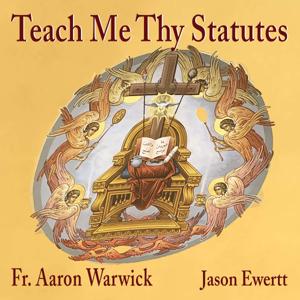
Teach Me Thy Statutes

Teach Me Thy Statutes

Download on the App Store

Teach Me Thy Statutes episodes

  • Offering a Defense for our Faith

    Today we discussed how to understand Peter’s admonition to prepare ourselves to provide a defense of our faith. This defense is best offered by living the faith vs. being able to intellectually explain it. Fr Aaron pointed out how we would be wise to remember the words from one of the saints of our Church who said, “If you are not edified by my presence, neither will you be edified by my words.” 

    13 min
  • Can You Imagine No Christmas?
    In contemplating the fact that the Nativity story is not included in Mark’s Gospel, our episode today focused on the most important aspect of the life of Christ, which was His teaching. And even though Matthew and Luke provide some details about the birth of Jesus, they also neglect any mention of His early life—the sole exception being the story told in Luke about the young Jesus staying behind in Jerusalem and teaching in the Temple. We see this emphasis on the teaching also in the three greatest feasts of our Church calendar: Pascha, Pentecost and Theophany. As Christians, therefore, we must understand that the most important thing in our lives should be Jesus’ teaching; for this is the reason that the Word became flesh.
    14 min
  • Salvation: Listener Questions
    Today’s episode focused on listener questions regarding salvation. Fr Aaron explained that there are different ways to approach this issue, which lead to a discussion around legalism as well as those looking for just the minimum requirements so that they can get to heaven without doing more than is necessary. As for the legalistic approach, there is something to be said here as we all will ultimately be declared either righteous or unrighteous. But we should understand that there are none who are righteous, and so in receiving this “not guilty” verdict at the Final Judgement, we must recognize that we receive this verdict only by God’s grace. And in return, we are expected to love our neighbor and be merciful even as our Father in heaven is merciful.
    16 min
  • Mary in Scripture
    Today’s episode focused on some of the most common questions regarding Mary, including the important distinction between worship and veneration. From a theological perspective, Fr Aaron explained that rather than making a statement about Mary, the names we use for Mary more specifically highlight our understanding of Christ. Finally, it was stressed that the key biblical aspect of Mary is seen in her willingness to submit to God and suffer great shame, even risking death, to bring Christ into the world. This tremendous example is why we regard her as the greatest among the Saints.
    14 min
  • Violence & Freedom: A Reflection on January 6, 2021
    In this episode, Fr Aaron expounds on his sermon from January 17, 2021, which reflected on the "siege of the US Capitol" building on January 6, 2021. In that sermon, Fr Aaron talked about the false gospel that we can obtain and retain true freedom through physical violence and war. He reminded of the teaching of Jesus and the true Gospel, that true freedom can only be found in making peace with your enemies. In this episode, we explored some important passages related to this authentic Gospel teaching, helping us to better understand it and the stories themselves.
    19 min
  • Enter By The Narrow Door
    In today’s episode we began with a discussion of the mustard seed and the leaven from Jesus’ parable, and how we learn from this teaching that no Christian work is too small. And as Christians, we should never concern ourselves with the outcome of our work for the Lord: we are called to plant the seeds, but we cannot produce. It is God alone who gives the growth. We then examined Jesus’ warning to “strive to enter by the narrow door” and discussed its implications.
    14 min
  • Exposing Darkness and Redeeming the Time
    Today we discussed how to juggle various ideals, namely our exposure of darkness while avoiding condemnation by our judgement of others. Father Aaron explained that we must first begin by exposing the darkness within ourselves. By repairing the darkness within ourselves and living by example, we become a light to others and expose the darkness. We also discussed what is meant by “redeeming the time.” Our liturgical tradition can help to provide meaning to our daily lives and aid us in avoiding the many distractions of the world. This enables us to keep our focus on doing the daily work of Christ, to serve others and help reconcile them to God and to all mankind.
    15 min
  • Delivering People to Satan and Forbidding Women to Speak?
    In today's passage Paul speaks of delivering people to Satan and forbids women to speak: what on earth does that mean and why does he say those things? Fr Aaron explains how the "delivering to Satan" is ultimately meant to instruct the sinners so that they would repent and be saved. During this discussion we touched on the common misconception that Satan has more power and influence than he truly has. And in regard to the concluding verses in today’s reading concerning women, it was stressed that the Church has never taken these passages literally, or rather applied them universally. St. Paul himself had female assistants and there were many women in the community who were very prominent and active in ministry. Fr. Aaron discussed some examples of why Paul might have said these words in a very limited and narrow context to Timothy.
    14 min
  • You Must Hate Your Father and Mother???
    Why does Jesus say we must hate our father and mother?!!! To better understand this statement, we considered the preceding Parable of the Great Banquet, and the excuses offered by the three invited guests. Through this parable, Jesus is teaching that while there are credible excuses for avoiding the call to defend Israel in war, these do not apply as credible excuses for the higher calling of Christ’s heavenly banquet. When applied to our reading today, we can see clearly that Jesus is telling us nothing should come between us and His invitation to live out the Gospel.
    11 min
  • Weddings, Adultery, and Stripes
    Today we discussed the common theme of a wedding or marriage to teach us about deeper biblical concepts. One example given was that of Christ and the Church in which Christ is the groom and the Church is His bride. Even relationships outside of marriage can be instructive, as is found in numerous examples throughout Scripture. One such example cited by Fr Aaron was that of Paul’s instruction on spiritual unfaithfulness in which the Gentile communities he converted were warned against seeking after other gods or turning back to idol worship. Then, specific to today’s reading, we concluded by examining the difference between those who Jesus says will receive many stripes and those who will receive few. As Christians, we should understand this to mean that as people of God, we have a greater responsibility to live our lives as we have been instructed by Scripture.
    13 min

About Teach Me Thy Statutes

From the publisher's feed

Each week, Fr. Aaron Warwick and Jason Ewertt meet to discuss biblical readings from the Orthodox lectionary.