
Sign up to save your podcasts
Or



Free Guides:
Weekly Time Blocking Planner
Who Are You, Really? 12 Prompts to Create Self-Awareness
Boundary Setting Cheat-Sheet
Understanding Imposter Syndrome
Connect with the hosts:
Madel Mazzella:
Instagram: @madelmazzella
TikTok: @madelmazzella
Website: madelmazzella.com
Kaitlyn Rapai:
Instagram: @kaitlyn_rapai_coaching
TikTok: @kaitlyn_rapai_coaching
Website: kaitlynrapai.com
In this episode of the podcast the hosts discuss time management and how it could be one of the best tools to help reduce life and work stress.
It’s true that so many teachers are organized, but many struggle juggling all the parts of their life, especially if they have the responsibility of a house, children, aging parents, or simply things that come up.
Kaitlyn and Madel point out that having a calendar system provides structure and creates a process that allows you to complete all the important tasks on your list. It’s important to point out that not all tasks deserve our attention. After making a list of all the tasks you’d like to accomplish, sort them in order of importance and allocate a time during the week for each.
Some people prefer to do weekly checks, while for others this might be different. The important thing is to have a system. Once it’s on the calendar, you just have to follow up with yourself. Train yourself to keep your word and show up to the scheduled activity assigned on the calendar.
Following this process could make a significant difference in your productivity and in achieving your goals. Once a particular task is on the calendar it’s as good as done. Some people like the idea of breaking larger tasks into smaller, more manageable steps. This can also help perceive the task as more attainable and less overwhelming.
This system can also help you make faster decisions (even saying no more often if this is something you struggle with). Once a task goes on your calendar you become unavailable during that time slot.
Being prepared with this process opens up more mental bandwidth, allowing you to free up space to welcome creativity, enjoyment and a more positive mindset.
Don't forget to subscribe to Teacher Thrive on your favorite podcast platform to receive updates on new episodes. If you find this podcast valuable, please leave a review and share it with fellow educators who are seeking to thrive in their teaching journey.
Original Music by: Matthew Dotson
Cover Art by: Nate Rapai
[Disclaimer: Any views or opinions expressed in this podcast are those of the hosts and guests and do not necessarily represent the views or opinions of any educational institutions or organizations.]
Free Guides:
Who Are You, Really? 12 Prompts to Create Self-Awareness
Boundary Setting Cheat-Sheet
Understanding Imposter Syndrome
Connect with the hosts:
Madel Mazzella:
Kaitlyn Rapai:
In this episode of the podcast, Madel and Kaitlyn discuss imposter syndrome; The fear of being found out despite our achievements and capabilities. This is a phenomenon that affects many more women than men and it expands to all types of situations.
There are 5 types of imposter syndrome according to Dr. Valerie Young
People who experience imposter syndrome:
Get the free guide to understanding imposter syndrome here.
When we feel like imposters, no amount of evidence to the contrary will suffice to make us feel otherwise. Feeling like an imposter happens when we’re having a thought error and we’re not present enough to be aware of it. If the feeling persists, it means we’ve gone on autopilot and there’s little to no reflection being done to stop it. This can cause us to prolong the negative feeling, which is completely unnecessary and unkind to ourselves.
Social conditioning prevents many women from verbalizing that we are great at what we do. We’re afraid to come across as boasting or arrogant. Instead, we want the accolades to come from others. We want others to validate our effort and hard work.
There are ways we can understand and overcome imposter syndrome. Knowing ourselves and being self-aware is number one. From that point we can make conscious decisions about how to shift our thinking.
Once we’re aware we are having a thought error we can:
Decide to focus on progress instead of perfection
Take inventory of our accomplishments and use them as reminders of our capabilities and strengths
Refuse to negate our achievements
Don't forget to subscribe to Teacher Thrive on your favorite podcast platform to receive updates on new episodes. If you find this podcast valuable, please leave a review and share it with fellow educators who are seeking to thrive in their teaching journey.
Original Music by: Matthew Dotson
Cover Art by: Nate Rapai
[Disclaimer: Any views or opinions expressed in this podcast are those of the hosts and guests and do not necessarily represent the views or opinions of any educational institutions or organizations.]
Free Guides:
Connect with the hosts:
Madel Mazzella:
Kaitlyn Rapai:
In this episode of the podcast, Madel and Kaitlyn discuss imposter syndrome; The fear of being found out despite our achievements and capabilities. This is a phenomenon that affects many more women than men and it expands to all types of situations.
There are 5 types of imposter syndrome according to Dr. Valerie Young
People who experience imposter syndrome:
Get the free guide to understanding imposter syndrome here.
When we feel like imposters, no amount of evidence to the contrary will suffice to make us feel otherwise. Feeling like an imposter happens when we’re having a thought error and we’re not present enough to be aware of it. If the feeling persists, it means we’ve gone on autopilot and there’s little to no reflection being done to stop it. This can cause us to prolong the negative feeling, which is completely unnecessary and unkind to ourselves.
Social conditioning prevents many women from verbalizing that we are great at what we do. We’re afraid to come across as boasting or arrogant. Instead, we want the accolades to come from others. We want others to validate our effort and hard work.
There are ways we can understand and overcome imposter syndrome. Knowing ourselves and being self-aware is number one. From that point we can make conscious decisions about how to shift our thinking.
Once we’re aware we are having a thought error we can:
Decide to focus on progress instead of perfection
Take inventory of our accomplishments and use them as reminders of our capabilities and strengths
Refuse to negate our achievements
Don't forget to subscribe to Teacher Thrive on your favorite podcast platform to receive updates on new episodes. If you find this podcast valuable, please leave a review and share it with fellow educators who are seeking to thrive in their teaching journey.
Original Music by: Matthew Dotson
Cover Art by: Nate Rapai
[Disclaimer: Any views or opinions expressed in this podcast are those of the hosts and guests and do not necessarily represent the views or opinions of any educational institutions or organizations.]
On this episode of the podcast your hosts, Madel Mazzella and Kaitlyn Rapai, discuss the importance self awareness has when we find ourselves thinking negatively. Download the Free Guide to Create Self-Awareness Here.
Being self-aware allows us to identify when we’ve fallen into a negative loop. When you’re in this loop, your ‘autopilot’ gets activated without you realizing it. Your perspective and attitude change, and suddenly you feel unable to cope with situations you were more than capable to handle in the past.
When you’re unaware that one thought could potentially be impacting your entire day you may feel overwhelmed throughout the day and you may be carrying this energy with you in everything you do.
One strategy we can use when we find ourselves stuck in a negative loop is get curious. You’ll discover the root of this negativity by acknowledging how you feel and then asking yourself why. The answer should be objective. For example, Madel shared how she didn’t mind her commute in the beginning of her career, in fact, she saw it as an opportunity to have ‘me’ time. But, later it became THE thing she complained about the most, and a big reason she felt stress and overwhelm.
Ask yourself “What am I thinking? How am I feeling?” - Utilize the Free Guide to Create Self-Awareness to help! It starts with getting to know yourself. The thoughts you think on repeat become your beliefs, and beliefs guide our actions. So, identify the disempowering beliefs you currently have.
Thoughts are powerful because they tell our brain what to focus on. If you’re thinking you’re overwhelmed, you will most likely find evidence to prove it.
You have the power to shift how you’re thinking. The first thing you need to have in order to do this is self-awareness. You can train your brain to think a different thought– not one that is the exact opposite of what you’re thinking, just a slightly different thought that is believable to you; one that can, little by little, get you out of the rut.
Instead of “I’m a total mess.” You can say “I’ve held the same job for 17 years… maybe I’m not a mess.”
It’s a small shift that opens up a different, more empowering possibility.
We will all continue to have negative thoughts and most probably get stuck in a negative thinking loop. Negative thoughts and feelings are part of the deal as a human being. But, there’s a big difference between being stuck in a negative thinking loop and not realizing you’ve gone on autopilot, and being aware that you have the power to shift your focus.
Connect with the hosts:
Madel Mazzella:
Instagram: @madelmazzella
TikTok: @madelmazzella
Website: madelmazzella.com
Kaitlyn Rapai:
Instagram: @kaitlyn_rapai_coaching
TikTok: @kaitlyn_rapai_coaching
Website: kaitlynrapai.com
Original Music by: Matthew Dotson
Cover Art by: Nate Rapai
Don't forget to subscribe to Teacher Thrive on your favorite podcast platform to receive updates on new episodes. If you find this podcast valuable, please leave a review and share it with fellow educators who are seeking to thrive in their teaching journey.
[Disclaimer: Any views or opinions expressed in this podcast are those of the hosts and guests and do not necessarily represent the views or opinions of any educational institutions or organizations.]
Teacher Thrive - Episode 4: Boundaries
To create a boundary is to draw a line to mark the limit of a situation, a behavior or action or a person. It indicates where you end and others begin. They can be used to protect our time and space.
Boundaries are 100% for yourself.
Grab our quick, two-page cheat sheet if you want to learn how to set and enforce a boundary.
Establishing boundaries is especially hard for people pleasers since they tend to want to be agreeable. But, it’s important to set boundaries in every area of your life in order to indicate to others how you’d like to be treated.
Setting boundaries is necessary for your wellbeing and it can be done from a loving place and out of love for oneself and not against other people. Oftentimes we may be afraid to set boundaries out of fear of disappointing others. But, oftentimes those fears are simply thoughts in our head, as opposed to what anyone’s thinking.
A lack of boundaries can lead to resentment, overwhelm and burnout. We want to be and do everything for everyone, except we ignore ourselves and what we truly want in the process. When you silence your voice to please others you create a hostile environment within yourself.
On the other hand, when we acknowledge our wants and needs and create boundaries to uphold them we show up differently. We say yes to the things we actually do want to do and in general have a much better disposition and affect.
Unless they are violated, boundaries need not be announced or explained. They only need to be communicated if they’ve been violated.
Both hosts agree that boundaries are an effective way to feel empowered. Once you create a boundary in one area of your life you’ll feel quite capable of doing the same in other areas. You also get to know yourself better since establishing a boundary requires reflection and acknowledgement about who you are and what you stand for.
Connect with the hosts:
Madel Mazzella:
Kaitlyn Rapai:
Original Music by: Matthew Dotson
Cover Art by: Nate Rapai
Don't forget to subscribe to Teacher Thrive on your favorite podcast platform to receive updates on new episodes. If you find this podcast valuable, please leave a review and share it with fellow educators who are seeking to thrive in their teaching journey.
[Disclaimer: Any views or opinions expressed in this podcast are those of the hosts and guests and do not necessarily represent the views or opinions of any educational institutions or organizations.]
In today’s episode the hosts, Madel and Kaitlyn discuss teacher self-care.
Many people hear “self-care” and automatically assume that it is selfish to do so.
The hosts emphasize the importance of prioritizing our self care. As teachers, we are accustomed to go above and beyond for our students and oftentimes forget to refill our cups as well.
They encourage teachers to practice doing something they love everyday as a form of self-care so they can show up for others without feeling resentful.
Self care looks different for everyone. It is important to believe that you can take care of yourself and not feel guilty about it.
Self care is not self-indulgence. It is how we cope with life stressors, and it could very well make a big difference in your personal life as well since you can show up more lovingly or more patiently for your loved ones at home instead of leaving it all at work.
Some of the hosts’ favorite forms of self care range from things done daily for personal hygiene to having a skincare routine, working out, etc.
Sometimes self-care is an act of radical self-love and it’s important to acknowledge and do the things that make us happy.
Self-care doesn’t have to be exhausting or costly. Reflect about your needs, and do things for yourself that take care of your needs; whether it is journaling, reading a book or going for a walk. Anything that feels doable for you.
Sometimes, organizing your home, or having a weekly routine can also be forms of self-care. Experiment doing different activities to gauge what’s manageable or enjoyable. What’s important is that you honor the relationship you have with yourself by taking care of yourself.
Below are the items the hosts mentioned in today’s episode.
*Neither host has any affiliations with the brands or the sellers.
Replica
Toner
Serum
Connect with the hosts:
Madel Mazzella:
Instagram: @unbotheredandsoft
TikTok: @madelmazzella
Kaitlyn Rapai:
Instagram: @kaitlyn_rapai_coaching
TikTok: @kaitlyn_rapai_coaching
Website: kaitlynrapai.com
Original Music by: Matthew Dotson
Cover Art by: Nate Rapai
Don't forget to subscribe to Teacher Thrive on your favorite podcast platform to receive updates on new episodes. If you find this podcast valuable, please leave a review and share it with fellow educators who are seeking to thrive in their teaching journey.
[Disclaimer: Any views or opinions expressed in this podcast are those of the hosts and guests and do not necessarily represent the views or opinions of any educational institutions or organizations.]
Free Guides:
Who Are You, Really? 12 Prompts to Create Self-Awareness
Thoughts That Build Resilience
Weekly Time Blocking Planner
Boundary Setting Cheat-Sheet
Understanding Imposter Syndrome
Connect with the hosts:
Madel Mazzella:
Instagram: @madelmazzella
TikTok: @madelmazzella
Website: madelmazzella.com
Kaitlyn Rapai:
Instagram: @the_teacher_burnout_coach
TikTok: @kaitlyn_rapai_coaching
Website: kaitlynrapai.com
In today’s episode the hosts, Madel and Kaitlyn discuss teacher burnout.
With so many expectations and demands placed on teachers it is no wonder so many of us experience so much exhaustion, stress and ultimately burnout.
Having a “good girl” mentality and neglecting to establish boundaries can lead to burnout. Setting intentions before starting the day helps when establishing boundaries. Once you know what your priorities are it’s easier to say no if it is in alignment with your priorities. Madel reminds us that when you say yes to others, when you want to say no, you’re saying no to yourself. When this is your pattern you can become resentful for always doing something you’d rather not do.
Kaitlyn shares that, as teachers, we always want to help and it can be hard to say no sometimes. But, when you learn to say yes only to the things you want to, instead of out of obligation, you show up differently. You feel good about saying yes, therefore, there is no resentment about it.
One strategy Kaitlyn uses is going to work with the intention of being curious, especially when students misbehave. She asks her students probing questions that help them express and manage how they’re feeling, and at the same time it helps her understand the behavior in a more compassionate way.
Another strategy Madel shares is working when you’re at work. She tries to avoid the water cooler talk as much as possible so she can complete her tasks at work, instead of at home.
The hosts encourage reading the book Essentialism, by Greg McKeown. In the book, the author affirms that we have to direct our time and energy where it matters to us. To do this we need to have 3 mindset shifts: choose and identify what we can control, discern and filter out the noise in order to let in what’s truly valuable to us. And, finally we have to have trade offs - you can do anything, but not everything.
Kaitlyn and Madel agree that when you take care of yourself, you can show up in a much better way for the students and for yourself. It also means that you show yourself grace when things don’t go according to plan.
Original Music by: Matthew Dotson
Cover Art by: Nate Rapai
Don't forget to subscribe to Teacher Thrive on your favorite podcast platform to receive updates on new episodes. If you find this podcast valuable, please leave a review and share it with fellow educators who are seeking to thrive in their teaching journey.
[Disclaimer: Any views or opinions expressed in this podcast are those of the hosts and guests and do not necessarily represent the views or opinions of any educational institutions or organizations. This podcast is presented solely for educational and entertainment purposes. The hosts are not licensed therapists and their opinion does not substitute the advice of a physician or other qualified professional]
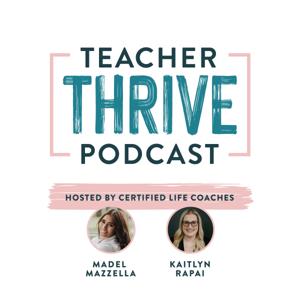
Welcome to the introductory episode of Teacher Thrive, the podcast dedicated to empowering educators to thrive in their profession. Join your hosts, Madel Mazzella and Kaitlyn Rapai, as they embark on this journey of providing valuable insights and strategies for teachers.
In this episode, certified life coaches and teachers, Madel Mazzella and Kaitlyn Rapai, discuss their roles as teachers and how they became life coaches. Madel shares how her conditioning had her thinking and acting on autopilot; and the meaning behind ‘unbothered and soft’. Madel works with culturally diverse women looking to evolve to the next best version of themselves. She’s a mindset and lifestyle coach helping women overcome their old conditioning to become empowered.
Kaitlyn shares how feeling burned out led her to coaching and how she was able to transform the way she was showing up by changing her thoughts about her job and herself. Kaitlyn works with teachers to prevent burnout and provides the tools that they need in order to overcome it so they can learn how to love their jobs again.
Together, Madel and Kaitlyn discuss the importance of thriving as a teacher rather than merely surviving the demands of the profession. They emphasize the transformative power of self-care, mindset, and continuous growth in the teaching journey.
Connect with the hosts:
Madel Mazzella:
Kaitlyn Rapai:
Don't forget to subscribe to Teacher Thrive on your favorite podcast platform to receive updates on new episodes. If you find this podcast valuable, please leave a review and share it with fellow educators who are seeking to thrive in their teaching journey.
[Disclaimer: Any views or opinions expressed in this podcast are those of the hosts and guests and do not necessarily represent the views or opinions of any educational institutions or organizations.]
From the publisher's feed