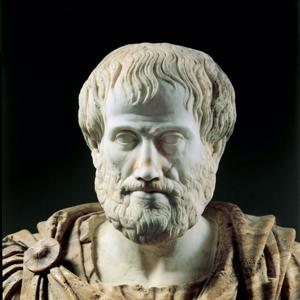
The Aristotle Project
Download on the App Store

The Aristotle Project episodes

  • Empedocles in Aristotle's "Metaphysics" Books A and B
    Now that we've got an idea on how Empedocles thought, now we can go back and see how Aristotle approaches him the the early portion of the "Metaphysics". Aristotle likes how Empedocles has a primitive idea of substance that is not a universal or abstract but which makes sense for living creatures and other physical beings.
    52 min
  • Empedocles' Theory of Evolution ep.3
    The Cosmic Cycles of of Empedocles are unique in all of Greek philosophy. Indeed their only parallel are the Hindu "Kalpas" and modern geological epochs. The cosmic cycles are implied the the laws of physics discussed in our last episode, the Four Element and the Twin Forces of Love and Strife. Empedocles uses his surprisingly modern physics to explain the mythology of monsters and gods and Creation. The cosmogony and zoogony (origin of animals) are among the most bizarre remnants of early Greek thought, but it all follows from a strict set of physical laws acting on the material elements.
    1 hr 10 min
  • Empedocles' "Physics", ep. 2
    In addition to his religious and magical doctrines, Empedocles was a major figure in the development of natural science. Surprisingly enough, he took a rather reductionistic view that the entire cosmos was nothing but the material elements and the forces of nature. However, these principles were seen in a way that seems rather bizarre from our modern perspective, but which are crucial for the development of Western philosophy and science.
    49 min
  • Empedocles on Rebirth and Karma
    We shall now take a short break from the core books of the metaphysics and spend a few episodes on Empedocles, who lived about 200 years before Aristotle and whose work mixes elements from yoga, Big Bang cosmology and evolutionary biology. After we learn about this curious philosophy, we shall then look at how Aristotle and MANY others used or criticized it. Our discussions will span modern science, epic poetry, archaic mythology, and to science of “first philosophy”.

    1 hr 7 min
  • Nature, Art, Chance and Substance - "Metaphsyics" Book Z.7-8
    According to Plato, the "really real" could never be destroyed or created. Aristotle holds that they can be created from previously existing form and matter, and that this can happen by nature.His arguments for this are pretty subtle, and are necessary for refuting idealism and asserting the reality of the physical world.
    1 hr 7 min
  • What has essence? - "Metaphysics" Book Z.4
    "Essentialism" has become a deragatory word in modern philosophy, but with Aristotle having an essence is something valuable and distinctiveAristotle considers only a very few beings to be "really real". As a result, we organisms have an essence in a much more real sense than colors and mere shapes.
    1 hr 7 min
  • Keeping it real - "Metaphysics" Book Z.1
    With book Zeta, Aristotle gives a more details explanation about the "really real" , which we translate as "substance'. He looks into what is meant by "really real"and why his view differs from both materialism and idealism. The view in Book Zeta is quite "naturalistic" but thinks that nature includes more than matter, but also form or what modern people call "information'.
    1 hr 5 min
  • Concerning Heraclitus "the Obscure".
    "You could not step twice into the same river." - As quoted in Plato, Cratylus, 402aHeraclitus of Ephesus is one of the most interesting of the Early Greek thinkers, appealing to people as different as Hegel and Nietzsche. In light of our discussion of his ideas in the last episode, we shall now hear the views of Heraclitus of Ephesus in his own words and his relevancy to us.
    1 hr 7 min

About The Aristotle Project

From the publisher's feed

Lively discussion of any topic you can imagine informed by the work of Aristotle. In most issues, I try to focus on how his thought might cohere with or relate to Darwinian evolution. I think that…