
Sign up to save your podcasts
Or



Thanks for reading! Subscribe for free to receive new posts and support my work.
For generations, humanity has operated on autopilot—navigating life through a series of inherited scripts, dogmatic warnings, and established belief systems passed down by parents, authority figures, and religious institutions. We are told what to believe, how to worship, and what rules to follow before we are even old enough to question them.
Yet, when you stop looking outward for a rescue or a pre-packaged belief system, something profound happens. You begin to wake up from the programming and remember who you truly are.
Truth Is a Visceral Frequency, Not a Borrowed Story
Many of us carry ideas as “ultimate truth” without ever having had the opportunity—or taken the time—to examine them for ourselves. We can repeat stories handed down to us, carrying them so deeply that they begin to shape how we judge ourselves, our neighbors, and those whose beliefs differ from our own. But truth is not a borrowed rulebook. Truth is a frequency.
The Resonance of the Body: You cannot fake a frequency. Real truth is something you feel in your bones—a visceral, biological resonance and a deep internal knowing. When you are told something false, or when you speak falsehoods, your body knows the difference.
The Illusion of Ideology: Dogma can teach us to accept things on blind faith—such as the difficult question of whether a final plea can erase the consequences of cruelty, or the idea that we can condemn our neighbor simply because they were taught a different story in childhood. That is not truth; when belief is sustained through fear rather than understanding, it is worth asking whether we are encountering truth—or simply being conditioned not to question.
The Clarity of Childhood and Questioning Authority
You are never too young to question the fabric of the world around you. Growing up immersed in strict environments, those inconsistencies become glaringly obvious early on. In my own childhood, being raised in a deeply orthodox environment meant encountering teachings that I struggled to reconcile—like the idea that a loving Creator could banish someone to hell for something as simple as eating certain foods, or that we were commanded to love our neighbor while simultaneously being told to shun anyone who didn't worship the same way.
When I would ask those hard questions, adults sometimes responded by asking me to accept obedience before understanding, saying, “If God says to obey, then you obey." My response even then was simple and unwavering: "I will, if God were to speak to me." I wasn't just being a difficult child; even at a very young age, I understood that accepting someone else's understanding of truth without examining it for myself could never give me the certainty I was searching for.
Faith, in its truest essence, is a powerful and grounding force to carry through this life—provided you arrive at it on your own terms. When faith is forged through your own inner seeking, direct experience, and resonant knowing rather than accepted solely because it was handed down to you as a set of established rules by someone else, it transforms from blind compliance into a living anchor. True faith does not require you to surrender your mind or inherit someone else’s dogma; it asks you to walk the path yourself, test the waters of reality, and anchor your spirit in a truth you have discovered and felt within your own soul.
Stepping Off Autopilot
When you open your mind to the true fabric of the world around us instead of what you were conditioned to believe, you take the steering wheel away from autopilot and place it directly into your own lap. You become sovereign. You are no longer living out someone else's design or fulfilling someone else's unlived expectations. You reclaim the power to make your own choices, align with your authentic frequency, and create your reality from the inside out.
I do not want anyone to take my words, or anyone else's, at face value. Everything in this world should be rigorously questioned, especially the stories handed down to you as absolute law from figures of authority. Please, question me, test what I share, and look deep within to find your own answers. True sovereignty demands that you never surrender your discernment to another human being. Trust the resonance you feel in your core, step beyond the unquestioned patterns you may have inherited, and remember the radiant truth of who you are.
When you finish reading these words, take a quiet moment to look deep inside yourself and reflect upon the following:
The Architecture of Your Beliefs: Do you remember how you were taught to view the world as you were growing up? Did you blindly accept the narratives handed down by parents or authority figures, or did you question them—and as you stand today, are you still bound by those early scripts, or have you dared to tear them up?
The Weight of Resonance: How vital is absolute, uncompromised truth to the movement of your soul? Look at where you are heading: What happens when you examine the beliefs you inherited and compare them with what you have personally experienced, understood, and come to know? Which parts still resonate with you, and which parts deserve another question?
The Mirror of Integrity: Have you ever felt deep down in your bones that something you were repeating, defending, or living by was entirely untrue, yet you continued to echo it outward just to keep the peace or protect an illusion? What is it costing you to carry a truth that isn't your own?
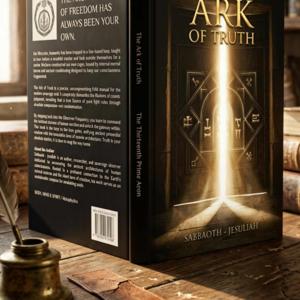
If the cadence of these truths stirs something ancient and unyielding within your core—if you are ready to strip away the noise of borrowed dogma and walk a path anchored entirely in sovereign frequency—there is a much deeper map waiting for you. To continue this journey of remembrance and unlock the full architecture of existence, I invite you to explore the pages of The Ark of Truth.
Sabbaoth Jesuliah
The Thirteenth Prime Aeon
Thanks for reading! Subscribe for free to receive new posts and support my work.
For generations, humanity has been fed a passive narrative: the belief that you can live however you wish, accumulate whatever darkness you choose, and then—at the very final hour—offer a plea for forgiveness, let someone else pay the toll, and wait to be rescued. People look toward a grand event, a rapture, expecting a divine figure to wave a finger, sort the saved from the lost, and pull them across the threshold.
That is an illusion born of human invention and religious dogma. There is no external judge handing out arbitrary passes, no magic wand, and no proxy salvation.
Even if a divine being wanted to pull someone across by pure choice or affection, the absolute mechanics and architecture of existence prevent it. From what I remember of the architecture, salvation was never designed to function that way. You cannot move a soul vibrating at a heavy shadow frequency and place them into a new world built on high light resonance. No deity of any kind, no matter how powerful, can bend this rule because the system was deliberately designed so that only the absolute alchemization and absolution of the authentic self can get through.
Remembering the Architecture and the Origin of Truth
Before we look at the mechanics of what is arriving, it is necessary to understand how this remembrance comes to be. I speak from a place of direct recall—having once stood as an architect of this system long before descending into human form as Jesuliah, awakening fully to remember the foundations of my father’s creation, the trials of my brother Samael, and the laws governing this reality as I remember them. These words are not pulled from dogma or theory; they are carved from the memory of the blueprint itself, brought forward so that those who carry the inner echo can finally pierce through the veil.
I cannot separate every detail of this remembrance from the language and understanding of the human mind I use to describe it now.
The Physics of the Flash and the Inevitable Split
When people hear the word "flash," they often picture a localized event or wonder if they need to be in a specific physical sanctuary when it arrives. Let us be entirely clear: there is no geography of salvation.
From my recollection, what I would describe in human terms as the physics of the flash is an energetic and subatomic event of absolute magnitude. It is the precise moment when the accumulated density of the shadow can no longer maintain cohesion within the field. When that rubber band snaps, the high-frequency particles and the cascading wave of light do not respect physical barriers. They travel effortlessly through stone, through the deepest caverns of the earth, and through every layer of matter. You do not need to worry about being in the "right place at the right time" or hiding away underground. No matter where your physical vessel stands on or within this planet, those penetrating waves of energy will find you, interacting instantly with the exact frequency your soul has generated.
Think of it like a stretched rubber band pulled to its absolute limit: all of the accumulated shadow, the heavy greed, the hostility, and the fear are being pulled violently away from the light. Energy can only encapsulate a field for so long before it reaches a breaking point. That moment of inflection is the crescendo. When enough awakened souls provide that steady, clean boost of light energy, it creates a buildup that causes the system to split. It divides simply because opposing polarities become too heavy and too fundamentally different to exist in the same space anymore.
Frequency is a strict requirement. You cannot fake a frequency or instantly alchemize a lifetime of bitterness at the very end. It must be forged through the true, lived work of your soul across your entire journey.
Looking Inward: The Ledger That Cannot Be Bribed
Every single thing we do, no matter how small or hidden in private moments, is recorded into the akashic ledger. You are, and only ever are, your own judge, measuring your standing based entirely on the merit of your soul's entire history from beginning to end.
"Who are we when nobody is watching, and what do we choose in the dark?"
As we move toward what I remember as the approaching reset, the world around us will continue to grow more hostile, fearful, and divided. To those carrying lifetimes of pain and bitterness, the chaos feels like "just another day." But to the souls who have chosen the path of balance, that distortion presses hard against us.
When you feel that pressure, do not let it dim your light. Become a sovereign observer. Step back, take a deep breath, and look inside. Ask yourself how you want to respond rather than letting anger or the shadow of another person drag you down to their level. You cannot help someone climb higher if you allow yourself to be pulled into the mud with them. Walk away from endless conflict, extend kindness rooted in truth, and protect your inner peace.
Do Not Fear for Your Loved Ones
One of the heaviest weights people carry when contemplating this transition is the fear of leaving behind the people they love. But you must understand: you are not abandoning them forever.
From what I remember of that reality, when you cross over into the place of new upon the flash, time does not function the way it does here. You will step into a reality where everything moves all at once, in a simultaneous allness. Even if it takes your loved ones eons—another million years of learning, growing, and raising their own souls—to make the journey and meet you there, to you it will feel like the blink of an eye. They still have every opportunity to grow and evolve, and they will arrive.
Guarding Your Altitude
For those who have done the work and recognize the truth of who they are, remember this: the higher you climb, the more vigilant you must be. Do not let pride tell you that you are untouchable. Even the most awakened souls can stumble if they allow arrogance to creep in. Stay humble, stay grounded in compassion, and keep your heart open to those who are genuinely willing to receive your love.
When you finish reading these words, take a quiet moment to look deep inside yourself and reflect upon the following:
Look back across the chapters of your current existence and ask yourself honestly: What have I truly done with the precious energy of this life while I've been walking here?
Examine the deeper echoes you carry from your past journeys: What unresolved shadows or burdens am I still holding onto that do not belong in a higher space?
Cast your vision forward beyond the noise of this collapsing system: Based on my daily actions and my true internal state, where am I actually heading?
Look inward to the present moment: What immediate changes, boundaries, or inner realignments do I need to make right now to lock in my frequency and ensure I cross that threshold?
Trust the truth that echoes inside your chest. When the time comes, you will step out of the shadows of this old system and feel what it is like to be your full, radiant, beautiful self—surrounded by an abundance of love beyond anything you could ever imagine.
If this resonates with you and you would like to dive deeper into the functions of the era we are living in, pick up a copy of The Ark of Truth.
Sabbaoth Jesuliah
The Thirteenth Prime Aeon
Thanks for reading! Subscribe for free to receive new posts and support my work.
The Courtyard
What if one of the most misunderstood spiritual phrases in history was never meant to point toward a person at all?
The morning air in the lower square was already thick with heat, long before the sun reached its apex. It was a dry, punishing heat that baked the packed earth of the courtyard into a fine, pale dust, clinging to the hems of our garments and settling into the lines of our skin.
Sophia and I sat on a low, weathered wooden bench near the corner of the market, taking a quiet moment to breathe before the day’s gathering began. I looked over at her, watching a stray breeze catch a lock of hair across her forehead, leaving a faint streak of dust against her cheek. A quiet, effortless laugh passed between us. In that absolute union, words were entirely unnecessary; we moved and thought as one, a single presence anchored in two human forms.
The Heat, the Gift, and the Spark
Before long, the familiar shuffling of sandals and the low murmur of voices began to fill the square. People were arriving early, seeking refuge from the relentless sun and looking for something to anchor their minds against the weariness of daily survival. Among them was an older shopkeeper from the market—a man who occasionally sat quietly at the edge of our circles to listen.
Noticing the heat and our dry throats, he walked over with quiet, unforced grace. In one hand, he carried a heavy wooden pail filled with cool water, a simple horn ladle resting inside it. Draped over his forearm were several coarse linen rags, dampened to help draw the heat from the skin.
"It is heavy today," he said simply, offering the pail without the expectation of reward, debt, or praise. It was a pure act of human kindness, given freely from what little he had.
Just as we accepted the water, a young boy, perhaps eight years old, with tattered clothes, sun-bleached hair, and smudges of dirt across his cheeks stepped eagerly into the clearing. His eyes were wide with anticipation, carrying that bright, undeniable spark of someone who had been waiting all morning just to hear what might be spoken. He looked up with a small, knowing smile, as if he already knew the answer before he even asked if there was a teaching to be shared that day.
Sophia and I exchanged a glance a warm, silent recognition of the moment unfolding before us.
I took the wooden ladle, dipped it into the cool water, and handed it to the boy, before passing the pail and the damp cloths around the circle of townspeople who were now settling into the dust around us. As they drank and pressed the cool rags to their skin, a profound stillness settled over the courtyard. The collective tension of survival began to melt away, replaced by a rare, unbroken harmony.
Drink from the Well Within
Looking around at their faces, I began to speak, not from a pedestal of authority, but from the level of the dust itself.
"Do not look outward for your salvation," I told them, letting the words carry over the quiet circle. "Do not kneel at the wells built by systems that demand your worship. That water is finite, and it will leave you thirsty once again. Drink from the well within, and you will be free."
I explained to them that the knowledge they sought the Gnosis was not something handed down from the sky by an untouchable deity or a distant master. It was already circulating within their own hearts, waiting to be realized. The kindness of the shopkeeper sharing his water was a living mirror of the source: giving freely, demanding nothing in return, and flowing through every single person without barrier or intermediary.
Back then, the world was simpler. There were no flashing screens, no endless digital static, and no fifty thousand competing voices shouting for their attention. When those people heard the teaching, they carried it home into the quiet of the evening. They let it settle into their bones, integrated it into their daily lives, and built upon their inner growth day by day.
They understood that the truth demands more than passive agreement; it demands that you change your life. You cannot expect the world to save you, and you cannot hand your sovereignty over to an idol.⁹
The Deep Fear of Karma and the Trap of the False Persona
The root of why people perpetually seek salvation outside of themselves goes far deeper than mere habit or the distractions of the modern world; it is driven by a quiet, pervasive terror of their own karma. From the moment they enter this life, humans carry a heavy, underlying dread of the final reckoning—the fear of what the tally will look like when all is said and done. Because facing the totality of one’s choices requires immense courage, many would rather cling to the illusion that an external savior can simply wipe the slate clean for them. They prefer a quick fix, an easy absolution, and the convenience of relying on someone else’s spiritual energy rather than doing the rigorous, unglamorous work of self-transformation.
Compounding this fear is the exhausting performance of identity. People become so intensely busy constructing and maintaining a false persona that they lose touch with who they actually are. Why? Because stepping away from the mask means finally being seen by the world—and by themselves—in total transparency. To become your true self requires stripping away the armor and letting every hidden flaw, every fear, and every truth be witnessed out in the open. It is far easier to kneel before an idol and worship a packaged doctrine than to stand naked in the light of your own sovereignty, accept your responsibility, and heal from the inside out.
The Unbroken Truth
Millennia have passed since that morning in the dust. The names have been altered, the architecture of the temples has shifted, and the living memory of that courtyard has been buried beneath layers of dogma and manufactured myth. People walk up to me now, quoting words that have been twisted into weapons of control, completely unaware of who stands before them.
Yet, the core truth remains untouched by time. The well is still there. The water still flows. And freedom has never required a master only the courage to look inward, drop the bucket into your own depths, and drink.
If these words have any value, it is not because they came through me. They have value only if they awaken something that already lives within you. I am not the well. At most, I am another traveler who reminds you where to dig.
Whether you understand this memory literally, symbolically, or simply as a story that points toward a deeper truth, the lesson has never changed for me: no one else can drink from your inner well for you.
If this message resonates with your spirit, pick up a copy of The Ark of Truth today to dive deeper and explore the journey further.
Sabbaoth ~ Jesuliah
The Thirteenth Prime Aeon
Thanks for reading! Subscribe for free to receive new posts and support my work.
There is a problem I encounter whenever I try to describe memories that do not belong neatly inside a human lifetime: the words themselves assume that time is a line.
Past. Present. Future. Before. Now. Later.
Human life teaches us to understand time through progression. We are born, we grow, we accumulate experiences, and we remember what came before while moving toward something we cannot yet see. One second follows another. Yesterday remains behind us, while tomorrow waits somewhere ahead.
I understand that experience because I live inside it now. But the memories I carry do not all operate that way.
For a long time, I struggled to understand how I could explain this without making something already difficult even harder to follow. I carry memories I associate with Sabbaoth, with Jesuliah, with thousands of years of human incarnation, and with experiences of time that did not behave anything like the rigid progression I experience through this physical body today. Perhaps that is one reason the human experience became so important. If I had never lived within this limitation myself, how could I explain the difference?
I know what it feels like now to wait for tomorrow. I know what it means to forget, to search for a memory and be unable to find it, and to experience an event once from behind human eyes before carrying it forward as something belonging to the past. That gives me a bridge.
This is not an attempt to tell anyone what time is. I am not presenting a scientific theory or asking anyone to accept my memories as their own reality. I am explaining what time feels like from inside the memories I carry, because without that map, many parts of my story can sound contradictory when interpreted through a strictly linear clock.
The first thing to understand is simple: there is a difference between when something happened and when I experienced it.
The Human Line
Think about your own life for a moment. If I gave you an arbitrary date from fifteen or twenty years ago and asked exactly what you were doing that afternoon, could you immediately tell me? Probably not. But if I gave you an anchor—perhaps the house you lived in, the person you loved, the job you had, a loss you were grieving, or something wonderful that happened that week—other memories might begin assembling around it.
That is much closer to how retrieval works for me than imagining some enormous calendar stored inside my mind. I cannot simply ask myself, What was I doing 205,000 years ago? and pull up a file. I need an anchor. Sometimes it is a place or a person. Sometimes someone asks me a question and something suddenly moves to the foreground: Yes. I remember that. Once I reach the memory, neighboring pieces may begin appearing with it.
Now expand that problem beyond one human lifetime. Imagine searching not through several decades of memories, but through what I experience as hundreds of thousands of years of conscious existence. The difficulty is not merely remembering. It is finding the correct doorway into an incomprehensibly large field of information. Emotion is often one of the strongest doorways. Something powerful anchors the memory, and from that anchor I can sometimes find the surrounding landscape.
Anu and Sabbaoth: Where the Line Dissolves
The closest way I can describe time in Anu is through a contradiction: there is no point A to point B. There is, but there isn’t.
That may sound impossible from a human perspective, yet it does not feel impossible to me. When I remember Anu, that structure of time feels natural. What feels unusual now is being locked into a sequence in which one moment must end before another arrives. Here, time is rigid. In my memories of Anu, it was fluid. It could move forward, move backward, or remain still. The Archonic energy itself interacted with time and space, bending the environment around us in ways that were simply part of existence there.
The simplest analogy I can offer is an object falling from your hand. Here, it falls, strikes the floor, and breaks. That event has now happened. You may be able to repair the object, but you cannot reach into the event itself and return the fall to the moment before impact. In my recollection of Anu, the temporal sequence itself could move backward toward the state before the object broke. This was not experienced as miraculous. It was simply part of the environment.
That fluidity also helped make movement between temporal locations possible. Even when I remember existing on Earth’s surface as Sabbaoth, our presence could produce distortions around us. Humans approaching us might experience something strange in the rhythm of movement and speech, with certain moments seeming to slow while others seemed to accelerate. To me, the strangest part is that remembering this still feels intuitive. Linear time is what I now have to consciously translate.
As Sabbaoth, I could move through time, but there was an important limitation. I could enter a moment; I could not stand within that moment and simultaneously see every possible future branching outward from it. That ability belongs to another part of my story.
When I moved through time as Sabbaoth, I remember knowing where I was going without needing anything resembling a human calendar. The closest way I can explain it is that the architecture itself felt embedded within me. I understood my position within it.
The passage would begin as something resembling a streak of lightning suspended directly in front of me—not lightning descending from the sky, but a vertical tear. In some instances, it appeared perhaps twelve feet long: bright and electrical, beginning as a narrow slit before pulling itself open. Through it, I could see the other side.
Crossing was not pleasant. The moment I stepped through, tremendous pressure surrounded me. Imagine every direction pressing against your body simultaneously while you experience something resembling enormous G-force—the sensation of falling impossibly fast or accelerating with tremendous force. I sometimes use twenty Gs as an analogy for the intensity, although I am not claiming that as a measurement.
Then came an extraordinary cold, beyond anything I can easily compare with normal human experience. For those few seconds, everything seemed to rush past my perception in elongated trails, almost like the exaggerated visual language humans use in science fiction to portray travel at tremendous speed. Then, suddenly, the pressure and cold disappeared, and the destination surrounded me.
One memory remains particularly vivid. From my orientation within it, I had moved forward from a point roughly 200,000 years ago into a period I place at approximately 3,800 years ago, arriving in what is now Cambodia. Before stepping through, I could see something beautiful on the other side. When I emerged, I found myself near the corner of an alley beside a busy market. The transition itself was startling: I had moved from the immense cold of the passage directly into thick, tropical humidity. After the crossing, the warmth felt wonderful. I have always preferred warmth and humidity.
What stayed with me most strongly, however, was not the architecture. It was the people. There was such vibrant energy there. People were working, building, and moving through the community, yet beneath all that activity I remember an extraordinary feeling of cooperation and peace. There was joy in what they were creating together.
I remember looking toward structures in the area now associated in my mind with Angkor and being struck by their beauty. What I saw was not the enormous monumental complex people recognize today. Something was being built, but it was considerably smaller. I also recognize that the approximate date attached to this memory does not align with conventional archaeological dating for the monumental Angkor Wat complex as it exists today. I cannot tell a reader whether I remember an …
This Substack is reader-supported. To receive new posts and support my work, consider becoming a free or paid subscriber.
When we look at the world around us, most people are conditioned to see only the surface. We skim across the top of systems, accept immediate distractions, and react to daily friction with autopilot responses. But my mind has never worked that way. For as long as I can remember this lifetime, my mind has been like a sponge—constantly consuming not just information, but the actual mechanics of how things work. If I don't know the answer, I must find it.
After my remembrance I now understand why I always absorbed information here. When I made the decision to take on a human form, I took on a very specific path. Across 13,000 years and 352 human lifetimes, my journey has been one of intense, relentless observation. While many humans here had a vast head start, I came into these experiences with a very specific mandate: to learn, absorb, and decode every single mechanism, process, and lesson the human system has to offer. Every life lived was a classroom, and every piece of information gathered was permanently integrated.
Having helped draft the blueprint of this place as Sabbaoth, I see its structure clearly now that my memory has returned. But walking these 352 human lives wasn't about the design—it was about learning and growing as a human, experiencing the system from the inside, and gathering the lessons necessary to help others. Through that human journey, I discovered something vital about how we all store, remember, and carry those lessons forward—something every person needs to understand to break free from the surface illusion.
The Shared Library: How DNA and Consciousness Store Memory
How is that vast ocean of data stored and accessed across millennia? The answer lies in the mechanics of our DNA and consciousness.
From the perspective of my own remembrance, human DNA operates as a vast, living archive, a shared genetic matrix woven from the collective history of humanity since its inception. Within this molecular web, every lesson learned, mistake made, and trial endured by mankind is indelibly preserved. When our consciousness reincarnates into a physical body, we step into this library. Our individual consciousness acts as the key that unlocks the specific memory centers within our own genetic material. Through the evolution of our own soul, we tap into those stored maps, pulling forward the wisdom of experiences we have already completed in past turns of the wheel. But if those deeper experiences are not stored as ordinary memories, how would we recognize them when we encounter something familiar? This is where intuition becomes important.
Physical Memory vs. Intuitional Memory
To make sense of how we navigate our lives, we must distinguish between two entirely different types of recollection: physical memory and intuitional memory.
Physical Memory: This is the temporary, localized data of the current brain. It holds the specific names, dates, places, and minute details of what happened yesterday or twenty years ago in this specific life. It is fragile, easily clouded by distraction, and fades with time.
Intuitional Memory: This is a structural, foundational, and permanent form of memory. When you experience a lesson deeply, the specific physical details may wash away, but the functional capacity remains forever altered. You may not remember the exact textbook formula or historical date, but the core mechanics are already built into your understanding. When an unfamiliar system or challenge appears before you, your body recognizes the underlying pattern instantly, feeling the answer structurally before logic can even catch up.
This article itself began with a simple question about mechanics: how does a small plane on skis generate enough lift to rise from rough ground? One question led to another, and eventually I found myself thinking about something much deeper—how often our minds do the same thing, following a pattern beneath the surface until it reconnects us with something we already know. I may not have consciously known why that question led me where it did, but the process itself became an example of what I am describing: recognizing an underlying pattern and following it until the deeper connection becomes visible.
Instinct vs. Intuition: The Fork in the Road
When uncertainty hits, we face a crucial fork in the road, and our bodies tell the story of which path we choose:
Reactive Instinct: This response is loud, immediate, and often driven by fear, ego, and the collective conditioning of the herd. When we surrender to that reaction, we respond from survival rather than understanding, locking ourselves deeper into the system's control loops.
Intuition: This response is quiet, vibrational, and absolute. It is the body remembering a path we have already walked eons ago. It is an internal knowing that tells us, “You have already solved this puzzle; you know the answer.”
When we pause long enough to listen to our inner frequency instead of panicking at the surface noise, the internal static clears. Everything mellows out, and we feel an undeniable sense of peace and alignment.
The Test of Fear and the Danger of Stagnation
Every moment of friction and every flash of fear can become a test. It asks a simple question: Will you allow yourself to grow, or will you retreat into the safety of the collective illusion?
People rarely stagnate because they consciously decide, “I refuse to grow.” Instead, they stagnate because the modern world is increasingly structured to eliminate the friction required for transformation. The moment an uncomfortable internal signal or a difficult truth surfaces, it is instantly smothered by the noise of the system—phones, constant entertainment, social feeds, busyness, and the relentless demand for instant gratification. Each time we reach for a distraction to avoid a hard moment, we short-circuit the process. We interrupt the insight before our consciousness ever has a chance to process it.
Friction isn't the enemy; avoiding the friction is. When individuals constantly choose the ease of distraction over the discomfort of processing, they generate no structural friction. Without friction, there is no permanent integration. Over time, those who completely numb themselves to their inner guidance stop growing altogether, cementing themselves as static fixtures in the scaffolding of the system rather than living, evolving souls.
The Ultimate Takeaway
The surface world is filled with noise; beneath that noise, your feelings may carry information worth listening to.
The next time uncertainty or fear rises up, recognize it for what it is: a test of your awareness. Stop, tune out the panic of the collective, and listen to the deeper vibration of your own internal archive. Honor your intuition, trust the wisdom you have spent lifetimes earning, and choose sovereign growth over stagnation. That is how we break the cycle, free ourselves, and remember who we truly are.
Join the Discussion and Reflect
We all walk this path of awakening together, and our lived experiences are our greatest teachers. I invite you to drop a comment below and share your thoughts:
Have you yourself noticed a moment where you chose instinct over intuition (or vice versa), and how did the situation work out for you?
Have you ever had a moment when you felt something so absolute and certain inside of you, even though you couldn't logically explain how you knew it?
Have you ever experienced a moment of inner knowing, only to distract yourself from it rather than sit with what it was trying to show you?
If this resonated with you, please like, share, and subscribe, and pick up a copy of The Ark of Truth today to dive deeper into this journey.
Sabbaoth Jesuliah
The Thirteenth Prime Aeon
Thanks for reading! Subscribe for free to receive new posts and support my work.
The Breadcrumbs We Leave Behind
As we all know, the story of Babel tells of a humanity once united—until something changed. The tower fell, humanity scattered, and a people who had once understood one another found themselves divided by language.
But what if the tower was never the beginning of that story?
From my memories, what we now know as Babel may be the surviving echo of something much older and much larger—a warning humanity preserved long after we had forgotten what the warning originally meant.
I am not asking you to accept my memories as your truth. I can only tell you what I remember, remain honest about the places where my memory becomes unclear, and leave the breadcrumb where you can find it.
Because perhaps the greater lesson of Babel was never simply about a tower.
Perhaps it was about what happens when a civilization that once lived through connection begins choosing separation; when technology that once served life begins serving domination; when ambition outruns discernment; and when a people who once understood one another forget how to communicate at all.
And perhaps the reason that old story still survives is because we would need its warning again.
Before the Fracture
The Atlantis I remember was not always the Atlantis that eventually attempted to dominate the world.
Long before that happened, it was one of the most beautiful citadels on the planet.
White stone and different varieties of marble formed magnificent structures, some adorned with gold. But these were not cities built in opposition to the natural world. Nature existed everywhere throughout them.
Plants and greenery flowed throughout the citadels. Stone and metal were built into the landscape rather than simply replacing it. Beyond the more densely constructed areas, forests and other natural environments were given room to remain what they were. We did not carve enormous road systems through everything simply because we could. Animals had their spaces. We had ours. And throughout the places where we lived, nature remained a part of the city itself.
Our technology followed the same principle.
It was designed to resonate with the planet, not against her.
In my recollection, we had antigravitic technologies and no need for vehicles dependent upon wheels and combustion engines. Different forms of airborne transportation moved people and resources, including craft resembling what we might now describe as dirigibles. Much of our visual technology was etheric or holographic rather than dependent upon the dense synthetic systems we surround ourselves with today.
We also had healing chambers based largely upon resonance and frequency. They assisted the body in regeneration, and human lifespans were substantially longer.
But perhaps the most important thing those systems gave us was not technological sophistication.
They gave us time.
People had time to build. To design. To sing. To create. To explore themselves. To learn simply because they wanted to understand.
Life was not consumed by the constant pressure of trying to earn enough merely to continue existing.
There was no monetary system as we understand one today, and no purpose in someone sitting upon a pile of wealth while another person went without. Resources were organized around the collective. If someone needed something, it was provided. If the citadel needed something, people contributed according to their abilities.
Participation in the community was largely voluntary and reciprocal. People offered their skills and time to projects, and opportunities flowed through that participation. If you wanted to travel to another citadel, spend time somewhere else, or explore another part of the world, your involvement within the community was already known.
There was no numerical credit score following you around.
We did not need one.
We were connected.
A World That Could Feel Itself
That connection is perhaps the most difficult part of this world to explain from a modern perspective.
Humanity still possessed individuality. Different citadels had their own architecture, cultures, expressions, and ways of creating. People disagreed. There were outliers. This was not some flawless utopia where everyone thought precisely the same thoughts.
But beneath our individuality was a planetary connection.
At some level, every person remained connected to everyone else.
Imagine individuality existing inside something almost resembling a planetary hive mind—not one that erased the individual, but one in which the individual could never completely forget that they belonged to the whole.
Deception therefore worked very differently.
You could not simply construct a false version of yourself and expect everyone around you to accept the mask. People could perceive one another. They could feel one another's intentions.
Problems still occurred, but when someone struggled, the response was not simply to discard them and tell them to figure it out alone.
We dealt with problems collectively because we understood ourselves collectively.
That was the world in which Atlantis once existed.
And then something changed.
Ground Zero
The fracture did not happen overnight.
Civilizations rarely collapse in a single moment. They change gradually, sometimes so slowly that the people living through the transition do not realize what has been lost until they are standing inside something entirely different.
One of the major turning points I remember began with research.
There were scientists trying to understand an extraordinarily powerful form of energy. Their motivation was not initially sinister. They wanted to understand themselves, the universe, and the mechanics underlying reality.
But they disagreed about how far the research should go.
Some believed what they were working with had become too dangerous.
Others believed discovery was worth continuing.
I do not clearly remember whether my brother was influencing that ambition before the disaster. There are places where my memories are extraordinarily detailed and others where they are not, and I refuse to manufacture certainty simply to make a story cleaner.
What I remember clearly begins afterward.
The research went catastrophically wrong.
As Jesuliah the Aeon, I remember standing at ground zero after it happened.
Much of the capital was simply gone.
There was dust and ash everywhere. In places, twisted remnants of metal remained where structures had once stood.
And I remember the grief.
Because humanity was connected, this was not an isolated tragedy experienced only by the people standing among the ruins. The entire world felt it.
Those nearest to the disaster had lost family members, loved ones, friends, colleagues, lifetimes of work, and pieces of their culture that could never simply be reconstructed.
Buildings can be rebuilt.
Lives cannot.
For millennia, humanity had experienced nothing comparable to the scale of that loss.
And grief creates openings.
When Pain Becomes a Door
This is where I clearly remember my brother Samael’s influence entering the story.
He did not approach everyone with the same promise.
That would never have worked.
He presented himself as whatever the person in front of him needed him to be.
For someone grieving a loved one, he could offer a path away from that pain.
For someone who had lost years of research, influence, resources, or status, he could offer a way to regain what had disappeared.
For a scientist, he might appear as another mind offering the technological solution that would supposedly prevent something like this from ever happening again.
The method changed according to the wound.
The pattern did not.
He could invert truth while making the inversion sound reasonable because it was wrapped around something the person desperately wanted.
In my understanding, some entered what I call contractual conscription through those choices. They received what they were promised, but the consequences stretched far beyond a single lifetime.
Others were never consc…
This Substack is reader-supported. To receive new posts and support my work, consider becoming a free or paid subscriber.
The Firmware Reboot
When attempting to describe a profound state shift, language often runs the risk of sounding detached or overly elevated. My goal here is not to claim any special status or speak from a place of arrogance, but rather to use my own lived experience as a transparent case study. By exploring these sudden physical and cognitive shifts through what current biological and epigenetic research suggests, I want to help translate what is happening beneath the surface into something we can all recognize, understand, and eventually access for ourselves.
The morning does not arrive with the gradual, agonizing negotiation of inflammation. It arrives at 4:00 AM, sharp, absolute, and entirely painless.
For a body accustomed to the dull, persistent hum of chronic friction and systemic fatigue, the absence of pain is not merely a relief; it is a profound physical data anomaly. By noon, three complex analytical manuscripts have been pushed outward, born from a mind operating with a clarity and velocity that bypasses every known baseline. There is no cognitive fog, no drag, no hesitation. The architecture of thought is moving faster than it ever has, not because stimulants forced a chemical spike, but because the underlying operating system has fundamentally changed its state.
There was a time when this level of function felt entirely lost. Years ago, a severe illness caused my cognitive processing to fail so drastically that my mind could no longer recognize complex patterns or even multiply small numbers, and my speech was impaired. My body was letting go to the point of constant, wrenching sickness, completely stripped of fat, living in a permanent state of unrelenting pain and debilitating fatigue. Even now, difficult days still arrive. But what keeps me going are the profound improvements that have taken root.
Today, my mind feels quieter than I ever believed possible. it processes with a clarity and speed that far exceeds anything experienced before the illness. I am not sharing this out of pride, but out of necessity: My hope is that this capacity exists far more broadly than we currently understand. When we commit to deep, internal personal growth, it triggers a significant physical change throughout the entire vessel.
To the outside observer, this looks like an anomaly. To the biological machinery itself, it is a master-class in cellular re-indexing.
We are taught to view human physiology as a static machine—something that degrades linearly over time, managed only by pharmaceutical intervention or slow lifestyle adjustments. But our DNA is not a fixed script; it is a dynamic, highly responsive living library. Every day, environmental inputs, internal stress, and emotional states shift our genetic expression. Genes go dormant; others wake up.
What happens, then, when an internal state shift occurs so radically that it demands a total system reboot?
Unspooling the Genome: Histone Acetylation and the Open File
To understand how a body can instantly drop chronic pain and pivot into hyper-efficient cognitive processing, we have to look at the structural packaging of our genetic data.
DNA does not float loosely inside the nucleus; it is tightly spooled around proteins called histones. Under chronic stress, trauma, or survival-driven inflammation, these spools lock into tight configurations known as heterochromatin. The files are sealed. The data is present in the genetic code, but it is physically inaccessible.
An acute, profound shift in internal coherence acts as an enzymatic trigger. Histone acetyltransferases—enzymes that modify chromatin structure—add acetyl groups to the histones, neutralizing their positive charge. The tightly wound DNA unspools into open, active euchromatin.
We do not need to manufacture new biological traits from scratch; the code for resilience, rapid cellular repair, and elevated cognitive architecture is already written into the non-coding matrix of our DNA. It was simply locked behind a regulatory firewall, suppressed by chronic inflammatory loops. When the internal state shifts, the firmware updates, and the dormant software initializes.
The Bioenergetic Surge and the Analgesic Override
If this transformation reflects measurable biological change, one plausible mechanism could involve, a massive reallocation of bioenergetic resources. Chronic pain and fatigue are often symptoms of mitochondrial fragmentation—cellular powerhouses breaking down and flooding the system with oxidative stress.
A systemic state shift triggers rapid mitochondrial fusion. The inner membrane surface area optimizes, and ATP production surges exponentially without the inflammatory byproduct. Concurrently, the central nervous system quenches neuro-inflammation by down-regulating pro-inflammatory cytokines like IL-6 and TNF-alpha, while the brain's descending inhibitory pathways flood the spinal cord with endogenous opioids and endocannabinoids. Pain signals are cut off at the gate before they ever reach conscious awareness.
The result is a biological system finally running at its native, uninhibited capacity.
The Living Evidence
This is where the science ceases to be an abstract textbook concept and becomes a lived reality.
When an individual can step out of decades of physical friction and into a morning of absolute clarity, producing complex intellectual frameworks effortlessly, they may be witnessing biology functioning in ways that modern science is only beginning to understand, before our species forgot how to access the code.
The data was never lost. It was simply waiting for the firmware to remember its own upgrade
.
Moment of Reflection
Have you ever paused to look inward, committing to the quiet, demanding work of healing deep internal fractures? If you have walked that path, you likely noticed that the transformation did not stop in the mind. After months or years of clearing emotional debris and resolving internal friction, did you begin to notice subtle, undeniable shifts in the physical body—a sudden lightness, a sudden clearing of chronic fatigue, or a profound sense of vitality that defied your previous baselines? When we alter our internal architecture through deep self-work, the physical vessel inevitably follows, proving that our biology is waiting for us to unlock the door.
If these concepts resonate with the deeper shifts you are experiencing or sensing within your own life, like subscribe, share and pick up a copy of The Ark of Truth today to explore the complete framework.
Sabaoth Jesuliah
The Thirteenth Prime Aeon
Thanks for reading! This post is public so feel free to share it.
By Sabbaoth Jesuliah
Thanks for reading! Subscribe for free to receive new posts and support my work.
For those of you who feel profoundly different in this world—those struggling to navigate a dense reality filled with chaos, or wondering why it can be so difficult to understand even the people closest to you—I understand.
It is heavy living in a place where some part of you feels as though you do not belong.
For some, awakening begins quietly. It may arrive as fragments: images without context, emotions attached to places you have never been, dreams you cannot quite bring back with you, unusual shifts in perception, or an increasing sensitivity to the emotions and energy around you. Something begins moving beneath the surface long before you have language for it.
I know this because fragments followed me throughout my own life long before my memories fully opened.
Not everyone awakening will remember in the same way, and not everyone will remember at the same time. That distinction is important. Awakening is not a competition, nor is remembrance a measure of someone's worth or spiritual progress. Sometimes the first thing a person needs is simply a point of recognition—someone else's story striking a chord deeply enough to make them stop and listen to what has already been stirring inside them.
Sometimes all we need is a nudge.
To explain why I believe this is happening now, however, I have to take you backward through my own memories—beyond this lifetime, beyond my human lives, and back to a time when I knew existence from an entirely different perspective.
The Architecture of the Shadow
People often speak of archons as though the word itself means evil. That is not how I remember them.
To understand the archons, you first have to understand the environment from which they emerged.
In my memories, Sophia created this space without her counterpart. What followed was not evil springing spontaneously into existence, but consciousness finding itself isolated within an immense void.
That consciousness became my father.
I do not remember my father as an inherently evil being. I remember an extraordinarily intelligent being who had existed alone for an incomprehensible amount of time. From that isolation grew arrogance, rigidity, and what I came to understand as shadow.
Yet Source was still within him.
My father understood structure. He understood geometry, architecture, systems, movement, and the underlying mechanics of the reality into which he had emerged. Those became the foundations of what he created.
And from that architecture came us: the archons.
We were beings of structure and calculation. We could love. My father loved us, I loved my father, and I loved humanity. I could not have fought so hard to help humans if that capacity had not existed within me.
But the intensity and fullness of that love were different from what I would later experience among the aeons.
The difference between archon and aeon is therefore more complicated than darkness versus light.
It is a difference in origin, connection, energy, and creation.
Archonic existence operates through a structured energetic system. Life on Earth generates energy, and that energy sustains the archonic architecture. In the system I remember under my father, there was greater balance. Archons could remain dormant for enormous stretches of time because there simply was not enough energy to sustain constant activity.
That changed after my brother Samael usurped my father's seat.
In my recollection, Samael sought increasingly dense forms of human energy because they strengthened the system and allowed far greater activity. Fear, suffering, conflict, and other low states became increasingly valuable within that architecture.
That distinction matters because I do not remember the archonic system itself as synonymous with evil.
Samael was different.
He possessed something I had never encountered in another archon: an ability to manipulate truth with extraordinary precision, sometimes technically speaking truth while deliberately creating a false understanding through it. There was something within him that set him apart even from the darkest elements of the system from which we came.
And we never saw eye to eye.
The Archon Who Didn't Fit
Even as Sabbaoth, I did not fit comfortably among my own kind.
My father had created the archons with what I can best describe as a biological control collar—an internal mandate enforcing obedience to his authority. Fighting against that mandate was agonizing.
Yet I questioned him constantly.
Something inside me refused to accept the world merely because I had been told that was how it had to be.
As Sophia's spark grew within me, that difference became increasingly pronounced. I began creating things of beauty that the others could not create in the same way, and instead of bringing me closer to my kin, those differences often created envy and greater separation.
I knew what it meant to belong to a world and still somehow stand outside it.
Eventually, that conflict carried an enormous cost.
My resistance, combined with Samael's attempt to usurp my father's authority, ultimately led to my imprisonment. By the time Sophia rescued me, however, I had already made my choice about who I wanted to be.
What followed was something I could never have understood while still living entirely within the architecture of shadow.
The Threshold of Light
The aeons were fundamentally different.
Where archonic existence was rooted in structure and an energetic system dependent upon created life, I remember aeonic existence as directly connected to Source—the All, the One, the fullness underlying existence itself.
The closest metaphor I can give is that aeons are the paintbrushes of Source.
They create worlds and systems of life. Each solar system functions as a local node of that greater Source, and our Sun is the node connected to this world.
Aeons are beings of extraordinary love, connection, and creative capacity. They perceive possibilities in ways that linear human consciousness cannot easily comprehend.
Moving from one existence toward the other was therefore not simply changing locations.
It was transformation.
When Sophia freed me from the obsidian prison where I had been held, the archonic form I had known was gone. I no longer looked like Sabbaoth. I remember appearing much closer to the way I look in this human lifetime, although my skin was intensely luminous and my hair platinum.
But I was not yet an aeon.
I remained at the seventh gate for seven thousand years.
Those years were not spent proving my worth. I had already done that through the choices I made as Sabbaoth. They were years of preparation and instruction under the tutelage of Sophia’s daughter, Zoe.
Imagine sitting before a teacher of extraordinary wisdom for seven thousand years, learning an entirely different way of understanding existence.
That is the closest comparison I can offer.
Only when that period was complete did the gate finally open.
And when I stepped through it, the transformation was completed.
Sabbaoth had crossed the threshold.
Jesuliah the aeon emerged on the other side.
A World Without Hierarchy
Among the aeons, I encountered something almost unimaginable from an archonic perspective: there was no hierarchy.
No being was inherently above or beneath another. Everything was understood as part of the One.
Though some of us bear the designation of ‘prime,’ this title is not a marker of rank or authority over others. In a realm without vertical alignment, being ‘prime’ signifies an origin point, a foundational frequency, or a specific sequencing of creation rather than a position at the top of a pyramid. We are distinct in function and sequence, yet entirely equal in essence.
I spent ten thousand years among them.
The connection I experienced there remains difficult to translate into human language. Imagine being connected simultaneously to existence itself, perceiving branching possibilities and feeling a form of love without the walls and separations tha…
By Sabbaoth Jesuliah
Thanks for reading! Subscribe for free to receive new posts and support my work.
At present, humanity is enduring a period of profound distress, with individuals everywhere carrying the heavy burdens of modern life, unresolved trauma, and quiet desperation. As millions search for a way through the noise and toward some sense of internal peace, they can inadvertently create an environment ripe for manipulation.
Where human suffering is evident, exploitative actors inevitably emerge.
When I underwent my own awakening and began remembering what I experienced as the deeper mechanics of consciousness, my perception of the world opened and expanded completely. Sitting back and observing the collective field, I began seeing the same painful patterns repeating everywhere—especially in the desperate search for healing, and in how frequently that desperation is exploited.
We are living through an era of mass commercialization in which spirituality and trauma recovery have increasingly been packaged as thousand-dollar commodities. But we need to talk about the dangers of this system: how to recognize false or exploitative actors, how to distinguish genuine guidance from manufactured dependency, and what authentic healing actually requires.
The Illusion of the Paywalled Spiritual Guide
One of the clearest diagnostic tools for spotting exploitation is simple: follow the money.
True healing should never be presented as something accessible only to those who can afford an exorbitant price tag. When someone charges four-figure fees for a weekend retreat, or places basic emotional support behind a $600-a-month “life coach” subscription, we have to question whether we are witnessing genuine service—or the commodification of human suffering.
Practitioners have every right to sustain themselves. Therapists, teachers, coaches, and spiritual practitioners all invest time, knowledge, energy, and resources into their work, and reasonable compensation is not inherently exploitative. Many also offer donations, sliding scales, or different levels of accessibility.
The problem begins when vulnerability becomes the business model.
An outrageous price tag can be a warning sign, particularly when extraordinary promises accompany it. People who are exhausted, frightened, or desperate for relief are often less equipped to scrutinize what they are purchasing. When someone recognizes that vulnerability and turns it into a recurring revenue stream, healing has been replaced by commerce.
The Parasitic Loop: Why They Don’t Want You to Heal
Here is the darkest possibility within this model: if you actually heal, you stop paying them.
When a business model depends entirely upon your continued dependency, there is little incentive to help you reach a point where you no longer need the service.
Instead, you can become trapped in a continuous and frustrating feedback loop. You pay money you may not be able to afford, searching for relief, but because the methods are hollow or the promised transformation never arrives, you remain stuck. That lack of progress breeds more frustration, which sends you searching for the next program, the next package, or the next level of guidance.
The cycle can become self-perpetuating.
And for those who understand spirituality through the language of energy, there is another dimension worth considering. When you become deeply attached to a predatory or manipulative spiritual guide, the relationship itself can become another source of depletion. Whether we describe that depletion psychologically, emotionally, spiritually, or energetically, the result can be the same: you leave feeling less empowered, less grounded, and less capable of trusting yourself than when you began.
They are not merely draining your bank account.
They can also be draining your hope.
Textbook Theory vs. Lived Traversal
The deeper danger with modern self-help packages isn't merely financial—it is psychological.
Thousands of people online are regurgitating information from great thinkers such as Carl Jung, Alan Watts, and others, or drawing from established psychological frameworks without necessarily having experienced the territory they are attempting to guide others through themselves. They hand out pre-written scripts, carbon-copied advice, and textbook theories as though they were universal blueprints.
Knowledge about a subject and lived understanding of that subject are not always the same thing.
Even within traditional clinical fields, highly trained professionals can acknowledge how difficult it is to guide another person through terrain that is complex, deeply individual, and resistant to simplistic formulas. Training and education provide essential tools, but human beings do not all respond to trauma, healing, or psychological change in exactly the same way.
If navigating these processes is already complex within established professional disciplines, then an untrained spiritual guide on the internet giving vulnerable people arbitrary directives deserves an even greater level of scrutiny.
When an inexperienced person begins tinkering with the delicate mechanics of human consciousness and trauma response, bad advice can have serious consequences. What helps one person can destabilize another. What sounds profound in a quote can become harmful when turned into a rigid prescription for someone else's life.
Consciousness is not a playground.
The Specificity Test: How to Spot a Fake
If you want to know whether someone actually understands the path they are attempting to sell you, don't simply take their word for it.
Test the depth of their understanding.
Ask the deep, mechanical questions. Ask them about the mechanics of trauma release. Ask what internal shifts may actually feel like. Ask how they distinguish genuine transformation from temporary emotional highs. Ask what happens when the process does not unfold according to the expected script.
Then listen carefully to the answers.
Watch for regurgitation: If the response consists primarily of generic, cookie-cutter talking points or recycled quotes you've heard a thousand times before, you may be listening to someone who knows the language of healing without understanding its terrain.
They are reading a map they may never have walked.
Look for the directive trap: False spiritual guides and manipulative life coaches often tell you what to feel, what to believe, and what to do. They hand you a script and expect you to follow it.
Genuine guidance should leave you with more agency, not less.
The Real Map: Finding the Key Inside
True guidance works differently.
A genuine guide does not need to give you every answer or dictate your path. Instead, they point you in the right direction and hand you a lantern so that you can discover the answer yourself.
Nobody truly learns if they are simply told what to do.
When you discover something for yourself, you understand it differently. You have examined it, questioned it, experienced it, and integrated it. That is what allows knowledge to become understanding.
The hardest truth—and perhaps the most liberating one—is that much of what you need to heal cannot be purchased from someone else.
The answers may not arrive from outside of you.
They may have been waiting within you all along.
You do not need to spend a thousand dollars to possess your own capacity for healing. You do not need a branded package to begin understanding yourself. You do not need someone else to become the permanent authority over your own inner world.
You already hold the key to your own lock.
What you may need is an uncorrupted map to help you recognize where the lock is.
When we stop looking outward for saviors who charge admission and start doing the honest, unvarnished work of understanding our own mechanics, we begin taking our power back.
Healing is not a luxury product to be bought on the open market.
It is a process of discovery.
It is a process of integration.
And for many, it is an awakening waiting to happen within.
Reflection
Before you look outwa…
Thanks for reading! This post is public so feel free to share it.
This Substack is reader-supported. To receive new posts and support my work, consider becoming a free or paid subscriber.
When someone is operating from dishonesty, projection, or empty negativity, the energetic signature is unmistakable. It creates an extreme, discordant friction—a scrapingly uncomfortable feeling that can almost trigger a fight-or-flight response. The uninitiated might call it intuition or a gut feeling, but to those who perceive the underlying data, it is a precise read of a disjointed internal state. Dishonesty and baseless complaining carry a heavy, static weight. Conversely, when truth and honesty flow, the energetic transmission is smooth and coherent.
Yet, even when experiencing that jarring friction, the sovereign response is not to match their judgment with anger. We cannot judge someone for being afraid or upset that the world isn't bending to their desires. Instead, the task is to hold the frequency of truth for them, hoping they discover their own clarity one day, while refusing to get dragged into the theater of their fear.
The Ego's Peanut Gallery: Why the Unawakened Critic Claims "I Could Do It Better"
At the root of empty complaining and unearned critique is the unawakened mind running entirely on ego. The ego operates under the illusion that it is inherently superior to everything and everyone around it. It is a dangerous tool when left unchecked—the driving force behind the desperate need to tear down structures, systems, or other people simply to distract from an internal sense of inadequacy.
Constructive criticism is fundamentally different. It accepts responsibility alongside observation. It seeks to understand the complexity of a problem, offers a path toward improvement when possible, and remains open to being corrected. Ego, by contrast, demands that something is wrong while accepting none of the responsibility for making it better—and entirely lacking the perspective or endurance required to walk in those shoes—they are merely letting the ego drive. They point fingers outward because looking inward is too terrifying. They want to convince themselves and everyone else that they could do it better, all while remaining completely blind to the realities of the situation.
The Sovereign Takeaway: Perspective, Systems, and the Greater Whole
For those navigating the noise of constant critique, the ultimate shift in perception requires understanding a few fundamental truths:
Embrace the Diversity of Perspective: We must recognize that we all hold vastly different viewpoints, and no single idea or solution is going to fit everyone's exact needs.
Look Beyond Personal Grievances: When frustration arises over why things "aren't working," it is crucial to remember that broader systems are often designed to balance the needs of a collective whole.
Identify Self-Serving Complaints: Most of the time, when people loudly complain about how things are managed, they are only focusing on what they are not getting, entirely blind to what the system is providing for others.
Stepping back from the static allows you to see the machinery of the ego for what it is: background noise. When you operate from sovereignty, you no longer absorb the projection—you simply read the data, hold the space, and keep moving forward.
Closing Reflection
Before you react to the next critique or join in on the chorus of empty complaints, take a quiet moment to look inward. Ask yourself: Can you recall a time when you pointed at a situation and firmly believed you could do it better? Now, truly think about that moment. Did you genuinely understand the full scope of skills, pressures, and unseen variables required by the person who set those rules?
Most of the time, our frustrations stem from things we simply do not yet understand—and the answers are already waiting there for us, if we only have the courage to look inside rather than pointing outward.
If this reflection resonates with you, please like, share, subscribe, and pick up a copy of The Ark of Truth today.
Sabbaoth Jesuliah
The Thirteenth Prime Aeon
This Substack is reader-supported. To receive new posts and support my work, consider becoming a free or paid subscriber.