
Sign up to save your podcasts
Or



In this episode, we’ll trace the journey of St. Nicholas—a 4th-century bishop from Myra—to the global legend we celebrate today. Along the way, we’ll explore the extraordinary life of Nicholas of Myra, the legends that shaped his saintly reputation, and how these stories evolved into the mythos of Santa Claus.
Don’t forget to check out my other episodes of “They didn’t teach that at school”. Available on all major podcast platforms.
Support the show
In this. the first episode of season 2 of "They Didn't Teach That at School," podcast author and presenter Mark Kerrigan B.Ed, M.TheolSt delves into the discovery and significance of the Gospel of Thomas, an apocryphal text comprising 114 sayings of Jesus, found in Nag Hammadi, Egypt, in 1945. Unlike the narrative-driven canonical gospels, the Gospel of Thomas emphasizes mystical and Gnostic themes, promoting self-knowledge and personal enlightenment. The episode explores the historical context of early Christianity, highlighting the differing visions of key figures like James, Peter, and Paul, and the rise of the orthodox church, which established a unified set of beliefs through councils and canonical criteria, ultimately shaping the dominant form of Christianity.
Support the show
In the grand finale of our first series, we explore the early days of Christianity, focusing on the Jewish Christian sect, the transformative influence of Paul of Tarsus, and the significant but often marginalized role of women like Mary Magdalene. Join us as we uncover hidden stories and challenge conventional narratives, shedding new light on the foundations of one of the world's largest religions.
Support the show
In today’s episode we are going to look at the various flood mythologies from some of the world’s religions. Floods have been a part of human history since time immemorial, and across different civilizations and religions, we find remarkable stories of deluges that reshaped entire landscapes and changed the course of humanity. In fact, of all the countries in the world, Japan stands out as one of the very few major cultures that do not have a flood myth. The Hebrew flood myth that focuses on Noah and his ark is probably one of the best known however cultures across the world including those in Mesopotamia, India, Africa, China and Mesoamerica all have stories of life shattering inundations. While the details may differ, the core elements of a catastrophic flood, a chosen hero, the construction of an ark or vessel, and the survival and repopulation of the earth are remarkably similar across these cultures. How did this happen? How did cultures separated by time and distance all develop remarkably similar tales?
Support the show
Today’s episode will begin by focusing on everyday life in Roman Occupied Judea. We are going to look at how people lived, the influence of Roman occupation on the populace and what led to Pontius Pilate making his fateful decision to execute Jesus of Nazareth. From there we will delve into sedition, rebellion and the tumultuous events that led to the catastrophic destruction of Jerusalem in 70CE.
Support the show
Today’s episode is part Two of a two-part podcast. In the previous podcast we looked at 5 of 10 distinct archaeological artefacts in history that corroborate with texts found in the Old Testament. In this week’s episode of Ancient Artifacts, we will examine the other 5 artifacts. The artifacts we will investigate today are:
The Pool of Bethesda
The Tel Dan Stele
The Mesha Stele
The Cyrus Cylinder
And finally, The Pilate Stone
Each of these artifact reveal, not only a fascinating insight into how these civilisations conducted themselves, but how the Hebrews observed and recorded their interactions with their neighbours.
Support the show
Today’s episode is part one of a two-part podcast. In this podcast we are going to look at 10 distinct archaeological artefacts in history that corroborate with texts found in the Old Testament. In this week’s episode of Ancient Artifacts, the 5 artifacts we will investigate are:
The Amarna Letters:
The Kurkh Monolith:
The Siege of Lachish Reliefs:
The Siloam Tunnel:
and
The Black Obelisk of Shalmaneser III.
Each of these artifact reveal, not only a fascinating insight into how these civilisations conducted themselves, but how the Hebrews observed and recorded their interactions with their neighbours.
Support the show
In chapter 19 of the Book of Acts of the Apostles, we encounter an unusual event that took place in the city of Ephesus.
According to the biblical account, the Apostle Paul had been preaching and performing miracles in Ephesus, which threatened the livelihood of those involved in the occult and magical practices. Many people who practiced magic arts and sorcery were deeply impacted by Paul's teachings and chose to renounce their previous practices.
As the newly converted believers turned away from their former practices, they brought together their books and scrolls on magic and sorcery. In Acts 19:19, it is stated, "A number who had practiced sorcery brought their scrolls together and burned them publicly. "
In this podcast we take a closer look at this episode in history and discover, not only was magic and witchcraft rife throughout the Roman Empire but that Christianity had a significant and lasting impact on its practice.
Support the show
In this episode of "They Didn't Teach that at School" we delve into the Jewish/Babylonian wars and examine a little known tactic used by King Nebuchadnezzar II against the Jews. We also look at the aftermath of the war and the effect it had, not only on the Jewish people, but on their neighbours as well.
Support the show
Our first ten podcasts are going to focus on the Bible and we are going to discover some incredible things that you probably didn’t know. I intend to get behind the scriptures and discover who they were written for, why they were written and what they say about the civilisation that wrote them. For our very first podcast, we're diving into the captivating realm of ancient Hebrew cosmology. It's important to note that these cosmological beliefs were the ones prevalent during ancient times and were not unique to Hebrew culture. They represent the cosmological understanding of that era. So get ready to uncover some fascinating insights into how the Hebrews perceived the world around them.
Support the show
From the publisher's feed
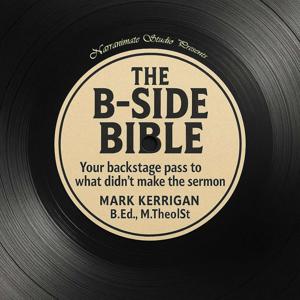
The B-Side Bible is a sharp, entertaining, and completely unvarnished dive into the hidden tracks, raw context, and overlooked history of the ancient world. The title is a nod to the…
This podcast is a strict, objective post-mortem of ancient literature and cultural anthropology. We leave modern theology and moralising at the door to explore the original socio-historical context of the scriptures—examining why these texts were engineered, who they were actually written for, and what they meant to the people living under the shadows of the Babylonian and Roman empires. From bizarre prophetic performance art and fringe characters to strategic political propaganda and ancient text-editing battles, The B-Side Bible pulls back the curtain on the deep cuts of history.
### About the Host
Mark Kerrigan holds a Bachelor of Education and a Master’s degree in Theological Studies. With over twenty years of experience as an educator, Mark excels at breaking down complex, rigorous academic research into engaging, accessible, and fascinating narratives. He is a multi-disciplinary creator under the Narranimate Studios banner, hosting both The B-Side Bible and the Forgotten Urban Histories podcast. Mark is also a versatile author, having written two speculative fiction novels as well as two children's novels. Across all his projects, he combines his background in education, narrative world-building, and historical criticism to strip the varnish off the past—delivering it exactly as it was: loud, accurate, and completely off the record.