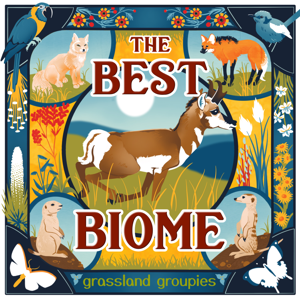
The Best Biome

The Best Biome

By Rachel Roth and Nicole BrownScienceLife SciencesNatural SciencesNature
Download on the App Store

The Best Biome episodes

  • #15 – Toads on Ice
    Episode Notes

    We're going back to the Eurasian Steppe this week to take a look at the Mongolian toad. How do these toads survive where no other amphibian dares to travel? What the heck is a drink patch? The answer is more complex than you might think.

    Thanks for listening to our weekly exploration of why grasslands are the best biome. We'll see you in two weeks!

    Primary Sources: Be sure to check out photos and more at our site!

    • Litvinchuk SN, Schepina NA, Borzée A. 2020. Reconstruction of past distribution for the Mongolian toad, Strauchbufo raddei (Anura: Bufonidae) using environmental modeling. PeerJ 8:e9216 https://doi.org/10.7717/peerj.9216
    • AmphibiaWeb 2017 Strauchbufo raddei: Mongolian Toad. University of California, Berkeley, CA, USA. Accessed Apr 23, 2021.
    • Berman, D. I., Bulakhova, N. A., Meshcheryakova, E. N., & Shekhovtsov, S. V. (2020). Overwintering and cold tolerance in the moor frog (Rana arvalis, Anura) across its range. Canadian Journal of Zoology. doi:10.1139/cjz-2019-0179
    • Kuzʹmin, S. L., Dunaev, E. A., Mȯnkhbai︠a︡r Kh, Mȯnkhbaatar, M., Oi︠u︡unchimėg Zh, & Tėrbish, K. (2017). Zemnovodnye Mongolii = Mongol orny khoër nutagtan = The amphibians of Mongolia. Tovarishchestvo nauchnykh izdaniĭ KMK.
    • Contact

      Website Facebook Twitter
      53 min
    • #14 – Muppets on the Steppe
      Episode Notes

      Saiga antelope: strange Muppet or amazing survivor? These animals have some amazing adaptations to help them survive the nearly insurmountable odds stacked against them. Also, sandalwood is evil apparently? Who knew.

      Thanks for listening to our weekly exploration of why grasslands are the best biome. We'll see you next time!

      Primary Sources: Be sure to check out photos and more at our site!

      1. Planet Earth II: why more than 200,000 saiga antelopes died in just days. Milner-Gulland, E., Morgan, E., and Kock, R. 2016. The Conversation.
      2. Saiga. Fitz, B., and Fitz, R. 1999. Documentary. CONTENT WARNING: footage of live animals butchered and horns taken.
      3. Big Island, Small Planet: Challenges and Failures in Conserving Hawaiian Sandalwood Trees. Leopold, S. 2015. PDF.  
      4. Steppe change – Kazakhstan saiga population has more than doubled in last two years. Knight, T. 2019. Fauna & Flora International. 
      5. Floppy-nosed antelope has baby boom, raising hope for critically endangered species. Bittel, J. 2020. National Geographic.
      6. Contact

        Website Facebook Twitter
        42 min
      7. #13 – Fruit Toss
        Episode Notes

        THE characteristic toucan species, Toco Toucan, tucanuçu, is the only toucan that doesn't live exclusively in forests. Like many hornbills in the Old World, these birds thrive in South America's savannas, where they're intricately connected to their ecosystems. Let's put them back in their place and do an explore.

        Thanks for listening to our weekly exploration of why grasslands are the best biome. We'll see you next week!

        Primary Sources:

        • Pizo, M. A., Donatti, C. I., Guedes, N. M. R., & Galetti, M. (2008). Conservation puzzle: Endangered hyacinth macaw depends on its nest predator for reproduction. Biological Conservation, 141(3), 792–796. doi:10.1016/j.biocon.2007.12.023
        • WikiAves: A Enciclopedia das Aves do Brasil
        • Animal Diversity Web: _Ramphastos toco_
        • Trupkiewicz, J., Garner, M. M., & Juan-Sallés, C. (2018). Passeriformes, Caprimulgiformes, Coraciiformes, Piciformes, Bucerotiformes, and Apodiformes. Pathology of Wildlife and Zoo Animals, 799–823. doi:10.1016/b978-0-12-805306-5.00033-x 
        • Contact

          Website Facebook Twitter
          47 min
        • Bonus: the North American Model (a critique)
          Nuance below:

          We have some feelings on the North American Model and the way it's implemented and discussed in the wildlife field. It usually disparages other models of wildlife conservation, silences non-consumptive users, and erases the indigenous "north American models" developed and implemented long before colonization.

          We'd love to hear other voices on this issue, so reach out if you'd like to bring your perspective to a future conversation!

          Recommended reading:

          • Study: Non-hunters contribute most to wildlife
          • An Indigenous Critique of the North American Model of Wildlife Conservation; https://doi.org/10.3167/ares.2018.090106
          • U.S. Fish and Wildlife Service: North American Model of Wildlife Conservation.
          • Contact

            Website Facebook Twitter
            25 min
          • #12 – Man and the Biosphere (Reserves)
            Episode Notes

            Apparently Biosphere Reserves are everywhere? Nicole's deep dive into UNESCO's Man and the Biosphere (MAB) Programme takes several twists and turns, linking natural and social sciences, the program's protected grasslands, the difficulties of international cooperation, and other land conservation efforts here in the United States. Happy Earth Day or something?

            Thanks for listening to our weekly exploration of why grasslands are the best biome. We'll see you next week!

            Primary Sources: Be sure to check out photos and more at our site!

            • UNESCO. (2021, March 24). Man and the Biosphere (MAB) Programme. https://en.unesco.org/mab
            • American Prairie Reserve
            • Kerr, A. (2017, November 21). The Trump Administration Takes Out 17 International Biosphere Reserves. http://www.andykerr.net/kerr-public-lands-blog/2017/6/23/the-trump-administration-takes-out-17-international-biosphere-reserves
            • Hegyi, N. (2019, December 8). Big Money Is Building A New Kind Of National Park In The Great Plains. https://www.npr.org/2019/12/08/780911812/big-money-is-building-a-new-kind-of-national-park-in-the-great-plains
            • Contact

              Website Facebook Twitter
              59 min
            • #11 – Riverine Grasslands and the Bengal Florican
              Episode Notes

              In Assam, India, the grasslands along the river Brahmaputra totally contain tigers, but Rachel is bound and determined to talk about something hiding in the shadows of those tigers: riverine and river-island grasslands and their flagship species the Bengal Florican.

              Thanks for listening to our weekly exploration of why grasslands are the best biome. We'll see you next week!

              Primary Sources: Be sure to check out photos and more at our site!

              • Batbayar, N., Bhardwaj, G. S., et al (2017). Averting the extinction of bustards in Asia. Forktail, 33, 1-26.
              • Grassland burning, clearing imperils birds of Brahmaputra's river islands. (2021, February 22). Mongabay India. Retrieved April 15, 2021, from https://india.mongabay.com/2021/02/grassland-burning-clearing-imperils-birds-of-brahmaputras-river-islands/
              • Girish Jathar's body of work.
              • Lahiri, S., Pathaw, N. A., & Krishnan, A. (2020). Convergent acoustic community structure in South Asian dry and wet grassland birds. BioRxiv (preprint). doi:10.1101/2020.08.07.241612
              • Contact

                Website Facebook Twitter
                56 min
              • #10 – Biospheres for Horses (Takhi)
                Episode Notes

                What has four legs and walks on its middle finger and features heavily in all your favorite childhood video games?? Horses are actually kinda neat, it turns out, especially the modern conservation work of the last remaining wild horse, Przewalkski's Horse, the Takhi. Nicole embraces her childhood horsegirl vibes and kinda sorta teaches Rachel to appreciate horses because they're like camels. This description brought to you by Rachel.

                Thanks for listening to our weekly exploration of why grasslands are the best biome. We'll see you next week!

                Primary Sources: Be sure to check out photos and more at our site!

                1. Origin of horse domestication. Britannica Encyclopedia.
                2. Biosphere reserves. (2020, October 30).
                3. Kaczensky, P., Burnik Šturm, M., Sablin, M. V., Voigt, C. C., Smith, S., Ganbaatar, O., et al. (2017). Stable isotopes Reveal diet shift FROM PRE-EXTINCTION TO Reintroduced Przewalski’s horses Scientific Reports, 7(1). doi:10.1038/s41598-017-05329-6
                4. Ransom, J. I., Kaczensky, P., Lubow, B. C., Ganbaatar, O., & Altansukh, N. (2012). A collaborative approach for estimating terrestrial wildlife abundance. Biological Conservation, 153, 219-226. doi:10.1016/j.biocon.2012.05.006
                5. William Taylor Assistant Professor and Curator of Archaeology. (2020, March 02). Humans domesticated horses – new tech could help archaeologists figure out where and when
                6. Contact

                  Website Facebook Twitter
                  1 hr 1 min
                7. #9 – Two Truths and a Lie: stump the naturalist edition
                  Episode Notes

                  In an April 1 break from the normal format, Nicole and Rachel try to stump each other with a game of Two Truths, One Lie. Buckle up for carnivorous prairie plants, Saiga death by banging, and so, so many bugs.

                  Thanks for listening to our weekly exploration of why grasslands are the best biome. We'll see you next week!

                  Primary Sources, pics, and more are on our site, to keep these notes spoiler-free. ;)

                  Contact

                  Website Facebook Twitter
                  1 hr 10 min
                8. #8 – Little Brown Bird
                  Episode Notes

                  Some of the smallest, most unassuming birds among us have the most amazing stories to tell. The Grasshopper Sparrow is a tiny little bird with a big personality. Learn about captive breeding of the Florida Grasshopper Sparrow and other ways we are helping this prairie icon avoid the brink of extinction.

                  Thanks for listening to our weekly exploration of why grasslands are the best biome. We'll see you next week!

                  Links we promised:

                  • https://www.3billionbirds.org/
                  • America's dwindling grasslands require action: https://thehill.com/blogs/congress-blog/politics/528890-americas-dwindling-grasslands-require-action?rl=1
                  • GRSP Songs from: Stokes Audio Field Guide
                  • Primary Sources: Be sure to check out photos and more at our site!

                    • Grasshopper Sparrow life history, All About Birds, Cornell Lab of Ornithology. https://www.allaboutbirds.org/guide/Grasshopper_Sparrow/lifehistory
                    • A Sparrow Back from the Brink with Andrew Walker, February 18, 2021, American Birding Podcast by the American Birding Association. https://www.aba.org/a-sparrow-back-from-the-brink-with-andrew-walker/
                    • Grasshopper Sparrow, Species Conservation Profiles, Partners in Flight. https://partnersinflight.org/species/grasshopper-sparrow/
                    • White Oak Conservation, Florida Grasshopper Sparrow Disease Risk Analysis. Workshop Report 9, April, 2019 https://www.fws.gov/verobeach/NewsReleasesPDFs/20190409_FGSPDRA.pdf
                    • Song and Garden Birds of North America by Alexander Wetmore (1964) Pittman, C. (2021, February 10).
                    • Bringing back the Florida Grasshopper Sparrow, the 'most Endangered bird' in the U.S. Retrieved from https://www.nationalgeographic.com/animals/article/captive-breeding-save-florida-grasshopper-sparrows
                    • Contact

                      Website Facebook Twitter
                      50 min
                    • #7 – Fat-tailed and CUTE
                      Episode Notes

                      What is mouse-sized, carnivorous, and gives birth to tiny fetal joeys? Lots of things probably, but this week dunnarts are the star of the show. Hailing from Australian grasslands, these fat-tailed little marsupials are losing their habitats before we've even figured out their social behaviors, but maybe their cute faces will help them sneak into charismatic species status.

                      Thanks for listening to our weekly exploration of why grasslands are the best biome. We'll see you next week!

                      Primary Sources:

                      • Curnow, C., Lewis, P., et al. About the Dunnart. World Wildlife Fund. Accessed 12 March 2021. https://wwf.panda.org/discover/our_focus/wildlife_practice/profiles/mammals/dunnart/
                      • Dunnarts. Bush Heritage Australia. Accessed 12 March 2021. https://www.bushheritage.org.au/species/dunnarts
                      • Walker, K. (June 2012). Husbandry Guidelines Fat-Tailed Dunnart. Western Sydney Institute of TAFE, Richmond. https://aszk.org.au/wp-content/uploads/2020/05/Mammals.-Fat-tailed-Dunnart-2012KW.pdf
                      • Jackson, S. (2003). Australian Mammals: Biology and Captive Management. CSIRO Publishing. ISBN 0643066357.
                      • Geggel, L. Why Are There So Many Marsupials in Australia? LiveScience, 3 Mar. 2019. https://www.livescience.com/64897-why-marsupials-in-australia.html
                      • Contact

                        Website Facebook Twitter
                        51 min

                      About The Best Biome

                      From the publisher's feed

                      Two prairie biologists make the ever-growing argument for why grasslands are the world's best biome.

                      More shows like The Best Biome

                      This American Life by This American Life

                      This American Life

                      90,603 Listeners