
Sign up to save your podcasts
Or



This podcast provides a comprehensive numismatic and historical overview of a 10 Centavos on 100 Cruzeiros overprinted banknote issued in Brazil between 1967 and 1970.
It details the macroeconomic instability and currency reforms under the PAEG following the 1964 political transition, profiles the signers Dênio Chagas Nogueira and Octávio Gouvêa de Bulhões, and examines the obverse portrait of Dom Pedro II alongside the reverse allegory of National Culture. Furthermore, it outlines the technical specifications, security features, mintage figures, the prominent "MINSTRO" typographical error (variety P-185a), and current market valuation.
A review of Trayectoria del Banco Occidental de México, s. a., Primer Banco Regional en Sinaloa: 44 años de Historia by María de los Ángeles Sitlalit García Murillo, Gustavo Aguilar Aguilar, Juan Antonio Fernández Velázquez
This podcast provides a comprehensive numismatic and historical overview of the Brazilian 5 Centavos on 50 Cruzeiros banknote (Pick-184a) issued during the Cruzeiro Novo overprint series between 1967 and 1970. It examines the macroeconomic instability and political upheaval of 1960s Brazil that necessitated monetary reform, the institutional transition from the National Treasury to the newly established Central Bank of Brazil, and the roles of key signatories Dênio Chagas Nogueira and Octávio Gouvêa de Bulhões.
Additionally, the podcast analyzes the banknote's obverse and reverse imagery—highlighting Princesa Isabel and the allegory of the Lei Áurea—details its security features and technical specifications, and evaluates its numismatic significance, specifically focusing on the cataloged "MINSTRO DA FAZENDA" typographical error and its current market valuation.
El Banco de Querétaro, S.A., was officially founded on February 24, 1903, when the federal Secretaría de Hacienda granted the banking concession to Nicolás del Moral and Guillermo Obregón8. The bank was successfully launched with an initial capitalization of 1,000,000 pesos12. The concessionaires and early board members were part of the wealthy regional elite who maintained close ties with the "Científicos"—the technocratic advisors of the Porfirio Díaz regime—which allowed them to integrate both Mexican and French financial capital13.
Economically, the bank operated as the designated state-chartered financial institution for the State of Querétaro, facilitating regional commerce, agricultural development, and industrialization. Querétaro was geographically and economically vital, serving as a major hub for the expanding national railroad network, which connected the agricultural heartland to the capital and the northern border. While El Banco de Querétaro was the primary state bank of issue, it was not a monopoly; it operated alongside branches of massive national institutions like the Banco Nacional de México (Banamex) and the Banco de Londres y México, which dominated large-scale federal transactions and commercial interests across the republic
The issuance of paper currency frequently serves as a historical ledger, recording the geopolitical struggles, economic shifts, and sovereign milestones of the issuing nation. The banknote depicted in the provided image—a 1 Peso Treasury Certificate of the Philippines, Victory Series No. 66—stands as a primary historical document. Issued during the twilight of the Second World War, this specific series was instrumental in the physical and psychological liberation of the Philippine Islands.
The analysis indicates that this currency was not merely a medium of exchange, but a strategic economic tool deployed to stabilize a shattered economy, delegitimize hostile occupation fiat currency, and re-establish the authority of the Commonwealth government.
Proyectos bancarios durante los años de la Reforma y del Segundo Imperio Leonor Ludlow
This podcast provides a comprehensive numismatic and historical evaluation of a Brazilian Centavo provisional banknote issued between 1967 and 1970 by the Central Bank of Brazil through a black circular overprint on a legacy 10 Cruzeiros banknote printed by Thomas De La Rue.
It covers the broader economic turbulence, inflation, and financial reforms under the PAEG plan following the 1964 military coup that led to the creation of the Cruzeiro Novo monetary standard. The report details the key figures behind the issue—including signatories Dênio Chagas Nogueira and Otávio Gouveia de Bulhões, as well as obverse portrait subject Getúlio Vargas and reverse imagery celebrating national steel production (CSN)—alongside technical specifications, security features, catalog identifiers (Pick P-183b), variety distinctions regarding the "MINSTRO" error, and current market valuation for collectors.
**This podcast provides a comprehensive numismatic and historical analysis of a 1914 Series 5 Yuan banknote (cataloged as Pick P-117n) issued by the Bank of Communications in Republic of China. Printed by the American Bank Note Company, the note features a steam passenger train on the obverse—symbolizing the bank's key role in financing national railway infrastructure such as the Beijing-Hankou line—and the Chinese Government Post Office on the reverse.*
The analysis details the historical context surrounding its issue, including the 1914 National Currency Regulations and the 1916 silver convertibility crisis, while outlining the profiles of signers Tang Shoumin and Wang Zisong (J.S. Wong). Additionally, it covers security features like intaglio printing and embedded planchettes, regional control marks (specifically the Shanghai overprint), series variations, counterfeiting indicators
This podcast provides a comprehensive numismatic and historical report on the 1935 Bank of Communications 10 Yuan banknote (Pick 155). It detailedly covers the economic context of the 1935 Chinese currency reform, the history and reorganization of the Bank of Communications, biographic details of key signatories, and an analysis of the complete 1935 series. Furthermore, the report features in-depth obverse and reverse design analyses—including associated history such as that of the Qing Dynasty and Summer Palace—security and anti-counterfeiting features, technical specifications, signature varieties, and a market valuation analysis including population data, recent sales, and an estimated visual grade for the subject banknote (Serial D940388 F).
This podcast provides a comprehensive numismatic and historical analysis of the 1967 Brazilian 50 Centavos overprinted banknote (50 Centavos Novos on 500 Cruzeiros, Pick P-186a). Issued by the newly established Central Bank of Brazil under Decree-Law No. 1 during a period of severe hyperinflation and economic reform following the 1964 military coup, this provisional issue revalued existing 500 Cruzeiros banknotes printed by the American Bank Note Company.
The note features a portrait of Dom João VI on the obverse alongside signatures of BCB President Dênio Chagas Nogueira and Finance Minister Octávio Gouvêa de Bulhões, while the reverse depicts an allegorical vignette of the 1808 Opening of the Ports by Cadmo Fausto de Sousa. Combining intaglio and offset security printing, this standard series note with a print run of approximately 90 million units represents a crucial monetary transition, with high-grade uncirculated examples currently valued at around $10.00 to $15.00 USD in today's collector market.
From the publisher's feed
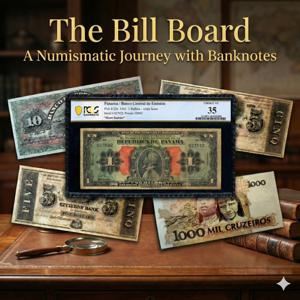
We will explore a wide number of topics, all dealing with banknotes. For individual banknotes, we will explore the history around the issuance of the banknote, including the series it belongs to,…