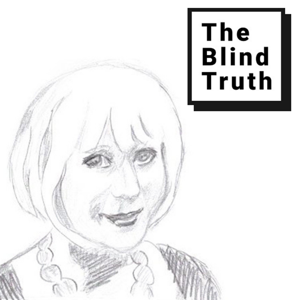
The Blind Truth
Download on the App Store

The Blind Truth episodes

  • 10: Knock Yourself Out
    It might be cold but the sky is blue and the sun is out and casting long winter shadows over the landscape. This is the weather for walking, and on Thursday afternoon I bunked off and went for a walk and a talk with my sister.

    The sister never leaves home without her penknife. I never leave home without a lipstick. She is academically gifted but once put her finger in the blender and switched it on to see if it was working. I was on the floor convulsing with laughter and incapable. She was making a cake at the time. Her solution to this mishap was to put a sign in front of said cake that read “not suitable for vegetarians”. I would not have thought of this.

    Our walk offers a huge variety in landscape and terrain. The sister thinks that this affords me the ideal opportunity to see what a long cane has to offer. I have tried to explain that it’s not designed for cross country. She has never come to terms with the reasons why a long cane cannot offer you a suitable form of mobility in the undergrowth. I have just never really got my head around the long cane full stop. I know I don’t make as much use of it as I know would be helpful but the under growth is a suggestion to far. She cannot see the point of any aid to mobility that cannot take on brambles and quagmires because this is where she tends to walk. I like to know the pavement below my feet is solid because that’s where I tend to walk.

    I do make a concession to the glare that the low slung sun causes and by which means the world in front of me can vanish, stabbed out by needle points of light rays. I wear ski glasses and a trilby.

    We set off well enough and occasionally the sister will helpfully tell me that we are coming to a nice flat piece of ground. More frequently she says, “Oh yeah. I forgot to mention that tree root and the huge pool of muddy slush that has just made its way into your shoe”. That’s the problem with having a good intellect. You cannot have your mind on higher things and be down in the dirt with your relatives at the same time.

    Sometimes she holds back a branch or a bramble and then lets it go just before I have cleared it. Very occasionally, she offers helpful narration on the wildlife, which she is extremely good at. She once forgot to mention a deer fence that I marched into at throat height. The convulsions that followed must have had more of an impact on her than me because she has never done that again. She will always say when we are at the fence. Then, as we tumble out of woodland onto the side of a windswept hill, and as I am pulling my hat down low and the jacket zip up high, she sometimes says, “we’re out of the wood and at the top of the hill. The wind is blowing.”

    I am ashamed then to say that Thursday’s brush with a tree was not of her making but mine and that the learning point for me was that I might be just as hooked by my phone as the next Joanna. At the precise moment she ducked below a branch, I lowered my head as I took my phone out of my bag. The brim of my hat obscured the tree branch and bang. I could see stars and felt my neck go crunch.

    As I was thinking about the £60 physio charge I was about to incur, I heard the sister say, “oh yes, there’s a tree branch”. The moral dilemma was whether to take responsibility or blame the sister. I’d like to say that I didn’t hesitate in doing the right thing, but I did, just for a split second.
    5 min
  • 9: On Your Bike
    I am a great fan of the bike. I have a bike. It lives in my shed and has flat tyres and never goes out. It’s a sit up and beg bike that I bought when my sister bought a hugely expensive mountain bike and all the gear because she was going to take up serious cross country cycling and offered to come out with me.

    We went cycling once together before she refused to go again. She refused on the grounds that it was too frightening to see the expressions of terror on the faces of those who had to dodge my unregulated progress. Her bike languished in the garden and finally expired. Lamenting it’s demise she asked me to give her mine. I refused on principle.

    My son is a great fan of the bike too. He loves bikes so much that not even getting knocked off his bike deterred him. The driver came out of a side turning without stopping or indicating and ploughed straight into my son who was catapulted across Chiswick High Road and landed on the bonnet of an oncoming car. (Hurrah I say!. It was on the car and not under it.) He broke his shoulder in three places and had to call for his own ambulance because no one else did.

    I am also a great fan of my son and support his choice to cycle. Like sex, I’d just prefer not to know about it. I do know he’s properly attired when he cycles though. A few weeks ago he drew up short in front of me in Clapham High Street shouting “Mother”. Me and the creature resembling a large ant, tottered to the pavement, him in his clip on shoes and lycra, me with my Waitrose bags.

    I would also venture to suggest that my son is a fan of mine. While he can recite my shortcomings he’s reasonably attached to me, and after a drink or two has been known to express his hope that I should live a long life, though he fears that I might meet my end under the wheels of a bike that I didn’t see coming.

    His fears were nearly realised in Esher recently, when I did get hit by a cyclist as I was crossing the road at the green man. It was my right of way. The offender, for that’s what he was, lobbed a few four letter words my way then cycled off and as the traffic flowed once more, I picked myself up and stood in the road with cars brushing past. I had to wait for the lights to change again before the traffic stopped and I could go on my way.

    They say that a little bit of fear every day is a good thing and helps you to know that you are alive. Navigating your right of way across a road, or your way down the pavement where cyclists loom is a bit like playing street fighter, which gets the cortisol levels racing.

    Viva the rise of pedal power, but spare a thought for those of us too old to have worn lycra and those of us who have never seen a lycra clad cyclist up close and personal unless we are related to them or until it is too late.
    5 min
  • 8: Banking Favours
    Banking is a dirty word these days and Bankers have come in for a pasting. Bank Station, with it’s ongoing improvement work, huge levels of public investment and disgruntal travellers is not a bad metaphor for anyone mystified by Banking. It’s confusing.

    It’s a constantly changing terrain down in Bank tube station, with it’s temporary signage that is like the small print in a loan agreement and just too tricky to read, it’s temporary structures, and all the twists and turns that only served to undermine my confidence in my own judgement because I ended up in Rotherhyde when I meant to go to Tooting.

    Dave, at Clapham North, has a technique for stuffing me in to the front carriage of the northbound rush hour service so I’m in the right place when I get to Bank. At Bank it’s my fellow commuters I generally rely on. While the ones that tut and complain at my dithering presence assume a greater importance in my consciousness than they deserve, spare a thanks for the people who go out of their way.

    The best of my fellow travellers ask if help is required rather than telling me that help will be provided. They meet me on equal terms and do not grab me or speak loudly and slowly. When I have my cane in my hand, which I don’t always do, they don’t point out the direction “over there” but explain. They offer up seats and I willingly accept to avoid having to fight not falling over on a moving train. They don’t plead for divine intercdence on my behalf and they don’t lose it if they realise that I can see to read my mobile phone.  It’s the little things that go a long way to making life easier. Just when I was getting lulled into these little interactions as the norm, I got my comeuppance.

    Having been wandering round Bank Station for about 20 minutes, a lovely man asked me if he could help. I was not swayed by his obvious charms but willingly accepted, and as we set out from the Central westbound platform for the second time that afternoon, in search of the Northern Line southbound, I surrendered to his judgement. We fell into conversation and I must say that I was fully engaged, although if you asked me now what he looked like or what we talked about, I would say that I have not got a clue.

    When we arrived on the southbound platform of the Northern line, he said that this is where he would leave me and I was suitably grateful and tried not to flick back my hair while saying my goodbyes to our brief encounter. He left me and as the train approached I heard the announcement; “this was the westbound Central line service to West Riselip”.  I set out to find the Northern line for the fourth time in an afternoon.
    4 min
  • 7: Grand Masters
    I did something rather wonderful this morning. It involved Grand Masters and there was not a golf ball in sight.

    Golf is a whole other story: I once went for a golf lesson. I have no idea how blind people make a go of this inscrutable game. I found it impossible to line the iron up with the ball and spent a frustrating hour beating the hell out of thin air and terrifying my coach. After the lesson ended and he mopped his brow, he told me not to come back.

    These Grand Masters would not have been seen dead, let alone alive, in the coveted Masters Green Jacket. It’s a truism of just about all paintings in Charles 1 collection that green doesn’t make much of an appearance. It was an unstable color. You couldn’t just drop a blob of blue into a blob of yellow and hope for the best. Reds predominate.

    I gave up going to art galleries a long time ago. It’s not that it’s impossible to appreciate the beauty and sentiment of great art. Good magnification can make it worthwhile, but it’s the crowds that do it.

    If you are trying to check out the art work with a pair of binoculars clamped to you face it makes it tricky to move to the best vantage point when the dear old public stand bang smack between you and the picture. Every time you move you have to refocus the binoculars and then bang, someone loses their patience because you are in their way. A neatly positioned nudge to the elbow delivers a nifty blow to the eye socket and game over.

    I’ve had more injuries in art galleries than on golf courses.

    What a treat it was then, to have “Charles 1 King and Collector”, at the Royal Academy, to myself, with only the hardiest of art lovers for company, at eight o’clock in the morning. There were no crowds, just a group of very polite people quietly waiting their turn. No risk of a black eye.

    My host for this uplifting start to the day, had invited me to a private view that I had never seen, and as we wandered from room to room, she shared her extensive knowledge of King Charles 1 and his appetite for buying up the the art of less fortunate royal bankrupts when they were forced to sell up. She read the catalogue notes out loud and gave me a wonderful description of the brush work of Van Dyck and Titian.

    It beats the last time I had the joy of such an enthusiastic guide: I went to the Tracy Emin at the Hayward. The notes were not accounts of the representation of noble ambition, but of earthier pursuits like sex and drugs and alcohol, all read out loud. I can get this at home. I can even manage to avoid making my bed, or possibly getting out of it, without too much trouble at home. Charles 1 collection, on the other hand, was well worth getting out of bed for.

    What would have capped it all off, was to be allowed to touch the few sculptures that were there. I did this at a Jacob Epstein exhibition years ago and it was wonderful. What the dark dense material of a sculpture couldn’t convey to my eye, fingers did. I might not have seen what the casual, or not so casual, viewer saw, but the picture in my head was fulsome and the effort worth it.

    We all filter our understanding of what we see through the lens of experience and where we’re standing at the time. Just because I happen to have a less visual experience of such delights does not mean it’s not worth it. It is.
    5 min
  • 6: A Good Read
    I’m about half way through reading ‘My Brilliant Friend”. I say I’m reading it. I’m actually listening to it as an audio book.

    There are those that say this isn’t reading at all and that it’s a lesser activity. These people are predominantly people who can see to read a Penguin Classic, which, lets face it, not many of us can do when you consider the meanness of ink and paper involved.

    Even in the world of sight loss, there are those who share this purist view of reading. They favour the generosity of a braille manuscript, that you need a wheelbarrow to shift. I prefer the audio file. It’s all positional.

    I agree that the voice of a narrator is a very different experience from the translation of a printed page to a picture in your head, but the audio book, that had its origins in making books accessible to those of us who don’t read print, is in the ascendancy. You don’t have to be blind to appreciate its charms. Everyone is doing it.

    Back in the day, blind subscribers to the tape library were treated to the tones of the volunteer reader, who delivered the doings of drama in a tone that sometimes strangled the moment. There were even the sounds of the odd doorbell and dogs barking. I haven’t tried it myself, but a friend told me that “you haven’t lived until you’ve heard porn read by a volunteer reader”.

    Ten years ago a publisher I know told me that audio books would never take off because they were associated with blindness and “who wants to get lumped in with a load of blind people.” These days I can download, just about any audio book. You can even get most of the curriculum, in an audio file if you want it.

    I bet it won’t be long before publishers see the potential and switching on the audio or large print function comes as standard on all digital formats. That should be a challenge for Biff and Chip and Kipper.

    Blindness has been a wonderful midwife: There were probably those who thought that people would never give up the quill in favour of the fountain pen or the typewriter. Both are early examples of technology for blind people. Then there is the thing that we all take for granted whenever we cross border control, or use a bank card, or send a pdf. Optical Character Recognition (OCR) began as a method of scanning and speaking everything from the gas bill to novels for the benefit of blind people. It gave us the very first mouse, (to be caressed not trapped). Now both mouse and character recognition technology are firmly embedded in our everyday life, and aren’t we the better for it?

    I’m not much of a techy but I’ve embraced it. It gets me from A to B with a talking map, allows me to command my friends to do strange things through text messages that cannot be recalled once sent and keeps me reading. Funny thing is that all these great ideas, designed to help overcome blindness, seem to have got lumped in with a load of people who can see and who have long forgotten just who gave birth to these inventions.

    What a pity that so few blind people can afford the rising costs of technology that once had them at its heart.
    5 min
  • 5: The Uber
    Some boroughs provide assistance with the cost of taxis to their blind residents. It gets people out and about and if you can’t use public transport it can be a lifeline. The idea is that the taxi comes to you rather than you having to find the taxi. Much like an Uber. I’ve never tried the Uber but given the alternatives, a light went on in my head and I thought I’d give it a go.

    My current taxi hailing technique is to stand on the side of the road with my arm outstretched, sometimes for half an hour, in the vein hope that a taxi might come along and stop and transport me to a glittering party at the Ritz or late night shopping at Morrisons. It’s always a vein hope, not because I never get invitations to glittering parties at the Ritz or go late night shopping in Morrisons. I often go to Morrisons.

    There will always be someone who positions themselves between me and the oncoming much longed for taxi. Now that really is the ultimate in queue jumping and the height of bad manners and I have no idea that it’s happening because I can neither see the taxi nor the queue jumper. They, on the other hand, have the advantage of being able to see exactly what they are doing.

    Enter the Uber: What a marvelous arrangement for anyone who can’t see. A cab you call up and it finds you. No more aching shoulders from my impression of an unsuccessful hitch hiker, no more losing out to someone who knows what they are doing. I am finally in the game.

    I loaded up the Uber app and learnt to navigate the site. There’s a lot to remember. Which blob does what, how to enter destinations and how to reply to texts. It all has to be memorised because I can’t readily see it. First time out and oh Lordy, they have made some changes to improve my experience of the site.

    Now I have no idea what any of the blobs are and when I do get it to work there is the awful dawning that the way you know your Uber has arrived is by knowing what the car looks like and what it’s registration is. All is not lost though as you can talk to your driver. They’ll come and get you if you explain that you can’t see. At least, that’s the theory.

    I don’t know how it happened but our driver ended up in Tavistock Square while we were in Leigh Street. He thoughtfully called to say that if we could make our way there he’d pick us up. My friend explained that we wouldn’t be able to do that because “we’re blind” and gave our precise location. “OK’ he said. Ten minutes elapsed and he called back to say he was still waiting. Well, that was a red rag and my companion snarled that being blind would make that tricky and that we were waiting for him. The driver said he didn’t see why being blind should make it a problem for us to find him and then my companion spoke very slowly. I won’t bother to repeat what he said but we had to start again.

    Our second attempt ended up with a long enough wait between ordering the Uber and the driver cancelling the job, that we actually considered going out to lunch.

    Nearly forty minutes later our third driver arrived within three minutes of pressing the button. He didn’t bat an eye lid about the very large guide dog. He wanted to know how long the training took. My companion said it took about eighteen months to two years to train a guide dog. “Not the dog,” said our driver. “How long does it take to train you?”
    5 min
  • 4: Seeing It Your Way
    A couple of days ago a friend of mine invited me out to Lunch last minute. She’s always to be relied on to pick a good place to eat. Thursday was no exception.

    The choice was not an easy one. Should we go for a starter as well as a main course? What was the difference between the kind of chicken we normally eat and a black one? Should we try something with truffle? Should I be really self disciplined and stick with lettuce salad?

    We had just got to the point when we thought we knew, but were giving the menu one last check. I normally get my friends to read the menu to me but I had my reading eye pressed to the page. When I say pressed, the right side of my nose was flat against the surface of the menu. It might not look comfortable but it gets the job done.

    “Madam,” a voice said. “I have something for you.”

    “Oh good,” I thought, imagining some delicacy to tickle my palate. How wrong I was. I looked up to find the suited restaurant manager standing next to me proffering a silver salver on which was laid out a folded white linen napkin. Nestling in the folds of the napkin were four pairs of glasses.

    “No thank you,” I said and carried on reading.

    “But madam, this will help you if you have forgotten your glasses.”

    “No thank you,” I said, returning to my menu.

    No sooner had I done so than I became gripped by a regret at my lack of manners. My friend launched in to fill the awkward space I’d left. “She’s blind as a bat. Beyond glasses. I wouldn’t bother if I were you.” We’re life long friends which gives her exemption from the normal rules of sighted people describing me in these terms.

    “You were really rude to him,” she said.” You had better make up for it and show a little interest in where the chicken comes from. He was trying to be helpful,” she hissed.

    “If you looked at people sideways and carried your white stick he’d know you couldn’t see. On second thoughts, probably just as well you didn’t or you might have hit him with it, poor man.”

    Four pairs of glasses bought in the chemist would probably meet the needs of most people who’d forgotten their specs, so proffering help was the most normal thing in the world. It was probably born out of an ethos of ultra customer service that should have just about covered it. What they couldn’t muster was a large print menu. Not even a trip to the photocopier would apparently make that possible.

    Sometimes, vision is a two-way thing. Not everyone can imagine that there are really people who see so little, or nothing at all, who are out in the world and eating. Not all of us who are doing the eating can imagine why it’s not possible to produce a large print menu or that glasses served on a silver salver is meant to be a kindness not an annoyance.

    On a day when a fellow customer in the supermarket had already told me how hilarious I looked when reading a price label, it was hard not to take a swipe. I could have done better.

    People are people. Maybe we all have our limitations. Black chicken, it turns out, is still chicken.
    5 min
  • 3: The Busy Body
    It might have been Joseph Heller who said something along the lines that just because you are paranoid, doesn’t mean they aren’t out to get you.

    Call me paranoid: It was the middle of the night and it was a desolate bus stop at Luton Airport. I was alone. There was just me, my red suitcase with huge white spots on it that is easier to see than a more restraint style of luggage, and there was my cane of course. Then came the man in the Aaron jumper, (never best worn with mourning dress), who asked me if I needed any help. I was polite but firm. I did not. It was kind of him to offer.

    It was a long cold wait, after the second delayed night flight in three days, and little chance of getting home. Aaron jumper and I had just missed the bus. He made me feel as if I was being watched. Luckily we were not alone for long and with each new member of the queue he mouthed and pointed at me. He had got there before any of them and he was first in the queue to ensure that I would be helped and they would be in no doubt who was doing the helping.

    When the bus finally arrived he led from the front and made sure I got just what he knew I needed. He gripped my cane and manouvred it for me, thus depriving me of my principle means of establishing what the hell was going on around me. He was going to make sure there were no accidents on his watch.

    While I was composing myself after a small tussle and a polite “it’s easier if I do it myself” he held back the waves of competing passengers by stretching out both arms to form a human shield, mouthing something, Les Dawson style, before commanding some bemused Bulgarians to “stand back”.

    The man who sold bus tickets thought he knew all about the white cane, but he was in for a treat. Aaron jumper clasped him by the shoulders and explained in more Les Dawson whispers, point and wink tones, that like the QEII, I was approaching.

    On the bus, I could sense him looking at me. It’s the strangest feeling to know you are being observed, scrutinised. I got out my phone to check the train times. Aaron jumper said, ‘You can see then”. Praise be that he didn’t say it was a miracle. “Yes” I said. There was a long pause and he said, “But not much”. In a kind of “I was right all along” tone.

    When we tipped off the bus at the railway station I suggested that he go first in case he missed his last train. At the ticket barrier he told an unsuspecting woman, in a high viz jacket, that he’d been helping me but he had to run for his train. “Go on” he commanded her. There was no more pointing a winking. “That lady’s blind,” he yelped. “She can’t see a dam thing.” Less she should be in any doubt he gave her a good shove in my general direction. There were raised voices, a tussle. I didn’t hang around. I hope he got his train alright.

    On the platform I busied myself with a little bit of eaves dropping on a conversation about one woman’s love affair with cigarettes. Call me paranoid, but they’ll get her in the end.
    5 min
  • 2: You Are What You Wear
    The young are all blessed with beauty. I admit that beauty is a subjective judgement. I think that my god daughter, who is keen on an orange skin tone, is a great beauty, although I have not, until now, been a great fan of orange.

    I wish I had known all of this when I was young and not at all bad looking. Now I have to remind myself that I will never be any younger or better looking than I am today, so I had better make the most of it, and making the most of it means shopping for clothes.

    The challenge is how to shop if you cannot see to do it.

    A blind woman I know is always impeccably presented. Surely it cannot be her husband who supports her in this. Left to the choices of the men I know I would be the owner of a double breasted mustard coloured blazer with epilates and half sleeves, a selection of synthetic zip up Scandinavian knitwear and some remarkably ambitious underwear.

    The trouble with my female friends is their tendency to impose their tastes on me. What they know with certainty, because they can see what I can not, is what is best for me. What I know with total certainty, because I can smell a turkey at fifty meters, is that they never get it right.

    My default position is to revert to what I know works. This will inevitably be a blue dress in the style of the many blue dresses I have in my wardrobe, which is now packed with blue dresses I hope to rely on over a life time of needing to dress myself.

    Last year, during a blue dress pre-purchase try on, I overheard a voice I knew, but could not place, in the cubicle next to me. She was with her personal shopper. Obviously I solicited an opinion. “Buy the blue dress,” they said, so I did.

    The challenge is now on to buy an outfit for my son’s wedding. I do not want to look like the Mother of the Groom. It is enough that I am his Mother.

    At the very least I think that I have four blue dresses that I can fit into now that would probably get me through the day without disgracing myself. I probably have another four that I like a lot and wish I had not had taken in. I might even have another four that would provide coverage.

    What I have also come to realise is that, just like crossing the road, this could end in a car crash. This is not a job for or any one of my friends, male or female, but rather, a job for a professional, and I’ve made a start. I’ve dipped my toe in the water and had my first experience of a personal shopper.

    All I had to do was book it. No more searching the rails, no more bemusement, no more knocking things over, no more exhaustion with trying to see what I can no longer see, no more giving up and going home.

    My personal shopper had an approach that encouraged me to trust her. Her job, she explained, was to give expression to the way I saw myself. What was in my imagination?

    Not once did she say “I think you should try a bigger size,” or “what about orange?” or “actually I can’t take this anymore.” Or “definitely get the G-string.” She was there to facilitate and that stretched to helpful descriptions of fit and look and all the searching. All I had to do was say that I didn’t want anything in blue.

    The personal shopper is a fabulous development. Every sight impaired person should have them as standard issue. Beyond the obvious advantage of being able to over ride their personal prejudices, in the choice of my clothes, they are a way of securing the longevity of my friendships with nearest and dearest as well as the promise of comfortable underwear.

    5 min
  • 1: Party On!
    The older we get the more common the experience of meeting people that you have met before and then having the same conversation with them that you had last time you met them. One, or both of you, cannot remember that you have ever met.

    I once delivered a training course in the Europa Hotel, Belfast, with a super friendly participant.  At the end of the day he asked me if I remembered him. I did not. It turned out that fifteen years earlier we had enjoyed a kiss at one of those wild South Belfast parties I used to go to in the early eighties. Funnily enough I don’t recall what we talked about but I do remember the kiss.

    Parties are a challenge if you can’t see much. These days I often find I can’t tell the difference between furniture and people let alone men and women, but I have a technique: I slowly circle round the room until I settle on the vibe that says I can join in. This is a tried and tested approach that has served me well.

    Recently I went to a party which seemed to me to be populated by people of my parents generation in bad wigs, some of who played tuneless guitar so loudly it made my ears itch and rendered speech impossible. It was also dark with only the odd flashing light to illuminate frenzied middle aged dancing. I had to revert to plan B. I stood still and tried to look relaxed and happy, as if the cacophony were my idea of heaven.

    During the course of a very long evening, a lot of people came to say hello and weirdly seemed to know who I was, even if I had no idea who they were. I always advise that it’s a good idea to say who you are. But they never proffered their identity, and feeling that it would be rude to enquire, I never asked.

    On the up side it’s a huge game; a bit like Twenty Questions. They say “Hello, how nice to see you” or “Hello, you look really well’. No one has ever says I look awful. I set myself the goal of asking enough of the right sort of questions to work out who I’m talking to and award myself points for the speed with which I can do this.

    On the down side, I didn’t manage to guess them all. I don’t know who it was who said I had the best dye job she’s ever seem. My hair isn’t dyed. A forgettable exchange I think.

    Midnight seemed a descent enough hour to retreat to my hosts’ guest room. Luckily I knew the way. Unluckily I got it wrong and ended up on my hands and knees crawling over a rockery and through the shrubbery. God knows if anyone saw me or what they must have thought if they did. More likely I will have been labelled blind drunk than plain old blind.

    That might have been alright when I was young because everyone got drunk at parties. It was the eighties. There were people to kiss. Nowadays I’d rather be thought blind than blind drunk and I’m saving my kisses for the dog. Apart from anything else, too much crawling about at parties won’t do my reputation any good.

    Twenty Questions may have come to the end of it’s useful life. I might just go for “I can’t see you. Who are you?”.
    5 min

About The Blind Truth

From the publisher's feed

Anna Tylor presents a series of very funny stories that spotlight everyday experiences of visually impaired people to reveal the absurdities of what lurks just below the surface.