
Sign up to save your podcasts
Or



The High-Impact Board Test
After fourteen episodes and a series of difficult questions, Peter brings everything together in the final Boardroom Test. Chair leadership, culture, accountability, strategy, composition, risk, finance, stakeholders, the CEO, decision-making and continuous learning all come together in one final challenge: because your board exists, is the organisation better governed?
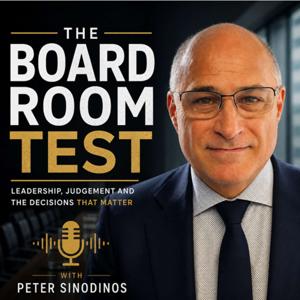
What makes a board genuinely effective when the pressure is on? In The Boardroom Test, Peter Sinodinos explores the real-world challenges of good governance from Chair leadership, board culture and accountability to strategy, risk, financial oversight, stakeholder trust and decision-making.
Drawing on Australian examples and practical experience, each episode asks the questions directors should be prepared to ask themselves and challenges boards to look beyond compliance to creating better decisions, stronger organisations and long-term value. Its raw but easy to understand. In this episode Peter talks about the number on question on people's lips - How do I get my first board role?
In simple terms Peter explains what you need to do. No rocket science just a practical guide.
Can Your Board Keep Up?
AI, cyber, geopolitics and systemic change are moving faster than many traditional governance models. Peter asks whether boards are learning quickly enough to understand the risks and opportunities confronting their organisations. The future-ready board doesn't need to predict the future; it needs to be capable of understanding it before its risks outrun it.
When Smart People Make Bad Decisions
A room full of intelligent people can still make a terrible decision. Peter explores groupthink, confirmation bias, authority bias and the influence of dominant personalities, while looking at practical ways boards can create space for dissent and better judgement. The goal isn't unanimous thinking, it’s disciplined thinking.
The Chair/CEO Relationship: Trust Without Friendship
The relationship between the Chair and CEO can be an organisation's greatest asset, or one of its greatest risks. Peter examines the delicate balance between trust, support, independence and accountability. How close is too close? And can a Chair maintain a strong relationship with a CEO while still having the difficult conversations that effective governance demands?
Who Owns the Social Licence?
An organisation can comply with the law and still lose the trust of its customers, employees, communities or regulators. Peter explores social license, ESG, reputation and stakeholder relationships, asking how boards should govern issues that can have a profound impact on long-term value. Because legality and legitimacy are not always the same thing.
Do You Really Understand the Numbers?
Directors don't need to be accountants, but they do need to understand the financial story behind the numbers. Peter explores financial literacy, cash flow, reporting, assumptions and the questions directors should be asking when the figures don't quite add up. Because the real test isn't knowing EBITDA, it’s knowing when the numbers deserve another question.
Are You Ready for the Risk You Can’t See?
Today's risks rarely arrive one at a time. Cyber, geopolitics, climate, supply chains, reputation and technology can combine to create crises that boards never anticipated. Peter explores risk appetite, resilience, “black swans” and “grey rhinos” and asks whether your board is prepared not just for the risks it can identify, but for the ones it can't predict.
The Board Evaluation That Actually Changes Something
Annual board evaluations can easily become a polite exercise that produces a report and little else. Peter asks what happens when boards use evaluation to confront uncomfortable truths about performance, behaviour, contribution and leadership. The real test is simple: what actually changed because of your last evaluation?
The Committee Trap: When Delegation Becomes Abdication
Board committees are designed to provide deeper scrutiny, but can delegation sometimes become an excuse for the full board to stop asking questions? Peter looks at Audit, Risk, Remuneration and other committees, exploring the difference between effective oversight and rubber stamping. Because good delegation should create confidence, not blind spots.
From the publisher's feed
My name is Peter Sinodinos. Over the years I’ve had the privilege of working closely with leaders, boards and organisations, observing what helps people and organisations perform at their best and…
I’ve also written and contributed to broader conversations about leadership, people and strategy, including my book Leadership: Ideas, People and Strategy, as well as work exploring governance, board effectiveness and organisational performance.
But The Boardroom Test isn't really about titles, credentials or my background. It’s about experience, and what that experience has taught me about the people and dynamics behind important decisions, because what really happens when the doors close and the boardroom begins ?
Behind the board papers, presentations and formal agendas are people. People with different experiences, perspectives, personalities and ambitions. People who have to build trust, challenge one another, navigate disagreement and, ultimately, make decisions that can have significant consequences.
The Boardroom Test is a 13-part journey into those dynamics.
Across 13 conversations, we explore leadership, judgement, governance, influence, courage, conflict, accountability and the relationships that shape decision-making when the stakes are high and the answers aren't always obvious.
We'll explore how to challenge without undermining, disagree without becoming disagreeable, listen when you think you already know the answer, and have the difficult conversations that leaders sometimes avoid.
Most importantly, we'll explore what it really takes to navigate the boardroom, not just to have a seat at the table, but to make a meaningful contribution when it matters.
Because being in the room is one thing.
Passing the Boardroom Test is another.
13 conversations. 13 perspectives. One question:
When the decision really matters, how do you show up?