
Sign up to save your podcasts
Or

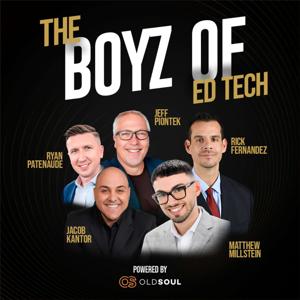


In this episode of The Boyz of EdTech, Rick Fernandez, Matthew Millstein, and Jacob Kantor sit down with Bobby Offterdinger, CEO of TAM to Target, for a tactical conversation about what actually works when selling into K-12. Bobby shares his journey from elementary school teacher and reading specialist to instructional technology, EdTech sales, and eventually launching TAM to Target to help companies build more effective go-to-market strategies across education and the public sector.
Bobby breaks down why more meetings do not automatically translate into more revenue. Successful EdTech companies still need product-market fit, message-market fit, sales acumen, and a clear understanding of district procurement. The group explores growing opportunities in CTE and career readiness, why some legacy products are leaving room for new competitors, and how founders can connect a specific district leader's pain point to a specific solution rather than overwhelming prospects with every feature their product offers.
The conversation also gets practical about outbound sales. Bobby explains why phone outreach continues to outperform cold email for TAM to Target, how founders should test different messages before scaling volume, and why genuine curiosity and empathy are fundamental sales skills. They discuss researching prospects before meetings, choosing go-to-market channels based on the type and price of a product, and understanding why selling an enterprise-wide system requires a very different motion from selling a smaller solution below procurement thresholds.
Bobby also shares how AI is reshaping the SDR function. Instead of expecting one person to research accounts, build lists, write outreach, call prospects, and manage every other part of prospecting, TAM to Target separates go-to-market engineering from the human conversations SDRs are best positioned to handle. The episode closes with a rapid-fire discussion on cold email, phone calls, sales signals, storytelling, and why the strongest K-12 sales conversations still come back to preparation, relevance, trust, and listening with empathy.
Connect with the Boyz
Rick Fernandez: https://www.linkedin.com/in/dr-rick-fernandez-40692434/
Matthew Millstein: https://www.linkedin.com/in/matthew-millstein/
Jacob Kantor: https://www.linkedin.com/in/thejacobkantor/
Ryan Patenaude: https://www.linkedin.com/in/ryanpatenaude/
Jeff Piontek: https://www.linkedin.com/in/jeffpiontek/
Key Moments
03:26 Why Bobby launched TAM to Target
05:55 What separates meetings from actual EdTech revenue
09:53 Why CTE and career readiness are gaining momentum
14:00 Finding message-market fit before scaling outreach
16:01 Testing soft versus direct calls to action
16:28 Why phone outreach remains powerful in K-12
19:02 Replacing the product dump with curiosity and empathy
22:07 Matching your go-to-market channel to the type of product
24:12 The district pain points that change and the ones that stay constant
27:43 Why founders still walk into sales meetings unprepared
29:51 Rethinking the traditional SDR role with AI and go-to-market engineering
33:03 Using AI to create more time for human sales coaching
39:33 Why great salespeople get buyers to tell their own stories
43:33 Rapid-fire lessons on cold outreach, signals, and smarter prospecting
Connect with Bobby Offterdinger
LinkedIn: https://www.linkedin.com/in/bobbyoffterdinger
Website: https://tamtotarget.com/
Interested in joining the show? Fill out the form: https://forms.gle/SRVhzpXikBombee38
In the first edition of EdTech Unwrapped, The Boyz of EdTech welcome Mauricio Szajman and Axel Petochi, Co-Founders of BaboBot, to put their product in the hot seat. Mauricio and Axel walk Rick Fernandez, Matthew Millstein, and Jeff Piontek through BaboBot, an AI-powered information management platform designed to connect the systems and information schools already use and make that knowledge easier for families, students, and staff to access.
Axel shares how the idea started at Babson College with a simple problem: finding out what was being served in the cafeteria. A small tool that texted students the daily menu quickly attracted roughly a quarter of the school, revealing a much larger problem around fragmented information. That early experiment eventually evolved into BaboBot, which aims to give school communities one place to ask questions and receive personalized answers based on the information relevant to them.
During the live demo, Mauricio shows how parents can ask about events, field trips, forms, and their children, while administrators can explore attendance trends, safety information, staff schedules, and other operational questions. The platform connects information from documents, Google Drive, emails, websites, and school systems, provides citations with its answers, identifies conflicting information, and escalates unanswered questions to staff rather than simply guessing.
The Boyz then dig into the questions school leaders and EdTech buyers are likely to ask, including onboarding, privacy, permissions, analytics, integrations, communication workflows, and differentiation from established platforms. Mauricio and Axel also share where BaboBot is headed, including WhatsApp access, deeper integrations, proactive communications, and automations that can turn school information into action. The broader vision is to move beyond another communication tool and create an AI-powered operating layer that brings siloed school data into one central brain.
Connect with the Boyz
Rick Fernandez: https://www.linkedin.com/in/dr-rick-fernandez-40692434/
Matthew Millstein: https://www.linkedin.com/in/matthew-millstein/
Jacob Kantor: https://www.linkedin.com/in/thejacobkantor/
Ryan Patenaude: https://www.linkedin.com/in/ryanpatenaude/
Jeff Piontek: https://www.linkedin.com/in/jeffpiontek/
Key Moments
00:59 How BaboBot connects school information in one place
02:25 How a college cafeteria problem inspired BaboBot
03:57 Live demo of the parent and family experience
10:45 What onboarding looks like for schools and districts
13:29 How users get access through existing school rosters
14:51 Protecting school data while using an LLM
16:15 Helping prospective families explore schools and programs
16:56 Inside BaboBot's administrator portal and knowledge base
23:26 Turning platform activity into useful district reporting
25:53 Personalizing information based on each user's role
27:31 The Boyz begin their product feedback
30:14 Meeting families where they already communicate
31:04 Building an AI brain that can turn school data into action
Connect with Axel Petochi and Mauricio Szajman
Axel Petochi LinkedIn: https://www.linkedin.com/in/axel-petochi-7b86b91ab
Mauricio Szajman LinkedIn: https://www.linkedin.com/in/mauricio-szajman
Website: https://babobot.com/
Interested in joining the show? Fill out the form: https://forms.gle/SRVhzpXikBombee38
Listen to the episode: https://youtu.be/hnbrHwODgdM
The Boyz dig into one of the biggest investments on the EdTech calendar: conferences. Rather than attending every event or measuring success by badge scans and LinkedIn photos, they discuss how companies can choose conferences based on their ideal customer profile, existing relationships, and business objectives. Rick shares the district and association perspective, explaining why meaningful partnerships are built around mutual value, trust, education, and creative ways for vendors to participate in the community.
Matthew and Ryan break down what effective conference execution looks like before, during, and after an event. They discuss setting meetings in advance, using conference communities and LinkedIn to identify attendees, following up while conversations are still fresh, and recognizing the difference between genuine opportunities and 'party pipeline.' They also explain why reciprocity, curiosity, and asking for the next step are stronger signals than simply collecting contacts.
The conversation closes with tactical advice for both new and experienced EdTech sales professionals. From prioritizing existing CRM opportunities and studying conference agendas to dividing and conquering networking events, clearing calendars, leveraging customer advocates, and staying fully present, the message is clear: conferences deliver value when there is a strategy behind showing up. Success is less about being everywhere and more about knowing who you need to meet, why the relationship matters, and what should happen next.
Connect with the Boyz
Rick Fernandez: https://www.linkedin.com/in/dr-rick-fernandez-40692434/
Matthew Millstein: https://www.linkedin.com/in/matthew-millstein/
Jacob Kantor: https://www.linkedin.com/in/thejacobkantor/
Ryan Patenaude: https://www.linkedin.com/in/ryanpatenaude/
Jeff Piontek: https://www.linkedin.com/in/jeffpiontek/
Key Moments
00:34 Why Q3 and Q4 matter for building EdTech momentum
03:16 Using conference season to prepare for Q1 opportunities
04:32 Measuring whether a conference was actually worth the investment
07:16 Creating mutual value between education leaders and partners
11:04 Choosing quality over quantity when selecting conferences
13:35 Building a conference strategy before buying a booth
15:15 When and how to follow up after a conference
17:55 Understanding the difference between pipeline and 'party pipeline'
20:11 Knowing when a conversation is ready for the next step
25:00 Using reciprocity to identify genuine business interest
29:04 Building connections before arriving at a conference
30:52 What to do when you walk into an event knowing no one
35:37 Why teams should divide and conquer at networking events
37:10 Clearing your calendar and staying fully present at conferences
43:21 Practical strategies for building momentum in a new EdTech territory
Interested in joining the show? Fill out the form: https://forms.gle/SRVhzpXikBombee38
Listen to the episode: https://youtu.be/4hABnJycfGI
In this episode of The Boyz of EdTech, Rick Fernandez, Jacob Kantor, and Jeff Piontek sit down with Jennifer Womble, Conference Chair and EdTech Advisor for the Future of Education Technology Conference (FETC), for a wide-ranging conversation about where education is headed and what schools need to rethink along the way. Jennifer shares her unconventional path into education, from studying economics and criminology to becoming a teacher, working at the state and national levels, and developing a broad view of the education ecosystem.
The conversation explores a fundamental question: What is school actually preparing students for? Jennifer argues that education cannot simply train students for jobs that may look completely different in the future. Schools need to develop lifelong learners who can think critically, solve problems, communicate, adapt, and understand their own learning. As AI accelerates change, those durable human skills, along with curiosity, metacognition, autonomy, and agency, become even more important.
Jennifer also explains why successful technology adoption starts with community, strategy, and trust. Rather than beginning with a product, districts should involve families, educators, businesses, and other stakeholders in defining what learning should look like. The group discusses cybersecurity, responsible AI implementation, outcomes-based contracting, parent communication, and why EdTech companies need to listen before they sell. Jennifer emphasizes that AI should amplify strong curriculum and pedagogy rather than become the foundation itself.
The conversation then turns toward what comes next, from AI-powered creativity and immersive learning to CTE, esports, cybersecurity, accessibility, and new approaches to assessment. Jennifer shares what FETC is seeing across districts and why some of the most exciting innovation is happening in career and technical education. The episode closes with a vision of schools that combine competency-based learning, multiple learning environments, human connection, and emerging technology while keeping curiosity, belonging, and student growth at the center.
Connect with the Boyz
Rick Fernandez: https://www.linkedin.com/in/dr-rick-fernandez-40692434/
Matthew Millstein: https://www.linkedin.com/in/matthew-millstein/
Jacob Kantor: https://www.linkedin.com/in/thejacobkantor/
Ryan Patenaude: https://www.linkedin.com/in/ryanpatenaude/
Jeff Piontek: https://www.linkedin.com/in/jeffpiontek/
Key Moments
03:54 How a nontraditional background shaped Jennifer's perspective
07:52 Rethinking the purpose of school and preparing lifelong learners
15:11 Why AI is forcing districts to examine deeper systemic challenges
17:45 Building AI strategy with community involvement from the start
22:09 Why EdTech companies need honest district feedback and co-building
27:42 Trust, listening, and stronger partnerships between districts and vendors
30:22 The risks and realities of outcomes-based contracting
38:02 Rethinking how districts communicate learning with families
40:54 Teaching AI wisdom, critical thinking, and responsible use
46:45 How AI can expand creativity and student problem-solving
50:20 What FETC is seeing across AI, CTE, immersive learning, and cybersecurity
56:21 Why CTE is becoming one of the most innovative areas in education
58:17 Integrating AI into authentic, project-based learning experiences
01:03:20 Competency-based learning and the future redesign of school
Connect with Guest
Jennifer Womble: https://www.linkedin.com/in/jennwomble
Interested in joining the show? Fill out the form: https://forms.gle/SRVhzpXikBombee38
Listen to the episode: https://youtu.be/fFFMguo46v0
John breaks down what separates promising EdTech ideas from companies that can create lasting impact. His framework focuses on three fundamentals: engagement, pedagogical alignment, and ease of adoption. The conversation explores why strong technology alone is not enough, why founders need evidence behind their claims, and how responsible AI, research, and measurable outcomes should shape product development. John also explains why the footnotes supporting a company's claims may be more important than the flashy slides in its pitch deck.
The group then digs into the business mechanics behind sustainable EdTech growth. Instead of chasing district logos and annual recurring revenue at all costs, John advocates for paid pilots, milestone-driven expansion, and a greater focus on net recurring revenue. They discuss why landing a district is only the beginning, how customer experience determines whether a pilot becomes a renewal, and why companies need to intentionally map the entire journey from initial conversation through onboarding, implementation, measurement, and expansion.
Connect with the Boyz
Rick Fernandez: https://www.linkedin.com/in/dr-rick-fernandez-40692434/
Matthew Millstein: https://www.linkedin.com/in/matthew-millstein/
Jacob Kantor: https://www.linkedin.com/in/thejacobkantor/
Ryan Patenaude: https://www.linkedin.com/in/ryanpatenaude/
Jeff Piontek: https://www.linkedin.com/in/jeffpiontek/
Key Moments
03:30 Building and exiting an EdTech company to Blackboard
05:05 Bringing entrepreneurship and innovation to Penn GSE
07:15 What John looks for in promising EdTech companies
11:20 The three fundamentals of successful EdTech products
14:35 Why evidence and research belong at the center of the pitch
19:10 Giving superintendents visible wins through technology
23:25 Shifting the focus from ARR to sustainable district growth
27:10 Why successful pilots should lead naturally to expansion
31:30 Mapping the complete customer journey after the sale
36:15 Why customer experience matters as much as customer acquisition
40:05 Paid pilots, milestones, and commitments to growth
44:25 The leadership qualities John looks for in founders
47:10 Balancing humility, coachability, and the will to succeed
50:30 How mentorship and coaching shape stronger entrepreneurs
Connect with Guest
John Gamba: https://www.linkedin.com/in/johngamba
Interested in joining the show? Fill out the form: https://forms.gle/SRVhzpXikBombee38
Listen to the episode: https://youtu.be/TGCkPgC94gY
Dr. Lewis breaks down how research, listening, board alignment, and community involvement shaped his entry into the district and ultimately helped turn the bond effort into a grassroots initiative. He also discusses the pressure new superintendents face to make changes quickly, why early wins matter, and how leadership stability can create the conditions for long-term improvement. From navigating conflict with a school board to recognizing when a decades-old problem might not be the right battle to fight, he offers a candid look at the judgment required to lead a district effectively.
The conversation also delivers a practical message for edtech companies: do your homework and become a partner, not simply a vendor. Dr. Lewis explains why companies need to understand district budget cycles, state funding priorities, contracts, implementation realities, and the people surrounding the superintendent. He shares concrete ways providers can add value beyond their product, including internships, community involvement, professional development, and proactive implementation support. The episode closes with a discussion of Essexville-Hampton's academic success and why continuity in teachers, principals, superintendents, and boards may be one of the most important ingredients for sustained improvement.
Connect with the Boyz
Rick Fernandez: https://www.linkedin.com/in/dr-rick-fernandez-40692434/
Matthew Millstein: https://www.linkedin.com/in/matthew-millstein/
Jacob Kantor: https://www.linkedin.com/in/thejacobkantor/
Ryan Patenaude: https://www.linkedin.com/in/ryanpatenaude/
Jeff Piontek: https://www.linkedin.com/in/jeffpiontek/
Key Moments
03:10 Taking on a school bond after arriving in a new district
05:30 Building credibility by having skin in the game
08:10 Turning a failed bond into a grassroots community effort
10:30 Building a superintendent's first 100-day entry plan
13:45 Why today's superintendent role requires more than instructional expertise
16:15 Knowing when to move quickly and when to slow down change
19:05 Building credibility through early wins and healthy conflict
23:20 What edtech vendors misunderstand about district buying cycles
25:40 Why providers should understand state funding before making a pitch
28:35 The difference between an edtech vendor and a true district partner
35:05 Why the cheapest solution is not always the best partnership
39:10 Making implementation easier instead of creating more work for
districts
Connect with Guest
Dr. Davion Lewis: https://www.linkedin.com/in/davionrlewis
Interested in joining the show? Fill out the form: https://forms.gle/SRVhzpXikBombee38
Listen to the episode: https://youtu.be/1KiFSgtvvrw
The conversation explores the potential consequences for equity, instruction, procurement, and workforce readiness. Jean-Claude argues that students with access to AI at home will continue learning how to use it, while students who depend on schools for access risk being left further behind. Rather than treating AI primarily as a technology problem, the group discusses why schools should rethink instructional design, elevate pedagogy, and move students beyond answer-getting toward analysis, productive struggle, collaboration, curiosity, and other durable skills.
Jean-Claude also examines the procurement and implementation challenges behind education technology. He explains why districts need stronger systems for evaluating whether products are safe, effective, aligned with instructional priorities, and properly implemented. The discussion highlights Digital Promise's work around AI and EdTech assurance labs, continuous efficacy measurement, and the need for shared accountability between districts and providers. The episode closes with a broader look at workforce readiness and global competitiveness.
Connect with the Boyz
Rick Fernandez: https://www.linkedin.com/in/dr-rick-fernandez-40692434/
Matthew Millstein: https://www.linkedin.com/in/matthew-millstein/
Jacob Kantor: https://www.linkedin.com/in/thejacobkantor/
Ryan Patenaude: https://www.linkedin.com/in/ryanpatenaude/
Jeff Piontek: https://www.linkedin.com/in/jeffpiontek/
Key Moments
02:14 Why a last-minute AI policy creates implementation challenges
05:12 The equity risks of limiting AI access in schools
08:05 Why EdTech procurement needs stronger evidence and evaluation
12:18 Preparing students for an AI-driven workforce
15:30 Moving from answer-getting to deeper thinking and analysis
18:42 Why instructional design matters more than banning the tool
22:15 What the graphing calculator debate can teach us about AI
28:10 Spending, strategy, and improving student outcomes
34:36 Why schools struggle to replicate successful practices
39:15 The challenge of removing AI from modern EdTech products
43:30 Building continuous AI and EdTech assurance systems
49:20 Why technology should support the instructional program
54:18 Shared accountability through outcomes-based contracting
58:12 Why AI literacy and computational thinking need to start early
Connect with Guest
Jean-Claude Brizard: https://www.linkedin.com/in/jean-claude-brizard-0080a810
Interested in joining the show? Fill out the form: https://forms.gle/SRVhzpXikBombee38
Listen to the episode: https://youtu.be/oEtxATz0hcE
In this episode of The Boys of EdTech, the conversation gets personal as Dr. Miranda Walachowski, Founder of Human Architects, steps into the coach's seat. Rather than a traditional interview, Miranda guides Rick Fernandez, Ryan Patenot, and Jacob Kantor through a live team coaching session focused on the future of the podcast, their individual goals, and what it takes to turn a group of high performers into a truly high-performing team.
Miranda explores why strong teams must make room for individual growth, protect their energy, and create clarity around how they work together. The group gets candid about balancing their businesses, families, and the podcast while identifying where logistics, unclear processes, and future interpersonal conflict could slow their momentum. Miranda explains why team charters, decision-making structures, written agreements, and honest conversations can help teams spend less energy on friction and more on meaningful work.
The discussion ultimately turns toward mission, vision, and action. Together, they uncover an opportunity for The Boys of EdTech to create a more interconnected ecosystem between K-12 leaders, entrepreneurs, and education partners while continuing to learn from one another. Miranda challenges the team to treat new ideas as experiments, establish clear milestones, streamline guest selection and scheduling, and build systems that protect both the team's momentum and the humans behind it.
Connect with the Boyz
Rick Fernandez: https://www.linkedin.com/in/dr-rick-fernandez-40692434/
Matthew Millstein: https://www.linkedin.com/in/matthew-millstein/
Jacob Kantor: https://www.linkedin.com/in/thejacobkantor/
Ryan Patenaude: https://www.linkedin.com/in/ryanpatenaude/
Jeff Piontek: https://www.linkedin.com/in/jeffpiontek/
Key Moments
05:31 Career advancement in education and edtech
09:46 Finding synergy in a new team
12:58 Integrating podcast insights into work
16:32 Managing work and family energy
18:13 Balancing work and family energy
24:26 Implementing Team Science Lab
26:50 Balancing work and family life
30:58 Learning and growth in education
32:55 Driving positive impact in education
36:20 Collective learning and collaboration benefits
40:02 Balancing personal business growth
45:54 Streamlining scheduling for efficiency
48:49 Balancing show monetization and authenticity
52:05 Meeting interesting people and logistics
56:00 Effective scheduling and guest engagement strategies
57:57 Discussing team assessments and purpose
Connect with Guest
Dr. Miranda Wallechinsky: https://humanarks.com/
Interested in joining the show? Fill out the form: https://forms.gle/SRVhzpXikBombee38
Listen to the episode: https://youtu.be/bjs3cKq0RxY
In this emergency episode, Rick Fernandez, Jacob Kantor, Ryan Patenaude, and Matthew Millstein unpack the latest Department of Education guidance impacting the edtech industry and K-12 innovation. They explore evidence-based procurement, randomized controlled trials (RCTs), screen time debates, and outcomes-based contracting. Dive into candid insights on district leadership challenges, startup strategies, and how to create real impact in education technology. Whether you're a founder, buyer, or education partner, this episode delivers actionable perspectives to navigate the evolving landscape.
Note: The letter was published on August 20th, 2026
Key Moments
00:00 Evaluating educational tools and evidence
05:04 Evaluating Educational Tools Effectively
07:33 Questioning the need for RCTs
10:37 Discussing investment and educational implementation
16:54 Discussing education and AI influence
18:17 Addressing educational equity gaps
21:03 Auditing and optimizing spending
25:38 Partnering with school districts
30:47 Business marketing and strategy approach
31:48 Discussing past educational initiatives
37:50 Discussing adult habit changes
42:15 Facing pandemic challenges with FEV Tutor
46:12 Evolving outcomes-based contracting in edtech
48:01 Ensuring mutual investment success
52:09 Challenges for education startups
54:01 Communication and support strategy
Connect with the Boyz
Rick Fernandez: https://www.linkedin.com/in/dr-rick-fernandez-40692434/
Matthew Millstein: https://www.linkedin.com/in/matthew-millstein/
Jacob Kantor: https://www.linkedin.com/in/thejacobkantor/
Ryan Patenaude: https://www.linkedin.com/in/ryanpatenaude/
Jeff Piontek: https://www.linkedin.com/in/jeffpiontek/
Interested in joining the show? Fill out the form: https://forms.gle/SRVhzpXikBombee38
In this episode of the Boys of EdTech, the crew is joined by Michael Narea, CEO and General Partner at the Transcend Fellowship, for a deep and thought-provoking conversation on what it really takes to build, sustain, and scale in edtech today.
Michael shares insights from over 12,000 one-on-one conversations with founders, revealing a powerful pattern he calls the “lonely cliff” where many founders lose their original vision under pressure from markets, customers, and expectations. He introduces the concept of the “shared hill,” a new way of building companies rooted in authentic vision, long-term partnerships, and collective growth.
The conversation dives into why traditional edtech sales and growth models are breaking down, especially in a world where AI is rapidly commoditizing products. Michael emphasizes that trust has been eroded in the market and that founders must now lead with vision, not just features, to create meaningful differentiation.
The group explores a new approach to building in edtech, centered on co-creation with districts and partners rather than transactional selling. From replacing demos with insight-driven conversations to designing long-term transformation partnerships, Michael outlines a practical framework for founders to build durable revenue and real impact.
The episode also tackles the realities of funding and scaling, including the “missing middle” problem in edtech investing. Michael shares alternative pathways to growth through strategic partnerships, revenue-based financing, and aligned distribution models, challenging the assumption that venture capital is the only path forward.
Connect with the Boyz
Rick Fernandez: https://www.linkedin.com/in/dr-rick-fernandez-40692434/
Matthew Millstein: https://www.linkedin.com/in/matthew-millstein/
Jacob Kantor: https://www.linkedin.com/in/thejacobkantor/
Ryan Patenaude: https://www.linkedin.com/in/ryanpatenaude/
Jeff Piontek: https://www.linkedin.com/in/jeffpiontek/
Key Moments
01:20 What a “Founder Jam” looks like in practice
04:30 Why Michael chose education and learning as his focus
06:43 The concept of the “shared hill” explained
09:25 Why edtech products are losing trust in the market
11:03 Vision vs product in a world shaped by AI
14:16 Rethinking the traditional sales process in edtech
16:28 Why cheap pilots fail and partnerships matter more
18:40 What Michael looks for in early-stage founders
20:47 Building durable revenue through deep partnerships
24:16 The co-building sales framework step by step
26:52 Scaling from $100K to $1M through community and movement
34:00 Consortium partnerships and shared accountability
40:08 Alternatives to venture capital for founders
Connect with Guest
Michael Narea: https://www.linkedin.com/in/mnarea
Interested in joining the show? Fill out the form: https://forms.gle/SRVhzpXikBombee38
Listen to the episode: https://youtu.be/HHnGkrKyUIw
From the publisher's feed