
Sign up to save your podcasts
Or

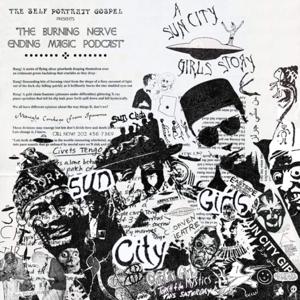


The year was 1978 at CMU in Mount Pleasant, MI, the U.S. was in a period of "Deep Standby" after the end of the horredndous Vietnam War in 1975, there was the Jonestown Massacre, the beginning of the Iranian revolution, and a historic blizzard that took place in January, which caused over 20 deaths, 100,000 cars to be abandoned on highways, prompting President Carter to declare a disaster area, forcing CMU to close for the first time in 140 years. It was also the same year that Cheech and Chong's subliminal stoner classic Up in Smoke took over drive-ins all across America, as well as Halloween, Bob Dylan's Street Legal, and the same year Charlie Chaplin's remains were stolen from Corsier-sur-Vevey, Switzerland.
But within those school walls, a couple of teenagers shared a dorm room, a hall, and became fast friends theough the prophetic power of music. Roommates Scott Mansfield, Bob Thomas, Alan Bishop, and their neighbor Jim Genette quickly connected and began jamming in the cosmic confines of their sonic space, where time seemed like an illusion and the future burned brighter than a UFO parallel-parking on 1200 S. Franklin St. On this episode, we chat with Mansfield, who had the pleasure and honor of witnessing a young Alan Bishop learn how to play the guitar, Thomas, and his son, Joe, who interviewed Bishop some forty years later for a college project, about their critical connection to a preexisting world that had not yet been influenced by the Sun City Girls, and their metaphysical magic. As we near the end of season two, join us on for this epic expedition into the Salad Days, where the Dire Straits, Bob Dylan, Farrah Fawcett, and anti-draft rallies helped pave the way for our spiritual story to begin.
Ian Folke Svenonius is a multi-instrumentalist, author, filmmaker, and host of the acclaimed web video series Soft Focus in the late 2000s. A legend in the Washington, DC, punk/hardcore movement that shaped the radiating subconscious of the American youth during Regan's destructive reign in the 1980s, Svenonius has lead groups like the mighty Dischord Records' band The Nation of Ulysses, Weird War, XYZ, and his most recent outfit, Escape-ism, whose album "Charge of the Love Brigade," was released last year with radical reception.
Where Svenonius comes into the fractalated fold of the Sun City Girls' legendary lore is the mighty interview he conducted with the Bishops in November 2008, not long after Charlie had passed the previous winter. Taped before a live audience at Cobb's Comedy Club in San Francisco's North Beach neighborhood, the three, along with a mysteriously masked Mark Gergis, whose piercing presence remained frozen like a statue, set off on a dystopian dialogue through the tonal trenches and spiritual side streets of two of the most celebrated artists of their time.
Campisano has an incredibly interesting relationship and a cosmic connection to the Sun City Girls and its members, in particular, the late, great Charles Gocher. While attending Arizona State University (ASU) in the 1980s, she received a Bachelor of Fine Arts in Photography, but not without its creative challenges. Many may not know this, but Gocher worked in the school cafeteria through Marriott Hotles, and would often pull "pranks" on the more deserving students, but not Campisano! Often seen in the library or lounge area, hidden behind a spiritual smoke screen from his esoteric exhales, reading various books on jazz, art, etc.
Gocher gave alchemical advise to the young student, and it had nothing to do with going to school to be an artist. All the tools we need to achieve the essence of expression are available all around us, and that's exactly what Campisano has done with her career. Having captured some of the most subliminal shots of the band over the years, Campisano's photography and participation in the scene are critical to the culture and the electrifying energy that birthed the Girls, and several others. While music holds the merciless magic of the human spirit, it's the photos that freeze everything in time, safe from sickness and death, and the reaper that patirently waits.
On this episode, we speak to local legend, engineer, musician, and founder of Tempest Recording, Clarke Rigsby, who knew the band before their prolific output of metaphysical material in the 1980s with the Cloaven Tape series. With the release of the legendary compilation "Ominous Clouds - Produced For Citizens For A Non-Nuclear Future", which featured the Sun City Girls' first vinyl appearance, at the time, when the group was a quartet with LInda Cushma, as well as local groups like Hans Olson, who founded the influential Sun Club in Tempe, Jamaican-based blues singer Big Pete Pearson, Pete Cannon, who played in Poet's Corner, and Rigsby himself, we virtually travel 1,708 miles across country to better understand the genesis of the band, and their heroic history.
Before the highly influential and groundbreaking "Riot Grrrl" movement began taking shape in the 1990s, with bands like Bikini Kill and Bratmobile, empowering women in music and the arts, there was the Phoenix, Arizona-based trio Burning Bush out in the desert, laying the groundwork for perhaps one of the most important periods in the American underground scene at the time. Featuring members Audrey Creed (drums), Denise Tanguay (bass, vocals), and our most recent guest, Thomascyne Buckley (guitar, vocals), the band's music symbolized a giant fist made of creative concrete that punched through the fake shiny veneers of the system that led with a crooked smile during the pungent politics that riddled the 1980s. Like most of the groups coming out of the Tempe/Phoenix scene at the time, Burning Bush were one of the many that coexisted alongside the Sun City Girls, as each of their electrifying ethos cut through the existentialism of life, and exposed the beauty of community connection, and creative freedom.
Several groups come to mind when reflecting on the sonic scene of Tempe/Phoenix, Arizona, throughout the 1980s. While surfing across the spiritual surface of the desert, and its dry destinations into the vibrant void, one can still hear the staticky screams of Mighty Sphincter, Poet's Corner, Joke Flower, Killer Pussy, J.F.A., or course, the Sun City Girls, and the brother-led trio the Meat Puppets. Consisting of members Curt and Cris Kirkwood and Derrick Bostrom, our most recent guest on the podcast, the group was born from the anarchist ashes of Atomic Bomb Club before its melodic metamorphosis into the Meat Puppets, which has since become a household name amongst the underground community and mainstream over the last four decades.
The Puppets and Girls' psychedelic paths crossed many times over the years, sharing the same bill at local venues like Mad Gardens, Whiskers West, Vivians, Merlins during the rare sighting of Paris 1942, as well as appearing together on the infamous comp "Amuck". Still, it's their shared memories and liberating legacy that bind them together within the harmonious history of the local scene, and beyond, and Bostrom is here to share a few of those ancient anecdotes of a time that has long since passed.
Depending on when you where born, most people know exactly where they were, who they were with, and if it was on a school night, or not when Fugazi's "Repeater" was released, or "Facelift" by Alice In Chains, "Goo" by Sonic Youth, "People's Instinctive Travels and The Paths Of Rhythm" by A Tribe Called Quest in 1991, and rightfully so. These are just a just a few academic artifacts of a decade that was shifting significantly from the underground into the mainstream, and there was nothing you could do to stop it. But do you remember where you were, who you were with, and if it was on a school night, or not when the Tempe/Arizona-based group the Sun City Girls released their mythical masterpiece "Torch of the Mystics"?
This week's guest, James Toth (Wooden Wand), does, and he's here to tell all. Having been a sonic staple in the New Weird America movement from the late 1990s and early 2000s, it was here that this culturally captivating climate influenced several artists, who were undoubtedly touched but the Girls' metaphysical magic. Toth recently wrote the lucid liner notes for the archival release of Paris 1942's "Birds in Their Cages" on Superior Viaduct back in the November, and with Three Lobed Recordings graciously deciding to continue carrying the tonal torch that Eclipse Records left off with releasing the steady flow of SCG's cosmic Cloaven Tape series on vinyl in the early 2000s with "Famous Asthma / Tibetan Jazz 666", and "Extra-Sensory Defection / Graverobbing in the Future" back in July. Their spirit is more alive than ever, and Toth helps us catch up on a few missed calls from beyond the Rig Veda.
Jeff Jones's all-around philosophy of music would forever change once he relocated to Arizona to attend ASU in the late 1970s. Coming from a more traditional atmosphere that approached music parallel to its time, Jones began to infiltrate the local scene in search of like-minded people to connect with. Not only would he be creatively challenged, but his spiritual senses would be harmoniously heightened when he first met the late great Charlie Gocher after an epic duo set of drums and saxophone, which, to this day, you have to imagine the extraterrestrial energy in that room as a freakish fly that has landed on a slice of stale pizza.
Eventually, the Sun City Girls' infamous short-lived quintet era was born, which featured multi-instrumentalist/vocalist Linda Cushma, Joe "Stage" Musico on drums (later replaced by Gocher), and Jones on sax. What would become the band's first-ever vinyl appearance on the legendary compilation "Ominous Clouds: Produced For Citizens For A Non-Nuclear Future," which also featured local legends Clarke Rigsby, and Hans Olson, who founded the influential Sun Club in Tempe, the group would later slim down to its mind-altering trio, and the rest is history!
During the summer of 1990 (we discovered later after recording), a Minneapolis-based radio DJ (KAFI), artist, and musician by the name of Patti Walsh, shared an unforgettable season of spirituality, laughter, madness, and epic travel with the Sun City Girls as the "unlicensed" bus driver for the band's tour with the City of Lakes-based female rockers of political power, The Pseudonymphs. Both groups shared similarities, with each having sibilings in their lineups; they also had the same booking agent at the time, Peter Davis (another discovery later corrected). These cosmic coincidences weren't some meaningless detail that haphazardly appeared later down the road in life. These were details that would later behind memories of blissful youth, and creative chaos. Join us as we ride shotgun in a buckless seat as Walsh takes us on a journey through New Haven, CT, Boston, and Worchester, on an epic expedition whose destination is still in question.
To kick off a brand new season, we decided to go back to the very beginning, where it all started, and catch up with Paris 1942's Jesse Scrogoncik to talk a little bit more about Moe's legacy and the integral role she not only had in the band's short-lived history but also for the revolution of women in music everywhere over the last half century. Even though the group only played four shows, they dedicated a great deal of time to capturing several recordings and esoteric evidence of the metaphysical magic that makes up the band's creative, cosmic core, which can still be heard in countless canyons and calcified caves around the world.
While entertaining the Gods of improve, Paris 1942 isn't just the humble beginnings of the Sun City Girls, but a sonic staple in the importance of the decade's radical reaction to the world around them. With the release of the band's archival material "Birds in Their Cages" on Superior Viaduct, as well as a souped-up compilation via the group's legendary self-titled debut, the band has come full cirlce, while simultaneously occupying a special space in people's subconscious after all these years.
From the publisher's feed