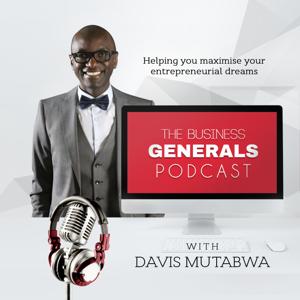
The Business Generals Podcast | Helping You Maximize Your Entrepreneurial Dreams - Every Single Week

The Business Generals Podcast | Helping You Maximize Your Entrepreneurial Dreams - Every Single Week

Download on the App Store

The Business Generals Podcast | Helping You Maximize Your Entrepreneurial Dreams - Every Single Week episodes

  • 079: How to Start a Full-time Online Business with Zero Startup Capital (w/ Daniel Scott)
    Daniel Walter Scott is a certified Adobe instructor (ICE) in Ireland, an Adobe Certified Expert (ACE) and he completed the Adobe Certified Associate training (ACA). He has been teaching for more than 14 years and is the founder of Bring Your Own Laptop (BYOL), an Adobe Certified Training Centre in Ireland, New Zealand, Australia and online.
    He has over 16,000 students on the Udemy platform with over 1,000 reviews and over 16 courses.
    Period in full-time business
    He had always been doing little businesses on the side in his evenings and weekends, but he went into it full-time business in 2009.
    Core revenue streams
    He has two main streams that are both based on training. One is a sit-down classroom where people book a course, come in and learn from an instructor. He has such training centres in Australia and Ireland.
    His other stream is online video training on Udemy and other platforms.
    Starting out in business
    Daniel used to work for other people but he was always curious about doing it for himself and when he decided to move from the UK to New Zealand, he also decided to start an online business. He started by building a sit-down classroom courses website and promoting it through SEO. He had to borrow some money from his grandmother to cater for his personal expenses so he could focus on building the website and getting customers.
    Getting the first set of clients
    He got his first customers through search engine optimization (SEO). He learnt everything he could about SEO because he wasn’t a good salesman so he needed the website to do the selling for him. Through that, his website ranked well and because there were people looking for courses, he was able to get customers.
    Working with zero budget
    Daniel says the one crucial thing he did that can work for anyone now, is content marketing. He says content marketing offers the best value for money. He makes his content in form of videos and in the beginning he used to write a lot of blog posts about his work. It was easy and free for him to do it because he wrote them himself.
    Number of videos
    At the beginning, he used to write a lot of blog posts and then he did one or two videos a month as a test. When the videos started doing well, he narrowed his content marketing down to videos.
    He says if he could get a do-over, he would have focused on videos from the very beginning, because progress on getting the website ranked would have taken place ten times faster. He says the content marketing through blog posts was very slow.
    Growth strategy at the beginning
    The sit-down classroom courses were more locally targeted so he worked with local businesses like blogs that existed around what he did. He also used to reach out to companies that complimented his work, to see whether he could do free stuff with them. That was the easiest way for him to market the business since it was targeting the local market.
    Tip: If you have something local, you have to focus your marketing (including SEO) on the local market
    The fundamentals that worked
    He says some of the things that really worked for him that can work for a local business include Google local listings (now known as Google Places, Goog Business, or Google Local) which get a business on a map that easily puts a business on top of searches for local products. The other thing, he says, is finding other websites that are linked to the business one is doing (these are mostly professional listings)
    Other things that may take some time and effort include relationship building with other businesses, going to conferences and meet-ups organized by businesses that are related to what one does. That way, one gets clients through word of mouth and referrals.
    Adobe certification
    He says being Adobe certified and having his training centre certified by Adobe, is very helpful.
    53 min
  • 078: LinkedIn Strategies to Generate Free Leads & Quickly Grow an Email List (w/ Nathanial Bibby)
    Nathanial Bibby is the founder of Bibby Consulting Group, a Melbourne Consulting Group. He is a leading Digital Marketing Strategist, LinkedIn Coach and Social Media Speaker. He is also the founder of Linkedinsider, the world’s leading online LinkedIn training course, and a Founding Trainer at the Australian Digital Marketing Institute (ADMi). 
    With over 12 years of Digital Marketing experience, Nathanial has been at the forefront of the information age. During his career, he has helped 4,000+ businesses throughout Australia and South East Asia gain a competitive edge through effective business growth strategies.  
    Core revenue streams 
    His core revenue stream is LinkedIn Lead Generation which is a very unique service that cannot be found easily advertised in marketing. They usually have to first educate people about it before they introduce it. Once they train people on LinkedIn, they also offer them the lead generation service.    
    Period in full time business and starting out 
    He has been in full-time business for about 4 years. He started out the day he quit his job and things had gotten really difficult financially, because he was being evicted, and hadn’t paid his bills, the power in his apartment had even been switched off. He found a way to get power to his apartment and sat down to write his business plan. The next day, he started making phone calls and one of the people he called was a real estate agency that he convinced to let him pitch on how he help their real estate agents to invest in their brand.  
    The real estate agents gathered in their conference area and Nathanial pitched a real estate personal branding make-up product that included a one page real estate website. Nathanial was charging $2,500 for the product and 8 of them signed up, with 6 of them paying on the spot. That totalled $15,000 and it enabled him to get freelancers to build 6 websites, 6 Facebook pages, and 6 LinkedIn profiles. He paid $300 for each of the 6 which totalled $1,800. The money enabled him to get out of his financial problems. 
    He still didn’t know what he would specialise in, but he later got an opportunity to sponsor an event for his friend and business coach. At the event, his friend thanked him for being a sponsor and introduced him as a LinkedIn Specialist who could people with their LinkedIn profiles. There were 100 people at the event, and at the end, 30 to 40 people went up to him wanting to have a one-on-one meeting. That was when he decided to specialize in LinkedIn Marketing. 
    Deciding to become an entrepreneur 
    He remembers that when he started out, he did it because he had no choice since he could not find assistance from anyone to deal with his financial woes. He was so desperate but got immediately motivated when he decided to start working on his business plan. He knew that he had to go straight to the customers, to the market, without even having any marketing material and systems in place. 
    Niching 
    The fact that he specializes in LinkedIn when there are very few people specializing in it, enables him to get clients constantly. Whenever people are organizing conferences on social media and digital marketing, they always want an expert on LinkedIn and when they search on Google, Nathanial’s service always comes up at the top of the search results. He gets called to speak at different events and interviews. His company has become an industry leader on LinkedIn and he also gets invited to speak on social media at different events. 
    Generating leads on LinkedIn 
    He says it’s easier to help a B2B (business-to-business) company but when dealing with a B2C (business-to-consumer) company, he has to ask them a few questions about their target marketing and how they get clients. Normally, LinkedIn marketing works better if a B2C business has business partners or distributors. He says smaller businesses that desire to sell directly to customers...
    35 min
  • 077: Five Things Redundancy and Social Welfare Taught Me (w/ Davis Mutabwa)
    Here are the FIVE things I learnt that may be helpful for you or a friend you know maybe experiencing one of these “out of body” experiences:

    * Being on Social Welfare Is Not Fun
    * I Should Have started Preparing Sooner
    * Have an Open Mind – Find a Coach and Model them
    * Consider Taking a Pay Cut – Get Back in the Game
    * Find a Plan-B Option that Works for YOU 

    Personal Lesson
    I remember it like yesterday, started just like any other Friday: drive down the freeway, get to work have my marmalade-on-toast, and work on completing the financial statements for publishing to the market the following week. At 4pm everything changed, I got the call to the CFO’s office, Legal Counsel also present, felt the situation was a little bit unusual, and sure enough I had been made redundant. I can still feel the shock of the reality of the feeling, very humbling, had until 5.30pm to make my way out.
    I wasn’t bitter or disappointed in the people that had hired me to be their Finance Manager. I knew the company was struggling and that the shareholders were putting pressure on the executive team, but there was so much going on, I didn’t expect it that day.
    I got back to my office and made the call to my wife telling her I was out of a job. Like a lot of people we didn’t have any Plan-b whatsoever – we were “all or nothing” – single income family with a mortgage, scary. It was a real blessing for us in a sense though, that we had literally just sold our home and so all the gains made on the home became our day to day income, this was only meant to be for a very short while. But soon enough, it became clear that the world was going through the global financial crisis, this was September 2009. Recruiters were not returning phone calls, people were not leaving their jobs. There was zero happening for 6 months straight, not one interview!
    The FIVE things I learnt

    * Being on Social Welfare Is Not Fun

    I had no idea where the nearest welfare office was and didn’t even understand how the whole system worked. I quickly found out that it does provide a safety net for families but doesn’t do more than maybe pay the rent. It didn’t cover the car payment so driving our once ‘fancy’ German car that at the time had another party listed on title i.e. bank, was no longer fun. I now had to drive carefully each night and be on the lookout for any suspicious looking cars near our house, make sure it’s not the sheriff!
    My advice: You don’t want to be on welfare.

    * I Should Have Started Preparing Sooner

    The social welfare system will not help you professionally get back into a good role – things may have changed now, yes the teams assigned to you will help you write up a resume and prepare you for an interview but in my experience they kind of didn’t even do that – just had to tick the boxes and show up each fortnight.
    Tip 1: Don’t leave it too late to have a Plan-B action plan. It took me 6 months to just get a contract role.
    Tip 2: Think about whether your savings can last you long and If not, then start putting a robust savings plan together or better still a Plan-B income source for you and your family.

    * Have an Open Mind: Find a Coach and Model them

    In November 2008, my wife and I attended a real estate coaching seminar, the concept was residential property sub-leasing – we had never heard of this approach to generating cash flow, it sounded interesting but life got in the way and never did anything with it. Immediately following my redundancy, we decided to hire the sub-leasing coach and invested over $10,000 from the sale of our home to kick this project off and this was our first venture as business owners. We operated this for about two and a half years running about 30 rental rooms in 3 large furnished properties mainly catering for the student...
    29 min
  • 076: How to Become a TEDx Speaker, Creating Your Big Talk and High Speaker Fees (w/ Tricia Brouk)
    Tricia Brouk is a performance expert, TEDx organizer, writer, director, choreographer, podcast host, and producer of theatre, TV and film. She hosts The Big Talk, a podcast series on iTunes and currently directs and dramaturges Big Talks and Keynotes. She is the current organizer of TEDxLincolnSquare – Risk Takers and Change Makers. 
    She has produced, directed or choreographed several award-winning theatre and TV/Film productions. Through her company, The Big Talk, she helps people identify, craft and deliver a life-changing Big Talk or Keynote. 
    Period in full time business and business background 
    She has owned a company for over 26 years. She moved to New York City from Missouri to pursue a dance career and had no interest in being a starving artist. She started Brouk Moves, an elite in-home personal training company where she hired people to work for her so that she could still make money even when she was on the road. The company has been going strong, has 15 trainers, 25 clients and recently started a personal chef service. The business has enabled her to pursue a creative life outside of business and also given her the opportunity to create a new business, The Big Talk. 
    Brouk Moves has been her primary income for the last 26 years and has enabled her to pay all her bills, avoid the life of a starving artist and produce theatre. Her team works on the business full time so she can have time to pursue other things. 
    Starving artists 
    She says she sees this a lot in the industry and she has observed that artists feel unworthy of making money, because when they make money they then feel that they are selling out, and that they are not truly artists. 
    She says artists deserve to be paid for what they are worth, to have money and create art simultaneously. 
    Tip: You are not giving up your artist soul by taking a big fat pay check 
    First gig 
    In her first big European tour, she got a weekly pay check to do what she loves including touring, dancing, and being a full time artist. That was while Brouk Moves was still bringing in money because her team was doing all the work. That when she knew she could make a living as an artist in the long term while also making a living as a business woman. 
    Tip: Once you pursue and achieve what your goal is, do not let go of that business! Do not think that you have to choose. You can maintain them both equally 
    Getting into entrepreneurship 
    She decided early on that she would live the way she wanted without being poor or waiting for gigs to find her. She is proactive, mindful and kind in the way she runs her business. Her trainers take time off whenever they want and the rest sub for them. 
    Tip 1: Stop waiting for that big artist contract, start creating your art, start creating your business, because if you wait for someone else to do it for you, you will spend your entire life waiting. 
    Tip 2: Get busy, create art no matter where it is, no matter what it is. Keep your artist muscle flexing and find a way to make money on your own terms 
    The first months in the fitness business 
    She started by working very hard and personally training all the clients she had. She used to wake up at 4.30am and would do the client training while also dancing and performing. Once she realised that she could hire a team to take on some of the work, she created a system where she could always be involved but didn’t need to be there. That enabled her to reduce her commutes, and her time was spent doing other things. When she hired other people, she had to trust them, let go, and make sure that she put systems in place to ensure the business would run efficiently. 
    Tip 1: If you are starting up, you have to dig in, roll up your sleeves and do the work 
    Tip 2: When starting out, you have to create a solid foundation first, then you can back off and do the other things that you want to do 

    55 min
  • 075: Five Key Benefits of a Home Based Business (w/ Davis Mutabwa)
    As corporate downsizing continues to make news and the internet makes telecommuting ever more productive more and more entrepreneurs are discovering the benefits of running businesses out of their homes. If you are looking to get out of the rat race, to spend more time with family and friends, and to live a more balanced life, a home-based business may be the right decision for you.
    Home-based businesses are quickly becoming the fastest growing form of business start-ups. Growing your business out of your home allows for flexibility that is difficult when renting or buying office and warehouse space. Although
    working at home requires self-discipline, the benefits can be substantial-especially in the start-up years.
    Starting a Home-Based Business
    Nearly one million Australians are running a business from home according to the Australian government. Forbes reported that home-based businesses were quickly becoming the fastest growing form of business start-ups. With a slowing global economy this statistic can only be expected to grow.
    Benefits of starting a Home-Based business out of your home
    There are many benefits and each would appeal to you differently but here are my top five that I find to be key:
    1. Ownership – Yours to build and grow
    2. Flexibility – No commute and freedom to structure your working hours
    3. Taxation – Put simply…the system favours business ownership
    4. Low Overheads – Investment can be low, no large office lease expenses
    5. Leverage – Ability to leverage your efforts and scale up
    Personal lesson
    My late dad was an Accountant – I took after him, he worked long and hard for over 20 years in senior management for a Swedish ball bearing manufacturer. I got back home from boarding school one summer, and dad sat me and my older brother down to let us know that he had been “let go”.
    Life quickly changed in a space of 6 months – moved out of the company house, no company car, no driver and no more executive perks.
    It became clear that though dad had a great job employment by nature generally does not provide any “business equity” – he got paid his redundancy package (maybe a year’s salary) and that was it, back to the drawing board…which was starting a home based consultancy business in accounting.
    This was my first encounter with the difference between business ownership and employment. You get to make your own conclusions here as to how you would respond to such a situation…I have shared in Episode 077: Five Things Redundancy Social Welfare Taught Me, how social welfare became an unwanted reality for me and my wife a few years ago when we went through the same scenario
    The 5 key benefits of starting a home-based business
    1. Ownership – Yours to build and grow
    Building a business means that you will be building equity for you and your family, if you work it right; and even if it takes you say 20 years to really get it established, that is just under half of your working life, you can build a substantial enterprise that is willable, saleable and transferable.
    The best time to start is while you are at the peak of your career which for most people is right now, start from your home and grow it from there – don’t just focus on building equity in your home, build some business equity as well.
    2. Flexibility – No commute and structure your working hours.
    A colleague said to me she spent about 2 hours last week getting home because there were two accidents on the major roads during peak hour…that’s happened to me several times before!
    The ABC reported that Australians on average spend close to an hour each day on the daily commute to and from work. A Gallup survey reported the same for the average American commute.
    20 min
  • 074: How He Launched a Speaking Career Through a Daily Sales Blog (w/ Anthony Iannarino)
    Anthony Iannarino is an international speaker, bestselling author, sales leader, and entrepreneur. He specializes in the complex business-to-business (B2B) sale. He is also a founder and managing partner of two closely-held, family-owned businesses in the staffing industry, leading both entities in strategic planning while growing sales.
    Anthony is best known for his work at The Sales Blog, which has helped him gain recognition as a top thought leader in sales strategy. He is the designer of Level 4 Value Creation and Building Consensus methodologies that help sales organizations achieve transformational, breakthrough results.
    Period in full time business
    He has been in full time for 10 years now.
    Core revenue streams
    Anthony has very diverse revenue streams. He still has a role in their family’s staffing business and he is a partner in another one of the family businesses. He just started an accounting and finance group (specialised in staffing) where he is a partner. He is also a speaker, coach, consultant and an author.
    He says he believes that we are in the age of constant accelerating disruptive change which keeps coming faster and is more disruptive especially for business people.
    The speaking, coaching and consulting revenue stream makes up about 75% of his overall income.
    Tip 1: You shouldn’t give up any revenue streams, you should have multiple revenues streams going at one time
    Tip 2: You should really think deeply about how you can create additional revenue streams
    Starting out in business
    Anthony used to run their small family business of about $3 Million a year, and with about 6 sales people, he built it up to $50 Million a year. That got the attention of many people who wanted to know how he achieved so much with such a small team. That business was a competitive displacement business which took big companies away from big competitors. People wanted him to help them in that same way but Anthony wasn’t interested until at some point when he felt that he could something to help people succeed in building and growing their businesses.
    So he started waking up an hour earlier than he used to every day, to write down everything he knew, and publishing it on his new blog. His goal at that point was to become a keynote speaker within a year. He worked very hard on building awareness on what he did and within 10 months, he got his first speaking gig.
    In those 10 months, he used to get a lot of inspiration from Seth Godin, and he applied what he learnt from him in his own work. Overtime, he got introduced to a group of people who had a sales content sharing group. That sharing ended up amplifying all of their messages.
    Tip 1: Because of the internet, as an entrepreneur, you have audiences worldwide and they are looking for you. Google will help them find you provided that you publish your best ideas, and people can tell how you create value and what you are all about
    Tip 2: One of the things that entrepreneurs struggle with when it comes to sales and marketing is the consistency of doing the work every single day
    Motivation during the first 10 months of the blog
    Anthony knew that the idea for the blog would work because the statistics were good and kept growing. He had confidence, faith and was willing to play the long game with the blog while building a body of work. He started by getting 7 people reading his blog posts up to the current 2,500 readers that visit the blog per day. On Mondays, the number goes up to 4,000.
    Tip 1: Stay with what you are doing for a long enough time that it actually sticks and you will get some traction. A lot of people give up right before that point where they get the traction because they start to worry it’s not going to work
    Tip 2: You just have to continually do the work and it will pay off, but it does take longer than you think
    52 min
  • 073: Helping Entrepreneurs Become Champions (w/ Nicky Billou)
    Nicky Billou is the No. 1 International Best-Selling Author of the book Finish Line Thinking: How To Think & Win Like A Champion. He is also the co-host of the No. 1 Podcast in the world for thought leaders called The Business Of Thought Leadership. His guests on the podcast have been the likes of Seth Godin, Barbara Corcoran, George Ross, Jen Widerstrom, Tony Hawk, Larry Winget, and Marie Forleo.  
    As an Accountability Coach at Finish Line Thinking, He energizes people to be their best selves. He works with entrepreneurs and professional sales people (top real estate agents, insurance brokers, financial advisors and sales people for top organizations) who want to be held accountable for producing top results. He offers a unique system that teaches people how to Think & Win Like a Champion when it comes to achieving goals. 
    Starting out 
    He worked for different technology and telecommunications companies, but the corporate world was not for him, because he felt that something was missing and every day he felt he wasn’t living according to his purpose. He eventually decided to start his own business, and because he did it alone, his success plateaued at some point. Luckily, he found the right mentor who taught him what he needed to succeed in the long term. 
    Leaving corporate 
    Nicky left his last job when the last company he used to work for went under. While other people were finding it hard to get a job, he got into consulting, but he went through a lot of years being stuck in the journey of being a business owner. It wasn’t until he started to see what his expertise was, that he was able to turn that into success. 
    He says the stages of the thought leader’s business journey are: 
    Stage 1: Being a new comer – this is for people thinking about getting into business or just getting started in business. They have no real experience owning their own business. They are not skilled at marketing and selling what they are offering, and they have no business systems. At this stage one is lucky to make any money at all. It’s a dangerous stage because if one doesn’t get passed it, they may need to get back to their corporate job. People in this stage make between $5,000 and $10,000 a year. 
    Stage 2: An unconscious expert – This is someone who has expertise but they are not clear what their expertise is. They have some systems in place but they are stuck in an obsolete time for money business model. Their sales are inconsistent because their marketing works sometimes, not all the time. They have lumpy billings and make between $30,000 and $50,000 a year. 
    Stage 3: Conscious Expert – Those in this stage have their message nailed which results in consistent marketing and more predicable sales. The challenge with this stage, is that one has to work lots of hours under a time for money business model which is not sustainable. They make between $150,000 and $300,000 a year. 
    Stage 4: Thought Leader – At this stage, one has arrived and they are making between $500,000 and $3 Million a year. It’s not about time for money, it’s about getting paid based on one’s expertise. One works between 50 and 150 days a year doing what they love, with the best clients of their choice. Very few get to this stage. 
    Nicky says there is a final stage called the Celebrity Thought Leader Stage, which is the stage for people like Tony Robbins, Gary Vaynerchuk, and Robin Sharma who are global iconic figures. They make between $5 Million and $100+ Million a year. They work whenever they want and they can work a little or a lot. They are sort after by the top business/industry leaders in the world and celebrities. They get to charge whatever they want and their impact is global. The challenge is, very few people get to be in this stage. 
    34 min
  • 072: USA Memory Champion – Turning Your Passion into Your Business (w/Nelson Dellis)
    Nelson Dellis is memory athlete, mnemonist (able to remember and recall unusually long lists of data such as unfamiliar names, list of numbers, and others), public speaker, and consultant. He is a four-time USA Memory Champion and the co-founder of Memory League, a new type of competitive memory platform that allows memory enthusiasts to challenge each other online.
    He is also the founder of Climb for Memory through which he preaches a lifestyle that combines both mental and physical fitness with proper diet and social involvement.
    HELP OUT in the endeavour to find a cure for Alzheimer’s by taking The Extreme Memory Challenge, a short, easy memory test online. It’s poised to be one of the largest long-term memory studies ever conducted. Just go to www.extremememorychallenge.com
    Becoming a memory enthusiast
    His grandmother died of Alzheimer’s in 2009 and that made Nelson develop an interest in memory. He saw how her mind slipped away and didn’t want the same thing to happen to him. From his research on memory, he discovered the US Memory Championship which to his surprise included average people who had just learnt some memory techniques and practised. That’s when he realised that memory was a skill like any other and from there he started off on his journey towards becoming a memory champion.
    Climb for Memory: Research on Alzheimer’s
    He says the current research is not clear on whether or not keeping the brain active deters Alzheimer’s. Some researchers say it doesn’t while others say it does. Nelson is a believer that keeping the brain active makes a big difference, judging from his own experience with his memory transformation.
    Core revenue streams
    He says it’s hard to define his business because his revenue sources have not always been clear. He is not much of a business guy. He started doing memory as a business when he found that he had won a few memory championships, had gotten a lot of media attention and was receiving a lot of requests for speaking engagements and different appearances. He used to work in coding and physics as a career but he decided to leave it behind.
    The majority of his revenues come from speaking engagements, doing different memory-related events, spokesperson deals, and other memory-related projects.
    Leaving the normal job
    He loved his formal job in the corporate world but when he started doing the memory-related projects, he had a hard time managing both. When he got an offer to do a memory event sponsored by a certain company, the head of marketing of that company approached him after the event, and asked him to work with them on a long-term basis. For Nelson to take their offer and focus entirely on memory-related work under their endorsement, they agreed to pay him the same amount he was getting as a salary at his job.
    Getting to the point of winning competitions
    He had to put in a lot of hard work to become a memory champion and it was easy because he was very passionate about it. He loved the whole process of memorization. He wanted to be the best, so he spent as much time as possible training his memory.
    He started getting serious about it in the summer of 2009 when his grandmother passed away. He entered into the first competition in March 2010 and came in 3rd place which was commendable considering it was his first time. That inspired him to train more seriously, and in 2011, he won the competition. He used to train every day after work for at least 2 hours. He says he also used to memorize numbers and cards while at work.
    Two ways to catapult memory retention skills
    He says one way is to pay attention which includes focusing on one thing at time and not multitasking. Since the brain is not good at memorizing abstract things like numbers, names or directions, the second way is to turn those things by association into pictures (visual imagery in the mind).
    50 min
  • 071: How to Sell 100+ Online Courses a Day as an Instructor on Udemy (w/ Mike Wheeler)
    Mike Wheeler is the founder of Mike Wheeler Media which provides Salesforce training, consulting and development services worldwide. Mike creates the course curriculum and provides training for users and those seeking to become certified on the Salesforce platform.
    He is also a world-class online trainer and instructor with over 27,000 students, over 9 courses and over 7,600 reviews on the Udemy online training platform.
    Period in full-time business
    He has been doing his own business since 2001 before which he used to do technical writing, training and curriculum development. He also supplements what he does with the business with some consulting work.
    Core revenue streams
    One of his primary revenue streams are his online courses on the Udemy platform. He says he has had sales on the platform every single day since he started offering his courses there. He also makes money from Salesforce consulting and development engagements.
    Starting out in the business
    Mike had a long career in the corporate world doing technical writing for different software companies. That work led him more towards contract work, but he says he had a few stints as an employee. He would always go in at the end of a project to write manuals. That was back when the internet was still new. The contracts would typically be 6 to 9 month engagements with different companies. He would basically go where the work was.
    Getting into Salesforce
    Mike encountered Salesforce in 2008 when he was doing technical writing and SEO (Search Engine Optimization) to better rank his technical writing services on Google. He then started getting into WordPress for websites and building his own websites. While building a website for a client, he was asked for a web delete form on Salesforce and he did it but as he was offering the website development services, he realised that Salesforce was becoming more and more popular in the market, so he decided to train more on it.
    One day, in 2011, while in a Barnes and Nobles book store, he came across a book on Salesforce development, read it and felt like he had what it took to go into the Salesforce platform professionally.
    Salesforce
    Mike says it’s a web-based or cloud-based platform that one can use and customize to fit any business or process. It can be used for marketing, sales and customer service. It can be used by any business, in any industry, and is customized through clicks instead of code, though a person can also use code if they want to.
    Salesforce is best known for the fact that it can be customized to meet the marketing, sales and service needs of any business. For example, a business owner can use Salesforce to replace Legacy systems, spreadsheets and many other processes/systems. Mike says Salesforce was one of the pioneers of cloud computing and SaaS business.
    Knowing the Salesforce business would work
    After learning Salesforce, he needed to use it in practice, so while still working as a technical writer he got more involved with Salesforce related work which enabled him to build on his expertise.
    Going into Salesforce training services
    As he was learning Saleforce, getting certified and seeking his first job as a Salesforce developer, he started to develop an interest in sharing the value of Salesforce with anyone who was seeking it as an attainable path to a cloud-based career. For several years, he thought he would blog about Salesforce or develop his own online help system, but he realised that it would be a big time commitment and hard to monetize. He ended up developing Salesforce-based online courses and teaching on Udemy. He came across Udemy when a friend referred him to a sale Udemy was holding for their courses.
    Mike really liked the Udemy business model which enables people to buy a course and keep it for life. He ended up buying more than 20 courses for everything he would be interested in...
    1 hr 6 min
  • 070: Converting Your Ideas and Giftings into Wealth and Your Wealth into Significance – Part 2 (w/ Davis Mutabwa)
    I am excited to have you join me in this solo episode which is actually a workshop I hosted for a over 50 entrepreneurs. It’s a relaxed yet entertaining training environment where I walk you through a couple of key concepts that have helped shape my mindset towards business over the last 20 years.
    Listen in and find out:

    * What your 2 missions in life should be?
    * The keys steps to move you from Idea Stage to Significance
    * Case studies on ideas and giftings that have been executed into global brands today
    * Plus much more

    Listen in to get all the juicy details in this episode on converting your ideas and gifts into wealth and your wealth into significance!.
    Remember to click subscribe on your podcast player so you don’t miss an episode. Access all the links and resources mentioned in the episode at https://www.businessgenerals.com/goals2
    Thanks for tuning in…see you next time!
    Cheers,
    Davis
    #TheBusinessGeneralsPodcast
    48 min

About The Business Generals Podcast | Helping You Maximize Your Entrepreneurial Dreams - Every Single Week

From the publisher's feed

Welcome to another super Episode of The Business Generals Podcast where I help you maximize your business dreams as an entrepreneur in your startup business. every single week I feature amazing guests…