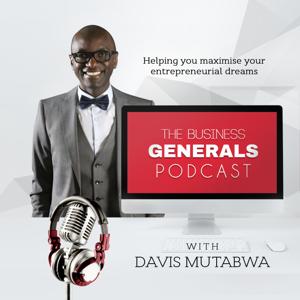
The Business Generals Podcast | Helping You Maximize Your Entrepreneurial Dreams - Every Single Week

The Business Generals Podcast | Helping You Maximize Your Entrepreneurial Dreams - Every Single Week

Download on the App Store

The Business Generals Podcast | Helping You Maximize Your Entrepreneurial Dreams - Every Single Week episodes

  • 039: How to Leverage Innovation, Grow Customer Engagement & Loyalty (w/ Nicholas Webb)
    Dr. Nicholas Webb is one of the world’s top business thought leaders as a senior partner at Lassen Innovation (www.lasseninnovation.com). He works with Fortune 500 companies throughout the world to help them lean their industries in innovation and strategy. He is a Bestselling author who has been awarded over 45 patents for breakthrough technologies including one of the world’s smallest medical implants. He is also the founder and CEO of Cravve (www.whatcustomerscrave.com). He has over 25 years’ experience working with leading brands to solve complex strategic, innovation and customer experiences challenges that drive growth and profit. His clients represent top global brands like FedEx, Pfizer, Blue Cross, Kaiser Permanente, McDonald’s, Gatorade, Dimer Motors Corporation, Johnson & Johnson and Cisco. 
    Nicholas is also one of the world’s Top Keynote Speakers and travels the world speaking on Innovation, Future Trends, Healthcare, Leadership and Customer Experience. 
    Time in full-time business 
    Nick says he hasn’t had a job in over 30 years. He left corporate life in favour of being autonomous. 
    Current Revenue streams 
    He generates his revenue by providing Fortune 500 companies with a diverse range of consultant services related to strategy, innovation and customer experience. He helps them build future ready organizations. 
    He also generates considerable revenue from his speaking business. He will have done 60 to 80 talks around the world in 2017 alone. 
    Tip 1: To be a successful boutique consultant competing with the largest firms in the world, you have to earn the right to serve your target clients. You need to write popular books, speak at all the top conferences, and have your community of fellow thought leaders validate your importance in the thought leader ecosystem. 
    Tip 2: Books are not a money maker but they help to propagate your message and differential view of the universe. 
    Science/Innovation type business 
    Nick invented one of the world’s smallest micro silicone implants for ocular surface disease. He also invented one of the world’s first wearable medical technologies 18 years ago. He is currently working with strategic partners like universities and industrial partners to start building out a disruption lab that will develop connected technologies that will help meet some of the new modern day challenges of healthcare. 
    Starting out in business 
    He used to work as a lifeguard in California when a friend referred him to a new company (STAAR Surgical) that was starting to make the first minimally invasive implant for cataract surgery. His friend needed someone to help market the product so Nick took up the challenge. Before marketing the product, he had to spend several weeks in a lab doing surgery on pigs’ eyes. His experience in that lab intrigued him. Nick did very well in helping them launch the technology and later went on to start his own ophthalmology company through which he worked with a famous refractive surgeon, Dr. Ron Jensen. Together they created a line of breakthrough technologies in the area of refractive surgery. He later sold the company to one of the largest medical companies in the US. 
    He used his experience and expertise from running the ophthalmology company to start providing consulting services to healthcare companies.  
    Initial focus on strategy and innovation 
    Nick used to have a new product development function within his previous business through which they used to develop non-regulated medical devices. Eventually, they choose to concentrate more on helping companies understand the future trajectory of technology and consumerization so the companies can take what they learn and apply it towards improving their revenues, profitability and customer satisfaction. 
    Early inventions 
    Nick was involved with a company in the dry eye...
    55 min
  • 038: How to Generate Recurring Revenue by Productizing Your Service Based Business (w/ Brian Casel)
    Brian Casel is an entrepreneur focused on bootstrapping online businesses that combine software with productized services. Since starting his self-employed career as a professional freelance web designer back in 2008, he has built and later sold web design/SaaS business in 2015. He now runs Audience Ops, a content marketing service focused on helping B2B software companies grow their audience and customer-base. 
    He writes and teaches about entrepreneurship and freelancing through his blog and newsletter at casjam.com. He also creates and sells courses and ebooks there, most notably his course, Productize, which teaches consultants how to build, launch, and grow a productized service business.  
    His work and articles have been featured or published in Mashable, Smashing Magazine, Mixergy, Entrepreneur Magazine, and others. He has spoken at industry conferences such as MicroConf and Double Your Freelancing Conf. He also co-hosts the Bootstrapped Web podcast with Jordan Gal, where they talk behind-the-scenes of bootstrapping their online businesses. 
    Being in full-time business 
    Brian left his last full-time job at a wed design agency in January 2008 which translates to about 9 years in business. He started doing freelance web design while also working on different product ideas that didn’t take off. Started RestaurantEngine in 2011 while still doing other freelance work. Launched RestaurantEngine in 2012 and in 2013 starting working on it full-time till 2015 when he sold it.    
    First product 
    The first product business that Brian worked on was creating Wordpress themes that he would sell as digital downloads. This made him some income every month but he sold the business to someone else in 2015. 
    Inspiration behind leaving formal employment to freelancing then to business 
    While still working at the web design agency, Brian noticed that the company used to hire freelancers occasionally. He realised that the freelancers were making a living from that, which prompted him to learn freelancing through free online resources. In 2008, he decided to start doing freelance work which actually helped him through the economic downturn and gradually led him towards starting his own business. 
    RestaurantEngine idea 
    While building websites for different clients in diverse industries, he realised how difficult it was for small business owners to build and set up their websites even on platforms like Wordpress. That inspired him to create a hosted platform built on top of Wordpress in order to make it easier for business owners to build websites for their businesses. While in the planning process he realised that he could not standardize the platform for all types of businesses so he had to specialize it to one business sector and he settled for the restaurant sector because restaurants always require the same content on their websites like menus, etc. Focusing on one industry/niche made it easier for him to market the product. 
    Going full-time into RestaurantEngine 
    Brian was balancing his freelance work with working on RestaurantEngine for 2 years before he could go full-time into it. He had three people working for him in customer support, one in sales and one in content marketing. He built the site himself and had one developer on-call to support when needed. 
    Determining the viability of the RestaurantEngine idea 
    Brian didn’t know whether the idea would work but it worked out eventually. He had to invest a lot in terms of time, hard work and personal finances in order to build the platform before it even launched and started generating revenue.  
    Tip: Validating a new product idea or business idea before going into it is very important 
    Transition from RestaurantEngine to Audience Ops 
    By the time he was selling RestaurantEngine, he had already started building Audience Ops. The sale closed in June 2015,
    52 min
  • 037: From Developing a Multi-Million Dollar Accounting Software to Helping Businesses Build Successful Software Products (w/ Steven Bristol)
    Steven Bristol co-founded, built, marketed, supported and sold a multi-million dollar SaaS software product called LessAccounting. LessAccounting is an easy-to-use small business-accounting software that allows clients to easily track online invoices and carry out their bookkeeping tasks conveniently.  
    He is also the co-founder of LessEverything, a company that builds software for different clients, creates integrations between products, and improves companies’ conversion rates. His program adventure started as a 9 year old writing BASIC. In the past 28 years he has written many languages, become a Ruby on Rails core contributor, and a 2007 Google Summer of Code Mentor. 
    He is a former motorcycle racer and has gone over 150 miles per hour with his knee on the ground. He is also a proud father of three. 
    Core Revenue streams 
    Steven jointly runs LessEverything, Inc. with his co-founder Allan Branch. They have two revenue streams with the first being offering consulting services to people who want to build successful businesses. He has been applying his talents and 10-year business experience in helping different SaaS products get to market and do better in the market. 
    Their second revenue stream is a business division called LessFilms.com which makes marketing videos for diverse clients. 
    Starting out in business 
    Never wanted to be an entrepreneur because from observing his entrepreneur parents, he felt it was too much work. He never really held a job for long and eventually felt formal employment was not for him. After he left his last job, he partnered up with Allan Branch to start working on LessAccounting. They also started the umbrella company LessEverything, Inc. 
    The viability of LessAccounting 
    He thinks they succeeded with the LessAccounting idea out of sheer arrogance and non-belief in failure. Their bar of success was also very low so they just needed the idea to generate enough money for them to sustain their company’s operations and meet their personal financial obligations.  
    The tech world was not very saturated with similar products back then and therefore it was easier for them to market LessAccounting and secure enough users to generate considerable revenue. 
    Main competitor issues 
    QuickBooks, their biggest competitor, saw them as a threat, and being an established company, they had an upper hand in terms of marketing. With their limited marketing budget, Steven and Allan became the first Twitter trolls. They discovered that majority of the Twitter reviews related to QuickBooks were negative so they created a website called weallhatequickbooks.com to leverage on the negative reviews. 
    Steven believes that QuickBooks used to replicate some of the features on LessAccounting into their product. 
    Getting the first paying clients 
    Steven and Allan had a lot of friends on Twitter who were either in the tech world, offering consulting services or starting their own business. They leveraged on that by tweeting out that they had launched LessAccounting and people immediately signed up for the free trial. At that point, Steven had not even developed the billing code but built it within a month so that they could start charging people to use the software. At first, they had about 4 paying customers and that number grew steadily from month to month. 
    Growth strategy in the beginning 
    Never really had a growth strategy but concentrated more on building LessAccounting. Steven and Allan did consulting work in order to generate enough income to finance the development of LessAccounting. 
    They used a lot of word of mouth by attending conferences to make friends who would recommend them to clients. Steven used to speak at Ruby on Rails/tech conferences globally. That approach proved to be fruitful in terms of marketing. 
    Dealing with the accounting aspect of LessAccounting 
    50 min
  • 036: Helping You Amplify Your Online Reach through Influencer Collaborations (w/ Fabrizio Perrone)
    Fabrizio Perrone is the founder and CEO of Buzzoole, a media platform that helps people become influential online. The 33 year old digital entrepreneur and innovator has been a serial startupper since 2007 and was among the first people in Italy to establish a successful online-based business. Buzzoole operates as a vertical tool for the construction and management of digital PR campaigns. As an influence engine optimization platform, it helps in generating quick, easy and qualitative word of mouth. Buzzoole enables new and established brands plan buzz campaigns with the same ease and speed of an Adwords campaign or Facebook ad, all within a self-service model. Buzzoole main clients and partners include Redbull, Ferrero, MSC Cruises, Henkel, Fastweb, Sammontana, Mailup, Orphea, GroupM, Mec Global, Aegis Media and Be On. 
    Starting out in business 
    Fabrizio knew that he wanted to be in business immediately he left University. While in Ireland, he came across a lot of businesses that would work well in Italy, and one idea in particular stood out to him. In mid-2008, he started an offline events company, the first in Italy to have imported an armoured limousine for hire to different clients. With time, and applying the experience he gained from the offline events industry, he slowly changed the company into a digital PR agency with its first service being viral marketing. The company then evolved into offering other digital PR services. He later sold it to a public company in 2013. His experience with that company formed the basis for his Buzzoole idea. 
    Period in full-time business 
    Fabrizio has been in full-time business for the last 9 years. When he started Buzzoole in mid-2013, he raised his first investor funding at the end of that year. The business grew steadily through 2014 then got another round of funding in year 2015. The company has been growing rapidly and is now establishing offices in different countries. 
    Choosing entrepreneurship Vs. a 9 to 5 job 
    He choose to be an entrepreneur when he discovered from the job interviews he taken, that employment was not for him. The entry-level employment terms he used to get from the big companies he interviewed with were not appealing to him. He wanted to do something that would be more challenging and rewarding in the long run. 
    The Buzzoole idea 
    He came up with the idea for Buzzoole when he realised how difficult it was to conduct digital PR campaigns manually. It was too labour intensive to contact every blogger and influencer one needed for their campaign, and managing the campaigns was also very cumbersome. The manual processes were highly ineffective. Fabrizio therefore decided to develop an efficient digital PR campaign technology that would include influencer analytics, campaign management and real-time reporting. He partnered up with his current CTO (Chief Technology Officer), who developed the Buzzoole platform including its algorithm.  
    The need for brands to engage with influencers and celebrities 
    Companies know that it’s more important what people say about their brands and products; that people widely talk about their brands. That is what builds a brand’s positioning and penetration into its target market. Influential people and celebrities are the most ideal in creating and spreading positive sentiments (word of mouth) about a product/brand. 
    Viability of the Buzzoole concept 
    Fabrizio applied the widespread knowledge that word of mouth is the most effective method of marketing a product. Data he collected showed that more than 80% of user trust from reviews online and more than 50% of all purchasing decisions made were due to online review consultations. Therefore, companies knew that effective digital PR was important in order to develop their brands. In the process of their campaigns, companies needed to follow-up on every process in order to make sure the expected results were...
    42 min
  • 035: How to Manage Your Virtual Staff, Pay Them, and Understand their Productivity Levels (w/ Dave Nevogt)
    Dave Nevogt is the co-founder of hubstaff.com which helps businesses easily manage virtual and remote teams through SaaS time tracking, project management, and employee development. 
    He has founded several multi-million dollar internet businesses since the he was 22, and has been working on them since 2003. His start was in online golf instruction in 2003 which he grew to $1.5Million by 2005. He sold those businesses in 2009, and then purchased and ran a larger search engine optimization software company that focused on link building. 
    While building and managing these companies he’s managed over 100 virtual employees/contractors concurrently. He also writes a popular blog series that teaches what his team has done to grow Hubstaff to where it is today. 
    Current Revenue streams 
    Hubstaff has been generating enough money to pay out the founders, pay employees’ salaries and sustain operations but it doesn’t have one sole revenue stream. The business is currently generating $6 Million in annual revenues from selling its software through a SaaS subscription model. 
    Starting out in business 
    Worked for 18 months in a large pharmaceutical company in Chicago. After that he only worked on his own businesses. His first business was a golf instruction e-commerce platform which taught people how to swing a golf club better through videos, eBooks and training aids. Within a year, the business was generating $1.5 Million in revenues and had customers globally. The business taught him his first skills in running an online business. 
    Scaling up the first business quickly 
    Dave believes it was a right place, right time scenario because he picked the right business and the right market. The business was very unique because there were only a few people doing what he was doing. The business’s quick growth was made possible by the high conversion rates the site was getting because he was using very cheap and unsaturated advertising channels like email marketing. Dave then sold off half of the business. 
    Transition to the next business  
    In the course of selling his business, Dave met one buyer in particular who used to buy underperforming ecommerce businesses, turn them around and sell them for a profit. Dave and the buyer bought a software related company together. With Dave managing its operations, the business started generating $2 Million in revenues from selling content. That gave him hands-on experience in running a software related company. They eventually sold off the business. 
    He also started Hubstaff while still running the software company. He currently runs the marketing and operations side of Hubstaff while his partner runs the technical (development) side of the company with each of them working with a team of 10 and 12 employees respectively. 
    The Hubstaff idea 
    While running the golf business, Dave was in dire need of software that would help him manage his technical staff since he had no technical knowledge and therefore needed to make sure he was effectively tracking their performance to ensure projects were being done on time and in the expected way. 
    That need gave Dave the initial idea of developing Hubstaff. He was also inspired by the need to develop a product that would give value to people, that they would use every day in their businesses. Hubstaff uses time tracking to enable business owners manage their virtual and remote employees by ensuring they are doing what they are expected to do at the right time. The software also acts like an activity tool. 
    Once he came up with the idea for Hubstaff, Dave looked for a local co-founder. They both invested $26,000 each into the start-up and started the development of the first applications which cost about $40,000. They invested the remainder of the capital into advertising and building traffic for the app. They initially launched the app on free trial basis in order to test the...
    53 min
  • 034: Helping Business Owners Effectively Streamline their Business Operations (w/ Raj Bhaskar)
    Rak Bhaskar is the co-founder and CEO of Hurdlr, a mobile business management application that is targeted at entrepreneurs and small business owners to help them bridge the gap between manual spreadsheets and complex small business accounting systems. 
    He is also the founder of Visual Homes, a leading real estate rental management platform designed specifically for subsidized housing programs. In 2010, he sold Visual Homes to Yardi Systems, a global leader in real estate software solutions. He also worked for Yardi for 2 years in a business development capacity. Raj holds a Business Administration, with honors, from The George Washington University   
    Current core revenue streams 
    Hurdlr’s core revenue stream is Mobile SaaS which users pay a small monthly fee to use.    
    Starting out in business 
    He was passionate about business from a young age and also grew up within a business-oriented environment. Was selling candy in the fifth and sixth grade after which he moved on to selling sodas at golf tournaments in high school. He also had a car detailing business and shovelled snow in the winters. 
    Always wanted to work for a start-up before starting his own business. After graduating college, he worked for a wireless software start-up for a year and then started his first business, Visual Homes which he sold to Yardi systems after 10 years. He worked for Yardi systems for a year and a half just to create value for the company while also gaining the perspective of being the employee of an established company. 
    Visual Homes idea 
    The idea for Visual Homes was based on helping local communities thrive through public and affordable housing. It also helped real estate agencies thrive in supporting the communities. The technology platform was primarily built to help in financial and compliance management of housing agencies. Visual Homes helps in determining who is eligible for public housing, among other things. 
    The idea for Visual Homes was not originally Raj’s. There was a business that had developed a similar technology so Raj bought it without paying for it upfront (had an agreement with the owner of the business to pay him later on) and derived the new technology from the old one. The old technology was targeted towards small agencies, but after Raj developed the new product, he targeted it towards medium and large agencies.  
    Growth strategy at the beginning 
    Raj looked up the top 500 housing agencies in the US and cold called all of them. Within 6 months, he landed his first contract, worth $500,000. That enabled him to meet all the financial needs of the business and build it up gradually. He initially outsourced the app enhancements to developers in India to keep his costs low. 
    Transitioning from a business background to a technical one 
    It helped a lot that Raj had started off his college education with computer science for three semesters.  
    Current growth strategy 
    Raj still uses cold calling while including demos and the building of long term relationships. That worked for the first five years of Visual Homes and within the second five years, the business started growing exponentially. 
    Tip 1: Know the market you’re in and understand what the sales cycles are like so that you can develop a realistic and achievable business plan 
    Tip 2: When you over-deliver on value, and provide your clients with exceptional unmatched service, they will always refer you to other clients 
    Knowing the Visual Homes idea would work 
    Raj persevered a lot and always made sure he over-delivered on value to clients which led to a lot of referral business coming in. 
    Starting Hurdlr 
    Released the Hurdlr app to the public more than a year ago. It took several years to develop the app because it is a real time income tax calculation engine which had to have mileage trackers and automated financial tracking.
    47 min
  • 033: How to Successfully Sell Your Book Online and Sustain Huge Sales (w/ Dave Chesson)
    Dave Chesson is a 9-year veteran of the US Navy who spent his nights working in online marketing, creating niche websites which earned him advertisement and affiliate commissions. Within a 3 year period, he now has 27 websites, 7 published books, and multiple YouTube channels with his greatest project being www.kindlepreneur.com. While working on the websites, Dave perfected his skills in SEO, website development, social media marketing, online video marketing, and a whole lot more. Later on he started publishing his own books and combined his online marketing skills to his self-publishing endeavours which created a consistent steady stream of sales that have made him a consistent No. 1 best-selling author on multiple topics. Through his new endeavour, Kindlepreneur, he does everything possible to show self-publishers how to harness the power of the internet to not only help them sell more books, but also build their author name brand 
    Core Revenue streams 
    Generates revenues from his books (Amazon pays him every time a person buys). Also generates revenue from being an Amazon associate where he uses Amazon affiliate links and gets paid for every person the links send to Amazon. His third largest revenue source is Google advertisements where Google puts ads on his website and when anybody clicks them, he gets paid. All the sources generate revenue for him without his presence or constant input.  
    Starting out in business 
    Started by weighing the options of leaving the Navy by choosing whether to go into an 8 to 5 job or starting a business. Settled on building up his own business and decided to start an online marketing business that he could do while still serving in the Navy outside of the US.  
    Discovered the viability of the business when he read a book about it. Tried out affiliate marketing and made a $1 sale when someone clicked his link. That’s when he realised it was a good business model and started to develop it from there.  
    Began by testing different ways to direct online traffic to landing pages and was also doing Facebook advertising and Google AdSense while paying for traffic. Later he decided to learn Search Engine Optimization (SEO) so that he could avoid paying for traffic by generating the traffic for himself. Became passionate about SEO and started creating his own niche websites that generated a lot of traffic. Eventually, he was selling a lot of different books through his websites and decided to start writing his own books to increase his revenues. He writes books tailored specifically to different markets to capture a larger market share of the global self-publishing industry. 
    Pre-determining the viability of every book 
    Used Amazon to determine whether every book he wanted to write had an existing market. He also used the same method to validate that every target market was willing to pay for books and that his books could beat the existing competitors’ books in terms of sales. That way he would always know in advance that he could publish a book that Amazon could sell for him. He would then use his websites to direct massive traffic to his own books. 
    Discovering the valuable resource that is Amazon 
    By applying his knowledge of Google and Google-oriented SEO, Dave discovered that Amazon was a huge search engine too because when people go to Amazon they first search for the product they want and they get search results about the product. Just like with Google, the products that show up at the top of the Amazon search list are the ones that sell more.  
    That raised his interest in Amazon-oriented SEO which has so far enabled him to sell massive numbers of his books. 
    Ranking high in an Amazon category 
    Tip 1: You first need to be indexed for a particular search keyword (Amazon asks for 7 keywords) 
    Tip 2: Make sure the keyword (s) is somewhere in your book title,
    45 min
  • 032: As Seen on TV – Getting Your Product onto QVC & Wal-Mart, From Zero to a Billion Dollars in Sales (w/ Bill McAlister)
    Bill McAlister is the owner and president of Top Dog Direct, the newest company in the direct response television (DRTV) industry. He has over 24 years’ experience in the manufacturing and wholesale distribution of consumer products. Throughout his career, Bill has sold more than $ 1 Billion worth of “As Seen on TV” products. He focuses exclusively towards the Direct Response TV arena which has resulted in the successful development of innovative TV marketing formats for a host of popular new products. He specializes in finding products, developing marketing strategies, and implementing the plans. His success stories include dramatic wins in both short-and long-form advertising and home shopping sales 
    Period in full time business 
    Never worked for anybody. Has owned businesses since he was 7 years old starting with lawn mowing/snow shovelling services and later while in high school, a painting company which put him through college. After college, he started an import company which led him to start his current business, Top Dog Direct. 
    Was the first person to import products for QVC and also worked on air selling the products which led him to specialize in the “As Seen on TV” products industry. Made more than 3,000 appearances on air within a 5 year period. QVC later bought his 100-Million dollar import company 
    Tough moments starting the import company and overcoming them 
    Was fortunate enough to get his first client as QVC which depended on him wholly as their sole importer thus ensuring sustainable revenue for him in the long-term.  
    Tip 1: Try to do one thing and do it very well 
    Tip 2: In business, when you do what you do very well, clients automatically recommend you to other clients 
    Reason for starting an import company and getting the first customer 
    Got introduced to the import business by a friend who had experience and success in the industry. The friend gave him the necessary industry knowledge and contacts necessary to set up his import entity. 
    Tip: Do not start a business without a game plan and make sure you develop a good business plan 
    Finding manufacturers/suppliers for his products 
    Currently works with the most established company in East Asia, Base4, which has offices across China, Japan, Taiwan, and South Korea. The company has been manufacturing all his products exclusively for the last 15 years.  
    Growing the current business 
    Doesn’t worry about growing the business, concentrates more on getting new products to keep sales going due to the fact that the “As Seen on TV” products business is primarily dependent on new products that attract demand.  
    He finds products from inventors, produces them; and sells them on TV and through online channels 
    Core revenue streams 
    The primary sources of revenue are retailers and online channels which have so far been extremely profitable 
    Product cycle from inventor to the market 
    Takes product ideas from inventors and has his engineers develop CAD/CAM drawings. It can take up to 90 days to develop a mould of the product and an additional 30 to 45 days to put out a television commercial of the product after which the product is tested on television with $25,000 worth of media. When the product sells well on TV, Bill approaches retailers like Wal-Mart so they can buy the product in large scale.  
    Works on 14 to 20 products a year with only 3 to 4 making to the market and thriving in terms of sales. Comes across thousands and sometimes tens of thousands of products every year. Constantly looks for new products online (for example, Kickstarter), Amazon, QVC, and other sources. 
    Selling inventors’ products on TV without charging them any money upfront 
    Understands the financial hardships that inventors go through while developing their products and therefore prefers to offer them a long-term partnership during the development process...

    50 min
  • 031: How to Double Your Customers, Sales & Profits (w/ Justin Christianson)
    Justin Christianson is a digital marketing guru whose core emphasis is on conversion optimization and implementation. He is the number one Amazon best-selling author of Conversion Fanatic: How to double your customers, sales and profits with A/B testing. He is also the co-founder and president of Conversion Fanatics, a full service conversion optimization company.  
    Conversion Fanatics provides its services to e-commerce, finance and software companies that have revenues of between $1Million and $200Million. The services have helped companies worldwide improve their revenues, increase their customers and retain existing ones. 
    Justin shares with us how to improve the performance of a website in terms of revenue and overall growth through conversion optimization and implementation. 
    Core Revenue streams 
    Revenue for Conversion Fanatics comes solely from the conversion optimization services they offer to diverse clients. They are currently developing proprietary software that will help support their services, allow other people to use it for business purposes and also generate additional revenues for the company 
    Starting out in business 
    Started in business in 2002 and has been in full time business for the last 11 years. Initially owned a successful information publishing company with some partners which he sold to them in 2009 and went into digital marketing. 
    Tip: Personal development is the best way to develop yourself as a new entrepreneur and some of the best ways to achieve that is through working in marketing, improving your mindset, and learning different things from free information accessible online 
    Getting the first set of clients 
    Has been doing A/B testing since he started working with his previous employer. He kept getting people asking him about various aspects of digital marketing like implementation and other technical aspects. Initially, as Conversion Fanatics, they provided a broad range of services but eventually specialized on services related to conversion optimization and implementation.  
    Helping clients develop and grow their online presence 
    Conversion Fanatics starts by finding out where the client’s target customers are online, where they go in terms of websites, blogs, etc., how they interact with the client’s online experience and how they relate to the client’s brand. They find out why the target customers do not visit the client’s website and why those who visit it do not do what the client desires them to do, for example, buy a product. 
    Tip: Pay attention to your website visitors, the analytics and understand the interactions of the target customers online. This is achievable through Google Analytics which is available for free. Other affordable software like Hotjar and CrazyEgg can help in determining how people interact on a website. One can also conduct usability testing by interviewing a few people from their target market 
    Starting up Conversion Fanatics and the growth strategy at the beginning 
    In the beginning, Justin and his partner invested $750 and started their company under the name “ROI Society”. They started building their clientele from scratch by creating a basic membership website through which they used webinars to train people on the importance of conversion optimization and how to do it themselves but the eventual feedback they got was that people did not want to learn optimization, they preferred it being done for them which is how the two entrepreneurs started offering implementation and optimization services to their first clients and specialized in that area to date. 
    Growth strategy now 
    Justin and his partner are currently using the more traditional direct response marketing channels like email marketing, direct mail, trade show sponsorships, and others because they discovered from their customer behaviour analysis that their target customers do not utilize social...
    53 min
  • 030: Scale Your Business…From Car detailing to Success in Telecom (w/ Rick Day)
    Rick has owned many businesses over a very successful and diverse professional and business career from car detailing to telecom which he successful exited for a tidy 8 figures.
    Rick says business success is hard, and there’s a lot of sub-standard advice out there. That’s why he’s so passionate about helping: because he’s been there, done that and he’s still in the game today, and he says his stuff works!
    You can find Rick at www.businessbyday.com check out his blog and his podcast while you are there!!
    Excited for you to be joining me in hearing Rick’s…so welcome to the show!!
    38 min

About The Business Generals Podcast | Helping You Maximize Your Entrepreneurial Dreams - Every Single Week

From the publisher's feed

Welcome to another super Episode of The Business Generals Podcast where I help you maximize your business dreams as an entrepreneur in your startup business. every single week I feature amazing guests…