
Sign up to save your podcasts
Or



After 40+ years in business, I'm starting something new.
Here's what I've learned: You're not starting from zero. You're starting from experience.
Your knowledge might be more valuable than you realize.
Learn how to turn what you already know into an income opportunity with The Know-How Method.
https://knowhowmethod.com
Get your 7 step guide about opening your studio: https://lprbusiness.com/7-point-reality-check
If I opened a recording studio today, I'd do a LOT of things differently.
After more than 40 years in the audio business and over 20 years owning and operating a commercial recording studio, I've learned some lessons the hard way.
Would I do it again? Absolutely — under the right circumstances.
But I wouldn't approach it the same way.
In this video, I'm sharing 7 things I'd do differently if I were starting a recording studio business today.
We're talking about finding clients before buying gear, keeping overhead under control, building systems, creating multiple income streams, and making sure your studio doesn't take over your entire life.
THE 7 THINGS I'D DO DIFFERENTLY:
Whether you're thinking about opening your first studio, running a home studio, or already operating a commercial facility, I hope these lessons help you avoid a few expensive mistakes.
WANT TO BUILD A REAL BUSINESS IN AUDIO?
Join us inside The Business of Audio community. We talk about recording, mixing, getting clients, and building a sustainable career doing what you love.
https://www.skool.com/sound-foundations-8658/about
QUESTION: If you were opening a recording studio tomorrow, what's the FIRST thing you'd spend your money on?
Let me know in the comments.
— Donny Baker Grammy®-winning Studio Owner / Engineer / Producer
The Business of Audio Learn to make your living making music happen.
#RecordingStudio #StudioBusiness #AudioEngineering #HomeStudio #MusicBusiness
Want to work in a recording studio but don't know how to get your foot in the door?
After more than 40 years in the audio business, including owning and operating a commercial recording studio, I've seen plenty of people try to break into this industry.
Some succeeded. Others never got past trying.
And the difference wasn't always talent or technical ability.
In this episode of The Business of Audio Podcast, I'm sharing what I believe beginners should focus on when trying to get their first opportunity in a professional recording studio.
We'll talk about:
Your first goal isn't to become the engineer. It's to become someone people want to work with.
GET MY FREE BOOK
I wrote a complete beginner's guide called So, You Want to Work in a Studio?
And I'm giving the entire eBook away FREE.
Get your copy here:
https://lprbusiness.com/studio-book
Get in. Become useful. Get invited back.
— Donny Baker
The Business of Audio — Learn to make your living making music happen.
Get Good. Get Clients. Get Paid.
What if your next source of income doesn't require you to learn anything new?
As audio engineers, producers, and studio owners, we're constantly being told to learn another skill, buy another plugin, take another course, or add another piece of gear.
But what if the opportunity isn't in what you need to learn next?
What if it's in what you already know?
Over the last couple of weeks, I've been exploring this idea: after years of working in audio—or any profession—we accumulate skills and experience that become so normal to us that we stop recognizing their value.
So this week, we're taking the next step:
What could you actually DO with what you already know?
Your experience could potentially become a service, consulting, coaching, tutoring, a workshop, a template, a guide—or simply another problem you're able to solve for someone.
And no, I'm not saying everybody needs to go make an online course.
The starting point is much simpler:
Who can you help, what problem can you solve, and how can you use what you already know to help them?
That's also a big part of the thinking behind a new project I've been developing called The Know-How Method—starting with real experience, real knowledge, and real problems you've actually solved.
Before you go looking for something new to learn, take another look at what you've already earned through experience.
YOUR TURN
What's ONE thing you know how to do really well?
Audio or otherwise.
Tell me in the comments. I'm curious to see what everybody comes up with.
JOIN THE BUSINESS OF AUDIO
If you're an audio engineer, producer, or studio owner trying to turn your skills into an actual career, come join us inside The Business of Audio.
Free resources, conversations with other audio professionals, and our weekly Shop Talk.
👉 https://www.skool.com/sound-foundations-8658/about
Get Good. Get Clients. Get Paid.
The things that are easiest for you may be some of the most valuable things you know.
After years of working in audio, certain things become automatic.
You hear a problem and recognize it. You open a session and know where to start. A client says something and experience tells you what's probably coming next.
Eventually we start thinking:
“Everybody knows that.”
They don't.
You know it because you've spent years learning it.
In this episode of The Business of Audio, we're talking about how experience becomes know-how—and why we often undervalue the skills we've worked hardest to develop.
I'll also give you a simple three-list exercise:
What do I know? What problems can I solve? What do people ask me for help with?
Where those three things overlap, there may be something worth paying attention to.
This also connects to the Know-How Method I introduced last week. I'm still building it, and I'll share more as it develops.
For now, answer this:
What's something in audio that's easy for you today—but took you YEARS to learn?
Tell me in the comments.
— Donny Baker The Business of Audio
Get Good. Get Clients. Get Paid.
#AudioEngineer #AudioBusiness #MusicProduction #KnowHow
What if the experience you’ve spent years building is worth more than you think?
After more than 40 years working in professional audio, I’ve realized my career taught me a whole lot more than recording, mixing, and producing.
It taught me how to work with clients, solve problems, manage projects, build systems, teach, run a business—and start over when things don’t go according to plan.
And that got me thinking:
Why do we only value the skills listed in our job description?
In this episode of The Business of Audio Podcast, I explore how the things that feel easy or ordinary to us may be incredibly valuable to someone who hasn’t spent years learning them.
It’s also the idea behind something new I’ve been working on called The Know-How Method:
What do you already know how to do that could help somebody else?
For some of you, that know-how is audio.
But maybe audio isn’t the only thing you know.
Listen in, then ask yourself:
What do I know today that I wish somebody had taught me 10 years ago?
— Donny Baker The Business of Audio Podcast
Get Good. Get Clients. Get Paid.
FREE GUIDE: Your first 5 Clients Playbook
https://www.skool.com/sound-foundations-8658/about
Are you actually not ready to start getting paid for your audio skills—or are you just waiting until you finally feel ready?
A lot of talented audio engineers spend years learning, practicing, buying gear, watching tutorials, and improving their skills...but never take the next step and ask someone to pay them.
In this episode of The Business of Audio, I'm talking about the difference between genuinely needing more experience and using "I'm not ready yet" as a reason to avoid putting yourself out there.
Your first client doesn't need the world's greatest audio engineer.
They need someone they trust who can solve their problem.
We'll talk about finding that first client, selling solutions instead of equipment, why your existing network is probably the best place to start, and why getting one paying client matters more than worrying about building an entire business right now.
Stop waiting. Start the conversation.
— Donny Baker The Business of Audio
Get Good. Get Clients. Get Paid.
👉 Get Your FREE Clients Red Flag Checklist: https://www.skool.com/sound-foundations-8658/about
When you're starting your audio career, saying YES to almost every opportunity can be a good thing.
You need experience. You need relationships. And you need to get into rooms and actually do the work.
But eventually, you have to learn another skill:
When to say NO.
After more than 40 years in the audio business, I've learned that not every client is the right client, not every project is worth taking, and sometimes the gig you turn down can be just as important as the one you accept.
In this episode, we're talking about difficult clients, red flags, pricing, working for "exposure," opportunity cost, protecting your time, referring projects to other professionals, and knowing when a job simply isn't the right fit.
The goal isn't to work with everybody.
It's to build a career working with the right people.
— Donny Baker The Business of Audio
Get Good. Get Clients. Get Paid.
👉 JOIN THE BUSINESS OF AUDIO COMMUNITY FOR FREE: https://www.skool.com/sound-foundations-8658/about
When I started working in audio, I thought the formula was simple:
Get really good at recording and mixing, and eventually people will hire you.
After more than 40 years in this business, I've learned that being good at audio is only part of what it takes to build a career.
I've watched incredibly talented engineers struggle to find consistent work while others built long careers—not necessarily because they were better engineers, but because they understood the other side of the business.
In this episode, we're talking about:
Don't stop getting better at your craft.
But if you want to make your living doing this, learn how to turn those skills into a business.
Get Good. Get Clients. Get Paid.
BUILD YOUR AUDIO BUSINESS WITH US: https://www.skool.com/sound-foundations-8658/about
You might not need more clients.
You might just need to do a better job following up with the people you already know.
Audio engineers spend a lot of time trying to find new leads, grow their audience, post on social media, and get strangers to notice them.
Meanwhile, their next project may already be sitting in their phone or inbox.
In this episode of The Business of Audio, I talk about one of the simplest business lessons I've learned over more than 40 years in the industry: silence doesn't always mean no.
We'll talk about:
And while I'm talking specifically about audio engineers, producers, and studio owners, this lesson applies to almost any service business.
Before you spend more money or time trying to find strangers...
Take another look at the people you already know.
Your next client might already be there.
Learn to make your living making music happen.
— Donny Baker The Business of Audio
From the publisher's feed
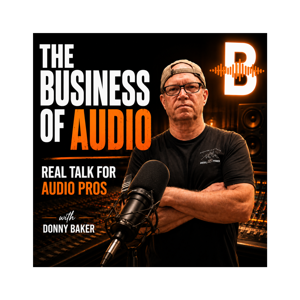
The Business of Audio Podcast is where audio engineers, producers, and studio owners learn how to build a real career in audio.
Hosted by Grammy-winning studio owner Donny…
Drawing from more than 40 years of experience in recording studios, live sound, music production, and business ownership, each episode delivers practical advice, real-world stories, and honest conversations about what it takes to turn audio skills into consistent income.
Whether you're just getting started or looking to grow your existing business, you'll find actionable insights designed to help you improve your craft, attract more clients, and build a career that lasts.
No fluff. No theory. Just real talk for audio pros.
Learn to make your living making music happen.