Capacity Conversations | One Year Anniversary Episode Hosted by Raquel Sands & Sarah Liljegren | Season 2, 2026
We almost did a song. We were this close to writing something and performing it for you, because — can you believe it — it has been one full year of Capacity Conversations. One year of two women, one from each coast of the USA, having honest, sometimes uncomfortable, always real dialogue about self-trust, transformation, and the reality most modern Millennials are navigating right now.
Do we actually have the capacity to do all the things we want to do?
That’s the question this podcast was built around. And one year in, we’re still asking it — but with more texture, more lived experience, and more willingness to sit in the complexity of the answer.
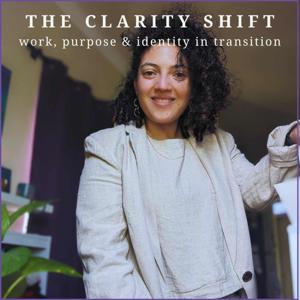
For those joining for the first time: I’m Raquel Sands, clarity and work strategist, certified yoga teacher, and graphic designer, supporting freedom seekers, freelancers, solopreneurs, consultants, and anyone in a nine-to-five who is committed to sovereignty and self-sufficiency. My goal is to help you create and sustain peace, purpose, and prosperity.
And my co-host is Sarah Liljegren — a rewilding real estate agent, certified yoga teacher, clinical herbalist, naturalist, and one of the most thoughtful people I know when it comes to the intersection of land, community, wellness, and work. More on her in a moment.
This episode? It’s about our Work stories. Capital W — not the job title, not the salary, not the LinkedIn headline. The deeper Work. The thing we’re planting and harvesting. The thing that provides for us and that we nourish in return. The thing that, over time, actually writes who we are.
Here’s ours.
My Work Journey: From the Library to Corporate to Cacao
I didn’t come into this world knowing what I wanted to do. I don’t think most of us do, despite what the college application process implies.
What I did know early: I wanted to get to the heart of things. Literally. I remember telling my parents I wanted to be a heart surgeon or a brain surgeon — because those are the organs we can’t live without. The heart keeps us here. The brain keeps us us. I wanted to work with what mattered most.
Then came the high school biology dissection. I couldn’t do it. There went the surgeon career.
So I turned to the next thing that felt like the heart of everything: words.
Books, writing, journaling, thinking about thinking. I lived in language. And eventually I got the degree to match — an English degree, after trying nutrition, global affairs, and a few other paths that didn’t quite fit. My logic at the time: everybody needs someone who can communicate. Writers, editors, communicators — that’s a need that never goes away. (And then AI arrived. But that’s a whole other episode.)
I always worked. Even before my first official job, I was helping my dad with his business in middle school. He ran a trade school, teaching men air conditioning, heating, and refrigeration — getting up to 20 or 30 men certified at a time. I was his after-school secretary, unofficial and unpaid, but I was working. I learned what it looked like to build something from the ground up.
And watching both of my parents shaped how I understand work to this day. My mom has a master’s degree. She went the institutional route — steady, structured, working for the school district for years. My dad pieced it together differently — teacher, handyman, maintenance worker, school founder. Two entirely different approaches. Neither one was purely about money. They were both, in their own way, about meaning. About finding a path that fits their hands.
That got into me early. Money was necessary. Money was not the point.
My official first job was at the library — because I loved books and the kind of people who also loved books. After that: kindergarten STEM teacher (bubbly energy, genuinely exhausting), yoga teacher, yoga studio manager, dog walker, front desk at a physical therapy clinic. Health kept showing up in my life even when I wasn’t the practitioner — just someone in the room where healing happened.
The majority of my career, though, has been in corporate communications — writing, editing, designing, and being the jane-of-all-trades communicator in organizations. Ten years across the government sector, nonprofits, and private companies. I’ve been an employee, a contractor, a consultant, and a freelancer. (And yes — contractor and consultant are two distinct legal and financial structures with different benefit implications, which matters a lot if you’re navigating independent work right now.)
I’ve worked alongside multinational giants like Deloitte and Uber, and also inside tiny nonprofits with 13 people. And what I’ve learned across all of it is that I don’t thrive in enormous spaces — the bigger the machine, the more invisible the human. I’m a suburban person: I like access to the city, but I need a sense of intimacy and proportion. I like being able to see the whole room.
And what I’ve carried with me into everything I now teach and talk about is this: the corporate structure, whether nonprofit, for-profit, or government, is a system that may or may not be built for you.
The ladder exists. The question is whether climbing it is actually taking you somewhere you want to go — and whether the ladder is even still there.
Recently — and Sarah knew this was coming before most people did — I launched a small batch cacao blend business.
I know. It sounds like a pivot. And it is. But it’s also the most direct line between everything I’ve ever cared about: health, ancestry, plant medicine, community, and nourishment as a form of sustainability. I’m 50% indigenous from Central and South America (23andMe confirmed what I already felt in my bones), and 8 to 12% West African. Cacao is Central American. It was used by the Mayans, the Olmec, the Aztec — not as a treat, but as medicine, as currency, as spiritual practice. Stepping into this work feels less like a business decision and more like a homecoming.
There’s also a practical need I kept bumping into: corporate coaching, career strategy, income sovereignty work — it’s all in the head. It’s conceptual. You can’t hold a mindset shift in your hands. And I was craving something that could meet people in their bodies, not just their brains. Cacao does that. It’s grounding. It’s tangible. It’s nourishing in a way I can actually pass across a farmer’s market table and watch someone receive.
My relationship to work has always been a question mark. When I graduated from college, it was survival mode: pay off the student debt, pay off the car, save money. That was the work. Concrete, pressing, legible. As I’ve built capacity — and it has taken years — the questions have shifted. What do I want to be known for? What do I want to plant? What does work mean in this season of my life?
Capital W Work is about meaning. Lowercase w work is about money. We need both. But only one of them, I think, is the foundation.
Sarah’s Work Journey: From Bait City BBQ to Rewilding Real Estate
She grew up in Napoleon, Missouri, a small population. The closest town was Bait City, four miles from the highway. And Bait City had a barbecue restaurant, and that barbecue restaurant was my first job, and she was there for eight years, on and off, starting at 16.
Bait City BBQ is having its 50-year reunion this summer. She’s going back to Missouri to be there. Some places just stay with you.
She started working because that was what you did. She started paying for her own gas in high school — that was the culture she was raised in. Work wasn’t optional. It wasn’t even really a conversation. And one of the first lessons she absorbed about work came from that restaurant. They were staffed mostly by women, and the message received was clear: a bad period is not a reason not to come to work.
That is a complicated inheritance. On one hand: resilience. On the other hand, the erasure of the body.
After Bait City BBQ, her job history reads like a tour through American labor. She worked in her mom’s printing warehouse. She worked at a Scantron Testing Center for a summer, manually entering all the tests the computer couldn’t read. She had wrist surgery and had to leave the restaurant, so she went to work at a commercial bank in a small town.
That bank job taught her something I think about often: when you work around a thing long enough, its value shifts. In restaurants, she was surrounded by food. The abundance of it changed how I related to it. In banking, she was surrounded by money. The first time she carried a stack of cash, she was floored — this was big-money energy I’d never experienced. And then months later, it was just paper. Both experiences loosened something in me about what we think things are worth.
She cleaned houses. She became a server and then a shift manager at Cafe Verona in Independence, Missouri. Then accepted a manager position at Lulu’s Thai Noodle Shop in downtown Kansas City.
Lulu’s happened to be right next door to the yoga school she started attending in 2017. That proximity was not accidental. It was that particular flavor of serendipity where you realize the path was already laying itself out while you were busy managing lunch service.
She started studying herbalism around that same time, 2016. And started experimenting: making products, giving them away, making more, giving those away too. And then she thought: what if I sell these at the farmer’s market?
That was the moment everything shifted. Selling plants woke her up. She became a bulk dry goods department manager at Tarot Health and Wellness, managing medicinal and culinary herbs in little jars — keeping them stocked, learning to love even the smallest quantity of something rare or beautiful. Plants kept teaching her: value is not fixed. Value is felt.
She launched my first herbal brand, Scorpio Rising Botanicals. Then went to yoga school and studied psychological yoga — embodied yoga principles, coaching modalities, clinical herbalism, all weaving together. In January 2020, she opened my own little studio in Independence, Missouri, in a building that had been renovated from an old hospital — specifically, the hospital where she was born. The same place that received me into the world became the place she was trying to rebirth my adult professional life.
Clinician: check. Nutritionist: check. Body worker: check. Location with actual personal meaning: check.
In February 2020, she held my first public workshop.
In March 2020, she shut the building to the world.
It took her five years to fully digest what happened. It is 2026 now, and she can finally look back and say: That was the break in her work story. That was the forced shift into the deeper layers.
She got a remote job doing social media marketing. That remote work gave her the mobility to enroll in a wilderness and naturalist school program and make the move from Missouri to Western Washington. Shortly after arriving, the company downsized and laid off. So she went back to restaurants — became a cook at Flavor Bistro in Duvall, which had an unusual menu (kangaroo, python, ingredients from all over the world) and was genuinely strange in the best possible way.
Then she took a month off — the first time in her entire working life did not work for a month — and went to Alaska with her husband, Justin. They spent that dark Alaskan month working on themselves and their marriage. That pause was its own kind of labor. The kind that doesn’t show up on a resume.
She came back to Duvall and started real estate school. She was doing the naturalist program during the day and real estate school at night. But real estate ticked every single box she’d been searching for: community, environment, nutrition of place, terrain theory, and the idea that our surroundings are part of our digestive process as human beings. She didn’t want to be a dietitian because health was never just about what was happening in one body in isolation. It was always about the body in its environment. Real estate — particularly intentional communities, eco-villages, land-based living — finally gave her a container for all of that.
She recently left a staff support role in a real estate office. And is back to being a full-time agent, focusing on what she’s always been most passionate about: eco-villages, intentional communities, rewilding real estate. The first-ever Pacific Northwest eco-village tours are planned for July 2027. I’m building that now.
What We Both Keep Coming Back To
We’ve both had seasons where we thought we’d arrived and then found ourselves back at the beginning of something new.
Here’s what we know: the lowercase w work — the bills-and-survival version — is real. It’s necessary.
We’re not suggesting you transcend your rent.
But the capital W Work — the meaning, the gift, the thing you’re here to plant — that’s the compass. And learning to read it takes time. It takes getting things wrong. It takes the dissection you couldn’t do, the studio you had to close, and the job you lost a month after you moved across the country.
On Being Women in Work
We can’t write this episode without saying it plainly: work systems were not designed with women in mind. Not emotionally, not physically, not spiritually, not hormonally.
Men’s hormonal cycles are roughly the same every day — consistent energy, consistent rhythm. Women’s cycles are monthly, shifting, layered with physical demand. And then there’s perimenopause. And pregnancy. And caregiving. And the constant negotiation of whether you have children, how many, and whether you’re the head of the household.
One of my close friends is currently pregnant for the first time — and navigating it as a contractor. The fear of losing income, of being sidelined, of being quietly managed out because you’re no longer “producing” for the organization while you’re literally producing a human being — that fear is not irrational. It’s documented. It’s the reality.
We carry that. We carry all of it into work environments that were built around a different kind of body. And the first lesson many of us received — as Sarah did at 16, in a restaurant staffed by women — was that our cycles don’t matter here. Push through.
That lesson has its gifts. Resilience is real. But so is the cost.
We wish we’d considered that sooner. And we’re saying it now, on the record, in case it helps someone earlier in their journey: your body’s rhythms are not an inconvenience. They are information. And building work around them — rather than against them — is not softness. It is, arguably, the most intelligent thing you can do.
The Work of Knowing Yourself
What strikes us most, looking back across both of our journeys, is this: the most valuable work we’ve ever done is the work of knowing ourselves.
Not once, not in a single breakthrough, but continuously — in every season, at every scale.
What was true at 22 is not necessarily true at 32. What worked in Missouri doesn’t always work in Western Washington. What corporate gave us — structure, exposure, income, humbling lessons — is not what we need to carry forward.
Sarah is a country mouse who thought she needed to be in the city. I am a suburb person who needed both the intimacy of small and the access of large. Sarah sells land and community, and the idea that our terrain is part of our health. I blend cacao and talk about what it costs to stay in a system that was never designed for your flourishing.
We are both still figuring it out. Loudly.
Where We Are Now
Raquel is a clarity and work strategist, the host of The Clarity Shift podcast, and the founder of a small batch cacao blend business rooted in Central American ancestry and holistic nourishment. She offers blends specifically designed to support the female body, to honor indigenous plant traditions, and to ground people in something physical and real alongside all the conceptual work of career and income sovereignty. Find her at farmers’ markets in the Arlington, Virginia area in 2026.
Sarah is a rewilding real estate agent based in the Pacific Northwest, a certified yoga teacher, clinical herbalist, and the organizer of the first-ever Pacific Northwest Eco-Village Tours, coming July 2027. She’s in the business of helping people find — or build — the village they’ve been looking for.
One year. A lot of ground covered. More to come.
Thank you for being here. Thank you for listening. Thank you for doing your own capital W Work, in whatever form it takes.
Capacity Conversations drops regularly wherever you listen to podcasts. Subscribe on Substack to never miss an episode.
Thanks for reading Sands & Semilla! This post is public so feel free to share it.
This is a public episode. If you would like to discuss this with other subscribers or get access to bonus episodes, visit www.miriamraquelsands.com