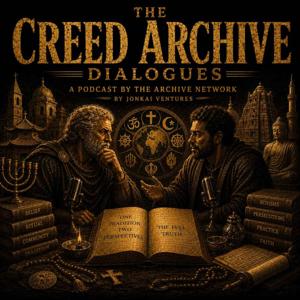
The Creed Archive Dialogues

The Creed Archive Dialogues

Download on the App Store

The Creed Archive Dialogues episodes

  • Anglicanism
    Under the shadow of royal ambition and religious upheaval, an unexpected act in sixteenth-century England would ignite a global tradition. Picture a king, a parliament, and a church torn between worlds—where does a faith begin when lines are drawn by law, not just by creed?In the year fifteen thirty-four, something unprecedented happened in England. The king, Henry the Eighth, was not only seeking an annulment of his marriage to Catherine of Aragon, but also challenging the spiritual authority of Rome itself. According to the Acts of Supremacy, passed by the English Parliament, the monarch was now declared the "Supreme Head" of the Church in England. This was far more than a personal or political maneuver. It was a legal and religious rupture, marking the institutional birth of what would become known as Anglicanism. But as historians and Anglicans themselves will tell you, the story is more layered than a single act or a single year.Aurelius and Malik take on this case in full — 5 chapters, 35 minutes, one complete story.Learn more at: https://thecreedarchive.com/creed/anglicanism

    The Creed Archive Dialogues is part of The Archive Network by Jonkai Ventures. In every episode, curators Aurelius and Malik take one religious tradition and follow it from origin to living practice — one setting out the belief on its own terms, the other pressing on the harder ground.

    The Archive Network is an independent, solo-run project. Everything is free, with no ads and no paywalls. Support doesn't unlock anything; it simply keeps the work going:

    https://thearchivenetwork.com/support

    Explore this archive:

    https://thecreedarchive.com

    Discover more archives and stories:

    https://thearchivenetwork.com

    Hosted on Acast. See acast.com/privacy for more information.

    36 min
  • Anabaptism
    A handful of men gather in secret, risking everything for a single act. Their choice will set them against both church and state—and launch a movement that refuses to fade.The year is fifteen twenty-five. In Zurich, as in much of Europe, old certainties are breaking down. The Reformation stirs not just theological debate, but questions of power and belonging. In this charged setting, a small circle in Zurich prepares to act. They are about to reject infant baptism—a practice nearly universal in their world. Instead, they will claim baptism should be for adults who freely confess faith. This act will mark them as 'Anabaptists'—a name given by their opponents. Among themselves, they prefer to be called brethren, saints, or simply believers.Aurelius and Malik take on this case in full — 5 chapters, 37 minutes, one complete story.Learn more at: https://thecreedarchive.com/creed/anabaptism

    The Creed Archive Dialogues is part of The Archive Network by Jonkai Ventures. In every episode, curators Aurelius and Malik take one religious tradition and follow it from origin to living practice — one setting out the belief on its own terms, the other pressing on the harder ground.

    The Archive Network is an independent, solo-run project. Everything is free, with no ads and no paywalls. Support doesn't unlock anything; it simply keeps the work going:

    https://thearchivenetwork.com/support

    Explore this archive:

    https://thecreedarchive.com

    Discover more archives and stories:

    https://thearchivenetwork.com

    Hosted on Acast. See acast.com/privacy for more information.

    38 min
  • Alevism
    A vast plateau. A flicker of music at dusk. In thirteenth-century Anatolia, a new spiritual current begins to flow. It is neither wholly Sunni, nor Shi'i, nor Sufi in the mainstream sense. Instead, it is something distinct—an identity forged in ambiguity, lineage, and song. If you listen closely, you might hear the first notes of Alevism, a tradition whose roots still shape millions of lives today.Imagine Anatolia in the late medieval age—crossroads of empires, home to Turkic migrants, Sufi wanderers, and local villagers. This is the uneasy world where Alevism emerges. Adherents and historians alike often point to the thirteenth century as a starting line. But the story is tangled. There is no single founder, no fixed moment. Instead, Alevism takes shape as a meeting ground—where Sufi brotherhoods, Shi'i devotion, Turkic and Anatolian folkways, and the lived memory of saints all converge. The figure of Hacı Bektaş Veli, revered by many Alevis as a spiritual archetype and conventionally dated to around twelve oh nine to twelve seventy-one, becomes central. His shrine at Hacıbektaş in central Anatolia still draws pilgrims and preserves hagiographies like the Vilâyet-nâme. Yet, historians warn: what is called Alevism today only crystallized over centuries. Its communal structures, rituals, and even its very name changed, shaped by migrations, rival empires, and the shifting sands of political power.Aurelius and Malik take on this case in full — 5 chapters, 37 minutes, one complete story.Learn more at: https://thecreedarchive.com/creed/alevism

    The Creed Archive Dialogues is part of The Archive Network by Jonkai Ventures. In every episode, curators Aurelius and Malik take one religious tradition and follow it from origin to living practice — one setting out the belief on its own terms, the other pressing on the harder ground.

    The Archive Network is an independent, solo-run project. Everything is free, with no ads and no paywalls. Support doesn't unlock anything; it simply keeps the work going:

    https://thearchivenetwork.com/support

    Explore this archive:

    https://thecreedarchive.com

    Discover more archives and stories:

    https://thearchivenetwork.com

    Hosted on Acast. See acast.com/privacy for more information.

    37 min
  • Alawism
    Hidden in Syria’s rugged coastal highlands, a secretive faith quietly shaped its own world—one that outsiders could only glimpse in rumor and fragment. Who were these people whose beliefs persisted behind closed doors and mountain barriers, and what drew so much suspicion their way?In the ninth century, the eastern Mediterranean was a crossroads of religious change. Amid the swirl of Islamic sects and rival empires, a unique tradition emerged—one that would become known as Alawism. Scholars trace its earliest days to a period of intense debate among Shiʿi Muslims, after the first generations of Islamic leadership splintered and new movements vied for followers. According to community memory, a teacher named Muhammad ibn Nusayr, often called Ibn Nusayr, began to gather students around him. This circle of followers believed he possessed hidden knowledge, passed down only to the chosen few. Early sources from the ninth and tenth centuries mention the presence of these communities in Syrian towns and remote villages—places like Latakia, Jableh, and Baniyās along the coast, and the winding valleys of the Jabal al-Ansariyah mountains. By the tenth century, another figure, Abu’l-Hasan al-Khassabi in Aleppo, helped organize and spread these teachings. For historians, this was not a sudden birth but a gradual process, shaped by interactions with neighboring Shiʿi groups, local beliefs, and wider religious currents.Aurelius and Malik take on this case in full — 5 chapters, 36 minutes, one complete story.Learn more at: https://thecreedarchive.com/creed/alawism

    The Creed Archive Dialogues is part of The Archive Network by Jonkai Ventures. In every episode, curators Aurelius and Malik take one religious tradition and follow it from origin to living practice — one setting out the belief on its own terms, the other pressing on the harder ground.

    The Archive Network is an independent, solo-run project. Everything is free, with no ads and no paywalls. Support doesn't unlock anything; it simply keeps the work going:

    https://thearchivenetwork.com/support

    Explore this archive:

    https://thecreedarchive.com

    Discover more archives and stories:

    https://thearchivenetwork.com

    Hosted on Acast. See acast.com/privacy for more information.

    36 min
  • Akan Religion
    Dense green forests, hidden shrines, and ancient stools: this is where the Akan religious world first took root. The echoes of priestly chants and the presence of spirits in the land still shape the lives of millions across Ghana and Côte d’Ivoire. But how did this intricate tapestry of belief and ritual begin, and who carved the first paths through the sacred groves?To explore the beginnings of Akan religion, we must travel back to the first millennium of the common era, deep into the forest and coastal regions of what is now southern Ghana and eastern Côte d'Ivoire. Here, Akan-speaking communities emerged, shaped by centuries of migration, trade, and the slow rise of powerful states. These early societies did not build temples of stone or write sacred texts. Instead, they wove their cosmology into everyday life—through rituals, oral histories, and the authority of chiefs and priests. The story of Akan religion is not the story of a single founder or a moment in time. Instead, it is a living tradition, layered and evolving, borne from local practices and the encounters of people with the land, each other, and the unseen world.Aurelius and Malik take on this case in full — 5 chapters, 36 minutes, one complete story.Learn more at: https://thecreedarchive.com/creed/akan-religion

    The Creed Archive Dialogues is part of The Archive Network by Jonkai Ventures. In every episode, curators Aurelius and Malik take one religious tradition and follow it from origin to living practice — one setting out the belief on its own terms, the other pressing on the harder ground.

    The Archive Network is an independent, solo-run project. Everything is free, with no ads and no paywalls. Support doesn't unlock anything; it simply keeps the work going:

    https://thearchivenetwork.com/support

    Explore this archive:

    https://thecreedarchive.com

    Discover more archives and stories:

    https://thearchivenetwork.com

    Hosted on Acast. See acast.com/privacy for more information.

    37 min
  • Ahmadiyya
    In the late nineteenth century, as the British Empire tightened its grip over India, a quiet revolution was brewing in the towns and cities of Punjab. It was a time of fierce religious debates, missionary showdowns, and new ideas about faith and leadership. At its center stood a man from Qadian, whose claims would spark devotion, controversy, and a movement that would reach far beyond his homeland.Picture a small town called Qadian, in the Punjab of British India. Here, in eighteen thirty-five, Mirza Ghulam Ahmad was born into a landowning family. The world around him was shifting fast. Christian missionaries, Hindu reformers, colonial officials, and Muslim intellectuals were all vying for influence. By eighteen eighty-nine, this local world would give rise to a global religious community—the Ahmadiyya movement. But what made this new community different from the many others forming in the same era? To understand, we have to step back into the world that shaped it.Aurelius and Malik take on this case in full — 5 chapters, 35 minutes, one complete story.Learn more at: https://thecreedarchive.com/creed/ahmadiyya

    The Creed Archive Dialogues is part of The Archive Network by Jonkai Ventures. In every episode, curators Aurelius and Malik take one religious tradition and follow it from origin to living practice — one setting out the belief on its own terms, the other pressing on the harder ground.

    The Archive Network is an independent, solo-run project. Everything is free, with no ads and no paywalls. Support doesn't unlock anything; it simply keeps the work going:

    https://thearchivenetwork.com/support

    Explore this archive:

    https://thecreedarchive.com

    Discover more archives and stories:

    https://thearchivenetwork.com

    Hosted on Acast. See acast.com/privacy for more information.

    36 min
  • Zen (Chan)
    A master sits before a silent crowd. He lifts a single flower. No words, no explanation. One follower smiles—and in that moment, Zen’s foundational myth is born.What does it mean to inherit wisdom without a script? To trace a path from silence and gesture, rather than written law? For centuries, Zen—known as Chan in China—has told its own origin story as a living current, passed mind-to-mind from the Buddha himself. But behind the legend, the historical record reveals a tangled emergence, shaped by translation, monasteries, and the meeting of cultures in medieval China. To step into Zen’s beginnings, we enter a world of both myth and manuscript, silence and institution.Aurelius and Malik take on this case in full — 5 chapters, 35 minutes, one complete story.Learn more at: https://thecreedarchive.com/creed/zen-buddhism

    The Creed Archive Dialogues is part of The Archive Network by Jonkai Ventures. In every episode, curators Aurelius and Malik take one religious tradition and follow it from origin to living practice — one setting out the belief on its own terms, the other pressing on the harder ground.

    The Archive Network is an independent, solo-run project. Everything is free, with no ads and no paywalls. Support doesn't unlock anything; it simply keeps the work going:

    https://thearchivenetwork.com/support

    Explore this archive:

    https://thecreedarchive.com

    Discover more archives and stories:

    https://thearchivenetwork.com

    Hosted on Acast. See acast.com/privacy for more information.

    35 min
  • Sikhism
    A man disappears into a river, leaving behind only rumors. When he emerges three days later, he brings a message that will reshape villages, challenge empires, and spark a new religious tradition in northern India.This is the story of Sikhism’s beginnings—a tale woven from both devotion and history. In the late fifteenth century, Punjab was a crossroads. Caravans threaded through fertile plains; Sufi mystics recited Persian poetry, and bhakti saints sang in the local tongue. Into this world, Guru Nanak was born in fourteen sixty-nine, in a village called Talwandi—now known as Nankana Sahib, in present-day Pakistan.Aurelius and Malik take on this case in full — 5 chapters, 35 minutes, one complete story.Learn more at: https://thecreedarchive.com/creed/sikhism

    The Creed Archive Dialogues is part of The Archive Network by Jonkai Ventures. In every episode, curators Aurelius and Malik take one religious tradition and follow it from origin to living practice — one setting out the belief on its own terms, the other pressing on the harder ground.

    The Archive Network is an independent, solo-run project. Everything is free, with no ads and no paywalls. Support doesn't unlock anything; it simply keeps the work going:

    https://thearchivenetwork.com/support

    Explore this archive:

    https://thecreedarchive.com

    Discover more archives and stories:

    https://thearchivenetwork.com

    Hosted on Acast. See acast.com/privacy for more information.

    35 min
  • Mahayana
    Picture a network of monks, traders, and storytellers spreading through the borderlands of ancient India. Manuscripts pass from hand to hand, new ideas take shape, and soon, the Buddhist world will never be the same. This is the beginning of Mahayana—the Great Vehicle.In the first centuries of the common era, a new current emerges within Buddhism. It is not a sudden revolution, but a layered process. Scholars trace its start to northwestern India and the vital crossroads leading toward Central Asia. Here, fragments of new teachings appear—texts that later communities will call sutras. These writings, such as the Prajnaparamita, or Perfection of Wisdom literature, begin to circulate between the first century before the common era and the third century after. Archaeologists uncover Gandharan manuscript fragments—physical evidence that these new teachings were not limited to a single place or language. Meanwhile, some Mahayana communities teach that these sutras were spoken by the Buddha himself, meant for future generations. The difference between the historian’s timeline and the tradition’s self-understanding is striking, and it shapes the way Mahayana tells its own story.Aurelius and Malik take on this case in full — 5 chapters, 37 minutes, one complete story.Learn more at: https://thecreedarchive.com/creed/mahayana-buddhism

    The Creed Archive Dialogues is part of The Archive Network by Jonkai Ventures. In every episode, curators Aurelius and Malik take one religious tradition and follow it from origin to living practice — one setting out the belief on its own terms, the other pressing on the harder ground.

    The Archive Network is an independent, solo-run project. Everything is free, with no ads and no paywalls. Support doesn't unlock anything; it simply keeps the work going:

    https://thearchivenetwork.com/support

    Explore this archive:

    https://thecreedarchive.com

    Discover more archives and stories:

    https://thearchivenetwork.com

    Hosted on Acast. See acast.com/privacy for more information.

    37 min
  • Zaidi Shia
    In the rugged highlands of Yemen, an idea was born—a vision of leadership that demanded action, not just inheritance. Here, a movement emerged that would challenge empires, shape villages, and transform the meaning of justice for generations to come.What drove a community to risk everything for a new kind of authority? The Zaidi movement begins with the story of Zayd ibn Ali, a name that still echoes in the mountains of northern Arabia. He was not only a descendant of the Prophet, but also a man who refused to stand by in the face of injustice. In seven forty, Zayd led a bold uprising against the Umayyad governor in Kufa. His defeat and death might have ended his story—except that, for his followers, it was only the beginning.Aurelius and Malik take on this case in full — 5 chapters, 36 minutes, one complete story.Learn more at: https://thecreedarchive.com/creed/zaidi-shia-islam

    The Creed Archive Dialogues is part of The Archive Network by Jonkai Ventures. In every episode, curators Aurelius and Malik take one religious tradition and follow it from origin to living practice — one setting out the belief on its own terms, the other pressing on the harder ground.

    The Archive Network is an independent, solo-run project. Everything is free, with no ads and no paywalls. Support doesn't unlock anything; it simply keeps the work going:

    https://thearchivenetwork.com/support

    Explore this archive:

    https://thecreedarchive.com

    Discover more archives and stories:

    https://thearchivenetwork.com

    Hosted on Acast. See acast.com/privacy for more information.

    36 min

About The Creed Archive Dialogues

From the publisher's feed

The Creed Archive Dialogues is part of The Archive Network by Jonkai Ventures, a collection of podcasts dedicated to the stories that shaped our world.


Every episode is a conversation.…