
Sign up to save your podcasts
Or

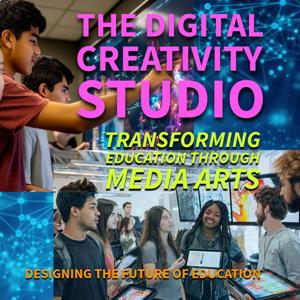


Are you ready for the future of education?
Imagine walking into a school where a twelve-year-old is scoring a documentary about her own neighborhood, learning music theory, narrative structure, and emotional intelligence — not because she was taught these things, but because her work demanded them. Where a student who has been labeled a reluctant learner is leading his group's discussion on cellular respiration, because a media arts project made him need to understand it. Where students are making genuinely difficult ethical decisions about how to represent mental health honestly — for a real audience, with real consequences.
This is the Digital Creativity Studio. And it is the subject of a new podcast series based on Dain Olsen's landmark book, Media Arts Education: Transforming Education Through Multimodal Cognition, Holistic Learning, and Techno-Embodiment (Routledge, 2024).
Episode 1 asks the question that most educational reform is afraid to ask: what if the structure of education itself is the problem? What if you cannot bolt transformation onto a factory? And what if the answer — counterintuitive, evidence-based, and already working in schools across the country — is Media Arts Education?
The Digital Creativity Studio: Transforming Education Through Media Arts is available now. Ten episodes. One framework. The most important conversation in education today.
Media Arts Education (MAE) is not just a subject area to make movies! Its the creative digital center of 21st C Education! In this podcast, based on my book, using NotebookLM's 'Deep Dive', MAE is presented as a "meta-framework" and an "evolutionary educational model," aiming for deep educational transformation beyond surface-level reforms. This is way beyond the aging "Factory Model"!
Podcast https://lnkd.in/gBKAZSfk
Site https://www.dainolsen.com/
Book https://amzn.to/3zwTnAg
Blog https://lnkd.in/gBKAZSfk
mediaartsedu.org
Media Arts Education (MAE) is presented as a "meta-framework" and an "evolutionary educational model," aiming for deep educational transformation beyond surface-level reforms. As a "meta-framework," it offers a holistic philosophy for learning, integrating various progressive educational approaches and seeing media arts as an extension of the human mind, enabling multimodal content translation across all subjects. Concurrently, its role as an "evolutionary educational model" highlights its inherent flexibility and adaptive nature, fostering metalearning and a "culture of learning" through continuous feedback, thus preparing students to critically and creatively engage with technology and AI. Ultimately, MAE seeks to redefine education by aligning it with natural human cognition and cultural expression in a technologically advanced society.
This podcast produced through Google's NotebookLM explains that media arts is deeply intertwined with all aspects of modern life, demanding a more critical and active engagement than passive consumption. Olsen defines media arts broadly as machine-based creative production, encompassing everything from flip books to AI-generated art, highlighting its historical evolution and the accelerating pace of technological change. The chapter emphasizes four key properties of media arts: interconnective (blending art forms), multimodal (engaging multiple senses), plastic (boundless potential), and potentiated (limitless possibility). Finally, it showcases how Olsen's pedagogical approach transforms traditional classrooms into creative studios, using media arts projects to foster critical thinking, collaboration, and real-world skills across various subjects, ultimately empowering students to become engaged citizens and creative problem-solvers.
The combination of Media Arts Education (MAE) and AI provides a more holistic and engaging learning experience than traditional education (TE). MAE emphasizes embodied cognition, multimodal learning, and active, student-centered approaches to learning. The author asserts that MAE mirrors our societal digital nervous system and provides a platform for students to directly engage with this system through the creation of multimedia projects. This approach, the author believes, empowers students to develop critical thinking skills, media literacy, and a deep understanding of their world, ultimately fostering a more equitable and empowered future for all.
This Deep Dive provides an overview of major themes and ideas presented in Dain Olsen’s book, Media Arts Education, Transforming Education Through Multimodal Cognition, Holistic Learning and Techno-Embodiment. These excerpts argue for a radical shift in educational philosophy and practice, positioning MAE as a central force in fostering holistic learning aligned with 21st-century realities.
Main Themes:
Implications for Education:
Olsen's work suggests a need for significant changes in educational systems to embrace the principles of MAE:
Imagine the Ideal Futuristic School! Students are highly engaged in dynamic, interdisciplinary projects, utilizing AI and emerging technologies to design, experiment and problem-solve in real world contexts. Learning is unleashed into limitless adventure of exploration, creativity, invention and experimentation!
Book - https://amzn.to/3zwTnAg Blog - https://bit.ly/4fSJCwj mediaartsedu.org - https://bit.ly/3XHsR0j
This Deep Dive Podcast introduces the transformation of K-12 education through AI and media arts, including photo, graphics, video, animation, sound, interactive design, 3D and XR design. These forms allow for unlimited creativity and active learning across arts, academics and STEM, where the core content comes alive and is applied to mastery through graphics, animation, story, sound, and interactive virtual dimensions.
Media Arts Education (MAE) offers a powerful alternative to our outdated industrial model: MAE leverages technology to create immersive, hands-on learning experiences that align with natural cognition. All students become active creators and problem-solvers, while developing a wide range of 21st-century skills.
MAE democratizes access and empowers ALL students, including those with socioeconomic and cognitive challenges: Media arts tools are accessible, adaptable, and engaging for learners of all abilities. MAE is based in cognitive and learning science research for more natural, resilient and motivating forms of learning. MAE also cultivates aesthetic empathy, digital literacy, and a sense of agency, preparing students to actively shape their culture and navigate an increasingly digital world.
#mediaartseducation
#medialiteracy
#artseducation
#futureoflearning
From the publisher's feed
Imagine the ideal futuristic school, with a Digital Creativity Studio at the center! Students are highly engaged in dynamic, interdisciplinary projects, utilizing AI and digital media technologies…
Site https://www.dainolsen.com/
Book https://amzn.to/3zwTnAg
Blog https://bit.ly/4fSJCwj
mediaartsedu.org https://bit.ly/3XHsR0j
Will schools ever evolve into a true 21st Century model? Will education ever reflect our current society rather than the 100 year old factory model? The Digital Creativity Studio Podcast examines how and why K-12 education is transformed and structurally reorganized through media arts, including AI, photo, graphics, video, animation, sound, interactive design, 3D and XR immersive design. These forms support unlimited creativity and project-based learning across arts, academics and STEM. Thus, the core content comes alive and is applied to mastery through producing graphics, animations, stories, interactive 3D models and virtual environments. Students are not measured solely on content retention, which is cognitively narrow and superficial, but on a holistic range of capacities.
Students can now collaborate with their peers and mentors on a limitless variety of challenges and engaging projects that exercise core skills and knowledge into mastery. This increases interest and motivation in learning, as well as its relevance in real world applications. Student-centered instruction ultimately supports students to become independent, lifelong learners, and to gain the skills necessary for a future with AI and emerging technologies.
Media Arts Education (MAE), a new digital arts subject area established through performance standards in 40 states, offers a powerful, holistic alternative to our outdated industrial model: MAE leverages technology and AI to create immersive, hands-on learning experiences that align with natural cognition, based in current cognitive and learning research. All students become active creators and problem-solvers, while developing a wide range of 21st-century skills, such as creative problem-solving, flexible cognition, information literacy, collaboration, systems thinking, and project management.
MAE democratizes access, academic achievement, and empowers ALL students, including those with socioeconomic and cognitive challenges: Media arts tools are accessible, adaptable, and engaging for learners of all abilities. MAE cultivates multimodal fluency, digital literacy, and cultural agency, preparing students to actively shape their worlds, thrive in a digital society, and address current global challenges across STEM and the arts.