
Sign up to save your podcasts
Or

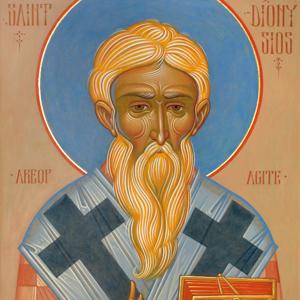


Kevin Clarke of Sacred Heart Seminary joins Sam Bennett and Dominic Cassella to discuss St. Maximus the Confessor’s Opuscula and Dispute with Pyrrhus. Clarke’s new translation and introduction is available here: https://www.amazon.com/Opuscula-Dispute-Pyrrhus-Theological-Polemical/dp/0813240824
We talk about why Maximus defended two wills and two activities in Christ, why his opponents thought this threatened Christ’s unity, and what was at stake for salvation. Other topics include Christ’s fear in Gethsemane, human freedom and deliberation, his experience of temptation and suffering, and Dionysius’s description of Christ’s “theandric activity.”
Max Rohstock argues that, for Dionysius, evil arises when human freedom turns away from the Good itself and becomes fixed on finite goods (wealth, power, pleasure) as though they were ultimate. Yet the Good never ceases to sustain us or call us back. In that sense, even our return to the Good begins from a grace that is already present.
Political philosopher Mark Blitz joins the podcast to discuss his new book, Aristotle’s Political Philosophy. We consider Aristotle’s account of the link between political life and human happiness, the regime as a way of life, the place of virtue in liberal democracy, and the tensions between politics, philosophy, and religion. Patrick Jones joins me for the conversation.
In this episode, Sam Bennett speaks with philosopher Jakub Jirsa about his new Bloomsbury book, The Function Argument in Aristotle’s Ethics. They discuss Aristotle’s famous function argument, what it means to ask whether human beings have a distinctive function, and how this question shapes Aristotle’s account of virtue, happiness, and the human good.
In this episode, I speak with Michele Pecorari about one of Aristotle’s arguments against Plato’s Form of the Good in Nicomachean Ethics 1.6. Aristotle notes that we call many different kinds of things good: God is good, as a substance; virtue is good, as a quality; the right amount is good, as a quantity; and the right time is good, as a time. We discuss why Aristotle thinks this creates a problem for Plato’s idea of a single Form of the Good.
The article discussed is Michele Pecorari’s “Goodness and Non-Univocity in Nicomachean Ethics 1.6,” published in Phronesis 71.1, pp. 25–51. The article is available here: https://brill.com/view/journals/phro/71/1/article-p25_2.xml
Gyula Klima discusses the medieval problem of universals, focusing on the divide between the via antiqua and the via moderna. The conversation centers especially on William of Ockham’s break with the older realist tradition, drawing on Klima’s article “What is Wrong with Nominalism?” (Divinitas, 2, 2025). Klima argues that the deepest shift is not simply metaphysical, but semantic: a new account of how words, concepts, and things are related.
Karsten Harries, emeritus Yale professor of philosophy, joins Dr. Sam Bennett for a conversation on Nicholas of Cusa’s On Learned Ignorance, the limits of reason, modern science, nihilism, Kant, Heidegger, beauty, and transcendence in human life.
In this episode, philosopher Christopher Hauser of the University of Scranton joins Dr. Sam Bennett to discuss Aristotle’s epistemology, specifically his theory of essence and how we come to know essences. We begin by clarifying what Aristotle means by essence, including the distinction between individuals and kinds, and between essential features and merely necessary properties. The conversation then turns to a central question in Aristotle’s philosophy: how do we grasp the fundamental definitions that capture something's essence? Hauser outlines three major interpretations of Aristotle’s view, intuitionism, explanationism, and a Socratic approach, and explains why he favors an explanationist account. Explanationism holds that we come to know essences not by immediate intellectual insight, but by developing and testing definitions in light of what they explain about a kind.
In this episode, Dr Sam Bennett speaks with the Italian literary critic and poet Piero Boitani about his recent book Timaeus in Paradise: Metaphors and Beauty from Plato to Dante and Beyond, alongside his long poetic work Plato’s Poem. We begin with the remarkable story behind these works, including the unexpected emergence of poetic inspiration late in Piero's life. From there, the conversation turns to the enduring influence of Plato’s Timaeus, especially its reception in the Western tradition and its role in shaping reflections on beauty, order, and metaphor. A central part of the discussion includes readings from Boitani’s poetry. We recite and reflect on passages such as Jacob’s Song for Rachel’s Beauty, and Dionysius Sings of Beauty, which traces a metaphysical vision of beauty as both the origin and end of the universe. As Boitani writes, “Europe, listening, experienced fire,” capturing the transmission of the Timaean vision across the tradition.
From the publisher's feed
The Dionysius Circle Podcast focuses on Christian Platonism and the broader Platonic tradition. We study the integration of Platonism within Christian philosophy and theology, along with Plato…
For more, visit DionysiusCircle.org.