
Sign up to save your podcasts
Or



Send us Fan Mail
Imagine this scenario: You are 27 years old, you've been in severe pain for years, you have eye surgery and then you wake up and you are permanently blind. This is what happened to Lynn Jensen. Her doctors told her that she may regain her sight in about 6 months time, but after 5 months she had a feeling that she would not regain her vision, which she did not. Her sight loss was due to an earlier brain injury. However, Lynn made it her mission to become a 'good' blind person. She became empowered when she started to learn some new skills as a blind person. She was later employed at a vision rehabilitation center, helping other people with vision loss, including: independent living, running workshops, and working as an independent consultant. Lynn was asked to write a short list of tips for travelling as a blind person. Once she started writing, the ideas just flowed and she had a lot of good info to share. The book took on a whole other life, and is now available to purchase. Lynn feels that low or no vision should not be an impairment to enjoying a travel experience.
Guide Dog Handler Lynn Jensen Launches New Travel Book for People with Sight Loss - BC & Alberta Guide Dogs
Home - Blind Travel Tips
Send us Fan Mail
Independence: Something very valuable that the disabled person does not want to lose. In this episode Steve and Chris discuss the topic of independence, and how Steve adapts being a disabled person. While Steve does live on his own, his independence is a little unique; because he is 100% blind and, in a wheelchair, he cannot necessarily leave his apartment on his own for his own safety. In the earlier time after Steve had the medical emergency that rendered him disabled, Steve had to relearn a lot of the day-to-day activities he used to perform as an abled bodied person. His self-esteem was quite affected, because he became reliant on other people to do just about anything. However, it is important to set up systems in place to assist a disabled person, depending on what their needs and limitations are. Steve has also benefitted from having the CSIL program (Choices in Supports for Independent Living). The technology that Steve uses also gives him independence - from Alexa, Siri, You Tube, audiobooks, and podcasts.
Send us Fan Mail
Steve interviews Brian Bell, who is a quadriplegic and lives in British Columbia. Brian was 38 when his life changed forever. He was living and working in a regional park doing numerous jobs and maintaining the park. He really enjoyed living there with his family and working on improving the home that came with the position. On an ordinary day, Brian decided to ride an all-terrain vehicle down an embankment. Brian hit the sand, flew forward with the vehicle, and landed on his head in between 2 large rocks, heard a 'pop' and a 'squish' in his head/neck area. Naturally, Brian was disoriented and couldn't move. He was eventually found by a couple of hikers, as he was lying on the ground - but couldn't yell for help. He assumed that he had broken his neck. He spent time in the hospital and was eventually transferred to GF Strong (a rehabilitation hospital in Vancouver). He came to the realization that he was mainly paralyzed from the neck down - no one had to tell Brian this. However, Brian can use his hands and arms to some degree. Brian has recorded 28 episodes of a podcast: QuadLife, talking with other quadriplegics. Listen to Brian's honest account as he maintains a remarkably positive attitude. QuadLife Podcast - Podcast - Apple Podcasts
Send us Fan Mail
Steve, Chris and Michelle Hewitt talk about the 10th anniversary of when Steve had his triple A medical emergency, his life changed forever, and he became a multi disabled person. Michelle does a great job of interviewing Steve; including asking him how he learned how to become a disabled person, how he overcame the anger and adjustment and bounced back to get on with his life, and how he came to do his podcast. You can tell that Steve really enjoys doing the podcast, and the sense of accomplishment he has in recording more than 60 episodes to date now - all of them are very unique and eclectic. He wants to continue to find interesting guests with great stores to tell. The other project that Steve accomplished is writing his book, Beyond Green Eyes: The Day I Died, The Life I Began (available on Amazon) HOME | Stevenvine
Send us Fan Mail
Jaime was born 3 months premature and diagnosed at an early age with Cerebral Palsy. The doctors told his parents not to expect too much (a discouraging statement from the medical community). Jaime wanted to be like everyone else, so he was determined to prove this statement wrong. He didn't want to be the 'underdog', he wanted to fight for what he believed in - himself. He struggled in school and was told by his parents not to get his hopes up. But he was determined to try - for example: learning to ski, swim, scuba dive, skateboard, drive a car, or ride a motorcycle. He accomplished all of these goals, because he fought for the right to try. Fast forward to this year, and Jaime wrote a book entitled: 'Staggering to Success; the Body resisted, but the Will didn't' He resisted the idea at first of writing a book, but he ended the book on a positive note - Jaime is grateful for his disability, what he has and what he can do. He writes about the highs and lows of his life, and he hopes that his readers can relate to his challenges and see themselves in his story. Jamie-Lange
Send us Fan Mail
We all know that as a disabled person, we have many mountains to climb. In Robert Hill's case, this is not just a metaphor - he is the real deal as a mountain climber with an Ostomy. Robert was diagnosed with Crohn's and Colitis when he was 23 years old. He led a very adventurous life and this diagnosis devasted Rob. He found meditation very helpful, as suggested by his brother. Once he got his Ostomy, he went into Ostomy supply sales. He realized that most people were not even that aware how a person with an Ostomy functions, nor do they notice as much as the person themselves do - in other words, it is not something to be self conscious about, and who cares (as Rob says). Rob climbed 7 mountain summits - a feat impressive in itself, but more challenging with an Ostomy, There are also some advantages to having an Ostomy pouch and mountain climbing - Rob explains this in a candid manner. We feel that this episode we have put together is very interesting and inspiring, whether you have an ostomy or not.
Send us Fan Mail
In this episode, Steve talks with Albert Ruel from British Columbia. Albert started to lose his vision in his early 20's; and then lost it completely by the time he was 34. He devoted the rest of his career to the disability, non-profit sector; previously he was in Forestry. Albert was inherently afraid of the dark, and he feared the day when his sight would be completely gone - but he actually felt a sense of relief, which he didn't expect. There was no more adjustment for him. Albert has lots of words of wisdom, not only if you are newly blind, but good advice for any of us. Albert worked for the CNIB (Canadian National Institute for the Blind) in different capacities, as well as the CCB (Canadian Council for the Blind), and various other non-profits, from fundraising to technical. Albert currently lives in Parksville, BC where he is happily retired, but remains busy in his community doing volunteer work and enjoying his life staying active and engaged.
Send us Fan Mail
Steve and Chris talk with Amanda Lockitch. Amanda has a background in theatre, film, teaching and public speaking. She is currently the Research and Outreach Manager for the non-profit organization Disability without Poverty. They are a rather small but collaborative group, based all over Canada, comprised mainly of individuals with their own disabilities. Disability Without Poverty (DWP) was established when activists across the country united to combat poverty related to disabilities. The main goal is to get the word out about the Canada Disability Benefit. Individuals with disabilities in Canda are roughly 27% of the population, and we will all likely be in that group in the future due to aging or other unforeseen circumstances. Amanda has some chronic health conditions herself but does not fit the disability category (as she defines it). She has a son on the autism spectrum, who was diagnosed at the age of 2.
Disability Without Poverty
Send us Fan Mail
Marie LeBlanc is a Canadian artist (photographer, performance, video) and an advocate for environmental sensitivities. Marie lives with Multiple Chemical Sensitivity (MCS) and Lyme disease. Her MCS makes her extremely sensitive to various exposures including: cleaning products, perfumes, electrical devices and the most devasting - mold. Her disability has forced her to live unconventionally in a van to protect Marie from the exposure to chemicals found in conventional housing. Marie has made it her life's work to advocate for herself and others by bringing attention to this rare disorder. She has collaborated with people and groups to raise awareness about MCS through her art.
Marie LeBlanc - Arts AccessAbility Network Manitoba
Send us Fan Mail
In this episode, Steve talks with John Cooper from Columbus, Georgia, who is a Physical Therapist Assistant working with the lower limb loss community. John has a particular passion for the work that he does and continues to practice his passion for the last 18 years. John talks about his grandfather, and how his recovery from brain surgery fueled John's passion to help others in rehabilitation. John tells the story about travelling with a below the knee amputee to a conference in Las Vegas, and what he learned from that trip. John also talks about support and how mental rehabilitation can be just as helpful as physical rehabilitation. He enjoys motivating his clients by giving them high fives, fist bumps and sharing the joy and satisfaction in their accomplishments.
From the publisher's feed
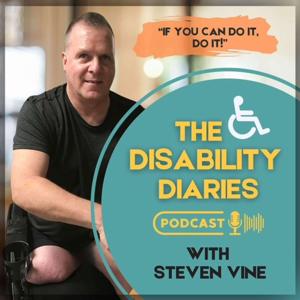
I am a disabled man and will be talking to both abled and disabled individuals about their challenges and how they overcome them. Also talking to other people in the disabled community (caregivers,…