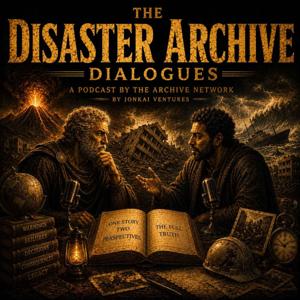
The Disaster Archive Dialogues

The Disaster Archive Dialogues

Download on the App Store

The Disaster Archive Dialogues episodes

  • Cyclone Nargis
    Before the storm had a name, and before the world watched in horror, the Irrawaddy Delta was a place where land and water never stopped negotiating with each other. But in two thousand eight, that balance tipped, and vulnerability was already woven into daily life.What happens when the ordinary risks you live with suddenly become catastrophic? In Myanmar’s Irrawaddy Delta, survival and exposure were two sides of the same coin. Life here turned on rice harvests, ferry crossings, and the tides that could nourish or threaten in equal measure. Villages like Labutta, Bogale, and Pyapon stood on low stilts above muddy ground, their walls of bamboo and roofs of thatch or corrugated metal. The delta was fertile, crowded, and dependent on natural rhythms—but it was also exposed, shaped by centuries of adaptation and the hard lessons of flood. The sea was never far, and neither was the memory of storms.Aurelius and Malik take on this case in full — 5 chapters, 33 minutes, one complete story.Learn more at: https://thedisasterarchive.com/disaster/cyclone-nargis

    The Disaster Archive Dialogues is part of The Archive Network by Jonkai Ventures. In every episode, curators Aurelius and Malik take one catastrophe and work through it from the world before to the legacy after — one reconstructing the sequence, the other pressing on the human cost.

    The Archive Network is an independent, solo-run project. Everything is free, with no ads and no paywalls. Support doesn't unlock anything; it simply keeps the work going:

    https://thearchivenetwork.com/support

    Explore this archive:

    https://thedisasterarchive.com

    Discover more archives and stories:

    https://thearchivenetwork.com

    Hosted on Acast. See acast.com/privacy for more information.

    34 min
  • Cyclone Mocha
    Salt wind scrapes across the Bay of Bengal, cutting through tarpaulin and bamboo. Here, the weather is not distant or theoretical. For those who live along this coast, every approaching storm is a test—one that can turn a home into a memory overnight.In early twenty twenty-three, western Myanmar and the camps of Cox’s Bazar in Bangladesh were already living on the threshold of disaster. The ground was fragile, the shelters were makeshift, and the people had long learned to expect hardship from land and sky alike. But what happens when a cyclone arrives in a place where the line between refuge and ruin has already worn thin?Aurelius and Malik take on this case in full — 5 chapters, 34 minutes, one complete story.Learn more at: https://thedisasterarchive.com/disaster/cyclone-mocha

    The Disaster Archive Dialogues is part of The Archive Network by Jonkai Ventures. In every episode, curators Aurelius and Malik take one catastrophe and work through it from the world before to the legacy after — one reconstructing the sequence, the other pressing on the human cost.

    The Archive Network is an independent, solo-run project. Everything is free, with no ads and no paywalls. Support doesn't unlock anything; it simply keeps the work going:

    https://thearchivenetwork.com/support

    Explore this archive:

    https://thedisasterarchive.com

    Discover more archives and stories:

    https://thearchivenetwork.com

    Hosted on Acast. See acast.com/privacy for more information.

    34 min
  • Cyclone Idai
    Before disaster, the world can feel deceptively stable. In Mozambique’s Beira, the sound of rain was just another part of life. But beneath the routine, danger was quietly building.If you lived there, would you have noticed how thin the safety net really was? The lower Pungwe basin had always been a place where people adapted to weather instead of trying to conquer it. Beira, a port city perched between the Indian Ocean and inland floodplains, sprawled across a narrow, flat strip of land. Every rainy season, canals, ditches, and rivers kept the city running—most years. Habits formed: thresholds were raised, eyes watched the sky, and storms were treated as inconveniences, not existential threats.Aurelius and Malik take on this case in full — 5 chapters, 33 minutes, one complete story.Learn more at: https://thedisasterarchive.com/disaster/cyclone-idai

    The Disaster Archive Dialogues is part of The Archive Network by Jonkai Ventures. In every episode, curators Aurelius and Malik take one catastrophe and work through it from the world before to the legacy after — one reconstructing the sequence, the other pressing on the human cost.

    The Archive Network is an independent, solo-run project. Everything is free, with no ads and no paywalls. Support doesn't unlock anything; it simply keeps the work going:

    https://thearchivenetwork.com/support

    Explore this archive:

    https://thedisasterarchive.com

    Discover more archives and stories:

    https://thearchivenetwork.com

    Hosted on Acast. See acast.com/privacy for more information.

    34 min
  • Cyclone Bhola
    In the final days before catastrophe, life in the Bay of Bengal delta followed a rhythm set by tides, storms, and the silent contest between land and sea. But beneath that everyday struggle, a deeper vulnerability was quietly taking shape—a risk so vast that most could not see it coming.In the shadow of embankments and under the watchful eyes of fishermen, a disaster was being written long before the winds began to howl. The northern edge of the Bay of Bengal was never truly still. Here, the ground was a patchwork of mud, rice fields, and water channels, shaped by each season’s flood. On Bhola Island and across the Meghna estuary, families rebuilt, adapted, and relied on the wisdom of generations. Fishermen set out at dawn, women fetched water from wells that sometimes vanished beneath the monsoon, and children played on paths that could disappear overnight. This was not a place for the careless, but it was home to millions. Life depended on fragile levees, quick boats, and houses built to be fixed, not fortified. The landscape itself taught a lesson: to survive, one must bend, never break.Aurelius and Malik take on this case in full — 5 chapters, 33 minutes, one complete story.Learn more at: https://thedisasterarchive.com/disaster/cyclone-bhola

    The Disaster Archive Dialogues is part of The Archive Network by Jonkai Ventures. In every episode, curators Aurelius and Malik take one catastrophe and work through it from the world before to the legacy after — one reconstructing the sequence, the other pressing on the human cost.

    The Archive Network is an independent, solo-run project. Everything is free, with no ads and no paywalls. Support doesn't unlock anything; it simply keeps the work going:

    https://thearchivenetwork.com/support

    Explore this archive:

    https://thedisasterarchive.com

    Discover more archives and stories:

    https://thearchivenetwork.com

    Hosted on Acast. See acast.com/privacy for more information.

    33 min
  • COVID-19
    Airports hummed with life. Departure boards flickered, suitcases rolled, and thousands moved through global hubs without a thought for risk. In that winter, nobody saw the cracks forming beneath the surface.The illusion of safety was everywhere. But a hidden vulnerability was growing. Modern life, so fast and interconnected, had stitched together a world that felt immune to catastrophe. International travel was routine. Families, students, business travelers crisscrossed continents, and every city was connected by invisible threads. It felt normal—until it wasn’t.Aurelius and Malik take on this case in full — 5 chapters, 32 minutes, one complete story.Learn more at: https://thedisasterarchive.com/disaster/covid-19

    The Disaster Archive Dialogues is part of The Archive Network by Jonkai Ventures. In every episode, curators Aurelius and Malik take one catastrophe and work through it from the world before to the legacy after — one reconstructing the sequence, the other pressing on the human cost.

    The Archive Network is an independent, solo-run project. Everything is free, with no ads and no paywalls. Support doesn't unlock anything; it simply keeps the work going:

    https://thearchivenetwork.com/support

    Explore this archive:

    https://thedisasterarchive.com

    Discover more archives and stories:

    https://thearchivenetwork.com

    Hosted on Acast. See acast.com/privacy for more information.

    33 min
  • Courrieres Mine Disaster
    In the first light of a winter morning in nineteen oh six, the towns around the Courrières coalfield moved to an unwavering rhythm. Miners descended into darkness each day, trusting that the ground below would hold as it always had. But beneath the surface, a chain of vulnerabilities was waiting to be triggered.The Courrières coalfield in France’s Pas-de-Calais region was more than an industrial engine. It was a dense, living network of shafts, galleries, and families, all bound together by the steady need for coal. The black dust on windowsills, the company houses, and the trains carrying coal—these were the marks of a region sustained and shaped by extraction. By the early twentieth century, the seams of coal lay deeper than ever, hotter, more dangerous. Technology and routine promised safety, but the truth underground was more fragile. In mining towns like Lens, Billy-Montigny, and Sallaumines, life was measured by the pit’s schedule. Paydays and school bells, meals and laundry, all revolved around the shaft. The Courrières company promised order, enforced rules, and kept the work moving, but every miner knew that the peace above ground was built on trust—trust in machines, in managers, and in the unseen air below.Aurelius and Malik take on this case in full — 5 chapters, 32 minutes, one complete story.Learn more at: https://thedisasterarchive.com/disaster/courrieres-mine-disaster

    The Disaster Archive Dialogues is part of The Archive Network by Jonkai Ventures. In every episode, curators Aurelius and Malik take one catastrophe and work through it from the world before to the legacy after — one reconstructing the sequence, the other pressing on the human cost.

    The Archive Network is an independent, solo-run project. Everything is free, with no ads and no paywalls. Support doesn't unlock anything; it simply keeps the work going:

    https://thearchivenetwork.com/support

    Explore this archive:

    https://thedisasterarchive.com

    Discover more archives and stories:

    https://thearchivenetwork.com

    Hosted on Acast. See acast.com/privacy for more information.

    33 min
  • Costa Concordia
    A cruise ship is meant to be a promise: safety, comfort, and escape from worry. But when you board a vessel like the Costa Concordia, what you really step into is a world built on invisible systems and trust. What if the calmest nights hide the most danger?Costa Concordia was supposed to represent the peak of modern cruising—immense, polished, and secure. She was built for Costa Crociere and launched in two thousand five, one of Europe’s largest passenger ships. Onboard, more than three thousand people could eat, sleep, and celebrate in a floating city. Glass elevators, sweeping staircases, sparkling dining rooms: every detail was designed to reassure. The dangers of the sea felt distant, hidden behind thick steel and strict routines. But beneath the glamour, the ship relied on an unbroken chain of human choices, and the smooth surface could not reveal what was waiting below.Aurelius and Malik take on this case in full — 5 chapters, 34 minutes, one complete story.Learn more at: https://thedisasterarchive.com/disaster/costa-concordia

    The Disaster Archive Dialogues is part of The Archive Network by Jonkai Ventures. In every episode, curators Aurelius and Malik take one catastrophe and work through it from the world before to the legacy after — one reconstructing the sequence, the other pressing on the human cost.

    The Archive Network is an independent, solo-run project. Everything is free, with no ads and no paywalls. Support doesn't unlock anything; it simply keeps the work going:

    https://thearchivenetwork.com/support

    Explore this archive:

    https://thedisasterarchive.com

    Discover more archives and stories:

    https://thearchivenetwork.com

    Hosted on Acast. See acast.com/privacy for more information.

    34 min
  • Concorde Crash
    At Paris-Charles de Gaulle, Concorde looked unstoppable. A machine born from ambition, slicing through clouds at twice the speed of sound—untouchable, untouchable, or so it seemed. But in the shadow of all that confidence, danger was building, almost invisible.It was the summer of two thousand. The Concorde was not just an airplane; it was an experience reserved for the fortunate. Passengers crossed the Atlantic in hours, not days. Paris to New York: breakfast in one world, dinner in another. The world watched Concorde as a symbol of what human engineering could achieve. Air France and British Airways kept this fleet airborne in a tightly controlled, glamorous bubble. Airports, maintenance crews, and regulators had all adapted to the unique demands of this remarkable machine. Everyone believed in the routine—believed it was enough. But routine, in aviation, is a fragile promise.Aurelius and Malik take on this case in full — 5 chapters, 33 minutes, one complete story.Learn more at: https://thedisasterarchive.com/disaster/concorde-crash

    The Disaster Archive Dialogues is part of The Archive Network by Jonkai Ventures. In every episode, curators Aurelius and Malik take one catastrophe and work through it from the world before to the legacy after — one reconstructing the sequence, the other pressing on the human cost.

    The Archive Network is an independent, solo-run project. Everything is free, with no ads and no paywalls. Support doesn't unlock anything; it simply keeps the work going:

    https://thearchivenetwork.com/support

    Explore this archive:

    https://thedisasterarchive.com

    Discover more archives and stories:

    https://thearchivenetwork.com

    Hosted on Acast. See acast.com/privacy for more information.

    34 min
  • Columbia Disaster
    A spacecraft stands ready for launch, gleaming under the Florida morning sun. But inside its elegant lines and layers lies a secret—a vulnerability that no one is prepared to see, even as it stares back from the launch pad.What happens when confidence itself becomes the most dangerous flaw? For decades, the space shuttle program represented the belief that routine could be engineered into the unknown. Columbia, the oldest orbiter, was a symbol of that faith—a winged machine meant to bridge Earth and orbit, reusable and reliable, carrying astronauts and national pride. But beneath the surface, compromise was everywhere. The shuttle’s design demanded insulation foam to keep its massive external tank from freezing, and fragile thermal tiles to protect against the brutal heat of re-entry. Every mission placed these components under stress, yet the system learned to live with their weaknesses. Foam loss became routine, and routine became dangerous.Aurelius and Malik take on this case in full — 5 chapters, 32 minutes, one complete story.Learn more at: https://thedisasterarchive.com/disaster/columbia-disaster

    The Disaster Archive Dialogues is part of The Archive Network by Jonkai Ventures. In every episode, curators Aurelius and Malik take one catastrophe and work through it from the world before to the legacy after — one reconstructing the sequence, the other pressing on the human cost.

    The Archive Network is an independent, solo-run project. Everything is free, with no ads and no paywalls. Support doesn't unlock anything; it simply keeps the work going:

    https://thearchivenetwork.com/support

    Explore this archive:

    https://thedisasterarchive.com

    Discover more archives and stories:

    https://thearchivenetwork.com

    Hosted on Acast. See acast.com/privacy for more information.

    32 min
  • Cocoanut Grove Fire
    Imagine stepping from a dark wartime street into a room so lush, so inviting, that the outside world simply vanishes. But beneath the surface, danger waits—woven into the walls, hiding in plain sight, and no one senses it yet.The Cocoanut Grove nightclub in Boston’s Bay Village was more than a place for music and cocktails. In nineteen forty-two, it was a fantasy—exotic décor, palm fronds, soft lighting, and a promise that for a night, you could forget the war raging beyond the blackout curtains. Inside, the world felt far away. But this comfort was built on a structure no one thought to question. The club was a maze of rooms, corridors, and hidden doors. Its very design, praised for intimacy, was already setting the stage for disaster. According to the later official investigation, these choices—softened boundaries, concealed exits, heavy decorations—would one day trap hundreds.Aurelius and Malik take on this case in full — 5 chapters, 33 minutes, one complete story.Learn more at: https://thedisasterarchive.com/disaster/cocoanut-grove-fire

    The Disaster Archive Dialogues is part of The Archive Network by Jonkai Ventures. In every episode, curators Aurelius and Malik take one catastrophe and work through it from the world before to the legacy after — one reconstructing the sequence, the other pressing on the human cost.

    The Archive Network is an independent, solo-run project. Everything is free, with no ads and no paywalls. Support doesn't unlock anything; it simply keeps the work going:

    https://thearchivenetwork.com/support

    Explore this archive:

    https://thedisasterarchive.com

    Discover more archives and stories:

    https://thearchivenetwork.com

    Hosted on Acast. See acast.com/privacy for more information.

    33 min

About The Disaster Archive Dialogues

From the publisher's feed

The Disaster Archive Dialogues is part of The Archive Network by Jonkai Ventures, a collection of podcasts dedicated to the stories that shaped our world.


Every episode is a conversation.…