
Sign up to save your podcasts
Or

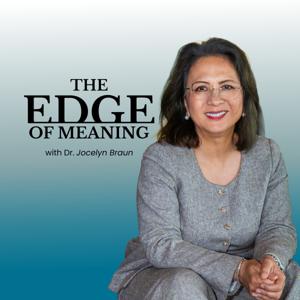


Many of us live surrounded by convenience, technology and movement, yet rarely touch soil, notice the seasons, or see how our food grows. We may not experience this as a loss. But it shapes us more deeply than we realise.
In this episode of The Edge of Meaning, Dr. Jocelyn Braun speaks with Kalpana Arias — guerrilla gardener, technologist, campaigner for the Right to Grow and the rights of nature, and founder of Nowadays On Earth. Kalpana grew up in Bogotá and Houston, and began gardening London's streets during the pandemic, when parks and community gardens closed their gates.
Together they ask what modern city life has normalised that may be deeply unnatural. Kalpana argues that our systems are not broken but working exactly as designed — and that design can change. The conversation moves through who gets access to nature in a city, why growing food changes people far beyond the harvest, the right to grow on public land, and why nature and technology need not sit on opposite sides.
It closes with an inward turn: rewilding the self, relearning patience, and the idea that we do not simply live alongside nature. We are part of it.
For anyone who lives in a city, works through screens, and senses something missing without quite knowing what.
Mentioned in this episode
- The Right to Grow campaign, started by Incredible Edible
- London National Park City
- David Abram
- Ed Yong, An Immense World
- Saidiya Hartman
Find Kalpana
LinkedIn: https://www.linkedin.com/in/kalpana-arias-a3b73b148/
Watch the full conversation on YouTube and find more at https://www.theedgeofmeaning.com
Hosted on Acast. See acast.com/privacy for more information.
Most of us are planning for someone we've never met. We save for her, work for her, postpone things on her behalf — and rarely stop to ask who she is, or whether she'd thank us.
In our first conversation, Dr Thomas Mathar — behavioural scientist, financial wellbeing expert and author of Your Path to Prosperity — explores what our financial lives reveal beyond the numbers: fear, freedom, safety, and the inherited stories we carry about what it means to live well.
We begin further back than most money conversations do. Money did not grow tidily out of barter — that story, as Thomas points out and I had to concede having taught it, is largely an invention. What money did was arrive alongside settlement, scale and strangers, and it has been entangled with how we live ever since. A psychologist, he says, would call the result a psychodynamic relationship: something we handle carefully, because of what it does back to us.
Which is where the mirror is. Thomas is precise about the part feeling plays, and his position is not that emotion corrupts financial decisions but that it informs them. Fear, envy and shame are worth interrogating rather than silencing — you can hear them out and still be the one deciding. Comparison, sharpened by social media, quietly resets the reference points against which we judge ourselves, which is why "enough" moves as we approach it. Security turns out to be only partly arithmetic. As he puts it: independence, freedom and security should not have to come from money. They are a state of mind.
The second half turns towards time. We talk about the go-go, slow-go and no-go years, and what changes when retirement is treated as three quite different decades rather than a single event. And we talk about the future self — who, it turns out, your brain files among strangers. Ask someone to picture themselves in thirty years and the same neural network lights up as when they think about a person they have never met. No wonder saving feels like giving money away. But as Thomas says: the future self is not a stranger. She is a person you will one day meet.
What stayed with me was a question rather than an answer: not whether we have enough, but whether we understand what we are asking money to do for us.
This is not financial advice, and it is not a conversation about products or portfolios. It is about the relationship underneath them.
—
Dr Thomas Mathar
LinkedIn: https://www.linkedin.com/in/mathar/
Your Path to Prosperity: https://www.amazon.co.uk/Your-Path-Prosperity-fund-happy/dp/1917391358
The Money Mindshift podcast: https://podcasts.apple.com/podcast/id1821463992
Help us grow by subscribing, leaving a review and sharing the episode. It would mean the world.
Join our community, sign up to our newsletter and dig deeper at www.theedgeofmeaning.com
Hosted on Acast. See acast.com/privacy for more information.
The Edge of Meaning explores the deeper questions beneath wealth, work, trust, technology, purpose and the lives we are trying to build.
One long-form conversation each month, hosted by Dr Jocelyn Braun — with short clips for when one idea is enough to begin, and reflections that carry the questions into everyday life.
These aren't conversations built for answers. They're built for orientation.
First episode: Money as a Mirror of the Mind, with Dr Thomas Mathar — out 8 September.
theedgeofmeaning.com
Hosted on Acast. See acast.com/privacy for more information.
From the publisher's feed
The Edge of Meaning explores the deeper questions beneath money, work, trust, technology, spirituality, lived experience and the lives we are trying to build.
One long-form conversation…
Hosted by Dr Jocelyn Braun, a fintech executive whose work cuts across finance, technology and education, and who brings experience, insight and curiosity to each conversation rather than a script.
This is a podcast that holds intellect and humanity together. The aim is orientation, not content residue.
Hosted on Acast. See acast.com/privacy for more information.