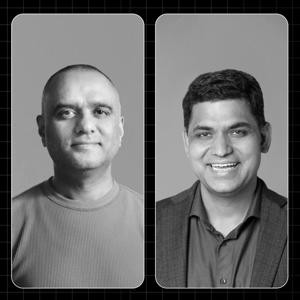
In this episode of The Effortless Podcast, Amit Prakash and Dheeraj Pandey are joined by Alex Dimakis for a wide-ranging, systems-first discussion on the future of long-horizon AI agents that can operate over time, learn from feedback, adapt to users, and function reliably inside real-world environments.
The conversation spans research and industry, unpacking why prompt engineering alone collapses at scale; how advisor models, reward-driven learning, and environment-based evaluation enable continual improvement without retraining frontier models; and why memory in AI systems is as much about forgetting as it is about recall. Drawing from distributed systems, reinforcement learning, and cognitive science, the trio explores how personalization, benchmarks, and context engineering are becoming the foundation of AI-native software.
Alex, Dheeraj, and Amit also examine the evolution from SFT to RL to JEPA-style world models, the role of harnesses and benchmarks in measuring real progress, and why enterprise AI has moved decisively from research into engineering. The result is a candid, deeply technical conversation about what it will actually take to move beyond demos and build agents that work over long horizons.
Key Topics & Timestamps
00:00 – Introduction, context, and holiday catch-up
04:00 – Teaching in the age of AI and why cognitive “exercise” still matters
08:00 – Industry sentiment: fear, trust, and skepticism around LLMs
12:00 – Memory in AI systems: documents, transcripts, and limits of recall
17:00 – Why forgetting is a feature, not a bug
22:00 – Advisor models and dynamic prompt augmentation
27:00 – Data vs metadata: control planes vs data planes in AI systems
32:00 – Personalization, rewards, and learning user preferences implicitly
37:00 – Why prompt-only workflows break down at scale
41:00 – RAG, advice, and moving beyond retrieval-centric systems
46:00 – Long-horizon agents and the limits of reflection-based prompting
51:00 – Environments, rewards, and agent-centric evaluation
56:00 – From Q&A benchmarks to agents that act in the world
1:01:00 – Terminal Bench, harnesses, and measuring real agent progress
1:06:00 – Frontier labs, open source, and the pace of change
1:11:00 – Context engineering as infrastructure (“the train tracks” analogy)
1:16:00 – Organizing agents: permissions, visibility, and enterprise structure
1:20:00 – SFT vs RL: imitation first, reinforcement last
1:25:00 – Anti-fragility, trial-and-error, and unsolved problems in continual learning
1:28:00 – Closing reflections on the future of long-horizon AI agents
Hosts:
Amit Prakash
CEO & Founder at AmpUp, Former engineer at Google AdSense and Microsoft Bing, with deep expertise in distributed systems, data platforms, and machine learning.
Dheeraj Pandey
Co-founder & CEO at DevRev, Former Co-founder & CEO of Nutanix. A systems thinker and product visionary focused on AI, software architecture, and the future of work.
Guest:
Alex Dimakis
Alex Dimakis is a Professor in UC Berkeley in the EECS department. He received his Ph.D. from UC Berkeley and the Diploma degree from NTU in Athens, Greece. He has published more than 150 papers and received several awards including the James Massey Award, NSF Career, a Google research award, the UC Berkeley Eli Jury dissertation award, and several best paper awards. He is an IEEE Fellow for contributions to distributed coding and learning. His research interests include Generative AI, Information Theory and Machine Learning. He co-founded Bespoke Labs, a startup focusing on data curation for specialized agents.
Follow the Hosts and the Guest:
Dheeraj Pandey:
LinkedIn - https://www.linkedin.com/in/dpandey
Twitter - https://x.com/dheeraj
Amit Prakash:
LinkedIn - https://www.linkedin.com/in/amit-prak...
Twitter - https://x.com/amitp42
Alex Dimakis:
LinkedIn - https://www.linkedin.com/in/alex-dima...
Twitter - https://x.com/AlexGDimakis
Share Your Thoughts
Have questions, comments, or ideas for future episodes?
📩 Email us at [email protected]
Don’t forget to Like, Comment, and Subscribe for more conversations at the intersection of AI, systems, and product design.