
Sign up to save your podcasts
Or

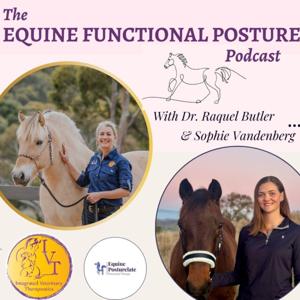


Episode 107 - The Neurological Examination
A horse can pass a lameness assessment and still show signs that warrant a neurological examination.
In this episode, Dr. Raquel Butler and Sophie Vandenberg explain how an equine neurological examination differs from a musculoskeletal assessment. They explore the tests veterinarians use to assess sensation, coordination, balance, limb awareness and nervous-system function, alongside signs that may indicate the need for further investigation.
We discuss:
To learn more about Dr Raquel Butler visit:
Facebook: Integrated Veterinary Therapeutics
Website: https://www.integratedvettherapeutics.com.au
To learn more about Sophie Vandenberg:
Facebook: Equine Posturelate - Sophie Vandenberg
Have any questions or topics you'd love us to cover?
Email us at: [email protected]
Episode 107 - Pre-Purchase Exams: Are They Worth It?
A pre-purchase examination can reduce risk and provide valuable information, but it cannot guarantee a horse's future soundness or suitability.
In this episode, Dr. Raquel Butler and Sophie Vandenberg explore what equine pre-purchase examinations can and cannot tell us. They discuss the standard stages of a veterinary examination, choosing radiographs and optional diagnostics, understanding fitness for purpose, and combining veterinary findings with observation, history and informed decision-making.
We discuss:
To learn more about Dr Raquel Butler visit:
Facebook: Integrated Veterinary Therapeutics
Website: https://www.integratedvettherapeutics.com.au
To learn more about Sophie Vandenberg:
Facebook: Equine Posturelate - Sophie Vandenberg
Have any questions or topics you'd love us to cover?
Email us at: [email protected]
Episode 105 - Post Colic Surgery Rehabilitation
Returning to performance after colic surgery does not necessarily mean that a horse's core function has fully recovered.
In this episode, Dr. Raquel Butler and Sophie Vandenberg discuss rehabilitation following colic surgery, including how abdominal surgery can affect core strength, posture, breathing and movement. They outline a staged approach that begins with wound management and gut health, then progresses through stability, functional activation, strength and a carefully assessed return to riding.
We discuss:
To learn more about Dr Raquel Butler visit:
Facebook: Integrated Veterinary Therapeutics
Website: https://www.integratedvettherapeutics.com.au
To learn more about Sophie Vandenberg:
Facebook: Equine Posturelate - Sophie Vandenberg
Have any questions or topics you'd love us to cover?
Email us at: [email protected]
Sometimes the most powerful change comes from doing less, waiting longer and observing more carefully.
This episode is a reflective discussion about a recent two-day equine posture clinic hosted by Dr Raquel involving five very different horses. Differing levels of balance, stability, communication and mental engagement shaped each horse's response, and we explain why the same exercise may need to look completely different for each individual horse.
We discuss:
To learn more about Dr Raquel Butler visit:
Facebook: Integrated Veterinary Therapeutics
Website: https://www.integratedvettherapeutics.com.au
To learn more about Sophie Vandenberg:
Facebook: Equine Functional Therapy
Have any questions or topics you'd love us to cover?
Email us at: [email protected]
Episode 103 - Guest: Sharon May Davis - Grading ECVM (Equine Complex Vertebral Malformation
ECVM is more than simply identifying an anatomical variation in the lower cervical spine.
In this episode, Dr. Raquel Butler and Sophie Vandenberg are joined by Dr. Sharon May-Davis PhD to explore the history, research and grading of Equine Complex Vertebral Malformation (ECVM), and what different presentations may mean for the individual horse.
We discuss:
To learn more about Dr Raquel Butler visit:
Facebook: Integrated Veterinary Therapeutics
Website: https://www.integratedvettherapeutics.com.au
To learn more about Sophie Vandenberg:
Facebook: Equine Posturelate – Sophie Vandenberg
Have any questions or topics you’d love us to cover?
Email us at: [email protected]
Pain management in horses is rarely about finding one single treatment.
In this episode, we explore how pain can be managed more holistically, why different types of pain may respond differently to treatment, and how movement, environment and daily management can all influence comfort and recovery.
We discuss:
To learn more about Dr Raquel Butler visit:
Facebook: Integrated Veterinary Therapeutics
Website: https://www.integratedvettherapeutics.com.au
To learn more about Sophie Vandenberg:
Facebook: Equine Posturelate – Sophie Vandenberg
Have any questions or topics you’d love us to cover?
Email us at: [email protected]
Pain in horses is not simply a direct measure of tissue damage.
In this episode, we explore what pain actually is, how the nervous system contributes to the pain experience, and why persistent pain can become much more complex than simply finding an injured structure.
We discuss:
To learn more about Dr Raquel Butler visit:
Facebook: Integrated Veterinary Therapeutics
Website: https://www.integratedvettherapeutics.com.au
To learn more about Sophie Vandenberg:
Facebook: Equine Posturelate – Sophie Vandenberg
Have any questions or topics you’d love us to cover?
Email us at: [email protected]
A dropped fetlock is often associated with Degenerative Suspensory Ligament Desmitis (DSLD), but does a sinking fetlock always indicate this degenerative disease?
Today we explore the current research around DSLD, discuss where the evidence is strong, where it remains uncertain, and why whole-body posture and loading may be an important part of the picture.
We discuss
A key question throughout the episode: are we sometimes diagnosing a degenerative ligament disorder when we are actually seeing the consequences of chronic postural dysfunction and inappropriate loading?
To learn more about Dr Raquel Butler visit:
Facebook: Integrated Veterinary Therapeutics
Website: https://www.integratedvettherapeutics.com.au
To learn more about Sophie Vandenberg:
Facebook: Equine Posturelate – Sophie Vandenberg
Have any questions or topics you’d love us to cover?
Email us at: [email protected]
When should we start riding a young horse?
There are strong opinions at both ends of the spectrum: start them young so the body adapts to load, or wait until the growth plates have closed before riding. In Part 2 of our growth plate series, we look at why the answer is much more individual than simply choosing an age.
We discuss the difference between loading and overloading, and why skeletal maturity alone doesn’t necessarily mean a horse is physically prepared to carry a rider.
In this episode we explore:
To learn more about Dr Raquel Butler visit:
Facebook: Integrated Veterinary Therapeutics
Website: https://www.integratedvettherapeutics.com.au
To learn more about Sophie Vandenberg:
Facebook: Equine Posturelate – Sophie Vandenberg
Have any questions or topics you’d love us to cover?
Email us at: [email protected]
Growth plates are central to skeletal development, but there is much more to them than simply knowing when they “close”.
Today we are explaining what growth plates are, how bones grow, and the factors that influence healthy development.
We discuss:
In Part 2, we’ll apply this information specifically to starting and training horses.
To learn more about Dr Raquel Butler visit:
Facebook: Integrated Veterinary Therapeutics
Website: https://www.integratedvettherapeutics.com.au
To learn more about Sophie Vandenberg:
Facebook: Equine Posturelate – Sophie Vandenberg
Have any questions or topics you’d love us to cover?
Email us at: [email protected]
From the publisher's feed

787 Listeners

8,378 Listeners

210 Listeners

131 Listeners
24 Listeners
213 Listeners
30 Listeners

19,146 Listeners

2,232 Listeners
48 Listeners