
Sign up to save your podcasts
Or

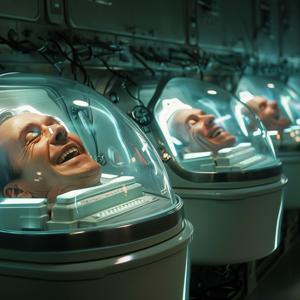


In a groundbreaking paper titled "Uncertainty at the Edge: Turing's Halting Problem and Its Implications for the Simulation Hypothesis," researcher Douglas C. Youvan explores a fascinating intersection between two seemingly unrelated concepts: Alan Turing's Halting Problem and the popular Simulation Hypothesis. This article delves into Youvan's work, examining how a fundamental limitation in computer science might have profound implications for our understanding of reality itself. This is an AI generated conversation about the article found here: https://theexperiencemachine.com/articles/the-halting-hypothesis/
Read and listen to more at TheExperienceMachine.com
In the realm of philosophical thought experiments, few have captured the public imagination quite like Nick Bostrom's Simulation Argument. The idea that our reality might be a computer simulation has spawned countless discussions, debates, and even Hollywood blockbusters. But while many have pondered the implications of living in a simulated world, few have attempted to quantify exactly how many simulations we might be existing in. Enter Dr. Hutan Ashrafian, whose paper "How Many Simulations Do We Exist In? A Practical Mathematical Solution to the Simulation Argument" offers a fresh, numbers-driven approach to this mind-bending concept. This is an AI generated conversation about the article found here: https://theexperiencemachine.com/articles/the-simulated-few/
Read and listen to more at TheExperienceMachine.com
What if the universe, in all its vast complexity, is nothing more than a grand computation? This question, central to the simulation hypothesis, finds an unlikely progenitor in the work of Konrad Zuse. His 1969 paper, "Rechnender Raum" or "Calculating Space," proposed that the universe operates as a colossal computational system, laying the foundation for digital physics and challenging our understanding of reality. This is an AI generated conversation about the article found here: https://theexperiencemachine.com/articles/the-matrix-konrad-zuse/
Read and listen to more at TheExperienceMachine.com
In the vast landscape of human imagination, few concepts rival the intrigue of existing in a simulated reality. We explore a captivating hypothesis that posits our universe as a mathematical approximation—an ingenious simulation crafted by our distant descendants. This theory suggests that our reality is a precisely calculated model, designed to mirror the macroscopic properties of a vastly more complex 'base reality' while conserving computational resources. It not only challenges our perception of existence but also offers a unique lens through which to view consciousness and the fundamental fabric of our universe. This is an AI generated conversation about the article found here: https://theexperiencemachine.com/articles/the-fractal-frontier-infinite-complexity-in-a-finite-simulation/
Read and listen to more at TheExperienceMachine.com
From the publisher's feed
Is our reality a sophisticated computer program? Welcome to the podcast where we grapple with the profound questions raised by the Simulation Hypothesis! We explore this idea – popularised by…