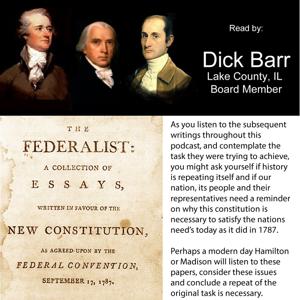
The Federalist Papers

The Federalist Papers

By Dick BarrHistory
Download on the App Store

The Federalist Papers episodes

  • Federalist Papers #15 - The Insufficiency of the Present Confederation to Preserve the Union
    Hamilton begins by telling the people that in the previous papers he has tried to convince them of the importance of the Union to "political safety and happiness." In this essay, he changes the theme to the "insufficiency of the present confederation to the preservation of the union." He argues that the majority of the people agree that the present form of government will eventually lead to "impending anarchy." He continues that the United States has reached the "last stage of national humiliation," because of large debts, territories in the possession of a foreign power, a lack of military, a lack of money, inability to navigate on the Mississippi River, lack of commerce, lack of respect by foreign powers, decrease in value of property, and unavailability of credit. In sum, because of "national disorder, poverty, and insignificance." Hamilton urges that the country must firmly stand for safety, tranquility, dignity, and reputation. He attacks the supporters of the Articles of Confederation, claiming that though they admit that the government is destitute of energy, they stand against "conferring upon it those powers which are requisite to supply that energy," wanting instead, something that is impossible, the augmentation of federal powers without decreasing the powers of the states. To Hamilton, the biggest problem in the existing government is the principle of legislation for states in a collective manner, which creates multiple sovereigns. Under this situation, the laws of the nation, though constitutionally binding, become merely suggestions that the states can choose to follow or not follow. While he sees nothing wrong with compacts between states, like such treaties that exist throughout the world, from experience he believes that little dependence can be placed on such agreements. He believes that the states of the country could stand in similar relation to each other, and it would not be ideal but would be "consistent and practicable." But if there is still some desire for a national government, it must take on different characteristics from a league of governments: we must extend "the authority of the union to the persons of the citizens, the only proper objects of government." The very idea of a government implies the power of making laws and those laws must contain a consequence, a penalty, applied by the military or the court. Because no system exists under the Articles of Confederation that properly carries out the law (no national court system), the government is useless. For Hamilton, government was created because the passions of men do not conform to the "dictates of reason and justice" and groups of men act with greater intelligence than individuals alone. Hamilton supposes that this is because reputation has a less active influence. In addition, he believes that because of the nature of sovereign power, people become obsessed with their own power. A meeting of many sovereign powers, then, like the Articles of Confederation, creates problems because a love of power means that people fail to compromise. The business of the government, therefore, cannot be carried out under this system and national interests become subservient to individual desires and wishes. Alexander Hamilton, finally, specifically attacks the Articles of Confederation as failing because the system was destined to fail. It did not happen all at once, but instead, gradually, progressing to the point that things have become a "stand-all," with everyone "yielding to the persuasive voice of immediate interest and convenience, till the frail and tottering edifice seems ready to fall upon our heads and to crush us beneath its ruins."

    25 min
  • Federalist Papers #14 - Objections to the Proposed Constitution From Extent of Territory Answered
    In this paper, Madison seeks to counter the arguments made by opponents of the Constitution that America is too large a country to be governed as a united republic. He argues that these critics, in arguing that a republic must be confined to a small territory, have confused a republic with a democracy. The difference, according to Madison, is that in a democracy the people meet and exercise the government in person, whereas in a republic the people govern the country through their elected representatives. Because a republic has representatives, it can extend over a large region. Madison calculates in some detail the size of the United States and argues that it is not too large to be governed by a republic, especially when compared to Great Britain and other European countries.

    Madison argues further that the general government will only be authorized to deal with issues of concern to the entire republic. State governments will be left to deal with local concerns, thus making the administration of a country as vast as the US more manageable. Furthermore, as America becomes more developed with roads, canals and other infrastructure, it will be easier for the states to communicate and thus easier for the national government to administer the country. Finally, although representatives from those states farthest from the capitol (such as Georgia) will have longer to travel, they will also be in greater need of the benefits of union due to the dangers inherent in being a frontier.

    Madison concludes this paper by exhorting Americans not to destroy their unity. He dismisses those who say no country has ever succeeded in what Americans are trying to accomplish, and encourages Americans to boldly accomplish what has not been accomplished before.
    17 min
  • Federalist Papers #13 - Advantage of the Union in Respect to Economy in Government
    IN THIS SHORT PAPER, HAMILTON ARGUES THAT A UNION WILL BE MORE COST EFFECTIVE THAN A SYSTEM OF MULTIPLE AMERICAN SOVEREIGNTIES. IF AMERICA WERE TO BE DIVIDED INTO THIRTEEN INDEPENDENT STATES, OR SOME SMALLER NUMBER OF CONFEDERACIES, EACH POLITY WOULD HAVE TO EMPLOY ITS OWN “CIVIL LIST,” OR BUREAUCRACY, TO MANAGE PUBLIC AFFAIRS. EACH STATE WOULD FURTHERMORE HAVE TO EMPLOY PEOPLE TO GUARD ITS BORDERS AGAINST ILLICIT TRADE AND AN ARMY TO DEFEND AGAINST INVASION. ALL THESE EXPENSES WOULD PROVE TO BE A SIGNIFICANT AND UNNECESSARY BURDEN TO EACH SOVEREIGNTY’S ECONOMY.
    IN CONTRAST, UNITED AMERICA WOULD BE ABLE TO MAKE DO WITH A SINGLE NATIONAL GOVERNMENT, A SINGLE ARMY, AND A SINGLE ENTITY RESPONSIBLE FOR CATCHING SMUGGLERS. THIS WOULD REDUCE WASTE AND INEFFICIENCY. HAMILTON POINTS TO THE EXAMPLE OF GREAT BRITAIN’S GOVERNMENT TO ARGUE THAT A SINGLE, WELL-STRUCTURED, NATIONAL GOVERNMENT COULD EASILY BE EXTENDED TO COVER LARGE SWATHS OF TERRITORY AND BIG POPULATIONS.
    8 min
  • Federalist Papers #12: The utility of the union in Respect to Revenue
    In this paper, Hamilton continues his defense of the union provided for by the Constitution by arguing that a single national government will be better able to collect taxes than individual, disunited states. He bases his argument on the assertions that a steady source of revenue is essential to the strength of any nation and that taxes on commerce and consumption are more desirable then direct taxes on individuals based on what they produce. He contends that if America were divided into multiple states or confederacies, it would be very easy for smugglers to bypass the commercial taxes put in place by the various states.

    He uses the example of France’s difficulty in patrolling its large land border with neighboring European countries and contends that smugglers could use the many land borders between the states to avoid tax collectors. For example, if New York had higher taxes than New Jersey, an English merchant could bring his goods to a New Jersey port, smuggle them across the border to New York and thus avoid the higher New York taxes. If, however, America were united as a single country, it would only need to patrol its Atlantic sea border and would thus be able to better secure taxes from foreign trade. Hamilton warns that if America is disunited then commercial taxes will soon prove insufficient, forcing the states to levy oppressive taxes on land owners.
    17 min
  • Federalist Papers #11: The Utility of the Union in Respect to Commercial Relations and a Navy
    In this paper, Alexander Hamilton continues the defense of union over disunion by outlining the benefits of the former for American commerce and naval power. He argues that in order for Americans to maintain an active commerce, by which he means the ability to control and shape the terms of its trade with foreign powers, America requires a union. He argues that only a union will be strong enough to secure favorable terms of trade with European powers.

    He contends further that a united America will be able to pool its diverse resources in building a powerful navy. This navy would then help deter European powers from threatening American commercial interests and stealing American resources. It would furthermore give America significant influence in shaping the international politics of the West Indies where the European powers have significant commercial interests. Hamilton warns that were America to find itself in a state of disunion, the individual states would be too weak to resist the predatory behavior of European powers who would be able to impose unfair terms of trade on the Americans. America would ultimately be reduced to what Hamilton calls a “passive commerce,” which would enrich foreign powers at the expense of American merchants.
    20 min
  • Federalist Papers #10: The Same Subject Continued
    FEDERALIST 10 (AUTHORED BY MADISON WRITING AS PUBLIUS) CLAIMS THAT THE “VIOLENCE OF FACTION” IS THE “MORTAL DISEASE” OF POPULAR GOVERNMENTS. EVEN TODAY, HE SAYS, POINTING TO THE EXPERIENCE OF THE STATES, THE DIVISIONS BETWEEN RIVAL PARTIES TOO OFTEN LEAD NOT TO REASONABLE COMPROMISES BUT TO DECISIONS MADE “NOT ACCORDING TO THE RULES OF JUSTICE, AND THE RIGHTS OF THE MINOR PARTY, BUT BY THE SUPERIOR FORCE OF AN INTERESTED AND OVERBEARING MAJORITY.” UNLESS IT REMEDIES THIS PROBLEM ON THE NATIONAL LEVEL, THE NEW CONSTITUTION WILL NOT CEMENT “A WELL CONSTRUCTED UNION” OF THE STATES.
    WE CAN CURE THE DISEASE OF FACTION EITHER BY “REMOVING ITS CAUSES” OR BY “CONTROLLING ITS EFFECTS.” THERE ARE BUT TWO WAYS TO REMOVE THE CAUSES OF FACTION: TO DESTROY “THE LIBERTY ESSENTIAL TO ITS EXISTENCE,” OR TO GIVE “TO EVERY CITIZEN THE SAME OPINIONS, THE SAME PASSIONS, AND THE SAME INTERESTS.” SINCE, IN OTHER WORDS, THE CAUSES OF FACTION ARE “SOWN IN THE NATURE OF MAN,” WE MUST DESIGN POPULAR GOVERNMENT TO CONTROL ITS EFFECTS.
    FORTUNATELY, PUBLIUS POINTS OUT, AMONG THE VARIOUS OPTIONS FOR POPULAR GOVERNMENT — A PURE DEMOCRACY, A SMALL REPUBLIC, OR A LARGE REPUBLIC — THE CONSTITUTION IS DESIGNED NOT ONLY FOR THE ACTUAL AMERICAN SITUATION BUT ALSO FOR THAT MOST LIKELY TO MITIGATE THE PROBLEM OF FACTION. IT IS DESIGNED FOR A LARGE REPUBLIC EXTENDING OVER A GEOGRAPHICALLY LARGE AND DIVERSE TERRITORY AND COMPREHENDING WITHIN ITS LIMITS A DIVERSE AND CONSTANTLY SHIFTING AND RECONFIGURING ARRAY OF INTEREST GROUPS. THIS VERY DIVERSITY WILL PREVENT ANY SINGLE FACTION FROM ACQUIRING THE POWER TO TYRANNIZE OVER THE OTHERS.
    23 min

About The Federalist Papers

From the publisher's feed

A reintroduction and reading of the Federalist Papers, first penned in 1787-1788, to support and defend the Nation's New Constitution.

As you listen to the subsequent writings throughout this…