
Sign up to save your podcasts
Or

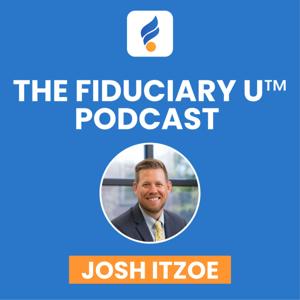


Welcome to episode #53 of the Fiduciary U™ Podcast.
In this episode, Josh Itzoe sits down with Nate Moody, Partner at Lebel & Harriman, to discuss building a career in retirement plan advisory, creating authentic relationships, and navigating the evolving financial services landscape.
Nate grew up in Gorham, Maine, in an entrepreneurial household where his father owned a collision repair business. After graduating from Bowdoin College, Nate turned down opportunities in Boston and New York to stay in Maine, betting on the long game of building deep local relationships. He started as an analyst at LeBell & Harriman in 2014 making $43,000—while his peers laughed from their Wall Street jobs—and became a partner in 2023. Today, his firm manages nearly 100,000 retirement plan participants, primarily in Maine.
During the conversation, Nate explains why he chose the employer retirement plan space over private wealth management. Working with a company's 401(k) plan allows him to impact hundreds or thousands of participants through a single decision—implementing auto-enrollment, reducing fees, or improving investment options—creating an exponential community impact. He also describes how genuine care for clients creates sustainable relationships. He emphasizes that clients can detect when advisors are just going through the motions versus truly investing in their success.
As it relates to next-gen advisors, here's his best advice:
The episode also touches on how technology, regulatory changes, and shifting client demographics are transforming the retirement plan advisory landscape.
Welcome to episode #52 of the Fiduciary U™ Podcast.
In this episode, Josh Itzoe sits down with Grant Ellis from Ellis Retirement Services to discuss his with deep roots in the retirement plan industry. Grant shares his unconventional entry into the business—from competitive golfer to internal wholesaler to TPA firm work with his actuary father, ultimately launching his own advisory practice at 27.
Grant's journey hasn't been limited to financial services. He's started multiple businesses, including a peanut butter company that grew to 15 employees before closing. These entrepreneurial experiences have given him invaluable perspective when working with plan sponsors and business owners, helping him understand that retirement plans, while important, are just one priority among many operational challenges.
The conversation explores Grant's philosophy on client relationships and business development. Rather than relying heavily on tactics and preparation, Grant emphasizes the power of authentic human connection. He approaches meetings simply by asking clients to share their stories, believing that genuine curiosity and emotional intelligence trump any rehearsed pitch or tool demonstration.
Grant, who has become a notable voice on LinkedIn for his industry insights, challenges advisors to focus less on becoming tool experts and more on becoming master craftsmen of human relationships. He argues that in an AI-driven future, technical tools won't differentiate advisors—the ability to connect deeply with clients will.
His advice for next-gen advisors: study human condition and develop relationship capital. Success in the advisory space isn't about having the perfect email template or the most sophisticated technology stack. It's about being technically sound while building trust through authentic human connection. As Grant puts it, clients don't choose their doctor based on having the newest scalpels—they choose based on competence and trust.
The episode concludes with Grant emphasizing that while tools are important for efficiency, they're means to an end, not the objective itself. The real differentiator is being exceptionally good at understanding and connecting with other human beings.
Welcome to episode #51 of the Fiduciary U™ Podcast. My guest today is Rob Madore from Marshberry.
In this episode, I interview Rob Madore, an expert in investment banking and management consulting. We discuss the role of MarshBerry, a management consulting and investment banking firm, in helping advisory firms grow and maximize their value. We also explore some of the current challenges and opportunities in the industry, including the integration of acquired firms and the importance of organic growth. Our conversation highlights the need for advisory firms to have a long-term plan and a solid growth foundation to achieve success.
We also discuss the challenges and strategies for growing and scaling advisory firms. We emphasize the importance of overcoming growth barriers, cultivating the next generation of advisors, and adapting to a constantly changing competitive landscape. We also touch on the value of niche specialization, differentiation, and focusing on the right types of clients. We conclude our conversation with a discussion on the drivers of value in advisory firms and the importance of scale, profitability, human and capital.
Listeners are encouraged to connect with Rob on LinkedIn or via email to learn more.
Welcome to episode #50 of the Fiduciary U™ Podcast. My guest today is Patrick Bushlack from The Standard.
In this conversation, we discuss Pooled Employer Plans (PEPs) and their growing impact on the retirement industry. We explore the different flavors of PEPs and the importance of advisor centricity in designing and implementing these plans. We also touch on the challenges faced by HR and benefits teams, the concept of indirect fee compression for financial advisors, and the need for a flexible framework in PEPs.
The conversation highlights the importance of good data, the role of a pooled plan provider, and the value of insulating plan sponsors from operational failures. We also discuss the benefits and challenges of Pooled Employer Plans (PEPs). We explore topics such as the service-first approach, intraplan subsidization, the role of advisors in PEPs, the potential for cost savings, and the timeline for setting up a PEP.
Patrick emphasizes the importance of curiosity and education for advisors considering PEPs. He also shares lessons learned from their experience with PEPs, including the high level of interest from employers and the need for flexibility and collaboration. Listeners are encouraged to connect with Patrick on LinkedIn or via email to learn more.
On this episode, Rebecca Hourihan from 401(k) Marketing and I discuss the changes in marketing strategies over the past decade and the importance of differentiation in the industry. She emphasizes the visual identity of advisors' websites and the need to showcase their office and team to create familiarity and connection with potential clients. She also highlights the significance of brand guidelines and professional photography in conveying a unique client experience.
She suggests focusing on email marketing campaigns, LinkedIn engagement, and maintaining an active blog to attract and retain clients. We discuss the importance of building a rewarding culture, designing an effective content strategy, and leveraging technology in the retirement industry.
We also explore the limitations and benefits of AI in content creation, the challenges of outdated technology, and the value of investing in the right tools and resources.
Additionally, we highlight the need for retirement advisors to view technology as an investment rather than an expense and the importance of storytelling and messaging in delivering high-value content. Overall, the conversation emphasizes the importance of leveraging technology and expertise to enhance the advisor's business and client experience.
In this conversation, I interview Justin Tarantin, the CEO of Venrollment, a participant engagement platform for retirement plans. We discuss the challenges of in-person education, the birth of Venrollment, the impact of COVID-19, and the importance of branding and differentiation. We also explore how Venrollment enables advisors to target the small plan market and deliver value to plan sponsors. Justin shares his career arc and the vision for Venrollment's future, including expanding into health benefits. The conversation concludes with a discussion on integrating retirement and health benefits and the challenges that come with it. We discuss the challenges and pain points in the retirement space and the importance of understanding the advisor pain points. We also explore the complexity of implementing new tools and the advantage of newer solutions with less technical debt. The focus is on making the advisor's life easier and finding simple solutions to complex challenges. Delegating and outsourcing lower-value activities is emphasized, as well as empowering education specialists. The conversation highlights the importance of investing in technology and using it to educate employees. Listeners are encouraged to connect with Venrollment for more information.
Welcome to Part 2 of episode #47 of the Fiduciary UÔ Podcast.
My guest today is Bill Chetney, Jr. from Viking Cove Institute. Bill’s dad Bill Chetney Sr. arguably created the first aggregator with National Retirement Partners (NRP), eventually selling it to LPL, and ultimately created GRPAA. Now it’s Bill Jr.’s turn to lead the organization forward and today he shares his vision for what that looks like.
On the show we cover a lot of ground around topics and the various ways Viking Cove Institue supports the independent advisor community through a combination of resources like training and educations, fintech solutions and partnerships, and favorable economics with product providers to create institutional scale that Viking Cove members can leverage to compete more effectively within the marketplace.
Welcome to Part 1 of episode #47 of the Fiduciary U™ Podcast.
My guest today is Bill Chetney, Jr. from Viking Cove Institute. Bill’s dad Bill Chetney Sr. arguably created the first aggregator with National Retirement Partners (NRP), eventually selling it to LPL, and ultimately created GRPAA. Now it’s Bill Jr.’s turn to lead the organization forward and today he shares his vision for what that looks like.
On the show we cover a lot of ground around topics and the various ways Viking Cove Institue supports the independent advisor community through a combination of resources like training and educations, fintech solutions and partnerships, and favorable economics with product providers to create institutional scale that Viking Cove members can leverage to compete more effectively within the marketplace.
Welcome to Part 2 of episode #46 of the Fiduciary U™ Podcast.
My guest today is Liz Davidson from Financial Finesse and this is her second time on the show.
On this episode, we discuss her new book, Money Strong: Your Guide to a Life Free of Financial Worries, her "START" framework which outlines a universal process that can be applied to anyone's financial life regardless of where they are, her writing process, why Financial Finesse focuses on "coaching" vs. "advice" to employees, their "Powered By" division which provides a combination of technology and coaching infrastructure to partners, how AI and mass personalization can help reach more people and drive transformational change, the behavioral and psychological aspects to financial stress, and much more.
Welcome to Part 1 of episode #46 of the Fiduciary U™ Podcast.
My guest today is Liz Davidson from Financial Finesse and this is her second time on the show.
On this episode, we discuss her new book, Money Strong: Your Guide to a Life Free of Financial Worries, her "START" framework which outlines a universal process that can be applied to anyone's financial life regardless of where they are, her writing process, why Financial Finesse focuses on "coaching" vs. "advice" to employees, their "Powered By" division which provides a combination of technology and coaching infrastructure to partners, how AI and mass personalization can help reach more people and drive transformational change, the behavioral and psychological aspects to financial stress, and much more.
From the publisher's feed

227,419 Listeners

39,013 Listeners

152,869 Listeners

6,759 Listeners
5,858 Listeners

1,034 Listeners

2,141 Listeners
244 Listeners

6,063 Listeners

11 Listeners

792 Listeners

29 Listeners
18 Listeners

1,439 Listeners
27 Listeners