
Sign up to save your podcasts
Or

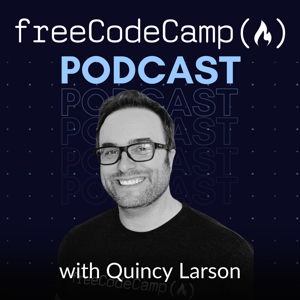


In this week's podcast episode of the freeCodeCamp podcast, Abbey chats with Harry Wolff, an engineering manager at MongoDB in New York City.
Harry has been in the world of tech for over a decade, holding jobs in various startups before ending up at Mongo. They discuss his journey to his current managerial role, what it's like to work at Mongo, how to start a meetup, and dos and don't for migrating from legacy codebases.
Harry started his tech career working for startups. He liked the excitement, he liked learning new things, and he liked showing off his skills. After working for a few startups, he stumbled upon a position at MongoDB. One short week after beginning the interview process, he was in.
The decision to leave his previous job was easier than he expected, and he reflected on the reasons he made the change:
"For me, it was a matter of taking what I could from my job at the time, but knowing when it was time to move on. One of the ways you know it's time to leave is when the company's getting more out of you than you're getting out of the company."Once Harry was settled in at Mongo, he got right to work. After a couple years as an engineer working on various projects, he achieved one of his major goals and became a manager.
Harry and I discussed his relatively new position in detail, and while he's still figuring things out, he has some valuable insights into his transition.
"One of the most difficult things about being a manager is that there's no easy way to evaluate the success of your day. There are no milestones to say you've accomplished a lot. You might have a eureka! moment where you figure something out, but you're definitely living in the grey a lot more. Because it's people - they change by the day and hour and minute."But one of the best things for Harry is how much he gets to learn - constantly, from many different people, and about many different things. In addition to reading about new programming languages, discussing what's new in the JavaScript ecosystem in his podcast, and making every effort to stay on top of new tech, Harry has learned more nuanced skills as well.
"One hard skill I needed to learn was being assertive and truthful when I needed to be. Most humans prefer that uncomfortable situations just resolve themselves...but if you wait six months [to deal with something], it becomes a dealbreaker."In addition to managing his team, working on his podcast, YouTube channel, and blog, and reading programming handbooks for fun, Harry has been working to update MongoDB's tech stack and move away from their legacy codebase. In the process, he's developed some insights into such migrations.
"You have to have a good reason for doing it. And part of this is scolding my former self who would say 'yeah, just do it!' But having learned more, you need to have a good reason. For us, it's more maintainable, less error-prone, and better for recruiting." "But don't rewrite everything - that's seldom the right answer. Occasionally there are exceptions, but they're exceptions."When Harry isn't working or creating content, he hangs out with his wife and new son in New York. He encourages people getting into tech to keep at it and not get discouraged.
"Never give up. Just keep hustling. Take with a grain of salt the feedback you get from companies and have confidence in what you do and don't know. And stay humble. It's hard but you have to just want it and keep hustling and stay curious."
Find Harry on Twitter here: https://twitter.com/hswolff
Find Abbey on Twitter here: https://twitter.com/abbeyrenn
On this week's episode of the freeCodeCamp podcast, Abbey chats with London-based software engineer Linh about how she left the field of biochemical engineering, taught herself to code, struggled to get her first dev job, and now gets to work at LEGO.
Linh moved to England when she was 11 years old. She spoke no English, but quickly learned and settled into her life there. She became fascinated with cosmetics and wanted to learn how to create them, so she decided to study biomedical and biochemical engineering in college - she even got her Master's degree in the subject.
But something didn't feel right - she didn't have the passion for it she thought she had. So she looked elsewhere. After briefly considering banking, and teaching for a bit, she stumbled into the world of tech through one of London's many fintech meetups.
As she started to learn more and meet more people, she realized she'd found her new passion: coding. So she decided to teach herself to code...and the rest is history. Just kidding - but you'll have to listen to find out what comes next :)
In this episode of the podcast, you'll learn all about how Linh taught herself to code, how she persevered through a long job search and got her first (and second and third) dev job, what exciting projects she's working on at LEGO, and how she'd advise anyone wanting to break into tech to go about it.
Find Linh on Twitter here: https://twitter.com/pinglinh
On this week's episode of the freeCodeCamp podcast, Abbey chats with front-end developer Joe Previte who lives and works in Arizona. Joe shares the story of how he made the tough decision to leave grad school, how he discovered coding, and how he stays motivated and continues to learn.
CS50 is the most popular course at Harvard, and hundreds of thousands of people have taken the free online version of the course as well.
We recently posted the lectures for the course on freeCodeCamp's YouTube channel - including the CS50 game development course - all free and commercial-free.
During this interview, David Malan and Colton Ogden talk about how they got into technology. They share tips for how to effectively learn computer science, and some advice for teachers and community leaders as well.
Colton shares one of his favorite game development hacks, and David tell us the story behind the CS50 catchphrase: "this is CS50"
Follow CS50 on Twitter: https://twitter.com/cs50
Subscribe to the CS50 podcast: https://podcasts.apple.com/us/podcast/cs50-podcast/id1459708246
Test out CS50's Integrated Development Environment: https://ide.cs50.io/
And CS50's Sandbox: https://sandbox.cs50.io/
The article Colton mentions about Resident Evil 2 on N64 (PDF): https://twvideo01.ubm-us.net/o1/vault/GD_Mag_Archives/GDM_September_2000.pdf
The Steve Ballmer CS50 guest lecture: https://www.youtube.com/watch?v=7lhlKF6MECs
And Steve Ballmer's sales pitch of CS50 itself: https://www.youtube.com/watch?v=El2mr5aS8y0
Fun fact: Brian Kernighan, whom David mentions as the CS50 teacher who preceded him, is also the co-creator of the C programming language. He's even has his own card in freeCodeCamp Programmer Playing Cards: https://www.freecodecamp.org/news/introducing-programmer-playing-cards-d3eeeffe9a11/
From the publisher's feed
275 Listeners
380 Listeners

288 Listeners

624 Listeners

581 Listeners
287 Listeners
44 Listeners

303 Listeners

213 Listeners

985 Listeners
188 Listeners

212 Listeners

201 Listeners
62 Listeners
140 Listeners