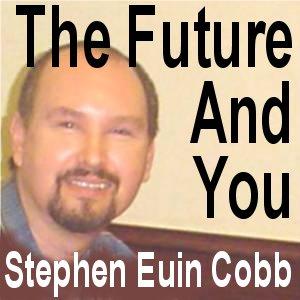
The Future And You

The Future And You

By Stephen Euin CobbScienceTechnology
Download on the App Store

The Future And You episodes

  • August 1, 2007 Episode
    Authors Catherine Asaro, Hildy Silverman, Randal L. Schwartz and Stoney Compton are joined by editor Paula Goodlett from Jim Baen's Universe Magazine. Hosted by Stephen Euin Cobb, this is the August 1, 2007 episode of The Future And You. [Running time: 114 minutes] --- Topics include: [1] News and Listener Feedback (a) Fred Saberhagen (author of the Berserker Series) has passed away. [2] Will future ballet dancers augment their bodies for greater strength and range of motion? And will we develop faster than light travel (FTL) in the same way we developed quanta mechanics and the relativistic equations? Author and scientist, Catherine Asaro covers both questions with authority because her career has included both. Concurrent with earning her doctorate in chemical physics from Harvard, she started and ran the Harvard University Ballet dance company, which still performs. [3] Stoney Compton (author of the alternate history novel Russian Amerika) provides summaries and short readings from Jim Baen's Universe, the online magazine of science fiction and fantasy. [4] How soon will e-books be as cheap as candy bars? As a child, Paula Goodlett, more than once, lived in towns without a library; where there was little available for her to read. Today she's the Managing Editor of Jim Baen's Universe Magazine and of The Grantville Gazette, both of which were created by Eric Flint and the late Jim Baen to experimentally test the waters of electronic publishing. Paula describes how these two experiments developed and what has been learned from them so far. She also provides hints of what changes are yet to be tried. [5] Another installment in our serialization of the novel Bones Burnt Black; this time the second half of chapter 16. [6] Infertility in America is increasing. This trend has lasted for decades, has been verified through statistics, and shows no sign of slowing. But while infertility is growing a new openness in talking about the subject is allowing its stigma to fade. Achieving Families Magazine is the "only magazine dedicated to providing real-life informative stories and articles to guide you through the challenges of infertility.? Hildy Silverman is more than just one of its editors; she's a living example of how science and technology are bringing the joy of childbearing to those who would otherwise be left out. Her daughter was conceived through technological intervention. Hildy describes new methods of conception, and the thorny legal problems they've created. [7] With its twitchy and crash-prone reputation, do you really want Microsoft Windows running the anesthesia and life support software during your next surgical procedure? And in the future, when nanorobots are ready to be injected into your bloodstream to protect you from heart attack, stroke and cancer, should you trust their AI software not to crash. Or more importantly, should you trust them not to get a bug that identifies, as a cancerous tumor which must be sliced up and removed, your heart or eyes or brain? Randal L. Schwartz is a programmer familiar with the weakness and frequent glitches of software.
    2 hr 16 min
  • July 1, 2007 Episode
    Battlestar Galactica cast member Bodie Olmos (son of Edward James Olmos and grandson of Howard Keel) is joined by the authors Robert Buettner, Mike Resnick, Randal L. Schwartz and Stoney Compton, as well as by Walt (The Bananaslug) Boyes from Jim Baen's Universe magazine. Hosted by Stephen Euin Cobb, this is the July 1, 2007 episode of The Future And You. [Running time: 118 minutes] ---Topics include: [1] A few items of News and Listener Feedback: (a) The World Death Stacks tournament now offers a trophy for artificial intelligence, (b) this show has been nominated for a 2007 Parsec Award in three categories, and (c) Listener Feedback from Bunnies of London (an expensive British escort service). [2] With the future coming at us faster and faster how can your favorite science fiction writers stay one step ahead of emerging technology and the changes it creates in our lives? The truth is, sometimes they can't. Robert Buettner describes the future inside and outside of his novels, and how he and other writers struggle with the ever accelerating speed of scientific advancement. [3] Walt Boyes and Stoney Compton provide an inside look at what's new in the latest issue of Jim Baen's Universe, the online magazine of science fiction and fantasy. [4] Mike Resnick addresses a wide variety of questions such as how his own medical conditions may someday require he use voice recognition software, and how these conditions have influenced his feelings about socialized medicine. He also tackles other tough questions: Will the worlds religions remain relevant? Is it OK for big brother to watch you if it reduces crime? Will artificial intelligence worship its creators rather than destroy them? Will the lessons of prohibition be forgotten when writing future laws concerning Marijuana? And consumerism American style: is it succeeding where fascism and communism failed? Is consumerism doing what it appears to be doing: conquering every nation on earth?[5] Another installment in our serialization of the novel Bones Burnt Black; this time the first half of chapter 16. [6] Is it time to buy beachfront property inside the virtual world called Second Life? Randal L. Schwartz, who rents an apartment inside, and is therefore a resident, describes this bizarre world which is both similar and dissimilar to our own. Randal also describes some of his ideas concerning artificial intelligence and how quantum computing and neural nets may relate to it. [7] The actor Bodie Olmos (son of Edward James Olmos and grandson of Howard Keel) describes his work on the set of the TV show Battlestar Galactica, as well as how it has affected his expectations of the future. He also talks of trends within his favorite hobbies: surfing and playing drums; and (in this interview taped June 2, 2007) reveals that Battlestar Galactica will end its run at the end of this season.
    1 hr 56 min
  • June 1, 2007 Episode
    Authors Robert J. Sawyer, Mike Resnick, David B. Coe, Edmund Schubert, Randal L. Schwartz and Stoney Compton are joined by Walt (The Bananaslug) Boyes and Davey Beauchamps. Hosted by Stephen Euin Cobb, this is the June 1, 2007 episode of The Future And You. [Running time: 167 minutes] --- Topics include: [1] News about your host's recent throat surgery, and listener feedback about the implanting and hardwiring of computers into the human brain. [2] Should we fear artificial intelligence? Once we make machines that are smarter than us how will we control or contain them? And if we try, won't they just outsmart us? Robert J. Sawyer explains why AI has dangerous possibilities which are being ignored today; and will continue to be ignored until, because of the accelerating pace of technological advancement, it will be too late. He discusses near term dangers, and ponders humanity's ultimate fate. Will we become pets or partners to machines, or something else for which we have no word? [3] Walt Boyes (The Bananaslug) and Stoney Compton give us an inside peek at what's going on in the current issue of Jim Baen's Universe Magazine. [4] Are state lotteries really an unethical tax upon the very people who can least afford them: the naive and gullible? Does the widespread popularity of gun ownership in America make the United States the only nation on earth that is unconquerable? Mike Resnick covers these and other subjects such as: Will Puerto Ricans ever vote for statehood knowing it will mean they'll have to begin paying income taxes? Will the US ever have socialized medicine? When Castro passes away, will Cuba embrace consumerism? [5] Another installment in our serialization of the novel Bones Burnt Black. [6] Did the documentary An Inconvenient Truth reveal as much about Al Gore and his political aspirations as it did about Al Gore's beliefs concerning climate change? David B. Coe describes what he sees as the many lessons from the movie including the probability that Al Gore will run for president in 2008, and his chances against Hillary and the other Democratic candidates. [7] In the next seven to fourteen years your monthly electric bill will drop to zero permanently, and you will drive a car every day which costs you nothing to fuel. An essay by your host about the soon-coming abundance of really cheap solar cells. [8] Are public libraries embracing the vast information access powers of the internet? The movement is called Library 2.0 and Davey Beauchamp (a professional librarian, and part-time writer and voice actor) has been helping it work its way into the quiet book-lined rooms of traditional libraries. Davey also describes trends in anime, his work on the second Writers for Relief anthology and announces that he has just been hired to write a rock opera based on the legend of Blue Beard the Pirate. [9] In the next three to five years diabetics will all stop poking needles into their fingertips forever. A mini-essay by your host about RFID chips which will be implanted inside human patients and provide constant medical measurements without wires. [10] What methods has Microsoft used that have given it a reputation for aggressive monopolism? And is it true, as some claim, that Microsoft's new Vista operating system has stolen 45 things from Apple's OS-10. Randal L. Schwartz talks of this as well as his experiments with podcasting and Geek Cruises. [11] Will the online science fiction and fantasy magazines survive? Edmund R. Schubert, editor of Orson Scott Card's Intergalactic Medicine Show, describes the strengths and weakness of this business; the money to be made and the trends he sees developing.
    2 hr 47 min
  • May 1, 2007 Episode

    Authors Mike Resnick, Kim Stanley Robinson, Elizabeth Bear, Dave Freer, Paul Levinson and Stoney Compton are joined by Randal L. Schwartz (programming consultant and activist) and Walt (the Bananaslug) Boyes of Jim Baen's Universe magazine. Hosted by Stephen Euin Cobb, this is the May 1, 2007 episode of The Future And You. [Running time: 142 minutes] ---Topics include: [1] News: (a) the recent discovery of the first earthlike planet other than our own, (b) your host's surgery, (c) your host will appear at ConCarolinas in Charlotte NC, USA (June 1-3, 2007), (d) listener feedback on superconductivity, sexual equality, the singularity and transhumanism. [2] Many online magazines now pay professional rates--sometimes much better than print magazines--does this mean the great electronic experiment was a success? Or just that the print magazines are dieing? Mike Resnick (editor of the highest paying online magazine) discusses this and provides another eyewitness report on how bad things really are across Africa. He also answers your host's question about Funny Novels: is there more money but less respect? [3] Walt (the Bananaslug) Boyes and Stoney Compton take us inside Jim Baen's Universe magazine. [4] Must a generation die off for a culture to change its most deeply held beliefs? Or is our current population somehow learning to become comfortable with nontraditional ideas, behaviors, clothing and lifestyles? Elizabeth Bear speaks of this and the universal notion of Us verses Them. [5] Have we been relying on non-lethal weapons for centuries without even realizing it? Kim Stanley Robinson insists that we have, and also argues that implanting a computer inside your skull is not trivial. It carries risks of damage and infection, and might best be reserved for solving life-altering problems like blindness or deafness. [6] Another installment in our serialization of the novel Bones Burnt Black. [7] Despite the numerous benefits, the renowned programmer Randal L. Schwartz insists he will be highly reluctant to accept a computer hardwired into his brain; and will refuse it entirely if its operating system is made by Microsoft since that would make his mind too easily hacked and too prone to spontaneously crashing. [8] Cell phones have changed our culture and altered the way we live, but their changes are not yet complete. Paul Levinson ponders what is yet to come. [9] Large scale engineering projects have been less visible recently thanks to all the buzz about nanotechnology. But the future is not given only to the very small. Those who design big are still thinking big, and the biggest place to build big is in the biggest place of all: space. Dave Freer presents his vision of how humanity will spread beyond the earth and fulfill its destiny among the stars.

    2 hr 23 min
  • April 1, 2007 Episode
    Authors David Drake, Alan Dean Foster, Dave Freer, Paul Levinson and Stoney Compton are joined by Ginjer Buchanan (of Ace and ROC books), Lucienne Diver (a top literary agent) and Walt Boyes (The Bananaslug from Jim Baen's Universe magazine). Hosted by Stephen Euin Cobb, this is the April 1, 2007 episode of The Future And You. [Running time: 121 minutes] --- Topics include: [1] News: (a) due to the host's vocal problems, this is the only episode which does not include an installment of the novel, Bones Burnt Black; (b) Death Stacks may now be played online for free without downloading anything; (c) TV channels from around the globe may be watched online for free by going to MyEasyTV.com; (d) your humble host proposes his fix for the confusion produced by dropped cell phone calls; and (e) your host will appear at RavenCon in Richmond VA, USA (April 20-22, 2007) and at ConCarolinas in Charlotte NC, USA (June 1-3, 2007). [2] Apartheid ended 13 years ago, so what are the trends within South Africa today? And what misconceptions do outsiders have? Dave Freer (born and raised in South Africa) talks of this as well as his scientific profession: ichthyology (the study of fish), and the thousands of times he has been scuba diving, and one dive in particular when he got his arm caught in a shellfish tunnel and very nearly drowned. [3] Walt Boyes (The Bananaslug) and Stoney Compton provide a peak into the current issue of Jim Baen's Universe magazine. [4] Are SF writers really trying to predict the future? Hugo Gernsback thought he was predicting, but were H.G. Wells or Jules Verne also trying to be predictors? Many people think so but David Drake says No and backs it with specific examples. [5] With half the Japanese populous reading eBooks on their cell phones and Steve Jobs intent on combining cell phones with iPods for computerless downloading of music, podcasts and audio books, just how fast are the changes coming? Ginjer Buchanan (Senior Executive Editor and Marketing Director of Ace and ROC books) talks of this as well as: why William Gibson is a national hero in Japan, the increasing feminization of America, the Vatican's website, and her fear that unemployment is the fate of all those who create, transport and sell physical books: from press operators and truck drivers to clerks in the giant chain bookstores. [6] An essay by your host entitled: My Father's Watch which concerns physics and nanotechnology and the drop we will see in energy prices during the next five to ten years. [7] Does the world need more people rather than fewer? Paul Levinson suggests that, since intelligence is our best resource then, more people will produce more intelligence, more innovation and a more rapid improvement to the human condition. He also addresses other questions: Is another dark age unlikely because (unlike in the ancient world) today there are so many copies of Humanity's collected knowledge? And is the fall of New Orleans (due to hurricane Katrina) a good example of how civilizations fall? And if so what can we learn from it? [8] Have audio book downloads become a bigger trend than eBook downloads? What about giving away free eBooks? Lucienne Diver, one of America's top literary agents, talks of this as well as her frustration with the large pharmaceutical companies and her skepticism over whether or not future medicine will ever provide a cure for the cryonics process. [9] Less-than-lethal weapons will soon take their place on the battlefield, but will they actually change anything? No, says Alan Dean Foster, and explains why. He also addresses the probability of the world entering a new dark age, and he disagrees with the host's notion that New Orleans can be used as a miniature example of the fall of civilization.
    2 hr 1 min
  • March 1, 2007 Episode
    Authors John Barnes, Kim Stanley Robinson, Elizabeth Bear, L.E. Modesitt, Jr. and Stoney Compton are joined by Ginjer Buchanan (of ACE and ROC Books), Walt Boyes (JBU's own Bananaslug) and Ricki Dean (Manager of a High School cafeteria). Hosted by Stephen Euin Cobb, this is the March 1, 2007 episode of The Future And You. [Running time: 155 minutes] --- Topics include: [1] News items: (a) your host will appear at RavenCon in Richmond VA, USA next month (b), a new version of Death Stacks may be played online and requires no download, (c) there's no such thing as a Chinese Journalist, and (d) a 15 percent probability Al Gore will be the next US president. [2] Generation Y is the most connected generation ever, but are its members obsessed with being in complete consensus on everything and horrified of being in open disagreement? And if so, how will this alter America ten years from now when Generation Y will comprise 40 percent of all American consumers? John Barnes, a consulting semiotician, has studied this subject in detail. [3] Bananaslug and Stoney present a reading by Louise Marley of the opening scenes of her short story The Spiral Road which is in the February 2007 issue of Jim Baen's Universe magazine. [4] What if everyone hypertexted within all conversations? What if you never had to define your terms because those not familiar with them could look them up faster than you could have provided the explanation. Elizabeth Bear has many ideas about this, AI, cell phones and the Singularity. [5] What if Russia still owned Alaska? What if Lenin and Trotsky had remained nobodies and the Czar and Czarina still ruled? Seeing how history pivots on the mundane can provide insights into the changes we will all face in the future. Stoney Compton, a life-long student of history, talks of this and shares anecdotes about Alaska and its native Athabaskan Indians. [6] Imagine you're in line in a cafeteria but federal regulations will not allow you to buy any kind of soft drink or fried foods. Now imagine ten thousand similarly restrictive cafeterias all across America. These are the cafeterias in public schools. To learn the trends our future wage earners are experiencing now, I spoke with Ricki Dean, Manager of a High School cafeteria. [7] Many authors' careers ended when Horror book sales collapsed in the 1980's. Might this happen to another genre? Ginjer Buchanan (Senior Executive Editor and Marketing Director of Ace and ROC books) talks of this and the rising popularity of audio books. A trend the big houses are making a serious effort not to be left out of. [8] Another installment in our serialization of the novel: Bones Burnt Black. [9] What would you do differently today if you knew your generation would live 300 years? Kim Stanley Robinson tackles this question and its social ramifications since he sees it as a genuine possibility based on what he has been hearing from his friends with the field of biotechnology. He also covers cryonics, SETI and our next earth. [10] Our stores are filled with every variety of goods, but does this variety give us only the illusion of choice? L.E. Modesitt, Jr. suggests that it does, and talks of his concern that we will be forced to rely on fossil fuels much farther into the future than anyone would like to admit.
    2 hr 36 min
  • February 1, 2007 Episode
    Authors Elizabeth Bear, Walter Jon Williams and L.E. Modesitt Jr. are joined by Toni Weisskopf (the head of Baen Books), Ginjer Buchanan (from ACE and ROC books), Scott Dean (mayor of Harlem GA) and Bananaslug and Stoney (from Jim Baen's Universe magazine). Hosted by Stephen Euin Cobb, this is the February 1, 2007 episode of The Future And You. [Running time: 126 minutes] --- Topics include: [1] News Items: (a) Trends in wine. (b) A low-tech nanotech breakthrough. (c) An AI programmer releases a free, open-source version of Death Stacks (a game invented by your host, Stephen Euin Cobb). (d) Your host's 2007 appearance schedule. (e) Your host has shaved his head. [2] Would you trust Microsoft to provide the operating system for your eventually augmented brain? Can atheists be both devout and non-militant? Elizabeth Bear hits these topics as well as non-lethal military weapons and her ongoing involvement with SETI-@-home. [3] Bananaslug and Stoney provide a peak into the new issue of Jim Baen's Universe magazine and even get Elizabeth Bear to read a sample of her work. [4] Will some of the big publishing houses get hurt during the transition to eBooks? Will some fold entirely? Toni Weisskopf (the head of Baen Books) describes how the big houses are bracing themselves. [5] Venice Italy is still sinking. Rich in history, the thousand year old city is threatened by every tide and storm surge, and may next have to deal with the effects of global warming. Scott Dean (the mayor of Harlem GA) just returned from nine days of walking through this city with an uncertain future. [6] Which science fiction authors most accurately depict the future? Ginjer Buchanan (Senior Executive Editor of Ace and ROC Books) names four heavyweights and backs her picks with their novels and credentials. [7] Another installment in our serialization of the novel: Bones Burnt Black. [8] Is the media worsening all social and political conflicts by presenting them to us as though they are between polar opposites? Has the media learned that disagreements which are subtle or nuanced or (God forbid) respectful will not sell papers or draw a TV audience? L.E. Modesitt Jr. describes this and how cell phones may be slowing maturity in young adults by preventing them from ever being on their own when facing life's problems. [9] What does Walter Jon Williams mean when he says that, The war against utopia has been won? And is he right in believing that biotechnology is likely to produce immortality within forty years? He also describes how consumer databases have already been used not only to market products to people but also to market political ideologies during campaigns.
    2 hr 6 min
  • January 1, 2007 Episode
    Authors Kim Stanley Robinson, David B. Coe, Jay Lake, Catherine Asaro and Sarah A. Hoyt are joined by John R. Douglas (from scifipedia.scifi.com) and Bananaslug and Stoney (from Jim Baen's Universe magazine). Hosted by Stephen Euin Cobb, this is the January 1, 2007 episode of The Future And You. [Running time: 125 minutes] --- Topics include: [1] Comments from listeners. [2] Is our world already changing too fast for our cultural headlights? Jay Lake (author and anthologist) discusses this as well as Wikipedia, Google and global warming. He also suggests that those who don't benefit from The Singularity at its very beginning will be left out of it forever. [3] Bananaslug and Stoney take us inside Jim Baen's Universe in this, the second official segment, from the online science fiction and fantasy magazine. [4] Do large segments of the American population have various vested interests in not looking at the future's potential dangers? John R. Douglas (editor at scifipedia and one of the organizers of World Fantasy Con) believes that Americans would rather be happy consumers than listen to scientists' scary predictions. He also says that too many business people plan for the future only as far as their company's next quarter, and not one second farther. He also suggests that the first immortal may already be alive; specifically, Bill Gates. [5] Another installment in our serialization of the novel: Bones Burnt Black. [6] Is the internet killing hundreds of used bookstores? When the one near her house closed, Sarah A. Hoyt (author and voracious reader) was surprised to discover that she was as much at fault as everyone else. As she gradually changed her book buying habits, without her knowledge, the rest of the population had been changing theirs too. [7] Does POD publishing (Print-on-demand) have a future? And are there times when it makes sense to use it now? Catherine Asaro (author, physicist and former president of SFWA) uses concrete examples from two of her friends. She also talks of eBooks and electronic rights. [8] Has digital photography achieved professional quality? David B. Coe (author and serious nature photographer) says the future is here now, and the advantages cannot be ignored. [9] Is our civilization in a time crunch? Have we reached a crisis point in history? Or has every generation seen themselves this way? Kim Stanley Robinson talks of this as well as nanotechnology and his doubts about the singularity and artificial intelligence.
    2 hr 5 min
  • December 1, 2006 Episode
    Authors Eric Flint, Mike Resnick, David B. Coe, Marjorie M. Liu, Catherine Asaro and Sarah A. Hoyt are guests, as are: Lucienne Diver (a major literary agent), Toni Weisskopf (the new head of Baen Books) and Walt Boyes (the soon to be famous Bananaslug). Hosted by Stephen Euin Cobb, this is the December 1, 2006 episode of The Future And You. [Running time: 152 minutes] --- Topics include: [1] News Item: This show is now teamed with the largest SF online magazine in the world Jim Baen's Universe. [2] Can the magazine equivalent of an e-book compete with magazines printed on paper? Launched this summer with the legendary publisher's name on its masthead and the support of Baen Books behind it, Eric Flint explains how he and the staff of Jim Baen's Universe intend to find out, as well as what they've learned already. [3] The podcasting debut of Jim Baen's Universe. Walt Boyes interviews Mike Resnick (winner of five Hugo Awards). [4] How rapid is the growth of home schooling? Is it really better than public school? And are parents even qualified to teach their kids? Catherine Asaro (author, physicist and former ballerina) who has home schooled her own daughter for years and now teaches advanced mathematics to eighty other home schooled children, emphasizes that it's not just for religious families anymore. [5] Toni Weisskopf (the new head of Baen Books) describes her take on the singularity, technological immortality, global warming, the next fall of civilization, the Chinese going to the moon, faster-than-light travel, cryonics and SETI. [6] Another installment in our serialization of the novel: Bones Burnt Black. [7] Is the future we live in today already weirder than the futures we dreamed of decades ago? Sarah A. Hoyt (author and polyglot) thinks so, and insists that if science increases our healthy years by a few more decades this will produce a huge cascade of changes throughout society. [8] Lucienne Diver (one of publishing's top literary agents) describes trends within the publishing industry, as well as her worries and hopes for the future outside the biz. [9] How can you verify scientifically the day when men and women are equal? Your host has devised an empirical measurement completely devoid of bias. [10] How soon will parents give in to the temptation to use increasingly available eugenics technologies to improve their own children? Marjorie M. Liu (N.Y. Times bestselling author and former lawyer) describes the inevitable legal and judicial problems soon to be dropped in society's lap. She also startles the host with her revelation that there are judges sitting on the bench right now who have not passed the bar, have never been lawyers and have no degree in law. [11] In the face of our looming energy crisis is it time for passionate environmentalists to rethink their knee-jerk opposition to nuclear power and hydroelectric dams? David B. Coe (author and environmentalist with a PhD in environmental history) risks his environmentalist street creds by insisting that it is.
    2 hr 33 min
  • November 1, 2006 Episode
    Authors Catherine Asaro, Kim Stanley Robinson, Alan Dean Foster and Sarah A. Hoyt are joined by Toni Weisskopf (the new head of Baen Books) and Paul Levinson (author, professor and media commentator). Hosted by Stephen Euin Cobb, this is the November 1, 2006 episode of The Future And You. [Running time: 150 minutes] --- Topics include: [1] Ideas from listeners. [2] Why do they keep raising the requirements of artificial intelligence every time someone builds a computer that meets the requirements? Catherine Asaro (author, physicist and former ballerina) discusses this and other transhumanist concerns. [3] With the tragic loss of its visionary founder, Jim Baen, what direction will Baen Books take into the future? Toni Weisskopf, Baen's new leader, provides many of the answers. [4] Chapter twelve in our serialization of the novel Bones Burnt Black. [5] Can political science become an actual science rather than a pretend science as it is now? And if it embraces the scientific method can it then become a tool to benefit all people, rather than just its divisive practitioners as it all too often does now? Kim Stanley Robinson, author and a self-proclaimed science patriot, speaks of this and other matters. [6] Are adults different today? Has intellectual maturity become a thing of the past? Instead of reaching a plateau of stability, do we now spend all our lives in a mentally malleable child-like state in which we are continually learning, growing and changing? Sarah A. Hoyt, author and life-long learner, insists the answer is Yes. [7] Has the time come for a single unified diagram which can integrate every kind of celestial object in the universe? Is it even possible to arrange in a single continuum all the objects from the tiniest tumbling grain of dust to quasars brighter than a billion suns? Your host thinks it is, and proposes just such a diagram in this essay. [8] What is the likelihood of technological immortality? Why is cryonics better than cremation? And do ecological preserves without armed enforcement against poachers have a meaningful future? Alan Dean Foster, author and world traveler, covers all this and more. [9] Can every celestial object in the universe be defined accurately using a simple notation system of just five numbers? Based on the universal diagram from his previous essay, your host makes a case for an equally universal system of classification. [10] What's it like to go head-to-head with Bill O'Reilly on his TV show The O'Reilly Factor? Paul Levinson (author, professor and media commentator) shares his experiences in that very public hot-seat.
    2 hr 30 min

About The Future And You

From the publisher's feed

This award-winning series explores The Future of Everything. What can we expect of next week, next year, next century? What will we eat, drive, wear, live in, vote for, want to buy, and want to avoid?โ€ฆ

More shows like The Future And You

Dan Carlin's Hardcore History by Dan Carlin

Dan Carlin's Hardcore History

63,956 Listeners

Common Sense with Dan Carlin by Dan Carlin

Common Sense with Dan Carlin

11,409 Listeners

Scott Sigler Slices by Scott Sigler

Scott Sigler Slices

1,083 Listeners

The Deadpod by J.Henrikson

The Deadpod

1,224 Listeners

Big Picture Science by Big Picture Science

Big Picture Science

937 Listeners

Meditation Oasis by Mary and Richard Maddux

Meditation Oasis

3,849 Listeners

Mac OS Ken by Ken Ray

Mac OS Ken

902 Listeners

Astronomy Cast by Fraser Cain and Dr. Pamela Gay

Astronomy Cast

2,878 Listeners

Philosophy Bites by Edmonds and Warburton

Philosophy Bites

1,540 Listeners

Dan Carlin's Hardcore History: Addendum by Dan Carlin

Dan Carlin's Hardcore History: Addendum

8,304 Listeners