
Sign up to save your podcasts
Or



A pre-trained model only predicts the next token. Alignment turned that autocomplete into a helpful assistant: InstructGPT's RLHF pipeline, then DPO and Constitutional AI.
Key takeaways:
Chapters:
00:00 From autocomplete to assistant
04:33 InstructGPT
04:51 Supervised fine-tuning
06:08 The reward model
07:13 Reinforcement learning with PPO
07:35 The KL leash
09:21 Small but aligned beats big
11:15 Open source and DPO
13:55 Constitutional AI
15:58 Reward hacking and sycophancy
20:45 Closing thought
Sources:
Related episode: S1E8: Why AI Now Reasons and Acts
Enjoyed it? Follow The GenAI Evolution Atlas (weekly generative AI deep dives and news roundups, hosted by Peter Liu) and rate it on Apple Podcasts or Spotify.
Also from Peter: Data Science in the Wild, how real companies ship ML and AI in production, one system per episode.
Made with AI-generated voices; curated by Peter Liu from the sources above.
Bigger models hit hard limits on memory, speed and cost. FlashAttention, mixture-of-experts, RoPE, KV-cache tricks, quantization and LoRA kept AI scaling without changing the Transformer's core design.
Key takeaways:
Chapters:
00:00 Hitting the scaling wall
06:59 FlashAttention
07:30 SRAM vs. HBM
09:36 Tiling
12:59 Mixture-of-experts
14:42 Routing tokens to experts
21:13 Rotary position embeddings
25:13 The KV cache problem
28:03 Grouped-query attention
30:06 PagedAttention and vLLM
31:09 Speculative decoding
32:40 Quantization
34:51 LoRA
38:00 Recap
Sources:
Related episode: S1E2: The Transformer Engine Behind Modern AI
Enjoyed it? Follow The GenAI Evolution Atlas (weekly generative AI deep dives and news roundups, hosted by Peter Liu) and rate it on Apple Podcasts or Spotify.
Also from Peter: Data Science in the Wild, how real companies ship ML and AI in production, one system per episode.
Made with AI-generated voices; curated by Peter Liu from the sources above.
Between 2019 and 2022, AI progress became a matter of scale. GPT-3, scaling laws, the Chinchilla correction, and the debate over whether “emergent” abilities are real or a measurement mirage.
Key takeaways:
Chapters:
00:00 When scale became the strategy
03:47 Why RNNs couldn't scale
07:14 The 2017 Transformer, briefly
17:14 GPT-2
18:07 GPT-3 and in-context learning
23:12 Kaplan's scaling laws
27:49 The Chinchilla correction
32:43 Attention's quadratic cost
34:02 Emergent abilities
36:11 The mirage argument
40:16 Why scale isn't enough
42:30 Instruction tuning and RLHF
47:48 Closing thought
Sources:
Related episode: S1E6: How Alignment Turned Autocomplete Into AI Assistants
Enjoyed it? Follow The GenAI Evolution Atlas (weekly generative AI deep dives and news roundups, hosted by Peter Liu) and rate it on Apple Podcasts or Spotify.
Also from Peter: Data Science in the Wild, how real companies ship ML and AI in production, one system per episode.
Made with AI-generated voices; curated by Peter Liu from the sources above.
In 2018–2019, AI stopped needing a labeled dataset for every task. Pre-train once on raw text, then adapt: how BERT, GPT and T5 split the field, and why that choice still shapes today's models.
Key takeaways:
Chapters:
00:00 2018: teaching AI to read
01:48 Pre-train once, adapt everywhere
07:34 Self-supervision: hide and predict
11:48 The fork: BERT vs. GPT
14:04 BERT's bidirectional masking
17:13 BERT in Google Search
18:58 GPT's left-to-right bet
22:42 Why causal models drift
23:33 T5: everything is text-to-text
27:40 One model absorbs every task
29:54 Hardware limits and tokenization
34:32 Fine-tuning in 2018–2019
40:11 Closing thought
Sources:
Related episode: S1E4: How Massive Scale Triggered Emergent AI
Enjoyed it? Follow The GenAI Evolution Atlas (weekly generative AI deep dives and news roundups, hosted by Peter Liu) and rate it on Apple Podcasts or Spotify.
Also from Peter: Data Science in the Wild, how real companies ship ML and AI in production, one system per episode.
Made with AI-generated voices; curated by Peter Liu from the sources above.
How the 2017 Transformer works, piece by piece: queries, keys and values, scaled softmax, multi-head attention, positional encodings, and why its quadratic cost shaped everything that came after.
Key takeaways:
Chapters:
00:00 A machine with no visible gears
03:05 The RNN problem, revisited
09:18 From encoder-decoder to attention
11:13 Attention Is All You Need
12:55 No built-in sense of order
14:21 Queries, keys and values
16:41 Scaled dot products and softmax
22:13 Multi-head attention
25:01 Positional encodings
27:01 Residuals and feed-forward layers
28:54 The decoder and masking
31:57 The quadratic cost
35:05 FlashAttention and mixture-of-experts
39:42 Closing thought
Sources:
Related episode: S1E5: How FlashAttention and MoE Saved AI Scaling
Enjoyed it? Follow The GenAI Evolution Atlas (weekly generative AI deep dives and news roundups, hosted by Peter Liu) and rate it on Apple Podcasts or Spotify.
Also from Peter: Data Science in the Wild, how real companies ship ML and AI in production, one system per episode.
Made with AI-generated voices; curated by Peter Liu from the sources above.
Before the Transformer there was the RNN bottleneck. This episode explains why attention had to be invented: slow sequential math, fading gradients, and the single vector that every translation had to squeeze through.
Key takeaways:
Chapters:
00:00 Why start before the Transformer
04:22 How RNNs read a sequence
07:12 Why sequential math wastes GPUs
09:39 Backpropagation through time
11:54 Vanishing and exploding gradients
13:09 LSTMs and gating
17:33 Machine translation and seq2seq
20:06 The fixed-size bottleneck
22:06 Bahdanau attention
25:26 Softmax alignment weights
30:32 Word embeddings and Word2Vec
37:35 Recap
40:12 Closing thought
Sources:
Related episode: S1E2: The Transformer Engine Behind Modern AI
Enjoyed it? Follow The GenAI Evolution Atlas (weekly generative AI deep dives and news roundups, hosted by Peter Liu) and rate it on Apple Podcasts or Spotify.
Also from Peter: Data Science in the Wild, how real companies ship ML and AI in production, one system per episode.
Made with AI-generated voices; curated by Peter Liu from the sources above.
From the publisher's feed
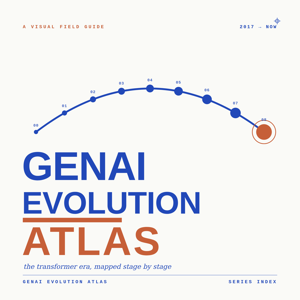
A map of how generative AI got here, and where it's going next.
Season 2 (ongoing): every Wednesday, a deep dive into the most important AI breakthrough of the week, and every Friday, a…
Season 1 (8 episodes): the full history of modern AI, from attention and the Transformer through scaling laws, alignment, multimodal models, and today's reasoning agents. Start here if you're new.
Hosted by Peter Liu. Episodes are produced with AI-generated voices from curated sources, which are linked in the show notes.