
Sign up to save your podcasts
Or

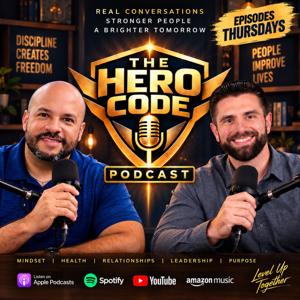


You've got a story worth telling. Now learn how to tell it.
Part 2 of The Hero Code's origin-story series is the HOW. Dr. Timothy Arena and Dr. Miguel Fernandez hand you the five-element framework every powerful origin story is built on (The Before, The Catalyst, The Journey, The Transformation, and The Mission), then walk through a complete two-minute origin story so you can hear what it sounds like when all five land.
Once you have the framework, you'll learn how to adjust the same true story for different contexts: a networking event, a job interview, your website, a keynote or podcast interview, and social media. Tim and Miguel also break down seven mistakes that make people cringe or tune out when someone tells their story, including staying in victim mode and apologizing for your path. And they close with five steps to write, practice, test, update, and use your own.
Along the way, Miguel tells his own origin story twice, once as the short networking version and once as the full podcast-interview version: growing up watching his mother suffer with Lupus, her doctors never comparing notes, and the doctor he decided to become because of it.
By the end you'll have a framework you can use in any room you walk into, and a reason to stop hiding the path that got you here.
#TheHeroCode #MyOriginStory #OriginStory #Storytelling #PersonalBranding
Question of the Day: Using the five elements, can you tell your origin story in two minutes right now?
Your assignments this week:
1. Right now, record a voice memo of your two-minute origin story using the five elements. Listen back. Refine it. Record it again until it sounds like you.
2. Share one element of your origin story on social media. Tag @TheHeroCodePodcast and use #TheHeroCode and #MyOriginStory. We're featuring some of our favorites in upcoming episodes.
3. Use your origin story in one professional context this week: a networking event, an email introduction, a LinkedIn update, or a conversation. See what happens.
Missed Part 1? Go back and listen to it first; this episode builds on that foundation.
If this two-part series has helped you, send both episodes to someone who's sitting on an incredible story and doesn't see their own power yet. Subscribe to The Hero Code if you haven't already, leave a review, and tell us what your origin story is teaching you.
Your story is still being written.
Every great hero has an origin story. You're sitting on yours right now, and it may be the most valuable asset you have.
In the first episode of The Hero Code, Dr. Timothy Arena and Dr. Miguel Fernandez open a two-part series on the origin story: why the people getting the opportunities aren't the ones with the best credentials, but the ones who know how to tell where they came from.
Part 1 covers why your origin story matters and the science of why a story connects where a list of credentials doesn't; why the struggles you've been hiding are actually your credentials; the difference between telling your story as a victim and as a victor; and the myth of the straight line to success, with the zigzag paths of Vera Wang, Julia Child, Colonel Sanders and Thomas Edison as evidence. Along the way: the story that changed how Tim's patients saw him, and two composite stories of people who stopped hiding the reason they do what they do.
By the end you'll know what to look for in your own story, and you'll have homework to do before Part 2 gives you the framework to craft and use it.
#TheHeroCode #MyOriginStory #OriginStory #HerosJourney #PersonalDevelopment
Question of the Day: What if the part of your story you're most ashamed of is actually the part someone else needs to hear?
Homework before Part 2:
1. Write down three significant challenges or transitions in your life. Don't filter them.
2. For each one, write down a skill or insight you gained from it.
3. Ask yourself: if I could only tell someone one thing about my journey, what would it be?
4. Share one insight with us on social media. Tag @TheHeroCodePodcast and use #TheHeroCode and #MyOriginStory. We read every one, and we may feature yours in a future episode.
Mentioned in this episode: Joseph Campbell's Hero's Journey; Uri Hasson's neural-coupling research at Princeton; Steve Jobs' 2005 Stanford commencement speech.
Part 2 drops next week with the five elements every origin story needs, how to tell it in different contexts, and how to shift from victim to victor in your storytelling. Subscribe so you don't miss it, leave us a review and tell us what you're working on, and send this episode to someone who's sitting on an incredible story and doesn't realize how powerful it is.
Your story is still being written.
From the publisher's feed
BECOME THE HERO OF YOUR OWN STORY.
The Hero Code is a personal development podcast from two Massachusetts Doctors of Chiropractic, Dr. Timothy Arena and Dr. Miguel Fernandez. We're not…
Every episode takes a big idea about growth and turns it into something you can actually do this week: a framework, a ritual, a question worth sitting with.
We treat life like an origin story. The comfort zone is the villain. Your morning is the training montage. Failure is a plot twist, not the ending. Expect friendly banter between two hosts who don't always agree, a healthy dose of superhero and board-game nerdery, straight talk with no fluff, and one Question of the Day to carry into your week.
If you know you're capable of more and you're done being talked down to by people who've never done the work, this is your show.
Your story is still being written.
#TheHeroCode