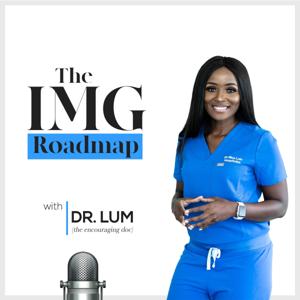
The IMG Roadmap Podcast

The IMG Roadmap Podcast

By Dr. Nina LumBusinessCareers
Download on the App Store

The IMG Roadmap Podcast episodes

  • 91. IMGRoadmap Series #90 Dr. Aditi Agrawal (Psychiatry)

    If you are an international medical student or graduate seeking to start residency in any of the 135 specialites in the USA next June, then this is for you! You don't want to regret missing out on this HUGE opportunity!

    Join the waitlist to be considered for the next round of the IMG roadmap course. The only course that helps you become a more competitive applicant for residency. Seats are limited. Sign up here to be considered!


    Can you complete the entire residency application process without actually being in the US? Though it may sound impossible, Dr. Aditi Agrawal’s story will surely surprise you. Keep listening to find out how she accomplished such a feat!

    Dr. Aditi Agrawal was born in India and completed her medical studies there at the Banaras Hindu University. She is currently an incoming PGY 1 resident at the St. Elizabeth medical center in Boston, Massachusetts.

    Here are some of the highlights of her USMLE journey, she:

    • Took Step 1 in August of 2019, and then started preparing for the other exams.
    • Persevered in spite of the cancellation of her US electives due to COVID.
    • In the interim, studied for Step 2 CK.
    • Engaged in a research project at her university.
    • Participated in a paid telerotation in August of 2020.
    • Did OET for ERAS certification which she gained just two days before her rank list submission.
    • Out of 150 applications, got 3 interviews immediately, and 5 more after networking on social media and sending letters of interest!
    • In retrospect, Dr. Agrawal recommends that other IMGs:

      • Join as many relevant online communities as possible, for example: Clinical Problem Solvers and PsychSIGN. 
      • Social media is a great equalizer since you do not need to be in the US to make your presence known.
      • Documentation of your accomplishments is essential, especially on social media. You never know who may be watching!
      • Collaboration, not only research projects but with other projects such as podcasts, and illustrations, helps you to make real, useful connections.
      • While applying, be sure to narrow your list down to options where you have a real chance. Check to see if there have been any previous IMG residents.
      • Pay attention to new programs and to those who sponsor visas.
      • When asked for her mantra for success, Dr. Agrawal stated the following:

        • She believes that the universe aligns to allow her to be successful.
        • She always tries to be kind and smart
        • She is driven by the search for a deeper understanding of life and human beings.
        • You can connect with Dr. Agrawal via:

          Twitter: @DrAditi_Life
          Instagram: @Aditi.life and @Usmleflashcards
          Her blog: girlintheboots.com

          Listen to the full episode on Apple, Spotify & Google Podcasts.

          42 min
        • 90. IMGRoadmap Series #89 Dr. Marc Katz (Cardiology)

          Quick pause, join the 2022 waitlist to be considered for the IMG ROADMAP live group coaching program that starts in Spring 2022. Click here to start now. 

          As a new year begins, IMGs all over the US continue to excel in their fields, inspiring thousands to do the same. Our guest today, 3rd year Cardiology fellow Dr. Marc Katz is no exception! Keep listening to find out more about his challenging yet rewarding journey.

          Dr. Katz attended Ross University and completed rotations in Brooklyn, New York. He completed Internal Medicine (IM) training at the Hahnemann University Hospital.

          He is currently a PGY6 in Cardiovascular Diseases, a subspecialty of IM.

          Here are some highlights of Dr. Katz’ Cardiology fellowship:

          • He chose IM because of its wide range of subspecialty opportunities when compared to family medicine, for instance.
          • He completed 4 years of medical school, 3 years of IM training, and 3 years of General Cardiology fellowship.
          • While he is qualified as a general cardiologist, he appreciates the fact that he can still specialize in more specific fields such as cardiac oncology, and electrophysiology.
          • Dr. Katz’ background also helped shape his medical success story:

            • He attended SUNY Bingham for his undergraduate degree, as a first generation American born to South African immigrant parents.
            • Initially, he didn’t know that he wanted to go into medicine, and so he earned a GPA of 3.4 and a just below average MCAT score.
            • After medical school, he felt like he was fighting an uphill battle to match into residency as an IMG.
            • While he found that Ivy League schools mainly only take people from “prestigious” schools, He advises IMGs not to be discouraged.
            • However, he also advises people considering becoming IMGs to be aware of the potential challenges they may face.
            • Here are Dr. Katz’ thoughts on the future of IMGs:

              • Step 1 going pass/fail is estimated to be another hurdle since program directors will likely find another metric by which to filter out applicants. So, it is important to build a strong application otherwise.
              • Every year, while there are enough US grads to take up all of the available residency spots, they continue to take IMGs. Be encouraged by that fact!
              • IMGs often fill underserved specialties and are invaluable in the US medical system. IMGs are here to stay!
              • You can reach out to Dr. Katz on:

                Instagram: @kittykatzmd

                Tik Tok: @kittykatzmd

                Youtube: @kittykatzmd

                Twitter: @kittykatzmd

                And his website: mykittykatz.com

                And you can also follow his cat, Pepperoni @pepperoni.the.kat!

                Listen to the full episode on Apple, Spotify & Google Podcasts.

                44 min
              • 89. Mock Residency Interview Sessions For IMGs With Feedback

                Interview Season is still in full swing. Are you anxious about your virtual interview? Are you interested to hear some common questions that you may be asked and to know the best way to respond to them?  

                This episode, originally recorded as an Instagram live session, not only gives you the blueprint for a successful residency interview, but also includes some rapid fire mock interview sessions with feedback, featuring IMGs from all over the world. Keep listening to find out more!


                Here are a few tips on how to make the most out of your interview:

                • Before you go to your interview:
                • - Consider your audience. Who are they, and what are they expecting of you?
                  - If the schedule of the interview day is given, be sure to take the time to memorize it and garner any information which may be beneficial in your preparation for that specific interview.
                  - Do lots of research on the people who will be interviewing you, as this may afford you an informational advantage.
                  - Look up the program online and get an overview of what the program entails.
                  - Speak to previous residents who went through the program if you can.
                • During your interview:
                • - Focus on what you are saying - your words matter more than body language during a virtual interview.
                • Being a good listener is an important skill - you need to properly understand the question in order to answer it accurately.
                • Always find the opportunity to assert your purpose for interviewing - how will you be a good fit for the program?
                • Storytelling is an invaluable tool to get your point across effectively. A good story has a strong character, an obstacle and an outcome.
                • Integrity is key when describing both successes and failures. If you need to expound on your failures, be honest as to what caused you to fail and the lessons you’ve learnt as a result.
                • When you’re asked about yourself:
                • - Keep your response less than 90 seconds long.
                  - Ensure that you are speaking in complete sentences and getting your point across.  
                  - Avoid rambling and always connect your story back to your being a good fit for the program.
                • Letters of interest should be sent prior to residency interview season but they can also be sent at any time throughout the process.
                • Here is some general feedback based on the rapid fire mock interview sessions with IMGs intending to match into various specialties:

                  • Ensure that your personal introduction is an attention-grabber in order to make yourself stand out.
                  • Focus on the elements of the specific program into which you are interviewing. Use your prior knowledge of the program and the program director or coordinator to demonstrate how this program aligns with your goals.
                  • Origin stories can show resilience - use your past experiences to emphasize why you are choosing to attend this residency interview. 
                  • When speaking about gap years, be sure to mention the fact the gap was unavoidable and show how you remained within the clinical space despite not being in school.
                  • Ensure that you do not sound rehearsed. Let your responses flow organically for best results!
                  • Listen to the full episodes via Apple, Spotify & Google Podcasts.

                    1 hr 3 min
                  • 88. Interview Prep For IMG’s Q&A

                    Are you nervous about your upcoming residency interview?

                    Do you have questions as to how to make those few interview invitations convert into your name being on the rank order list?

                    Keep listening to this live Q&A session on interview prep for IMG's to get all of the answers you need! Some questions we address in this episode include:

                    How do I prepare for behavioral questions?

                    Interviewers just use these questions to find out more about how you think.

                    Pause, think and answer to the best of your ability. Use scientific evidence where you can.

                    What is the best time to send letters of interest?

                    There is no best time - you should send them as soon as your interest emerges. "Now" is the best time!

                    What are some questions that I can ask an interviewer?

                    Ask a question that proves that you are receptive to instruction and learning  during the residency process.

                    A good example is: what do you think makes a successful resident?

                    Another is: what are some milestones that you expect interns to have achieved by the first half of the year?

                    Use these as an opportunity to promote yourself as a good fit for the program.

                    How do I stand out from other applicants via zoom?

                    Interact, smile, converse with the interviewers.

                    However, the most important part is to stand out in your individual interview.

                    What is the best way to show interest in a program?

                    Go through the program’s website and learn as much as you can to draw parallels between your strengths as a candidate and the program’s requirements.

                    Validate your interest with evidence you found by doing your homework.

                    How do I justify wanting to do residency in one state while living in another?

                    State valid reasons based on research done on the program.

                    Don't focus too hard on the fact that you aren't a local.

                    Leverage your strengths to show that you would be a good candidate for the program.

                    How do connections help during the interview season?

                    These are only helpful if the people put in a good word for you thereby improving your chances of matching.

                    People trust their contacts and their opinions, so it doesn't hurt to ask people to recommend you!

                    How do I answer the question: tell me about yourself?

                    Use the past, present and the future.

                    State what you have done before, are doing currently and will do in the future as relates to your medical career and the program you're interviewing into.

                    Be as forthcoming as possible, while emphasizing why you accepted the invitation to interview.

                    How can I stand out as a re-applicant?

                    • Ask for feedback from the previous interview.
                    • Ask your  mentors to put in a good word.
                    • Engage in introspection to identify your weaknesses during your previous interview.
                    • Overall, confidence is key. Talk, smile, laugh, interact and you will be fine! You can book my interview coaching service at drninalum.com/interview today.

                      Listen to the full episode on Apple, Spotify & Google Podcasts.

                      27 min
                    • 87. How to Find Research Opportunities as an IMG

                      Medical research focuses on coming up with solutions to help clinicians heal the population. Therefore, research is an essential aspect of the medical field for doctors and other medical professionals alike.

                      This episode features a live conversation between Dr. Lum and Dr. Wafa Qulikhan who has come to follow up after her IMGRoadmap Interview and drop some gems on how to find research opportunities as an IMG. Keep listening to find out more about her techniques!

                      First, it is important to understand that medicine and research, while closely related, are separate entities.  Within research, you have many options that may align with your interests, personality, strengths and weaknesses.

                      Here are a few practical tips on how to go about landing the right research opportunities based on Dr. Qulikhan’s own experience:

                      • Print out your CV and make as many copies as possible.
                      • Hand out these documents to as many doctors with their own practice as possible.
                      • Networking is key! Put yourself out there and speak to people who will get you in the door - Dr. Qulikhan started as an observer who presented herself as someone who was willing to help the doctors who would take her under their wing.
                      • If you are applying to higher-ranked universities, while it’s fine to aim high, it’s also beneficial to establish yourself within your community and work your way up.
                      • If you are not a US citizen, always ensure that your Visa affairs are in order!
                      • Try to get a subscription to Pubmed and other official journals to see the layout of research submissions.
                      • Be focused, but do not be too narrow-sighted when considering research opportunities. Research in fields different from your intended field is also great!
                      • Here are some of the pathways you can take:

                        • Online searches - you can either reach out to programs yourself and volunteer your time or respond to advertisements of vacancies.
                        • Go through a university based program which has a defined research component.
                        • Paid opportunities such as certain observerships.
                        • Speaking to alumni - word of mouth is powerful! Listen to your mentors and those who have been there before you.
                        • Research outside of the US - You can use your research from your own medical school, or work with your attending and preceptors there.
                        • Different specialties have different requirements and some are more research-based than others. 

                          Overall, do not lose your sense of self and authenticity - start small and show interest and initiative. All relevant research is beneficial. It's important to be optimistic, diligent and to put yourself out there to gain the research opportunities you need!

                          Listen to the full episode via Apple, Spotify & Google Podcasts.


                          45 min
                        • 86. How to Fill Your ERAS Application as an IMG

                          Though this year’s ERAS season may be over, it is never too early to start preparing for next year. This episode features a live session which was geared at helping IMGs to fill out their ERAS application in a way that ensures success. Keep listening to find out more!

                          Here are some invaluable tips and tricks to make your application count:

                          • AMC account information:
                          • State your basic information including your address regardless of whether it is within or outside of the US. Do not be fraudulent!

                            • Are you allowed to work in the US?
                            • Pick the most applicable category which corresponds to your specific situation, otherwise, you can choose “other” which is fine!

                              • NRMP match information:
                              • Fill in as applicable with NRMP ID.  It’s fine if you don’t yet have that information. You can add it later on.

                                American Urological Association (AUA) number,  if applicable, should also be included here.

                                If you are a couple’s match, this is the place to include this.

                                • Additional information :
                                • ECFMG certification should be added here.

                                  Other certifications such as Basic Life Support (BLS), while good to have on the application, come second place to your USMLE step scores.

                                  • Military information:
                                  • Describe your military obligations if applicable. In the US, military service is regarded highly and honorably!

                                    • Higher education:
                                    • Include programs which resulted in you obtaining a degree. This is not the place for other types of certification.

                                      Put expiration dates for certifications where applicable.

                                      • Research opportunities and any other certifications/ training that do not fall under any other categories can come under work experience.
                                      • Was your medical training extended or interrupted?
                                      • Be precise, honest, express reasons concisely.

                                        • Membership, professional societies, medical school awards, other awards and accomplishments:
                                        • List all relevant awards and achievements. Write as succinctly as possible.

                                          • Training experience:
                                          • List any prior American Osteopathic Association (AOA), Accreditation Council for Graduate Medical Education (ACGME) and other residencies and fellowships.

                                            You can list these certifications regardless of if you finished the program or not.

                                            • Clinical and Teaching experience should be treated as work experience:
                                            • In the description do the following:

                                              - Use action words and descriptive terms.

                                              - In a single sentence, state: time spent, role, actions taken and lessons learnt.

                                              - Include reasons for leaving.

                                              - Add Numbers -- it’s quantifiable and adds credibility.

                                              • Are you board certified in another state or country?
                                              • Include organization’s name, address and relevant details. Board certification in any country matters!

                                                For a more in depth guide on how to fill your ERAS form successfully, sign up for the IMGRoadmap Course where in Modules 6 & 7 this topic is examined in detail!

                                                Listen to this full episode on Apple, Spotify & Google Podcasts.

                                                35 min
                                              • 85. Tips on Networking for IMGs - Following up With Dr. Nina Snowden!

                                                In the age of the virtual residency application process, it may seem like your networking options are limited as an IMG, but Dr. Nina Snowden is back to remind you that the world is your oyster.

                                                Keep listening to find out how you can take a page from her book as you write your own medical success story!

                                                How do you get started with networking toward your residency application?

                                                Dr. Snowden used platforms such as Match a Resident and Residency Explorer to get an early start, learn more about her programs of interest and narrow down her options before beginning to apply and network.

                                                What should your emails to program directors contain?

                                                • Ensure that your email address contains your first and last name.  A good idea is to create a separate email just for this purpose.
                                                • State your purpose clearly and succinctly.
                                                • Be specific and intentional.
                                                • Ask direct questions.
                                                • How important are research and publications when applying and networking as an IMG?

                                                  While research is generally important, it is not always a critical determining factor as to whether a physician will get accepted into a residency program.

                                                  If you have the research opportunities, make the best of them. If you don’t, it’s not the end of the world!

                                                  What are the best ways for IMGs to boost applications despite failures and gaps?

                                                  • Clinical experience is always a sure way to make you a more palatable applicant.
                                                  • Networking is the name of the game! You should pitch yourself as though you are a business in order to complete the “transaction” of landing your dream residency.
                                                  • Is attending Student National Medical Association (SNMA) conferences beneficial?

                                                    Dr. Snowden attended the SNMA conference and ended up meeting her future program director there! She was able to introduce herself and network, thereby improving her chances of matching within that program.

                                                    Do elective rotations after application opening date count?

                                                    It’s good to have these elective rotations for your graduation requirements, however, the people reviewing your applications will probably not get a chance to see them within this timeframe.

                                                    What are some practical ways to network during rotating at a hospital?

                                                    Just show up and demonstrate your winning personality and killer work ethic. Excellence during rotations gives you good leverage when networking with program directors.

                                                    Want to hear more about Dr. Snowden’s story? You can find her full podcast episode here!

                                                    Listen to this full episode on Apple, Spotify & Google Podcasts.

                                                    57 min
                                                  • 84. Residency Interview Q&A - How to Ace Your Residency Interview as an IMG

                                                    You’ve done it! You’ve landed an interview with your program of interest! They've seen your application and they like you on paper. They want to gauge how compatible you are with the program. How can you make this interview count?

                                                    Keep listening to this Residency Interview Q&A session to get some tried and true advice!

                                                    How do you prepare questions to ask the faculty?

                                                    Google it! Do not ask questions that can be answered easily online. To show that you’ve done your homework, instead, ask about:

                                                    • The academic success of previous doctors within the program, to show that you are thinking ahead.
                                                    • The percentage of successful applicants into your intended specialty/subspecialty.
                                                    • Outcomes and board exam pass rates.
                                                    • Questions related to the conversation you’re having with the faculty member.
                                                    • Don’t ask about socially controversial topics.

                                                      How to stand out as a Non-US IMG when trying to match into surgery?

                                                      • Be charismatic.
                                                      • Show an edge - surgical specialties tend to favor a more edgy, outgoing personality over the more somber personalities favored in other specialties.
                                                      • How do I emphasize my training in a resource-limited charity hospital without coming across as offensive?

                                                        • This is an advantage! Underserved areas tend to hire a lot of IMGs.
                                                        • Use a captivating, true story to relay your message and show your experience.
                                                        • What are some good resources to help you prepare for your interview?

                                                          • Google model answers and responses, but these will vary from source to source.
                                                          • Think ahead of answers to personal questions. You know yourself best!
                                                          • How do you answer the question, “Tell me about yourself?”

                                                            Focus on:

                                                            • Summarizing the biggest life lessons that you’ve learnt,
                                                            • Describing yourself as an ideal candidate,
                                                            • What makes you resilient,
                                                            • What makes you easy to work with,
                                                            • What makes you likeable, different, yet special.
                                                            • How do you address weaknesses?

                                                              • Look for aspects of your life that were once a challenge but that you have now overcome.
                                                              • How have these made you a stronger and better individual?
                                                              • What steps should you take if your B2 visa renewal is denied?

                                                                A good idea is to leave your applications in and use any invitations to interview as leverage to help the US Embassy to reconsider their decision.

                                                                What are some of the don’ts in the interview?

                                                                • Improper Attire.
                                                                • Lack of professionalism.
                                                                • Negative talk about other programs or people as this reflects badly on you, and doesn’t make you seem trustworthy.
                                                                • Feel free to browse through drninalum.com and follow @drninalum and @IMGRoadmap for assistance on how to write your own medical success story!

                                                                  Listen to the full episode on Apple, Spotify & Google Podcasts.


                                                                  23 min
                                                                • 83. Supplemental ERAS for IMGs

                                                                  Let’s talk about the Supplemental ERAS Application!

                                                                  The Supplemental ERAS Application is only applicable to Internal Medicine, Dermatology and Surgery.

                                                                  While it is optional, it is advisable that IMGs take advantage of this opportunity to give their chances of matching a boost.

                                                                  Even if you’re applying for a specialty that is not applicable, there are certain elements from the Supplemental ERAS application that you may want to incorporate into your regular ERAS application.

                                                                  The Supplemental ERAS Application is separate from and will be available before the regular ERAS Application. Therefore, you should avoid calling the reader cross-referencing the two of them.

                                                                  Using the Supplemental ERAS Application can also be beneficial in that you may be able to  complete your holistic application at an earlier date, thereby improving your chances of matching.

                                                                  In fact, the Supplemental ERAS Application forms an integral part of the Holistic Application Process, so it is important to not only list your qualifications, but to outline your stories and experiences.

                                                                  You should outline stories and experiences that are important to you and not only what you think the application reviewers want to hear.

                                                                  Even if you may think that your volunteer work or research opportunities were not within the most prestigious of circumstances, you can still list these if they are important to you and your goals as a future resident. Give the application reviewers a reason to believe that you are passionate about your goal specialty!

                                                                  Tips on speaking about relevant experience:

                                                                  • Use details
                                                                  • Speak factually
                                                                  • Use metrics
                                                                  • Add an effective job description
                                                                  • Describe why it was meaningful and lessons you learnt.
                                                                  • Geographic preferences, while not mandatory, can be hidden if these preferences are flexible.  This way, you don’t run the risk of being rejected by programs which do not necessarily fit within your desired geographical area.

                                                                    Similarly, urban vs rural preferences and research vs surgery preferences can be selected and hidden upon request.

                                                                    However, If you have a true preference, especially with valid reasoning behind it, it’s a good idea to expound on this within your application.

                                                                    Overall, the supplemental ERAS Application can be an invaluable tool to increase your chances of matching by affording you the opportunity to submit a more holistic application.

                                                                    Eager to learn more? Click here to be redirected to drninalum.com for more resources including an ERAS Calculator link and the detailed document about the Supplemental ERAS Application.

                                                                    Also,  feel free to follow @drninalum and @imgroadmap for more free advice on how to make your Supplemental ERAS Application count!

                                                                    Listen to the full episode via Apple, Spotify & Google Podcasts!

                                                                    28 min
                                                                  • 82. IMGRoadmap Series #88 Dr. Devanshi Shah (Pediatrics)

                                                                    Have you always dreamed about specializing in pediatrics but you are not sure what steps to take to achieve this goal? Dr. Devanshi Shah joins us today to share her medical success story from medical school to serving as a PGY1 pediatrics resident at Maimonides Medical Center, New York. Keep listening to find out how she did it!

                                                                    Indian-born Dr. Shah completed medical school in Mumbai in June of 2020, after which she immediately started working towards her aspiration of completing residency in pediatrics in the United States.

                                                                    Here are a few highlights of Dr. Shah’s Medical Background:

                                                                    • She completed medical school at one of the largest tertiary care educational centers in India.
                                                                    • Started preparation for USMLE during the 3rd year of her 5.5 year MBBS program.
                                                                    • Applied for electives during her 4th year while completing application for USMLE exams including step 2 CS.
                                                                    • Wrote her final MBBS exam in 2019 and completed US clinical rotations in hematology, and pediatric endocrinology for which she had applied a year in advance.
                                                                    • Through these rotations, she gained a valuable introduction to American healthcare systems and EMRs.
                                                                    • Took Step 2 CS in Houston before returning to Mumbai for her last year of mandatory internship.
                                                                    • Though internship was especially difficult because of the many sleepless nights required to study and work at the same time, Dr. Shah was still able to score 241 in both her Step 1 and Step 2 CK!

                                                                      Due to the Covid-19 pandemic, though Dr. Shah faced various challenges in the residency application process such as the novelty of virtual interviews. She was still thankful to be able to participate in the match.

                                                                      She landed quite a few interviews and eventually matched into her first choice of program at Maimonides Medical Center!

                                                                      Dr. Shah postulates that letters of interest and intent can positively affect an applicant’s chances of matching, as was proven through her own experience. She defines these letters as follows:

                                                                      Letter of Interest:
                                                                      This is a succinct, clearly-written letter that is directed to prospective programs hoping for an interview. It discusses you as a candidate, your scores, what you're doing clinically, your experience, and your knowledge of the program.

                                                                      Letter of Intent:
                                                                      This is a letter written to the program you are planning to rank number 1 - do not send it to more than one program. It should state why you are ranking the program first and how you can be an asset to them.

                                                                      What are some key pieces of advice that IMGs interested in pediatrics should consider?

                                                                      • Do not apply as a backup, or failsafe - commit fully because you have a lifelong passion for dealing with children and their parents,
                                                                      • Gain as much experience with kids even outside of the medical capacity.
                                                                      • Understand the important distinctions between pediatrics and other specialties such as internal medicine.
                                                                      • Work on your intra and interpersonal skills.
                                                                      • Strive to have at least one American LOR within pediatrics and as much US clinical experience as possible.
                                                                      • Work hard and do your best!
                                                                      • You can reach out to Dr. Shah via her Instagram @thepediatricsgirl.

                                                                        Listen to the full episode via Apple, Spotify & Google Podcasts. 

                                                                        30 min

                                                                      About The IMG Roadmap Podcast

                                                                      From the publisher's feed

                                                                      The IMG Roadmap is the only podcast dedicated to guiding International Medical Graduates (IMGs) with success blueprints for this unique pathway.