
Sign up to save your podcasts
Or



Guest Overview
Serendipity brought Ryan Watson and Henry Sweets together, unified by their vision of the power of urban farming to improve the health of local communities, they spent seven years nurturing and building North Brooklyn Farm, on the banks of the East River in Brooklyn, nestled under the Williamsburg Bridge.
This extraordinary oasis, a gathering place for the local community amid the New York metropolis, recently closed due to the real-estate development. However, in this two-part episode, we discover that Ryan’s vision remains evident in the role and need for urban farming.
In Part One, we discuss Ryan’s upbringing, education, and what influenced him to walk away from a career in Corporate Law to pursue his love or agriculture and farming, and the genesis of North Brooklyn Farms.
In part two, Ryan and I discuss his experience and learnings from running an urban farm and community gathering space for seven years and the impact the Farm had on the community in Brooklyn. We discuss his current rural farming adventure at Wild Russet Farms in the Catskills of NY State, how a new generation of millennial farmers could create a more sustainable future beyond industrial agriculture.
In this honest and wide-ranging discussion, we also cover his views on ducation, technology, curiosity, risk-taking, failure, persistence, work ethic, values, and the future.
I hope you enjoy the contemplative perspectives social impact, and community-minded spirit of Ryan Watson.
What we discuss:
Growing up in Venice Beach California as a single child in a part Jewish and Catholic household.
The differing roles of his parents and the influences.
His fathers affect his work ethic, leadership skills and being in the Zone.
The diversity and world view that developed from his Jewish and Catholic parents and befriending Cuban and Mexican friends.
Studying political science at UCLA.
Taking a Year out to travel.
Working at an office at UCLA and not resonating with office work.
Joining the campaigning team for the Obama campaign in 2008.
Teaching in Korea.
His discovery of his love of growing vegetables and peace and splice on gardening.
After traveling he returned to New York amidst the financial crisis to study law and his LSAT’s and finally to hit a breaking point.
The value of having legal training.
The realization of the burden of having a student debt and how that would tie him down.
Getting the book the $100 start-up to focus on his venture and his uncle's support for his ambition.
New York’s culture for community gardening and taking over vacant lots and community activism especially in Greenpoint.
His early experience of working in community agriculture in Greenpoint.
Quoting his job in 2012 to start his agriculture journey and getting invaluable training at Battery Park Urban Garden.
The serendipity of meeting Henry Sweets and having a joint vision for what a farm in the community should be as part of the social fabric of a city.
The Two Trees RFP and being selected.
The experience of running North Brooklyn Farm and the impact on the community.
Links to Social
Ryan’s Instagram
Links in show
North Brooklyn Farm
Two Trees
Wild Russet Farm
$100 Start Up
GTD
Art of happiness
Andrew Carter Small Hold
Hosted on Acast. See acast.com/privacy for more information.
Hosted on Acast. See acast.com/privacy for more information.
Guest Overview
Born and raised in a small isolated California town, influenced by what she describes as a ‘consistent, persistent, and gentle’ math teacher father and the ‘artistic and creative’ mother, serendipity led her to discover her love of the history of science at Wollongong University in Australia and then commit her life to be a historian of science - is this weeks guest Pamela H Smith.
Pamela is a Professor of History at Columbia University and Founding Director of the Center for Science and Society where she leads the Making and Knowing Research Project.
In Part two we discuss how Pamela established the Making and Knowing Research Project, its purpose and we discuss the origins of her most recent launch - The Secrets of Craft and Nature in Renaissance France. A Digital Critical Edition and it’s English Translation. That might sound dry to many but this is a remarkable sixteenth-century manuscript that contains over 900 recipes for making art objects, medical remedies, and materials for the household and workshop.
Pamela explains how the craft workshop practices record extensive first-hand experimentation with natural materials and provide unique insights into the material, technical, and intellectual world of the late sixteenth century and bring a better understanding of how and why nature was investigated, collected, and used in art in early modern Europe. It sheds light on the origins of the natural sciences in the creative labors of Renaissance artists and artisans’ workshops.
The digital critical edition is an open-source resource is available for anyone to experiment and follow the recipes and directions.
We also cover her views of education, failure, persistence and the need to create a more evolved and sustainable economic model.
Please enjoy and share this extensive exploration and mind-expanding journey through history of science with Pamela H Smith.
What we discuss:
Pamela explains the Making and Knowing project and the fusion of disciplines to study the connection between craft and science
The emergence of the Royal Society and the first project of interviewing artisans to identify general principles
Active Science vs Certain Science
The parallels to the creative class of today
I ask Pamela about her thoughts in imitation and she explains the development of Intellectual property and propriety forms and the nature of our economy.
We discuss theory and practice and persistence and the culture of fearing failure.
Pamela describes the development of The Digital Critical Edition the verbatim translation of the French Manuscript of over 400 pages of artisanal recipes and makes this open-source and available for the public and artisans.
The recreation of the objects that have been created by her students.
Interest in the human hand and it's capacity in nature.
We discuss the aims of Pamela to facilitate and create a new maker sensibility in today's world and how this could create a new economic and sustainable model based on handwork and craft. Pamela cites examples from India.
We also discuss the imperative of embracing new economic models, the need to celebrate diversity, the importance of persistence.
Social Links
Digital Critical Edition
Links In the Show
Digital Critical Edition
Columbia University
Wollongong University
Buckminster Fuller
Frank Lloyd Wright
National Science Foundation
Manhattan Project
Royal Society in London
Francis Bacon
Academie Des Sciences
Aristotle
Bernard Pallisy on Theory and Practice
Bryan Stevenson True Justice
Elizabeth King Radical Small
Hosted on Acast. See acast.com/privacy for more information.
Hosted on Acast. See acast.com/privacy for more information.
Hosted on Acast. See acast.com/privacy for more information.
Guest Overview
This week's guest is Nick Fitz, founder, and CEO of the new charitable giving app, Give Momentum, Born in Washington DC, raised in a reform household, to socially conscious parents, Nick learned values "around justice and giving back" from an early age.
Serendipity brought him together with his founding partners Ari Kagan and Ivan Dimitrov, to develop the Momentum app. It was the moment they realized there was no simple way to bridge the gap between people's willingness to donate and their actual ability to make a contribution.
Nick and I discuss the genesis of the app, how it's disrupting the philanthropic giving sector, empowering users to give in a simple, frictionless manner and overcoming the barriers most people face when wanting to give by enabling good intentions to result in giving actions and behaviors. The app lets you arrange automated small-dollar donations that are triggered by ordinary moments or events that relate to how you live your life.
Nick discusses how the app could develop, and we cover the broader challenges facing the $400+ billion philanthropic sector ( US ), the systemic societal challenges, and the need for wholesale tax reform. Nick discusses advocacy, optimism, the evidence-based social good movement, and the value that NGO's add, in ways that the government can't. The importance of supporting independent organizations that can influence changes in government policy.
Of course, we discuss serendipity, curiosity, and his perspective on risk and fear.
I hope you enjoy this stimulating discussion and the insights, ideas and social innovations of Nick Fitz.
What We Discuss
Discuss his upbringing to the State Department
And developing his sense of obligation
Impact his father on his critical thinking and his mother's influence his people values
Growing up an environment of safety a
Environmental stewardship influence of the progressive Jewish community
His education from Sidwell School to Grinnell College in Iowa to studying moral psychology at the University of British Columbia
Evolving his academic work at the Center for Advanced Hindsight under Dan Ariely
Psychology for good
Examples of Behavioral Science at work
How momentum came to life to enable social impact without changing people's behaviors
Evidence-based social good
The research and insights that led to creating the app
The set it and forget
Giving 100%
Letting users offer a tip
Raising Venture Capital
We cover the broader philanthropic sector
We discuss advocacy and the need for tax reform
The challenges with the Criminal justice system
Animal welfare
Social Links
Give Momentum
Links in the Show
Dan Ariely
Center for Advanced Hindsight
Indistractable
Tristen Harris
Center for Humane Technology
Ideas 42
Peter Singer The Life You Can Save
Rutger Bergman
Rob Reich on Philanthropy
Common Sense Media
FreeWill
Freedom App
Hosted on Acast. See acast.com/privacy for more information.
Hosted on Acast. See acast.com/privacy for more information.
Guest Overview
Former CIA Deputy Director of Intelligence, Carmen Medina is a veteran of the Intelligence Community, she is also the author of Rebels at Work: A Handbook for Leading Change from Within.
Puerto Rican born, to a fun-loving father and an achievement-driven mother, Carmen excelled through an itinerant childhood to lead school debating teams. Her forensic debating skills and serendipity led her to a University scholarship and ultimately set her on her path to a 32-year career in the CIA.
In Part two we discuss her perspective on power, the current state of the world and her hope for the future. We also cover the role of curiosity and creativity in her work at the CIA, applying empathy to be heard by policy and decision-makers in today’s polarized political environment. And finally, we end with her life insights as she answers our quick-fire questions.
I hope you enjoy this refreshing and fun episode and learn from the kindness, reflective wisdom, and optimism of Carmen Medina.
Thanks to Munish Walther Puri for the connection.
What we Discuss
The role of curiosity and creativity in her role as an analyst
Her curiosity in soft power over hard power
Her prediction that peace would happen without violence
The brittleness of power
The evolution of the CIA’s intelligence on how societies work
Embracing cognitive bias
Dealing With Trump
Her optimism and how reading a book called Complexity changed her perspective
Her perspective on the world
What if the Romans had discovered the Internet and Electricity?
Carmen’s view on talking truth to power
Respecting decision makers cognitive style and personality and providing a broader context so they listen, and in a framework, they appreciate
The role of empathy
Her Principles
Inequality of opportunity
Expecting and demanding failure
Taking ownership of your impossible
Social Links
Rebels at Work
Links In The Show
Olive Shriner
Argo
Zero Dark Thirty
Zanu PF
Bob Gates
Iran US Embassy
Complexity Mitch Walthrop
Browser Newsletter
FW de Klerke
Steve Blank
James C Scott Two Cheers For Anarchism
Don Burke CIA
Babylon Berlin
Hosted on Acast. See acast.com/privacy for more information.
Guest Overview
Carmen Medina is a former CIA Deputy Director of Intelligence. A veteran of the Intelligence Community, she is also the author of Rebels at Work: A Handbook for Leading Change from Within.
Puerto Rican born, to a fun-loving father and an achievement-driven mother, Carmen excelled through an itinerant childhood to lead school debating teams. Her forensic debating skills and serendipity led her to a University scholarship and ultimately set her on her path to a 32-year career in the CIA.
In Part One Carmen unpacks her chaotic and unsettled upbringing and childhood, the role of her education, how debating helped her develop the skills that served her well over her CIA career.
We discuss her experience of interning at the CIA in 1978, a time before desktop computers, operating as a human algorithm, to running the South Africa desk, and leaning into the male-dominated CIA culture to make her voice heard.
In Part Two we discuss her perspective on power, the current state of the world and her hope for the future. We also cover the role of curiosity and creativity in her work at the CIA, applying empathy to be heard by policy and decision-makers in today’s polarized political environment.
And finally, we end with her life insights as she answers our quick fire questions.
I hope you enjoy this refreshing and fun episode and learn from the kindness, reflective wisdom, and optimism of Carmen Medina.
What we Discuss
The impact of her itinerant upbringing from being an Army child
The role her mother played in setting her standards for achievement
How her father made her appreciate the fun in life
The role of her grandmother in being a rock of stability
Developing a skill and talent forensic debating at school
Being the first in her family to go to college and university
Dealing with male prejudice of her father questioning her need to learn
How a serendipitous debating experience led her to secure a scholarship at a Catholic University in Washington DC
How she transitioned out of Law to Georgetown for a Masters in Foreign Service
Getting accepted as an intern at the CIA
Being asked to stay on a full time
Starting out as a watch officer before the era of Desktop computers
We discuss how her role was pre-internet days she acted as a human algorithm or search engine
Her point of view on the veracity CIA based films Argo and Zero Dark Thirty
How she was promoted to the Africa Division to cover South Africa while apartheid was still in full force.
The experience of joining a male-dominated CIA at age 24 and being determined to avoid being pigeonholed as just another token woman.
The challenges of conveying an image in the workplace as a woman.
The role of curiosity and creativity in her role as an analyst
Her curiosity in soft power over hard power
Her prediction that peace would happen without violence
The brittleness of power
The evolution of the CIA’s intelligence on how societies work
Embracing cognitive bias
Her optimism and how reading a book called Complexity changed her perspective
Her perspective on the world
What if the Romans had discovered the Internet and Electricity?
Carmen’s view on talking truth to power
Respecting decision makers cognitive style and personality and providing a broader context so they listen, and in a framework, they appreciate
The role of empathy
Her Principles
Inequality of opportunity
Expecting and demanding failure
Taking ownership of your impossible
Social Links
Rebels at Work
Links In The Show
Olive Shriner
Argo
Zero Dark Thirty
Zanu PF
Bob Gates
Iran US Embassy
Complexity Mitch Walthrop
Browser Newsletter
FW de Klerke
Steve Blank
James C Scott Two Cheers For Anarchism
Don Burke CIA
Babylon Berlin
Hosted on Acast. See acast.com/privacy for more information.
Hosted on Acast. See acast.com/privacy for more information.
From the publisher's feed
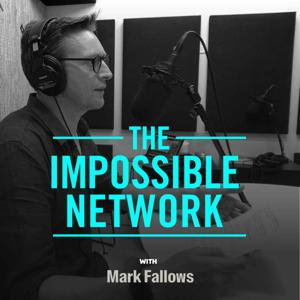
The weekly podcast tells the stories of curious-minded, purposeful people, creating positive change for social good.
Our guests include creative problem-solvers, storytellers, activists and…
Each week, host Mark Fallows explores who his guests are as humans, who or what made them, what they are working to achieve or impact in the world, and where serendipity has impacted their journey.
Learn, gain insights, and be inspired by how a diverse range of people have broken through obstacles, fearlessly exceeded the boundaries society sets, and taken chances, regardless of risk, that most fear, in pursuit of their ‘impossible’.
Hosted on Acast. See acast.com/privacy for more information.