
Sign up to save your podcasts
Or



The idea of 14,000 satellites in low earth orbit sounds pretty scary but in context there’s over a million cars on the road in the UK alone and low earth orbit is a really big 3D space. So, should people be worried about space sustainability? Shouldn’t they just relax and remember there’s loads and loads of space out there?
Or should they still be scared? What happens when satellites do cross paths? If they’re all part of the SpaceX Starlink constellation they’ll talk to each other instantaneously and get out of the way. But what if the contact is with a satellite from another country? Is it fair to say they’re on the equivalent of email or telephone? And what if they do collide? Will it be like the experiment in 2007 when the Chinese fired a missile at a defunct weather satellite? On the one hand, “great shot lads, you’ve hit something moving at 4km per second” but on the other, “you’ve probably caused a millennia worth of debris problems”.
If it’s within our capabilities to move bikes and cars and trains and planes around the world in an ordered fashion, shouldn’t it be well within human capabilities to extend the use of space? Is there a role for the UK in being “the AA” of space and is the UK-New Zealand debris removal agreement a useful step down this road?
Join Alice and Jonners as they talk to Phil Buckley, partner at the Public Service Consultants and a specialist in space sustainability, about the perils and pitfalls of satellite traffic jams and an opportunity that the UK “could be absolutely brilliant at”.
Contributors:
Alice Bunn, President of UKspace
Dr Alice Bunn OBE FIMechE FRAeS CEng | LinkedIn
UKspace: Overview | LinkedIn
Jonathan Daves, The Karman Line
Jonathan Daves | LinkedIn
Phil Buckley, Partner at the PSC
Phil Buckley | LinkedIn
Key topics covered:
Hosted on Acast. See acast.com/privacy for more information.
Why do people in the space sector think they have a comms problem and yet the public at large think space is sexy? Should we stop evangelising about the technology that gets stuff into space rather than the core marketing message? After all, KFC is about the chicken not the trucks that deliver it.
What are the leadership opportunities in the UK from launch in Scotland and what is the “environmental conscience” behind that endeavour? And how did we end up with kids in St Austell working on global lunar space missions on the back of a famous “failure”?
Join Alice, Jess Ratty from Halo Global and John Harrington UK editor of PR Week, as they confront the introspection of space and figure out better ways of confounding British understatement and amazing a world of would-be investors.
Contributors:
Alice Bunn, President of UKspace
Dr Alice Bunn OBE FIMechE FRAeS CEng | LinkedIn
UKspace: Overview | LinkedIn
Jess Ratty, Founder and Leader, Halo Global
Jess Ratty | LinkedIn
John Harrington, UK Editor, PR Week
John Harrington | LinkedIn
PR Week UK
Key topics covered:
Hosted on Acast. See acast.com/privacy for more information.
With a mind boggling 1.8 million satellites filed for launch before 2030 how are we going to manage the congested and contested realm of space? We know about warfare in space but how about lawfare in space? Who actually owns the moon? More pointedly, who owns the resources of the moon? How useful are the UK’s regulatory frameworks and how do you dispose of a fridge in low earth orbit?
Join Alice, Jonners and international lawyer Joanne Wheeler, “the single powerhouse behind many of the space business successes”, as they mull on the legal challenges of an exponentially growing race for space.
Contributors:
Alice Bunn, President of UKspace
Dr Alice Bunn OBE FIMechE FRAeS CEng | LinkedIn
UKspace: Overview | LinkedIn
Jonathan Daves, The Karman Line
Jonathan Daves | LinkedIn
Joanne Wheeler, Managing Partner, Alden Legal
Joanne Wheeler | LinkedIn
Key topics covered:
Hosted on Acast. See acast.com/privacy for more information.
How can Britain exploit the “astonishing opportunity” to become a global energy supplier from space? Why is space an engineering problem not a £7 billion physics problem like nuclear fusion? What did Gordon Brown do that transformed the UK film industry and why is this relevant to space? What connects the Crusades, crates of gold, coffee shops, blockchain and space?
Join Alice, Jonners and Mark Garnier MP as they figure out if space investment is big, messy and complicated or actually straightforward. And they argue why the UK Government must get properly involved.
Contributors:
Alice Bunn, President of UKspace
Dr Alice Bunn OBE FIMechE FRAeS CEng | LinkedIn
UKspace: Overview | LinkedIn
Jonathan Daves, The Karman Line
Jonathan Daves | LinkedIn
Mark Garnier, MP for Wyre Forest
Mark Garnier | LinkedIn
Key topics covered:
Hosted on Acast. See acast.com/privacy for more information.
So, we’re flying humans around the moon and bringing them back. But why are we doing it? To build a strategic outpost? To play power games? To do science? And if it's science, isn’t the useful value of resources on the moon a bit opaque? For example, why do we need to mine helium-3 when we can produce it on earth? More problematic, if you’re investing billions of dollars in putting sensitive instruments on the moon and you’ve got good access to light and frozen water, what happens when somebody else comes along and says: “I’d quite like a bit of that as well please”? How quickly does astropolitics become geopolitics?
Join Alice and her guests, Libby Jackson, Head of Space at the Science Museum and Ian Annett, Chair UKSpace Launch Committee, as they debate the value of Artemis II and celebrate the idea of being driven to push boundaries. “We’re human, what can we do?”
Contributors:
Alice Bunn, President of UKspace
Dr Alice Bunn OBE FIMechE FRAeS CEng | LinkedIn
UKspace: Overview | LinkedIn
Ian Annett, Chair UKSpace Launch Committee
Ian Annett | LinkedIn
Libby Jackson OBE FRAeS, Head of Space, the Science Museum
Libby Jackson OBE FRAeS | LinkedIn
Key topics covered:
Hosted on Acast. See acast.com/privacy for more information.
How do we solve population pressure and climate crisis in space? How has GPS allowed us to provide 12% more food globally? How did the UK become a global leader in small satellite manufacture after the British Government said, “there’s no future for the UK satellite industry”? How did Elon Musk turn reusable rockets from science fiction to science fact in less than 20 years? What else are “Elon and Jeff” going to allow us to do? And why is SpaceX still “the elephant in the room”?
Join Alice as she talks to Will Whitehorn, chair of giant space tech investor Seraphim and former president of Virgin Galactic, as they discuss the implications of “The Elon Musk show” and its legacy, “the beginnings of a competitive space industry of scale”.
Keep up to date with what is happening in the space industry. Register for free
Contributors:
Alice Bunn, President of UKspace
Dr Alice Bunn OBE FIMechE FRAeS CEng | LinkedIn
UKspace: Overview | LinkedIn
Will Whitehorn OBE, Seraphim Space Investment Trust
Will Whitehorn OBE | LinkedIn
Key topics covered:
Hosted on Acast. See acast.com/privacy for more information.
What did the Space-Comm Expo conference and exhibition tell us about connecting space and wider business? How does this manifest as tech connectivity in telecoms and why do farmers care about that? What did we learn about the benefits of extreme cold in manufacturing laboratories and why do pharmas care about that? How vulnerable are global logistics to the spoofing of navigation signals? And why is the UK government centralising space strategy in the Department for Science, Innovation and Technology?
Join Alice and Jonners as they reflect on the UK space sector’s largest trade event and the “energy, diversity and …sheer scope of what this industry has to offer”.
Contributors:
Alice Bunn, President of UKspace
Dr Alice Bunn OBE FIMechE FRAeS CEng | LinkedIn
UKspace: Overview | LinkedIn
Jonathan Daves, The Karman Line
Jonathan Daves | LinkedIn
Key topics covered:
Space-Comm Expo, London, March 2026
Conference overview
Sector integration
Insurance
Customer utility
Government role
Future outlook
Technological advancements
· Telecoms
· Manufacturing
Defence and security
· Satellite capabilities
· Current threats
Hosted on Acast. See acast.com/privacy for more information.
The space race is on but scientists are worried for our ozone. As this new frontier looks to expand with new investors, how should the environment sector respond? Plus, an unprecedented recommendation from the Environment Agency concerning PFAS. Listen to the ECO Chamber to find out more.
Once only the domain of US and Russian governments, the cost of launching things into space has come down, enabling more and more rockets and satellites to enter space.
However, NASA has warned that the growth of space travel could cause damage to the ozone layer. Dr Alice Bunn, the UK Space Agency’s former international director, joins the team this week to discuss the fine line to be treaded.
PLUS: The Marine Management Organisation has hired a new chief after a two-year search; South West Water has pleaded guilty to offences related to the supply of water “unfit for human consumption”; and the UK has legislated a lead shot ban – the first chemicals restriction since Brexit.
The ECO Chamber is brought to you by journalists at ENDS Report.
Hosted on Acast. See acast.com/privacy for more information.
As of 2026, the UK space industry is a significant and strategic driver of the national economy, contributing over £19 billion in revenue and supporting tens of thousands of high-skilled jobs. Satellite-based services and data underpin roughly 18% of UK GDP, equivalent to approximately £454 billion of the wider economy. And the sector is growing exponentially.
But this is just the tip of the iceberg. For the space industry to fully realise its potential it needs more of the right people to understand what’s happening and get involved. People like policy makers, investors, regulators, planners, communicators, lawyers and consultants.
Dr Alice Bunn, the president of UK Space, and her panel of guests, Sam Adlen co-CEO of Space Solar, Nick Shave managing director of Astroscale and Anushka Sharma founder of Naaut, discuss the surprising, awe inspiring business of space and make the compelling case for why more companies and investors should get involved.
Contributors:
Host:
Alice Bunn, President of UKspace
Dr Alice Bunn OBE FIMechE FRAeS CEng | LinkedIn
UKspace: Overview | LinkedIn
Guests:
Nick Shave, Managing Director of Astroscale
Nick Shave FRAeS | LinkedIn
Astroscale: Overview | LinkedIn
Sam Adlen, CEO of Space Solar
Sam Adlen | LinkedIn
Space Solar: Overview | LinkedIn
Anushka Sharma, founder of Naaut
Anushka Sharma | LinkedIn
Naaut: About | LinkedIn
Key topics covered:
Impact of Space on Everyday Life
Sustainability and Innovation in Orbit
Economic and Regulatory Landscape
The Future of Space Exploration
Hosted on Acast. See acast.com/privacy for more information.
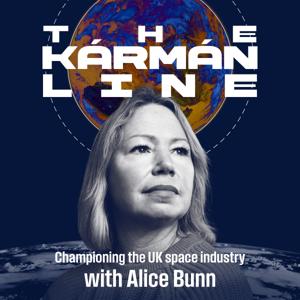
Introducing the Kármán Line, the only channel dedicated to the UK space industry.
Whether you're an investor, innovator, lawyer or scientist, if you want to keep up to date with this fast moving, full-of-potential sector listen to our interviews with the leading figures in the sector.
Dr Alice Bunn, former-international director of UK Space Agency and now president of UKspace, joins the show.
More to come. Subscribe here.
Hosted on Acast. See acast.com/privacy for more information.
From the publisher's feed
Hosted on Acast. See acast.com/privacy for more information.