
Sign up to save your podcasts
Or



Have you ever felt like the life you're living isn't quite the life you want?
This is the first episode of Living the Leap, a special series featuring people in the middle of change, before they know exactly how their story turns out.
Faith Lyons and her husband had built a good life in London: a thriving career, friends, family nearby, and two young children. But when they sat down together and compared the values they wanted their family life to reflect with how they were actually living, "zero percent matched."
So they decided to change it.
In 2024, Faith, her Finnish-American husband, and their two children left London for rural Finland. Nearly two years later, they're building a house on family land, raising their children in a language Faith is still learning, and figuring out who they are in the life they chose.
Faith is the founder of The Nugget App and spent nearly 20 years living and working in cities around the world. We talk about how she and her husband knew something needed to change, how they made the decision together, and what the move has changed about motherhood, marriage, work, identity, and her definition of success.
I loved meeting Faith in the middle of her story, while the answers are still unfolding.
Chapters
00:15 — What if the life you built no longer fits?
03:49 — Do your values match the life you’re actually living?
10:06 — How do you make a life-changing decision together?
12:56 — The move was only the first hard decision
16:22 — She didn’t realize how fast she was going until she stopped
21:33 — “I still don’t know who Faith is in Finland”
29:32 — When changing your life changes your definition of success
36:20 — Staying can be a decision too
42:50 — Learning to trust the big decisions
About Faith Lyons
Faith Lyons has traveled to 64 countries and called six home. She spent nearly 20 years living and working in global cities from Guatemala to Miami, DC, Port-au-Prince, Singapore, NYC, and London, managing multi-million-dollar humanitarian responses and global partnerships. After becoming a mom and experiencing how isolating parenthood can be without welcoming places for families, she founded The Nugget App to help families find places they can enjoy together, from baby to grandparent. In 2024, Faith and her Finnish-American husband packed up their two young children and traded London for rural Finland, moving to the forest for more time together and a slower pace of life. Faith is a huge proponent of living a life of many chapters and knowing when to slow down to enjoy the current one.
Links & resources
Join us! The Nugget App https://www.thenugget.app/
Instagram: @thenugget.app
LinkedIn: https://www.linkedin.com/in/falyons/
Book a call: https://gumdrop.ai/faith/
Credits: Hosted by Janine Mathó. Produced by Janine Mathó and Richard Lewis.
Please listen, follow, rate, and review The LifeLong Leap on Apple Podcasts, Spotify, or wherever you listen to podcasts. Follow @janinematho on social media. Visit janinematho.com and send your questions or guest pitches to [email protected].
Have you ever found yourself carrying more and more simply because you can?
So many of us feel that the only way to keep up with the pace of life is to take on more and move faster. But what if becoming more capable doesn't mean pushing yourself harder?
Psychologist Dr. Dan Peters and I talk about the surprising difference between competence and capacity, why highly capable people are often so good at overriding the signals that tell them to slow down, and how to notice what your body is telling you before you've pushed yourself too far.
We also explore a question that's getting harder to ignore: if AI allows us to do more and move faster, does that mean we should? Dan shares what technology can genuinely help us with, where human connection still matters, and why understanding ourselves doesn't always lead to real change.
And after nearly three decades of working with people, Dan shares something he wishes he'd understood much earlier about becoming who we really are, rather than who we think we're supposed to be.
This conversation made me rethink what it actually means to become more capable in a world that keeps asking more of us.
Chapters
00:14 — Becoming more capable of meeting change
04:06 — When your usual strengths stop working
07:05 — Are we taking in more than we can hold?
10:55 — High performers are very good at overriding the signals
15:44 — If AI lets us do more, should we do more?
19:00 — We confuse competence with capacity
25:30 — When people no longer fit the systems we built
34:12 — Understanding yourself isn’t the same as changing
40:26 — How much of who we are have we learned to hide?
About Dr. Dan Peters
Dr. Dan Peters, Ph.D., is a licensed psychologist, author, speaker, coach, and host of Make It a Great One with Dr. Dan. For more than 30 years, he has helped people reconnect with themselves so they can live with greater presence, authenticity, and purpose. As Co-Founder and Executive Director of Summit Center, he brings together decades of clinical psychology, coaching, and leadership experience to help people become more fully themselves.
Links & resources
Dr. Dan Peters: https://www.drdanpeters.com/
Make It a Great One with Dr. Dan Peters: https://podcasts.apple.com/us/podcast/make-it-a-great-one-with-dr-dan-1-podcast-for/id1157097748
Credits: Hosted by Janine Mathó. Produced by Janine Mathó and Richard Lewis.
Please listen, follow, rate, and review The LifeLong Leap on Apple Podcasts, Spotify, or wherever you listen to podcasts. Follow @janinematho on social media. Visit janinematho.com and send your questions or guest pitches to [email protected].
Have you ever sat down to do something that really needed your attention and a few minutes later realized your mind was everywhere except where you wanted it to be?
I do it too. And all those little moments add up to something bigger. Because attention isn’t only about getting our work done; we need it to read, learn, think something through, notice what’s happening around us, and really listen to another person.
So what happens when we live in an environment that is constantly pulling our attention somewhere else? And can we learn to take it back?
Our guest is cognitive psychologist and bestselling author Mark Tigchelaar, named by The Times as “the world’s leading expert in focus.” He has spent more than two decades studying attention, focus and sustainable performance.
But Mark doesn't only study how our brains perform. He's climbed Mont Blanc, completed a 72-hour Hell Week with the Dutch Navy SEALs, and learned to skydive, putting his knowledge of focus to some pretty extreme tests.
We talk about why we get distracted even when we've put our phones away; what happens in our brains every time we're interrupted; why scrolling isn't actually giving us a break; and why Mark believes we need to create more “islands of attention in a world full of noise.”
And we take the conversation beyond individual habits. What happens when our workplaces make it almost impossible to focus? What does sustainable high performance actually require? And what should we be teaching children about attention and learning in a world of AI?
This conversation made me think differently about something most of us give away hundreds of times a day without really noticing: our attention.
Chapters
00:14 — Can we learn to take our attention back?
02:11 — What jumping out of a plane taught Mark about attention
07:09 — Create islands of attention in a world full of noise
14:57 — The hidden cost of every interruption
24:06 — Your mind may be more distracting than your phone
35:05 — Scrolling isn’t relaxation. It’s sedation.
40:51 — What does sustainable high performance really require?
50:17 — What are we teaching children about attention?
56:08 — What do we need to protect in ourselves?
About Mark Tigchelaar
Mark Tigchelaar is a cognitive psychologist and bestselling author named by The Times as “the world’s leading expert in focus.” His six books on focus and attention have been translated into more than 20 languages. He has trained over 100,000 people across 1,600+ keynotes on how to work with — instead of against — a distracted brain. Diagnosed with severe dyslexia only after secondary school, he turned his own struggle with attention into his life's work. His mission is simple: help people stop scrolling their lives away.
Links & resources
Mark Tigchelaar: https://marktigchelaar.com/
Focus On/Off: https://marktigchelaar.com/author/
Mark Tigchelaar on LinkedIn:https://www.linkedin.com/in/mark-tigchelaar-focus/
Credits: Hosted by Janine Mathó. Produced by Janine Mathó and Richard Lewis.
Please listen, follow, rate, and review The LifeLong Leap on Apple Podcasts, Spotify, or wherever you listen to podcasts. Follow @janinematho on social media. Visit janinematho.com and send your questions or guest pitches to [email protected].
How Do We Thrive in a World That Never Stops Changing?
That question has taken me around the world over the past few months, into conversations with researchers, CEOs, educators, innovators, athletes, and people right in the messy middle of changing their own lives.
But one conversation I keep thinking about happened around a low table in a school in Bangalore, with a group of nine-, ten-, and eleven-year-olds.
We talked about the future. AI. Climate. War. What adults are doing. And whether young people can actually make a difference.
I’m Janine Mathó, a future-of-learning expert and author, and in this first episode of The Lifelong Leap, I’m sharing why I started this podcast, some of the questions I can’t stop thinking about, and a glimpse of what’s coming.
Because as quickly as the world is changing, there’s a more important question that affects all of us: What capabilities do we need to develop, and what conditions do we need to create, to thrive in a world of continuous change?
You’ll hear from people across disciplines and around the world, and you’ll also hear from people living through change before they know how it turns out, in special episodes I’m calling Living the Leap.
I’m so glad you’re here. We have some extraordinary conversations to explore, and I think they will change the way we think about what comes next. I can’t wait to get into them with you.
Chapters
00:00 How do we thrive in a world that never stops changing?
02:31 Our children are already living with the future
05:02 What do attention, AI and learning have in common?
07:21 What you’ll hear on The Lifelong Leap
09:55 What do humans need to thrive through continuous change?
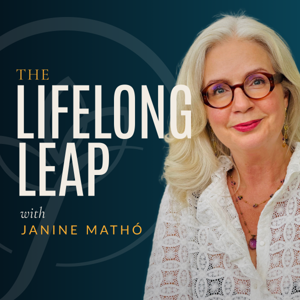
Our world is changing fast, and most of us are just trying to keep up. But how can we actually thrive in a world like this? Join future-of-learning expert and award-winning author Janine Mathó, who has spent more than 25 years studying how people learn, grow, and navigate change, as she talks with researchers, educators, innovators, and everyday people about some of the biggest questions shaping our lives: How do we keep evolving as the world around us changes? What should work look like when technology can do more of what humans used to do? How do we prepare young people for a future none of us can predict? And what does living longer mean for how we learn, work, and build our lives?
The Lifelong Leap brings these conversations together to help us cut through the noise and make sense of our changing world, together.
Are you ready? Let’s take The Lifelong Leap together.
From the publisher's feed
Our world is changing fast, and most of us are just trying to keep up. But how can we actually thrive in a world like this? Join future-of-learning expert and author Janine Mathó as she talks with…