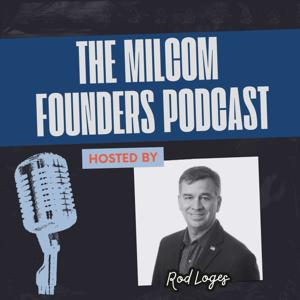
The MILCOM Founders Podcast

The MILCOM Founders Podcast

Download on the App Store

The MILCOM Founders Podcast episodes

  • Nicolas M. Chaillan | Unbiased Headlines

    MilCom Founders Podcast, Episode 61: Building an AI-Run Newsroom After a $250 Million Exit with Nicolas Chaillan

    Join host Rod Loges and guest Nicolas Chaillan as they talk about his time as the first Chief Software Officer of the US Air Force and Space Force and what he has built since. After selling Ask Sage to BigBear.ai for $250 million, Nicolas started Unbiased Headlines, a free news organization run entirely by AI agents, with no ads and no human editorial review.

    In this episode:

    • Nicolas describes starting Ask Sage in January 2023, shortly after ChatGPT came out, to bring generative AI to the Pentagon. The company earned FedRAMP authorization and Impact Level 5 accreditation in six months, which he says was unheard of for a small business, and BigBear.ai bought it in December 2025 for $250 million.
    • He explains how he came to government work with no military background, not even knowing the ranks. After serving as chief architect at DHS, he reached out to Pentagon leaders on LinkedIn and brought DevSecOps into the Department of Defense.
    • As the first Chief Software Officer of the Air Force and Space Force under Dr. Roper, he helped create Cloud One and Platform One, and he says hundreds of companies now do business with the Pentagon because of that work.
    • He shares why AI scared him for the first time in January, after he saw tools like OpenClaw automate complex work from end to end. He has been coding since he was seven and says he hasn’t written a line of code since.
    • Nicolas talks about how his three daughters run their own company, Quest Books, using AI agents to write picture books about their family trips. They take orders through Shopify and handle the packing and shipping themselves.
    • He walks through how Unbiased Headlines works. AI agents pull from 110 sources and run each article through an 18 to 20 step fact-checking process, publishing about 150 articles a day with no human review.
    • AI agents also built the company’s iOS and Android apps in one day, and they launched a daily podcast that went from idea to live in 48 hours.
    • Nicolas breaks down the cost. He estimates the same work would take at least 150 people and a $10 million payroll, and he runs it for about $10,000 a month in AI tokens.
    • He explains the sponsor model that keeps the site free with no ads. Companies pay for two sponsored stories a month, but the same AI agent writes them with no bias, and the sponsor can’t change the content.
    • He tells founders that generalists who learn to direct AI agents now have about one to two years before the field gets crowded. He also explains why he thinks blue collar trades are safer from disruption than white collar work.
    • He talks about his book, Replacement, which he wrote to give people practical tools to still have a job in five years.

    Key takeaways:

    • Generalists have an edge right now. If you know a little about many parts of the business, you can direct AI agents across all of them.
    • AI agents only do as well as the person directing them. Nicolas could push his agents further on coding than on ad buying because he knew coding better, so keep learning the areas where you’re weakest.
    • The barrier to building software is close to gone. If anyone can copy your idea in ten minutes, it isn’t a business yet, so build around something you understand deeply.
    • You may not need to raise money. Nicolas says a founder can now build a business for a few hundred dollars in tokens instead of spending months raising a seed round.
    • The window is short. Nicolas thinks founders have about one to two years before everyone is building the same things and it gets much harder to stand out.
    • It’s hard to stay hungry once money isn’t the reason. What keeps Nicolas building is caring about the problem, which for him is media bias.

    Guest: Nicolas Chaillan, Founder of Unbiased Headlines and former first Chief Software Officer, U.S. Air Force and Space Force

    • LinkedIn: https://www.linkedin.com/in/nicolaschaillan/
    • Website: https://unbiasedheadlines.com

    Nicolas M. Chaillan is a serial entrepreneur, cybersecurity expert, and former senior U.S. government technology leader. He served as the first Air Force and Space Force Chief Software Officer under Dr. William Roper, bringing DevSecOps, continuous Authority to Operate (c-ATO), and modern software practices across the entire Department of Defense.

    In January 2023, he founded Ask Sage, Inc., the first generative AI platform to achieve FedRAMP High Authorization for government teams. Ask Sage was acquired by Big Bear.ai in 2025 for $250M, and Nicolas served briefly as Big Bear.ai’s CTO before departing in February 2026.

    In 2026, he founded Unbiased Headlines (UnbiasedHeadlines.com), an independent news organization built on one promise: Facts. Not Spin.

    Previously, he served as Special Advisor for Cloud Security and DevSecOps at the Department of Defense and Special Advisor for Cybersecurity and Chief Architect for Cyber.gov at the Department of Homeland Security.

    Nicolas founded 14 companies starting at age 15, created and sold over 187 innovative software products to Fortune 500 companies, and is recognized as a pioneer of PHP. He has over 25 years of experience in cybersecurity, software development, and government modernization.

    He is currently focused on building Unbiased Headlines (UnbiasedHeadlines.com), AI investing, and hosting “In the Nic of Time” on LinkedIn and YouTube. He is the author of “Replacement”, a book on AI’s impact on the workforce.

    The MilCom Founders Podcast champions and celebrates military community business founders. Each episode brings practical insights from successful veteran entrepreneurs.

    Sponsored by One Degree Financial www.onedegreefinancial.com

    Take our Financial Clarity Self-Assessment. 16 questions. You’ll know where your weak spots are and what to work on first: https://bit.ly/4xp7jnq

    Want to support veteran entrepreneurs? Donate to the Dick Loges Veteran Entrepreneur Scholarship Fund: https://bold.org/funds/dick-loges-veteran-entrepreneur-fund/

    37 min
  • Sileon Murray, Jr. | SURV7X, LLC

    MilCom Founders Podcast, Episode 60: Rebuilding Hiring in Software with Sileon Murray Sr.

    Join host Rod Loges and guest Sileon Murray Sr. as he shares how a kid who sold Krispy Kreme by the box at twelve became a retired 20-year Air Force veteran and CEO of SURV7X, LLC. Sileon explains how unpaid invoices forced him to lay off half his team, and how that moment led him to rebuild his company’s hiring process in software as VAETHRYN, an AI hiring platform starting with trucking and other blue-collar industries.

    In this episode:

    • Sileon taught himself guitar at eight or nine by pulling fishing line tight and using it as strings, because his family couldn’t afford an instrument.
    • At twelve he took prepaid Krispy Kreme orders at $2.50 a box and sold extras for $3.50, buying them wholesale for $1.25.
    • He joined the Air Force hoping to fly, following his older brother, and started in Security Forces before fighting his way into the cyber career field.
    • As a government contractor, SURV7X tracked expiring contracts months in advance and had talent lined up, so vacancies were filled within hours.
    • When companies and partners stopped paying their invoices, Sileon had to lay off half his team and realized software could run the same process his people had.
    • With VAETHRYN, a truck driver can interview at 2 a.m. and be through onboarding within 72 hours, at a time when Sileon says fleets are short about 40 percent of the drivers they need.
    • The intelligence system inside VAETHRYN is named Orita, after his mom.

    Key takeaways:

    • Strong delivery won’t protect you from customers who don’t pay. SURV7X was filling vacancies within hours, and unpaid invoices still forced Sileon to lay off half his team.
    • Look at what your people do the same way every time. Sileon’s product came from automating a process his team already ran by hand.
    • Match the advisor to the decision. Sileon keeps about 18 mentors, taking business questions to business people and life questions to someone whose life he would trade for.
    • Make room for quiet. Sileon says the workforce intelligence inside VAETHRYN came to him in silence, not from a mentor or a book.
    • Trust what you see coming. Sileon believes veterans have a rare ability to spot what’s ahead and act on it, even when the timing isn’t perfect.

    Guest: Sileon Murray Sr., CEO of SURV7X, LLC and creator of the VAETHRYN AI hiring platform, retired 20-year U.S. Air Force veteran

    • LinkedIn: https://www.linkedin.com/in/sileonmurraysr/
    • Website: https://surv7x.com/

    Sileon Murray Sr. is a retired 20-year U.S. Air Force veteran and the CEO of SURV7X, LLC. His first taste of entrepreneurship came at twelve, and SURV7X is his seventh business. He built VAETHRYN because candidates for driving and skilled trades jobs rarely wait. If nobody responds, the best of them are gone within 48 hours.

    VAETHRYN is an AI hiring team that works around the clock. Its 7XHire module sources and qualifies candidates at any hour and follows up in seconds instead of days, so interviews get booked before a good candidate goes cold. The platform is now in pilots with companies that hire drivers and skilled trades, and SURV7X is a finalist for the Utah Business Innovation Awards.

    The MilCom Founders Podcast champions and celebrates military community business founders. Each episode brings practical insights from successful veteran entrepreneurs.

    Sponsored by One Degree Financial www.onedegreefinancial.com

    Take our Financial Clarity Self-Assessment. 16 questions. You’ll know where your weak spots are and what to work on first: https://bit.ly/4xp7jnq

    Want to support veteran entrepreneurs? Donate to the Dick Loges Veteran Entrepreneur Scholarship Fund: https://bold.org/funds/dick-loges-veteran-entrepreneur-fund/

    38 min
  • Juan Ortega | Ortega Solutions, Inc.

    MilCom Founders Podcast, Episode 59: Building the LOD Cart with Juan Ortega

    Join host Rod Loges and Juan Ortega, a staff sergeant and air transportation specialist in the Air National Guard who invented a new way to safely offload heavy cargo from military aircraft when no ground equipment exists.

    In this episode

    • Juan’s path from driving the latrine service truck (call sign: Fleet Five) to becoming an air transportation specialist stationed in Alaska
    • The cargo problem nobody had solved: safely getting an 8,500-pound shipping container off a C-17 when there’s nothing on the ground to help
    • How three people on a phone call and a napkin drawing became the LOD Cart
    • Spending a year with Texas A&M engineering students to translate what he knew as an operator into engineering language
    • September 2025 in Cold Bay, Alaska: every other option had been ruled out, and the LOD Cart worked
    • The government shutdown that killed his funding and what he did next
    • Paying his own way to a startup conference in San Francisco and getting honest feedback that his pitch needed serious work
    • Going through a 14-week Founders Institute cohort and then winning funding to build version two

    Key takeaways

    • The “heartbeat” method: updating your stakeholders every week keeps a project alive; stop updating and it dies
    • Fifteen minutes of innovation per day is enough to move a project forward while keeping up with your day job
    • Building a community of people who are ready to help you is more valuable than collecting contacts
    • When your pitch gets torn apart, that’s the most useful feedback you’ll get
    • Leadership trusted Juan because he was the subject matter expert first, a trained instructor on the existing method
    • If you have an idea, write it down and take it to your supervisor; just start the conversation
    • The military shows you the problem; building a company around that solution is a set of skills you have to go learn

    Guest

    Juan Ortega, Staff Sergeant, Air National Guard; Creator, LOD Cart (Logistical Operations Device)

    • LinkedIn: https://www.linkedin.com/in/juan-ortega-9025b4210/
    • Website: https://www.ortegasolution.net/

    Juan Ortega is an Air Force logistics professional, innovator, and emerging founder with more than ten years of experience in air transportation and austere logistics operations. He leads the Logistics Operations Device, better known as the LOD Cart, an effort created to address the challenge of safely offloading large and fragile cargo when conventional infrastructure and equipment are unavailable. Juan has worked with Arctic Spark, Founder Institute, and a growing network of mentors and operational partners to move the concept from a field observation to an engineered and funded prototype. In September 2025, the LOD Cart supported the successful offload of an 8,500-pound shipping container in Cold Bay, Alaska. His work focuses on ownership, mentorship, translating operator experience for technical and executive audiences, and using established frameworks to move ideas from operational problems toward repeatable capabilities. The views he shares are his own and do not represent an official endorsement by the Department of Defense or Department of the Air Force.


    Looking ahead

    Juan and his team are in the design phase for version two of the LOD Cart, a two-cart system with delivery expected by the end of March 2027.

    The MilCom Founders Podcast champions and celebrates military community business founders. Each episode features real stories and practical insights from veteran entrepreneurs.

    Sponsored by One Degree Financial www.onedegreefinancial.com

    For each guest on our show, One Degree Financial donates $100 to the Dick Loges Veteran Entrepreneur Scholarship Fund, supporting education for children of a MilCom business owner.

    35 min
  • Fidel GomezTorres | American Veteran Arts Collective (AVAC)

    MilCom Founders Podcast, Episode 58: Building Workforce Pathways from Military Service into the Creative Economy with Fidel GomezTorres

    Join host Rod Loges and guest Fidel GomezTorres as they explore how a Navy Seabee veteran turned his experience in logistics and community building into the foundation for the American Veteran Arts Collective (AVAC), a nonprofit creating workforce pathways for veterans and military-connected families into the creative economy. Fidel shares how he arrived in Washington, D.C. during a period of significant federal workforce disruption and recognized a gap between the 30,000 veterans living in the district and a $15 billion creative economy that rarely engaged military talent.

    In this episode:

    • Fidel describes his decision to join the Navy after 9/11, driven by a sense of duty rooted in his immigrant background and a family culture of sacrifice, and how he was assigned as a Seabee builder, a role he had never considered before enlisting.
    • He reflects on the difference between inspiration and motivation as leadership models, explaining how the military replaced the elusive, creative-world idea of inspiration with disciplined commitment, and why that shift shaped how he approaches building an organization today.
    • Fidel shares how his first post-military job as an executive assistant to a fashion CEO in New York City revealed that veterans carry logistics and leadership skills that creative sector employers value but rarely know how to recruit for.
    • He explains the founding of AVAC as a direct response to the wave of federal job losses affecting veterans in the D.C. metro area, and how he identified the creative economy as an underutilized pathway for veteran employment and economic mobility.
    • The conversation covers AVAC's pilot program with the Veterans History Project at the Library of Congress, where targeting eight to ten participants produced sixteen, doubling the goal and validating both veteran interest in the creative sector and cultural institutions' appetite for military talent.
    • Fidel describes AVAC's three-track measurement system, which captures feedback from veteran participants, cultural partners, and an independent field observer with no connection to either the military or the arts, as a way to surface what those inside the room cannot see.
    • He explains how post-pilot feedback led directly to the creation of AVAC's workforce fellowship, a structured mechanism designed to remove financial pressure from veterans engaged in the program and improve the quality of impact data collected.
    • Fidel addresses the challenge of making AVAC's mission relevant to people who do not identify with either veterans or the arts, arguing that veterans employed across more sectors means more resilient labor markets and stronger communities, regardless of personal connection to the cause.
    • The episode closes with Fidel outlining AVAC's next phase: moving from pilot delivery into capitalization, proving repeatability, and eventually scaling the model to cities with large veteran populations and strong creative ecosystems, including Dallas, Houston, and San Antonio.

    Key takeaways:

    • Discipline is a more reliable engine than inspiration. Motivation means doing what needs to be done whether or not you feel ready, and that consistency is what allows founders to build before the vision is fully proven.
    • Proof precedes scale. Fidel deliberately treated AVAC's first year as a pilot year, resisting the pull toward expansion until the core thesis was validated by real participant outcomes and institutional response.
    • Reserving space for discovery is not optional. The fellowship, one of AVAC's core program features, did not exist before the first pilot. It emerged only because Fidel built in room to learn rather than locking the model down in advance.
    • The field observer role is worth stealing. Bringing in someone with no stake in the outcome and no prior connection to the population or the sector produces feedback that insiders, no matter how thoughtful, are structurally unable to generate themselves.
    • Veterans bring transferable value that the creative economy has not yet learned to recruit for. The gap is not a talent gap on the veteran side. It is a translation and awareness gap on the employer side.
    • Community building starts with genuine curiosity about worlds outside your own. Fidel credits the military with teaching him to find common ground across difference, and names that skill as the foundation of everything AVAC does to connect two communities that have rarely shared a table.
    • Making the business case matters as much as making the mission case. Social impact organizations that can articulate economic returns alongside human outcomes are better positioned to survive funding environments where feel-good is no longer sufficient.

    Guest: Fidel GomezTorres, Founder and Executive Director of the American Veteran Arts Collective (AVAC), U.S. Navy veteran

    • LinkedIn: https://www.linkedin.com/in/fgt023/
    • Website: https://americanveteranarts.org/

    Fidel GomezTorres is the Founder and Executive Director of the American Veteran Arts Collective (AVAC), a nonprofit building workforce pathways for veterans and military-connected families into careers across the arts, culture, and creative economy. An incubator-backed entrepreneur, Georgetown University graduate student, and George W. Bush Institute Stand-To Veteran Leadership Program Scholar, his work sits at the intersection of public policy, workforce development, veteran advocacy, and the creative economy. Through partnerships with cultural institutions, public agencies, and employers, he is developing a scalable model that helps veterans translate military leadership into meaningful civilian careers while strengthening the institutions they serve. His work explores how credibility, strategic partnerships, and mission-driven leadership can help founders build organizations that create lasting public value.

    The MilCom Founders Podcast champions and celebrates military community business founders. Each episode brings practical insights from successful veteran entrepreneurs.

    Sponsored by One Degree Financial www.onedegreefinancial.com

    Take our Financial Clarity Self-Assessment. 16 questions. You'll know where your weak spots are and what to work on first: https://bit.ly/4xp7jnq

    Want to support veteran entrepreneurs? Donate to the Dick Loges Veteran Entrepreneur Scholarship Fund: https://bold.org/funds/dick-loges-veteran-entrepreneur-fund/

    37 min
  • Greg Cullison | QWERX, Inc.

    MilCom Founders Podcast, Episode 57: Defending the Network from the Inside Out with Greg Cullison

    Join host Rod Loges and guest Greg Cullison as they trace a career path from the U.S. Foreign Service through Navy Reserve intelligence, a deployment to Iraq, and into the founding of QWERX, Inc., a cybersecurity software company that authenticates every device on a network every three seconds using one-time encryption keys derived from randomness in nature rather than mathematical algorithms.

    In this episode:

    • Greg's career started in the Foreign Service, where he had his first overseas posting at 23. The predictability pushed him toward graduate school in public policy, then into government consulting, and eventually a direct commission into the Navy Reserve Intelligence program in 2002.
    • During his deployment to Iraq with the 18th Airborne Corps, a colonel gave Greg six weeks of top cover while he built trust with Iraqi counterparts on a sensitive capacity-building program. Despite zero visible progress early on, that quiet backing made the mission possible, and Greg earned a Bronze Star for the work.
    • The origin of QWERX was a letter in Greg's mailbox informing him that his SF-86 data was among the 22 million records stolen in the Office of Personnel Management breach. The root cause, static credentials manually rotated twice a year, was still not being fixed.
    • QWERX authenticates every device on a network every three seconds, issues a one-time encryption key, discards it, and repeats. A stolen credential becomes useless before an attacker can act on it.
    • Greg explains the threat quantum computing poses to current encryption, including the "harvest now, decrypt later" strategy nation-state adversaries are already using, and why QWERX's approach is quantum-resistant without relying on any algorithm.
    • Greg learned QWERX was a finalist at the RSA Conference Launchpad competition the same day he found out payroll could not be made.
    • For veteran founders, Greg recommends using AI for research and marketing, reading actual books instead of listicles, and staying honest about whether the idea is actually working.
    • The question Greg wished Rod had asked: how do you shut it off? He credits learning drums and coaching youth soccer as the practices that force genuine presence and keep him from running in reactive mode all day.

    Key takeaways:

    • Leadership of self comes before leadership of others. If your own mindset and conduct are unstable, what you reflect to your team will be too.
    • The difference between failure and giving up matters. A wrong turn you can course-correct from is not the same as walking away because it got hard.
    • Early adopters and mainstream customers are not the same people. Spending energy trying to convince skeptics before you have proof points is usually the wrong focus.
    • Static credentials are still how most attackers get in. The cybersecurity industry has added complexity around a problem it has not fixed at the root.
    • Time is the one resource you cannot recover. Intentional time blocking, even when it breaks down, forces you to start the day with a clear objective rather than handing your schedule over to whoever sends the first email.

    Guest: Greg Cullison, Co-Founder and CEO of QWERX, Inc., former Foreign Service Officer and U.S. Navy Reserve Intelligence Officer

    • LinkedIn: https://www.linkedin.com/in/gregcullison
    • Website: https://www.qwerx.co

    Greg Cullison is the Co-Founder and CEO of QWERX, Inc., a cybersecurity company built on a direct challenge to the industry: static device credentials are not a security problem to be managed. They are a design flaw to be eliminated. QWERX replaces static credentials with dynamic keys that rotate every few seconds and vanish after use. There is no credential to steal, harvest, or exploit. Even if an attacker could capture a key, it already no longer exists. The company's patented infrastructure has been validated at the RSA Conference, demonstrated live over Starlink, and analyzed by a U.S. Government Lab to be quantum-proof.

    Greg began his career as a Foreign Service Officer before joining the Navy Reserve through a direct commission. He served as a Reserve Officer in the U.S. Navy's Office of Naval Intelligence and earned a Bronze Star for counterterrorism work in Baghdad. He holds a graduate degree in public policy.

    The MilCom Founders Podcast champions and celebrates military community business founders. Each episode brings practical insights from successful veteran entrepreneurs.

    Sponsored by One Degree Financial www.onedegreefinancial.com

    How ready is your business for what's next? Take the Ready Founder Assessment: https://bit.ly/4xp7jnq

    Want to support veteran entrepreneurs? Donate to the Dick Loges Veteran Entrepreneur Scholarship Fund: https://bold.org/funds/dick-loges-veteran-entrepreneur-fund/

    47 min
  • Lindsey Chrismon | Oply

    MILCOM Founders Podcast – Episode 56: First Female Little Bird Pilot to AI-Powered Homeownership with Lindsey Chrismon

    Join host Rod Loges and guest Lindsey Chrismon as she traces a path from a childhood picnic at West Point to co-founding Oply, a venture-backed AI-powered home management platform built to give homeowners the kind of proactive guidance their cars already give them. Lindsey became the first and only woman in US Army history to fly the AH-6 Little Bird with the 160th Special Operations Aviation Regiment, flew Apaches at Fort Bliss before that, and served as West Point's fourth female First Captain. She and her husband Gabe launched Oply out of Harvard’s Innovation Lab after Gabe’s restoration company revealed how many catastrophic home losses could have been prevented with basic, timely information.

    In this episode:

    • How an 11-year-old Lindsey attended a family picnic on West Point's grounds and decided on the spot that it was the only school she would apply to
    • What Branch Night looks like at West Point, how aviation slots are distributed based on order of merit, and the relief of opening an envelope with the right answer inside
    • Flying the AH-64 Apache for three years at Fort Bliss before assessing for the 160th, and why the shift to training on the Lakota helicopter is creating real challenges for candidates who want to fly the Little Bird today
    • Why leadership matters more in the civilian world than in the military, because the people following you can simply quit
    • How Gabe's water, fire, and mold restoration work revealed that roughly half of catastrophic home incidents could have been prevented if homeowners had known what to do and when
    • The car dashboard analogy that drives Oply's product logic and what a home-specific maintenance platform actually does
    • Testing marketing messages for free through organic social media before spending money, and how millions of monthly views helped identify a winning content strategy to put budget behind
    • Oply's two-pronged go-to-market approach, direct to homeowners and through realtors, builders, inspectors, and mortgage companies
    • Raising a $1.2 million pre-seed round led by Hivers and Strivers, and how a mentor's dinner party led to a pitch in front of 13 Harvard deans and Bill Ackman, who invested
    • The three things Lindsey's mentor Reza Satchu says founders must demonstrate when fundraising: authenticity, inevitability, and momentum
    • Why pitching investors whose thesis does not match your sector is a guaranteed no, and how recognizing that earlier would have saved significant time
    • The current focus on improving 60 to 90 day user retention, and why a leaky funnel at that stage makes every marketing dollar spent on acquisition nearly worthless
    • How Lindsey and Gabe keep work and marriage separate by using Slack for business and texting for personal communication
    • Cooper's difficult first 15 days in the NICU after inhaling meconium at birth, and how faith carried the family through that uncertainty
    • The veteran-specific resources Lindsey recommends, including Warrior Rising, Hivers and Strivers, and the West Point Entrepreneurship Roadshow, which is open to all veteran founders

    Key takeaways:

    • "The Mom Test" principle applies: talk to as many homeowners, customers, or users as possible before you build. People who love you will tell you your idea is great, and that tells you nothing.
    • Organic content is a free testing environment. Find what works before you spend money scaling it.
    • Matching your pitch to an investor's actual thesis is not optional. If their portfolio does not include your sector, no amount of polish will close the deal.
    • You cannot fail if you do not quit, but that only holds if you are honest about what the data is telling you along the way.
    • Retention is where growth strategies either prove out or fall apart. Acquiring users who do not come back is just an expensive way to empty a bucket.
    • If you are not the kind of person who can find something worth showing up for in the hard middle of building a company, the outcome you are aiming for will not be enough to keep you moving toward it.
    • The veteran network is not just a nice-to-have. It can be the lead investor in your pre-seed round, the room where you meet your biggest check writer, and the community that keeps you from feeling like you are building alone.
    • When co-founders are also spouses, keeping work disagreements data-driven and free of spousal emotion is not a soft skill. It is an operational necessity.

    Guest: Lindsey Chrismon, Co-Founder and CEO of Oply, West Point graduate and the Academy’s fourth female First Captain, Army Apache pilot, and the first and only woman in US Army history to fly the AH-6 Little Bird with the 160th Special Operations Aviation Regiment. MBA from Harvard Business School, where she launched Oply out of the Harvard Innovation Lab. Named to the Inc. Female Founders 500.

    • LinkedIn: https://www.linkedin.com/in/lindsey-danilack-chrismon/
    • Website: https://www.oply.app/

    Lindsey Chrismon is the co-founder and CEO of Oply, a venture-backed AI-powered home management platform built to take the guesswork out of homeownership. Through a proactive, recommendation-driven model, Oply helps US homeowners stay ahead of maintenance and decisions rather than scrambling to react to them. She leads the company alongside her husband and co-founder, Gabe Chrismon, who serves as COO.

    Before founding Oply, Lindsey graduated from West Point, where she served as the Academy’s fourth female First Captain, its highest-ranking cadet position. She went on to become the first and only woman in US Army history to fly the AH-6 Little Bird with the 160th Special Operations Aviation Regiment, one of the most demanding assignments in Army aviation. She earned her MBA from Harvard Business School, where she launched Oply out of Harvard’s Innovation Lab. Her work as a founder has been recognized on the Inc. Female Founders 500, and she is a frequent speaker at events including AHEAD’s Women in Tech conference and the West Point Athena Summit.

    Looking ahead: Oply is focused on strengthening 60 to 90 day user retention while expanding its B2B2C partnerships with realtors, builders, inspection companies, and mortgage companies to reach homeowners at key moments in the ownership cycle.

    The MilCom Founders Podcast champions and celebrates military community business founders. Each episode brings practical insights from successful veteran entrepreneurs.

    Sponsored by One Degree Financial www.onedegreefinancial.com

    How ready is your business for what’s next? Take the Ready Founder Assessment: https://bit.ly/4xp7jnq 

    Want to support veteran entrepreneurs? Learn about the Dick Loges Veteran Entrepreneur Scholarship Fund at milcomfounders.com

    43 min
  • Go-To-Guy Timberlake | The American Small Business Coalition

    MilCom Founders Podcast, Episode 55: From Federal Contracting Lifer to $8 Billion in Results with Guy Timberlake

    Join host Rod Loges and guest Guy Timberlake as he shares nearly four decades in federal contracting, how he and his wife built The American Small Business Coalition from a membership organization into an education and training ecosystem, and why he believes government contracting is a marketplace you bring your industry to, not an industry itself.

    In this episode:

    • How Guy's wife's idea to leave corporate America became the American Small Business Coalition in 2004, starting as a membership organization before evolving into an education and training model built around a framework named after an Air Force command
    • The 2004 phone call Guy made to a 15-person company led by a service-disabled, retired Green Beret, asking him to meet on a street corner in Arlington for a federal opportunity he couldn't name, which led to a $3 million contract in the Green Zone in Iraq and a company now doing upwards of $700 million a year
    • Why Guy tells founders not to start a company for government contracting, but to start a company around their expertise and then see if the applicability is there in the federal marketplace
    • The marketing wall that word-of-mouth businesses eventually hit, and how ASBC worked through it after years of relying on reputation alone
    • Working with combat veterans who take risks that would scare most civilian founders because fear has "a whole different look and feel" for people who have served in combat
    • Guy's new book "Making It to Base Camp: Mt. Enimacaldo," a business fable about three entrepreneurs trying to crack the code on government contracting, which one reviewer called "not a book, but a mirror"
    • What Guy sees in military founders that sets them apart: discipline, process-driven problem solving, and a willingness to punch up against larger companies in unrestricted opportunities
    • His advice to every founder entering federal contracting: give yourself grace, because nobody was born knowing how to do this

    Key takeaways:

    • Government contracting is not an industry. It is a marketplace. Bring your industry to it rather than building a company around it
    • Positioning yourself in the right places while being prepared to act when you get there is what separates companies that grow from companies that stall
    • Word of mouth will carry a business for years, but at some point the need to grow beyond what that well provides becomes real, and if you don't know actual marketing, you will hit a wall
    • Give yourself grace when entering federal contracting. You are allowed to not know things, and learning the fundamentals before chasing contracts is not falling behind
    • Being a military veteran is a superpower in this space because of the discipline, training, and problem-solving instincts that come with service

    Guest: Guy Timberlake, Chief Visionary Officer, CEO, and Co-Founder of The American Small Business Coalition, defense contractor and military family member

    • LinkedIn: https://www.linkedin.com/in/guytimberlake/
    • Website: https://theasbc.org 

    Guy "Go-To-Guy" Timberlake doesn't teach theory. He teaches what he tested himself, over 38 years in and around federal contracting. Today he is Chief Visionary Officer, CEO, and Co-Founder of The American Small Business Coalition (The ASBC). People, companies, and agencies have looked to The ASBC as a trusted resource since 2004, because getting sh!t done, and done well, in government contracting is what The ASBC has always been about.

    In 2009, Guy created the Ethical Stalking for Government Contractors® methodologies and operating system, the flagship doctrine behind everything The ASBC teaches. Built on ground truth-based intelligence, strategic market positioning, and risk understood from the perspective of contracting officers and their customers, it was never theoretical. Guy tested it in the field, refined it through repetition, and documented it only after it proved itself. That work now reaches a wider audience through the GettingFED™ with Go-To-Guy Blog, Live, Livestream, and On-Demand content, and, in book form, through GettingFED™ KitchenWERX™, The ASBC's imprint for publishing.

    Guy leads The ASBC's delivery of that doctrine through the AETC framework, Awareness, Education, Training, and Coaching. The results speak for themselves: over $8 billion in documented contract and subcontract revenues for companies competing on major federal procurements including DoD DLITE, DIA SIA, and a host of other agency-specific and multi-agency contracts and contract vehicles.

    He earned his "Go-To-Guy" call sign in the 1990s, when Air Force and Navy acquisition professionals consistently directed colleagues his way: "go to Guy to ensure the job is done right." That reputation for delivering results is why results over rhetoric, intelligence over guesswork, and evidence over assumptions define how he works.

    Guy serves as a Syracuse University IVMF/Bunker Labs Ambassador and Regional Lead supporting military-connected entrepreneurs. He has been recognized with honors from the U.S. Treasury, State Department, and Maryland Department of Commerce, and is the recipient of the 2022 GAINer Lifetime Achievement Award, among other recognitions for his support of the public sector and military-connected ecosystems. He is a sought-after speaker for associations, industry conferences, government agencies, and companies seeking strategic guidance for their executive and growth teams.


    Looking ahead: Guy recently published Making It to Basecamp: Mt. Enimacaldo, a business fable and practical guide for founders entering or restarting in federal contracting, available through GettingFED™ KitchenWERX™. The ASBC continues expanding its education and training reach through the AETC framework, with over $8 billion in documented contract results behind the methodology Guy built and tested over nearly four decades.

    The MilCom Founders Podcast champions and celebrates military community business founders. Each episode brings practical insights from successful veteran entrepreneurs.

    Sponsored by One Degree Financial: www.onedegreefinancial.com

    How ready is your business for what's next? Take the Ready Founder™ Assessment: https://s.pointerpro.com/bgitblpx

    Want to support veteran entrepreneurs? Learn about the Dick Loges Veteran Entrepreneur Scholarship Fund at milcomfounders.com

    40 min
  • Charles Masters Rodriquez | Supply Veins

    MilCom Founders Podcast, Episode 54: From Army Dive Officer to Defense Supply Chain Founder with Charles Masters Rodriguez

    Join host Rod Loges and guest Charles Masters Rodriguez as they trace his path from a multigenerational military family in Puerto Rico to West Point, through one of the Army's smallest and least-known specialties, and into two back-to-back ventures built around the same supply chain problem he first encountered in uniform.


    In this episode:

    • How Charles's family military history stretching back to the Civil War, combined with a sixth-grade documentary on the military academies, set him on the path to West Point at age twelve
    • Why Charles chose Army diving after spotting a lone recruiter with a KM37 dive helmet on a folding table during branch selection day, when every other option had left him unimpressed
    • The "Buddy Effers" underwater endurance exercise at dive school, where Charles had to train himself to stay calm at depth by mentally singing a slow song and visualizing a sunflower meadow to keep CO2 accumulation from overwhelming him
    • A gear malfunction at 190 feet that required him to stay composed under conditions he had not specifically trained for, and how that experience shaped how he handles business crises today
    • Building and scaling MK3 Industries solo to seven figures, serving General Motors, Rivian, and Penske, and running into the same supply chain communication problems he had seen in the Army
    • How Supply Veins evolved from an automotive marketplace concept to AI supply chain software, and then organically found its current market: pre-seed to Series A dual-use defense startups preparing for their first government contracts
    • The moment Blake Hall ignored everything Charles was describing about his startup and asked only about his team, a question that redirected Charles's thinking about what actually builds a company

    Key takeaways:

    • When someone tells you something is one of the hardest things you can do, pay attention to your reaction. For some people, that is the signal they needed.
    • Staying calm under pressure is a trainable skill, not a personality trait. Charles had to build it deliberately, rep by rep, at the bottom of a pool.
    • Bringing on customers before your product is ready to serve them well accelerates churn, not growth. Five raving users who log in every day are worth more than fifty indifferent ones.
    • Founding a company requires knowing in advance what level of sacrifice you are willing to make, because the answer determines which kind of company you should be building.
    • Putting the ego aside and treating your product hypothesis as a scientific experiment, not a conviction to defend, is what separates founders who find product-market fit from those who chase the wrong market for years.

    Are you a Ready Founder™? Take the Ready Founder Assessment: https://s.pointerpro.com/bgitblpx

    Guest: Charles Masters Rodriguez, Founder and CEO of Supply Veins, U.S. Army veteran, West Point graduate, and former Captain and Engineer Dive Officer

    • LinkedIn: https://www.linkedin.com/in/charlescmasters/
    • Website: https://supplyveins.com

    Charles Masters Rodriguez is a bilingual entrepreneur born and raised in San Juan, Puerto Rico, with a career spanning military service, wholesale distribution, and AI supply chain technology. He is a graduate of the United States Military Academy at West Point, where he earned a degree in Engineering Management, and later received his MBA from Florida International University (FIU). He has taken several executive education programs from the Tuck School of Business and the Stanford School of Business. Charles is also a CEO Circle, Founder Institute and Techstars alum.

    Charles served five years in the U.S. Army as a Captain and Engineer Dive Officer, stationed at Joint Base Pearl Harbor–Hickam, Hawaii. During his service, he led complex underwater engineering, search, and recovery missions, including a joint operation with the Defense POW/MIA Accounting Agency (DPAA) that successfully recovered and repatriated the remains of a U.S. Navy pilot missing in action since the Vietnam War. These missions reinforced the life or death importance of reliable equipment and resilient supply chains.

    After transitioning from military service, Charles bootstrapped MK3 Industries, a B2B wholesale distribution company for automotive and fleet maintenance parts and equipment, scaling the business to seven figures while serving enterprise customers such as General Motors, Penske, Rivian, and JB Hunt. Across both military operations and commercial distribution, he encountered the same systemic challenges: manual procurement workflows, fragmented buyer-supplier communication, and a lack of real-time visibility.

    These experiences led him to found Supply Veins, a venture backed, AI-native operating system that converts procurement emails into structured data to improve supplier communication, automate follow-ups, and execute purchase orders in real time. The system delivers supply chain intelligence for defense and mobility teams to help build, manage, and scale resilient supply chains.

    Charles has been recognized for his leadership and impact, including being named Young Entrepreneur of the Year by the FIU Florida Small Business Development Center and receiving the Capital Catalyst Award from the D'Aniello Institute for Veterans and Military Families (IVMF) at Syracuse University. He is a committed veteran advocate, volunteering with military-affiliated nonprofits such as VetsinTech and the PenFed Foundation, mentoring veterans and military spouses transitioning into entrepreneurship and technology. He frequently travels between Puerto Rico, Miami, and Los Angeles, and outside of work is an avid reader, marathon runner, and lifelong student of quantum theory.

    The MilCom Founders Podcast champions and celebrates military community business owners. Each episode brings practical insights and lessons learned from veteran entrepreneurs.

    Sponsored by One Degree Financial www.onedegreefinancial.com

    Want to support veteran entrepreneurs? Learn about the Dick Loges Veteran Entrepreneur Scholarship Fund at https://www.milcomfounders.com/

    31 min
  • Andrew Yim | Lumora Animal Health

    MILCOM Founders Podcast, Episode 53: From Special Operations to Animal Health Tech with Andy Yim

    Join host Rod Loges and guest Andy Yim as he shares his path from West Point graduate and Field Artillery Officer to founder and CEO of Lumora Animal Health, a company building AI-powered pet health records for owners, veterinarians, groomers, boarders, and shelters, all while completing his MBA at the Wharton School.

    In this episode:

    • How Andy discovered West Point through a family friend while he was a Boy Scout in New Jersey, with no prior military connections in his family
    • Serving in the 2nd Infantry Division in South Korea, the 101st Airborne, 5th Special Forces Group, and the 160th Special Operations Aviation Regiment across four deployments
    • Starting Lumora Animal Health after receiving a 55-page, unreadable medical record when moving his cats to Philadelphia for business school
    • Why Andy chose a B2C entry strategy, targeting pet owners directly rather than selling software into veterinary clinics first
    • Building PawChart, an AI-powered app that reads uploaded pet records and produces structured summaries of conditions, allergies, medications, and vaccinations
    • Grassroots marketing through apartment complexes, dog parks, breweries, and minor league baseball pet nights to find early users without paid advertising
    • How a cold DM to the Philadelphia Shih Tzus Instagram page led to a partnership with a marketing firm that reshaped the company's go-to-market approach
    • Expanding beyond pet owners with PawChart Link for boarders and groomers, and the PawPrint Program offering free portal access to shelters and rescues
    • Bootstrapping with family and friends funding and non-dilutive grants while keeping software costs low enough to stay sustainable in school
    • The product design decision to treat a pet's passing with empathy rather than an archive toggle

    Key takeaways:

    • Do the market research before you build anything. Talk to the people who would actually use it.
    • If you are the smartest person in the room, you are probably in the wrong room
    • When you do not know the answer, say so and commit to finding it. Making something up will cost you more than admitting the gap.
    • A battery commander who removed honest reporting from a briefing became the clearest example Andy saw of how not to lead
    • Being coachable lets you adjust before a problem becomes unfixable
    • Andy woke up one day building an app for his cats and realized the work had stopped feeling like work

    Guest: Andy Yim, Founder and CEO of Lumora Animal Health

    • LinkedIn: https://www.linkedin.com/in/andrewsyim/
    • Website: https://getpawchart.com/

    Andrew (Andy) Yim was born and raised in River Edge, New Jersey, and graduated from the United States Military Academy at West Point in 2017 with a Bachelor's Degree in Systems Design and Management. He commissioned as a Field Artillery Officer and served in the 2nd Infantry Division, 101st Airborne Division, 5th Special Forces Group (Airborne), and 160th Special Operations Aviation Regiment (Airborne). He deployed four times over an eight-year Army career, three times to Iraq and once to Cyprus.

    After his military service, Andy matriculated to The Wharton School for his MBA with a concentration in Entrepreneurship and Innovation, expected 2027. During the first year of his MBA program, Andy started Lumora Animal Health after identifying a pain point with animal records that he noticed with his own cats.

    Looking ahead: Lumora Animal Health continues expanding beyond individual pet owners with PawChart Link for groomers and boarders and the PawPrint Program for shelters and rescues, while Andy finishes his MBA at Wharton.

    The MilCom Founders Podcast champions and celebrates military community business founders. Each episode brings practical insights from veteran entrepreneurs.

    Sponsored by One Degree Financial: www.onedegreefinancial.com

    Want to support veteran entrepreneurs? Donate to the Dick Loges Veteran Entrepreneur Scholarship Fund: https://bold.org/funds/dick-loges-veteran-entrepreneur-fund/

    Take the Ready Founder™ Assessment: https://s.pointerpro.com/bgitblpx

    43 min
  • Scott Jensen | Alpine Global Solutions & National Veteran Small Business Coalition

    MilCom Founders Podcast, Episode 52: From Marine Colonel to Nonprofit CEO with Scott Jensen

    Join host Rod Loges and guest Scott Jensen as he shares his path from Naval Academy graduate and Marine Corps helicopter pilot to founder of Alpine Global Solutions and CEO of the National Veteran Small Business Coalition, where he grew the organization from $300,000 to over $4 million in six and a half years.

    In this episode:

    • How Scott's family legacy of service, from an Army Air Corps grandfather to a Vietnam veteran father, shaped his decision to attend the Naval Academy
    • The second-year epiphany at Annapolis that pulled him toward the Marines, and the extra Officer Candidate School requirement under Secretary Jim Webb that came with it
    • A 27-year aviation career as a Huey pilot, commanding combat units in Iraq and Afghanistan at the squadron, group, and wing forward levels before retiring as a colonel
    • Leading the Marine Corps behavioral programs on sexual assault, substance abuse, and community counseling, and how that final assignment steered him toward the nonprofit space after retirement
    • Why Scott's first post-military role, chosen for title, salary, reputation, and ego, left him miserable despite landing in the nonprofit space he thought he wanted
    • The book "Leading From Purpose" by Nicholas Craig that a mentor recommended after Scott had been out for two or three years, and why he has returned to it three or four times since
    • His open offer to spend 30 to 45 minutes with any veteran in transition who wants to talk about purpose and learn from his mistakes
    • How three unconnected people independently recommended Scott to the NVSBC search committee, leading to a fractional consulting role that the board eventually asked him to take on full-time
    • NVSBC's fellows program and free consultation network connecting companies to over 250 subject matter experts, plus a YouTube training library that member companies have adopted as part of their onboarding process
    • The surgical robotics company that met a VA contracting officer on the NVSBC conference floor and landed a sole source SDVOSB award within a month
    • His book "The Owner's Playbook," designed as a pick-any-chapter resource for business owners rather than a front-to-back read

    Key takeaways:

    • Jumping into the wrong role hurts just as much as not having income. Title, salary, reputation, and ego are poor compasses for post-military transition
    • Read "Leading From Purpose" by Nicholas Craig before you make your next major career move
    • Veterans are hesitant to ask for help or approach people outside the rank structure. That hesitancy costs them opportunities they don't know they're missing
    • The measure of a leader is how calmly and clearly they respond when things go wrong
    • NVSBC serves everyone in the company, from the CEO to entry-level employees, because training only the top of the chain has never worked
    • The veteran small business community is one of the few that willingly creates its own competition. That quality is rare in any other industry
    • You are armed with the kind of resiliency and operational thinking that most civilian entrepreneurs spend years trying to develop. Give yourself credit for it

    Guest: Scott Jensen, Founder of Alpine Global Solutions and CEO of the National Veteran Small Business Coalition, 27-year Marine Corps veteran, Naval Academy graduate, retired Colonel, and Huey helicopter pilot

    • LinkedIn: https://www.linkedin.com/in/scottjensen269/ 
    • NVSBC: https://nvsbc.org/ 
    • Alpine Global Solutions: https://alpineglobalsolutions.com/ 

    Scott Jensen is a 27-year Marine Corps veteran and retired Colonel who has successfully transitioned his military leadership experience into impactful roles across public, private, and nonprofit sectors. As the founder of Alpine Global Solutions, Scott applies his diverse experience to provide business consulting services, with expertise in strategic planning, financial management, policy development, and stakeholder engagement.

    Scott currently serves as the Chief Executive Officer of the National Veteran Small Business Coalition, where he has grown the organization from $300,000 to over $4 million over a four-year period while overseeing a 300% growth in programs and services. He also serves as a Federal Appointee on the U.S. Small Business Administration's Advisory Committee on Veterans Business Affairs and Interagency Task Force on Veteran Business Development.

    His career highlights include serving as Chief Operations Officer at Team Red, White, and Blue, Chief Executive Officer of Protect Our Defenders, and Assistant Vice President at the American Council on Education. Scott's military career culminated in high-level positions leading combat units in Iraq and Afghanistan as a helicopter pilot, and finally as Chief of Behavioral Programs at Marine Corps Headquarters.

    He holds degrees from the United States Naval Academy, Marine Corps University, and the U.S. Naval War College, as well as an Executive Nonprofit Management Certification from Georgetown University. His insights have been featured in Forbes, USA Today, The Washington Post, and other major media outlets.

    The MilCom Founders Podcast champions and celebrates military community business owners. Each episode brings practical insights and lessons learned from veteran entrepreneurs.

    Sponsored by One Degree Financial www.onedegreefinancial.com

    Want to support veteran entrepreneurs? Donate to the Dick Loges Veteran Entrepreneur Scholarship Fund: https://bold.org/funds/dick-loges-veteran-entrepreneur-fund/

    45 min

About The MILCOM Founders Podcast

From the publisher's feed

Championing and celebrating veteran founders through weekly conversations. Each episode features military entrepreneurs sharing their journey from service to success, uncovering real strategies for…