
Sign up to save your podcasts
Or

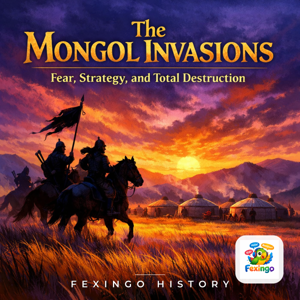


In this episode, Lucas and Luna dive into the Mongol horse archer — the backbone of Genghis Khan's military machine. They explore the composite bow's devastating power, the Mongols' unrivaled equestrian skills from childhood, and the tactical genius of feigned retreats and the 'snowball arrow' volley. The conversation covers specific battles like the 1221 Battle of the Indus, where Jalal al-Din's brave stand against Genghis was undone by arrow storms, and the 1241 Battle of Mohi, where Subutai used night attacks and archery to shatter Hungarian knights. Lucas explains the life of a warrior: starting with a bow at age three, training with mounted archery games like 'kök börü' (wolf hunt), and the logistics of the yam system supplying arrows. They discuss the composite bow's construction from horn, sinew, and wood, and how Mongol archers could shoot accurately at 300 meters. Luna asks about the psychological impact of the Mongol arrow storm, and Lucas recounts how even heavily armored knights were pierced at close range. The episode ends with a reflection on how Mongol archery shaped Eurasian warfare for centuries, from the Mamluks to the Mughals.
#MongolHorseArchers #CompositeBow #GenghisKhan #BattleOfMohi #BattleOfTheIndus #Subutai #JalalAlDin #MongolTactics #FeignedRetreat #SteppeWarfare #YamSystem #MongolEmpire #HorseArchery #MedievalWarfare #KökBörü #CentralAsia #History #FexingoHistory
Keep every episode free: buymeacoffee.com/fexingo
In 1258, Hulagu Khan's Mongol army laid siege to Baghdad, the heart of the Abbasid Caliphate and a center of Islamic civilization. Over the course of a few weeks, the city was utterly destroyed—libraries burned, canals ruined, and the caliph executed. This episode explores the political divisions that weakened Baghdad, the siege itself, and the enduring controversy over how many died. We discuss the role of Hulagu's Christian wife Dokuz Khatun and Shiite vizier Ibn al-Alqami in shaping the campaign. Was the destruction as total as later writers claimed? We examine contemporary accounts from Juvayni and Ibn Kathir to separate fact from legend. A sobering look at how one siege reshaped the medieval world.
#Baghdad1258 #HulaguKhan #AbbasidCaliphate #MongolSiege #IslamicGoldenAge #DokuzKhatun #IbnAlAlqami #Juvayni #IbnKathir #MongolEmpire #TigrisRiver #Mustasim #SiegeWarfare #HistoricalDestruction #MedievalHistory #MiddleEast #History #FexingoHistory
Keep every episode free: buymeacoffee.com/fexingo
In this episode, Lucas and Luna explore a strange and little-known chapter of Mongol military history: the use of weather magic and ritual specialists on campaign. They focus on the figure of the ba'urchi — a shaman who accompanied Mongol armies to summon storms, fog, and cold. Drawing on accounts from The Secret History of the Mongols, Juvayni, and Rashid al-Din, they examine specific cases: the legendary blizzard that helped Subutai and Jebe defeat the Kipchaks at the Kalka River in 1223, and the early summer snow that saved the Mongols from a Georgian ambush. The conversation touches on how Mongol battlefield shamans used ritual objects like the jada stone, believed to command rain, and how this form of psychological warfare amplified their terrifying reputation. They also compare Mongol weather magic to similar practices among the Khitan, Jurchen, and steppe nomads before them. This episode offers a fresh lens on Mongol conquest strategy: not just military brilliance, but a belief system that made the natural world a weapon.
#MongolWeatherMagic #Baurchi #MongolShamanism #JadaStone #KalkaRiver1223 #Subutai #Jebe #Kipchaks #SecretHistoryOfTheMongols #Juvayni #RashidAlDin #MongolEmpire #SteppeWitchcraft #BattlefieldClimate #PsychologicalWarfare #History #FexingoHistory #MongolInvasions
Keep every episode free: buymeacoffee.com/fexingo
In February 1238, the Mongol army under Batu Khan and Subutai laid siege to the city of Vladimir, capital of the Vladimir-Suzdal principality. This episode dives into the winter campaign that shattered the Rus' resistance, focusing on the tactics, the betrayal of Prince Yuri Vsevolodovich, and the ferocious battle at the Sit River. We explore how Mongol siege engineers adapted to frozen conditions, why the Rus' princes failed to unite, and the aftermath that left Vladimir a charred ruin. Join Lucas and Luna as they unravel the strategies and human cost of one of the most decisive invasions of Kievan Rus'.
#MongolSiegeOfVladimir #BatuKhan #Subutai #PrinceYuriVsevolodovich #KievanRus #SitRiver #WinterCampaign #MongolEmpire #MongolInvasions #MedievalRussia #1238 #SiegeWarfare #MongolTactics #RusPrinces #MongolConquest #History #FexingoHistory #MilitaryHistory
Keep every episode free: buymeacoffee.com/fexingo
Before the internet, before the Pony Express, there was the Yam — a relay network of riders, horses, and fortified stations that stretched from the Caspian Sea to the Pacific Ocean. In this episode, Lucas and Luna unpack how the Mongol Empire's postal and intelligence system made swift conquest possible. They trace its origins under Genghis Khan, its expansion under Ögedei, and the daily life of yamchi riders who could cover 200 miles in a single day. Guest historian sources like Juvayni and Marco Polo describe stations stocked with fresh mounts and food, while paiza passes granted safe passage across the empire. But the Yam was more than mail: it carried spies, tax revenues, and military orders that kept a sprawling realm unified. Lucas also explores the system's dark side — how it enabled rapid troop movements and surveillance, and how its collapse contributed to the empire's fragmentation. This is a story of logistics, speed, and control, told through the hoofbeats of Mongol horses.
#Yam #MongolEmpire #GenghisKhan #Ögedei #Juvayni #MarcoPolo #Paiza #Yamchi #Karakorum #CentralAsia #PostalSystem #Logistics #Horseback #Steppe #Intelligence #Empire #History #FexingoHistory
Keep every episode free: buymeacoffee.com/fexingo
Most people know Sorghaghtani Beki, but two other Mongol women ruled the entire empire as regents: Töregene Khatun and her daughter-in-law Oghul Qaimish. In this episode, Lucas and Luna explore how these khans' widows seized power, manipulated factions, and held the Mongol Empire together—and nearly tore it apart—between 1241 and 1251. We trace Töregene's rise from Merkit captive to de facto ruler of the world's largest land empire, her alliance with the Muslim merchant Abd al-Rahman, and her bitter feud with Chagatai. Then Oghul Qaimish's doomed regency, her struggles with Kublai and Möngke's ambitious mother Sorghaghtani, and her eventual execution by Möngke. Drawing on the Secret History of the Mongols, Juvayni, and Rashid al-Din, we see how women shaped the imperial succession—and how their stories were nearly erased.
#TöregeneKhatun #OghulQaimish #MongolWomen #MongolEmpire #Regency #SorghaghtaniBeki #ÖgedeiKhan #GüyükKhan #MöngkeKhan #AbdAlRahman #Chagatai #Juvayni #RashidAlDin #SecretHistory #Karakorum #EmpressDowager #History #FexingoHistory
Keep every episode free: buymeacoffee.com/fexingo
In 1256, Hulagu Khan's Mongol army marched on the mountain fortress of Alamut, stronghold of the Nizari Ismaili state—better known in the West as the Assassins. This episode explores how the Mongols methodically dismantled a network of castles across northern Iran, the role of the Grand Master Rukn al-Din Khurshah, and the legendary library of Alamut that was reportedly burned. We discuss the Assassins' internal divisions, their failed diplomacy with the Mongols, and how Hulagu used the Assassins' own fear tactics against them. The episode also touches on the Persian historian Juvayni, who was present at the siege and later wrote about the destruction of the library. What did the Mongols really find at Alamut? Was the library as vast as legend claims? And how did the fall of the Assassins pave the way for the sack of Baghdad? This episode gets into the details of a campaign that erased one of the medieval world's most feared and secretive orders.
#Alamut #Assassins #NizariIsmaili #HulaguKhan #MongolEmpire #RuknAlDinKhurshah #Juvayni #SiegeOfAlamut #MiddleEastHistory #MedievalHistory #PersianHistory #Castles #LibraryOfAlamut #MongolInvasions #SecretHistory #Ismaili #History #FexingoHistory
Keep every episode free: buymeacoffee.com/fexingo
In 1221, as Genghis Khan pursued the Khwarezmian prince Jalal al-Din to the banks of the Indus River, the Mongol Empire stood at the threshold of the Indian subcontinent. What stopped them? This episode of The Mongol Invasions examines the aborted invasion of India—the battle of the Indus, where Jalal al-Din made a legendary leap to escape capture, and the strategic reasons why Genghis Khan turned back rather than push into the Delhi Sultanate. We explore the Delhi Sultanate under Iltutmish, the Mongol fear of Indian heat and disease, the role of the Kipchak slave soldiers, and the centuries of raids that followed under later khans like Tarmashirin. Featuring insights from Juzjani's Tabakat-i-Nasiri and the chilling Mongol demand that Iltutmish 'clear the country of rebels'—a demand he diplomatically evaded. A turning point that may have saved India from devastation, but brought centuries of frontier warfare. Keywords: Genghis Khan, Jalal al-Din, Indus River, Delhi Sultanate, Iltutmish, Kipchak, Mamluk, Tarmashirin, Juzjani, Tabakat-i-Nasiri, Mongol invasion of India, battle of the Indus 1221.
#MongolInvasionofIndia #GenghisKhan #Jalal_al-Din #Iltutmish #DelhiSultanate #BattleOfTheIndus #IndusRiver #MongolRaids #Tarmashirin #Juzjani #Tabakat_i_Nasiri #KipchakSlaveSoldiers #MamlukDynasty #History #FexingoHistory #MongolEmpire #MedievalIndia #CentralAsia
Keep every episode free: buymeacoffee.com/fexingo
In this episode, Lucas and Luna explore the Mongol conquest of the Song Dynasty, the longest and most difficult campaign in Mongol history. After decades of warfare, Kublai Khan finally broke through Song defenses, using siege engines, naval innovations, and psychological pressure. They discuss key battles like Xiangyang and Yashan, the role of Muslim engineers, and the tragic end of the Song loyalists. The episode also covers the administrative challenges of ruling southern China and the cultural exchange that followed. Listeners will learn about the Song resistance, the fall of Hangzhou, and the last stand at Yashan that ended with the child emperor's death. This is a story of epic scale, innovation, and human cost.
#MongolEmpire #SongDynasty #KublaiKhan #Xiangyang #Yashan #SiegeWarfare #ChineseHistory #NavalWarfare #MongolConquest #SouthernSong #Hangzhou #Bayan #LiuZheng #MuslimEngineers #CounterweightTrebuchet #History #FexingoHistory #MedievalWarfare
Keep every episode free: buymeacoffee.com/fexingo
When Genghis Khan conquered a tribe, he didn't just demand tribute—he demanded their daughters. This episode dives into the Mongol Empire's strategic use of marriage alliances, focusing on the little-known story of the Qongirat tribe's queens. From Börte, Genghis's first wife, to the Qongirat women who ruled as empresses of the Yuan dynasty, we explore how brides were political assets, hostages, and power brokers. Learn about the 'senior wife' system, the role of sons-in-law as governors, and how Kublai Khan married his daughters into the Korean kingdom of Goryeo to secure its loyalty. We also cover the controversy: were these marriages a form of political hostage-taking? The episode draws on the Secret History of the Mongols and Persian chroniclers like Rashid al-Din. No previous episode has focused on this specific marriage network—here we trace the personal ties that held the empire together.
#MongolEmpire #MarriageAlliances #GenghisKhan #Börte #Qongirat #YuanDynasty #KublaiKhan #SecretHistoryoftheMongols #RashidAlDin #Goryeo #MongolQueens #PoliticalHostages #SteppeDiplomacy #CentralAsia #WomenInHistory #EmpireBuilding #History #FexingoHistory
Keep every episode free: buymeacoffee.com/fexingo
From the publisher's feed