
Sign up to save your podcasts
Or

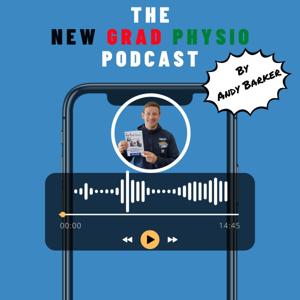


Do you rush to get your patient on the bed...
Find out more in this week's podcast episode.
Enjoy the show!
Andy
The New Grad Physio Mentor
PS. I'd love to hear your feedback on this podcast. Please leave a review or get in touch at [email protected] and he will get right back to you.
PPS. To get a copy of my book ‘How To Become A Competent, Confident & Competitive New Grad Physio’ or to access ALL his FREE learning resources head to www.newgradphysio.com
Remember being told at University that the aim of your subjective assessment was to identify a hypothesis...
Enjoy the show!
PPS. To get a copy of my book ‘How To Become A Competent, Confident & Competitive New Grad Physio’ or to access ALL his FREE learning resources head to www.newgradphysio.com
Super exciting news to share with you…
Registration has just opened for my final events of 2022...
Lower Limb Course [Online] - Wednesday 30th November 2022
Upper Limb Course [Online] - Wednesday 7th December 2022
Both courses will run in the evening (18:00-21:00) and every attendee gets a CPD certificate for attending.
I have cut all the fluff that you get on a full day course and we get straight into the content...
So you can learn what you would do on an 8 hour course in just 3!
And for just £37!
Find out more here…
8 Hours of CPD in Just 3 Hours!
Andy
The New Grad Physio Mentor
PS. I'd love to hear your feedback on this podcast. Please leave a review or get in touch at [email protected] and he will get right back to you.
PPS. To get a copy of my book ‘How To Become A Competent, Confident & Competitive New Grad Physio’ or to access ALL his FREE learning resources head to www.newgradphysio.com
Many therapists struggle with ankle syndesmosis injuries...
Often incorrectly diagnosing them as lateral ankle injuries, like an ATFL or CFL injury, but this is a BIG issue...
As they need to be managed very differently!
This area of the ankle is often glossed over at Uni so it is no great surprise you might struggle to differentiate syndesmosis injuries to other lateral ankle injuries.
The ankle is a relatively simple joint, that moves up and down, and the mechanisms of injuries are often clear for both lateral ankle (inversion) and syndesmosis injuries (dorsiflexion and external rotation)...
So why do so many therapists get it wrong?
Find out in this week's podcast episode...
And learn the one ankle syndesmosis test you need to know!
Enjoy the show!
PS. I'd love to hear your feedback on this podcast.
Please leave a review or get in touch at [email protected] and he will get right back to you.
PPS. To get a copy of my book ‘How To Become A Competent, Confident & Competitive New Grad Physio’ or to access ALL his FREE learning resources head to www.newgradphysio.com
Do you sometimes get your head in a spin when assessing patients with neck pain?
I used to be the same as a new grad.
Any patient with neural symptoms, pins and needles or weakness...
I used to worry(alot).
I'd worry that I might might them worse…
And struggle to make the call whether they were safe to treat...
Or whether or not I needed to refer them on to A&E.
Sound like you?
What I have learnt over the years is that through a simple, structured assessment you can rule out almost all serious pathologies…
In nearly all patients with neck pain, even those with serious symptoms.
Learn more in this week's podcast episode!
Enjoy the show!
PS. Andy would love to hear your feedback on this podcast.
Please leave a review or get in touch at [email protected] and he will get right back to you.
PPS. To get a copy of Andy’s book ‘How To Become A Competent, Confident & Competitive New Grad Physio’ or to access ALL his FREE learning resources head to www.newgradphysio.com
Do you worry that you might miss something when you are treating patients with neck pain?
Many therapists do, both news grads and experienced therapists...
But this is not great as it affects your ability to clinically reason...
And in turn help your patient out of pain and back to full fitness.
So many therapists have the wrong end of the stick when it comes to treating neck pain...
Which often leads to a 'hands-off' approach...
Where treatment and rehab is ultra cautious...
Which is often not the best approach for your patient.
Want to learn my biggest tips for treating neck pain so you feel better equipped and confident to treat patients with all different types of neck injuries...
Even those tricky patients with nerve pain or other irritable symptoms...
Enjoy the show!
PS. Andy would love to hear your feedback on this podcast. Please leave a review or get in touch at [email protected] and he will get right back to you.
PPS. To get a copy of Andy’s book ‘How To Become A Competent, Confident & Competitive New Grad Physio’ or to access ALL his FREE learning resources head to www.newgradphysio.com
‘Why didn’t they teach us this at Uni?’
This was a question I got asked by a therapist on a course I was teaching on just last week.
He was talking about how University had missed the bit about how to properly design and implement a rehab plan for a patient.
University teaching typically teaches you a very basic way to assess, treat and rehab your patients...
In the textbook way.
But if you have ever seen a patient in real life, you will know that these textbook patients do not actually exist!
You were taught that if your patient had [x] issue...
You would do treatment technique [y]…
Or rehab exercise [z], then their problem would go away.
It would be nice if it was that simple, but clearly it is not.
Every single patient you see is different.
They have a different story, different goals, previous injuries and non-msk issues that can affect their rehab.
Even if patients seem similar in how they present, they will never be the same...
And as such require an individual treatment and rehab plan to fix them up.
Learn how to do this in this week's podcast episode.
Enjoy the show!
PS. Andy would love to hear your feedback on this podcast. Please leave a review or get in touch at [email protected] and he will get right back to you.
PPS. To get a copy of Andy’s book ‘How To Become A Competent, Confident & Competitive New Grad Physio’ or to access ALL his FREE learning resources head to www.newgradphysio.com
Picking the right exercise in hamstring injury rehab can be tough.
How do you know what exercise is best?
Is it a romanian deadlift, some form of hamstring bridge, a slider....
Maybe it's nordics?
It must be nordics, right, because everyone is using them?
Improvements in hamstring strength link to reductions in hamstring injuries, that is clear from the current evidence base.
You increase the capacity of a muscle via strength training, then it has a higher threshold before it breaks, which seems pretty obvious when you think about it.
But if it was just as simple as improving strength, why is it that even some of the strongest athletes and patients still break down?
Improving strength of the hamstrings, or any other muscle for that reason, can actually make some patients and athletes worse...
And actually increase their injury risk!
Learn more about hamstring injury rehab, including why nordics might not be the best hamstring exercise after all, and why some rehab exercises can actually increase injury risk, in this week's podcast episode.
Enjoy the show!
PS. Andy would love to hear your feedback on this podcast. Please leave a review or get in touch at [email protected] and he will get right back to you.
PPS. To get a copy of Andy’s book ‘How To Become A Competent, Confident & Competitive New Grad Physio’ or to access ALL his FREE learning resources head to www.newgradphysio.com
Why is it that some hands-on treatment techniques work really well with your knee pain patients...
Yet the same techniques do nothing for other patients with almost identical symptoms?
In short, if your techniques are not working, you are probably treating the wrong thing...
Or the wrong part of the knee!
To understand what you need to do differently, you need to fully understand how the knee joint functions...
And only when you know this, can you get quick results with your patients struggling with knee pain, each and every time, regardless of their pathology.
Find out how to do this yourself in this week's podcast episode.
Enjoy the show!
PS. Andy would love to hear your feedback on this podcast. Please leave a review or get in touch at [email protected] and he will get right back to you.
PPS. To get a copy of Andy’s book ‘How To Become A Competent, Confident & Competitive New Grad Physio’ or to access ALL his FREE learning resources head to www.newgradphysio.com
If you are a physio it seems you have to love or hate manual therapy.
Which camp are you in?
I'm in neither camp, and probably sit somewhere in the middle.
I see the value in manual therapy for SOME patients and not others...
And use it differently with different injuries and how I use manual therapy changes as the rehab plan progresses.
How I now use my hands-on treatments is very different to when I started out as a new grad physio.
I made a lot of errors, mainly because I did not truly understand what I was actually trying to do (hint - I was not breaking down scar tissue or smoothing out muscle tissue like I thought I was!).
Listen to this week's podcast episode and hear why my ways of working have changed so much and learn how to better use manual therapy yourself(if you choose to use it) to get better results with your patients and athletes that actually work...
With patients pain and symptoms not returning almost as soon as they jump off the treatment table!
Enjoy the show!
Andy
The New Grad Physio Mentor
PS. Andy would love to hear your feedback on this podcast. Please leave a review or get in touch at [email protected] and he will get right back to you.
PPS. To get a copy of Andy’s book ‘How To Become A Competent, Confident & Competitive New Grad Physio’ or to access ALL his FREE learning resources head to www.newgradphysio.com
From the publisher's feed

37,563 Listeners

37 Listeners

9 Listeners