
Sign up to save your podcasts
Or

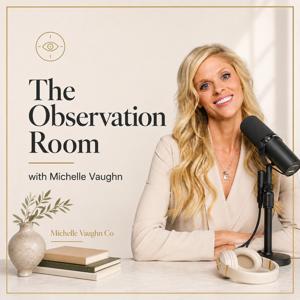


Imagine me in the passenger seat and my son driving. We're in the same car, on the same road, and we're living two different realities. Then there's the space where those two lives meet.
In this episode of The Observation Room, I look at the stories we tell about each other and what those stories create between us. I follow that question through Adidas and Puma, the McDonald brothers and Ray Kroc, relationships, negotiation, and my own work leading a team.
I also talk about the difference between seeing someone's perspective and carrying their pain, why seeing several sides doesn't have to stop you from making a decision, and what I mean when I say I can twist the room. I can't know someone else's experience just by imagining it. I can ask and leave room for an answer I didn't expect.
Join the community: https://www.michellevaughn.co/community
Subscribe and choose the newsletter that fits your interests: https://www.michellevaughn.co
Listen to The Observation Room: https://www.michellevaughn.co/podcast
Watch on YouTube: https://www.youtube.com/watch?v=PrwvtfCBOAw
Chapters
00:00 Adidas, Puma, and two versions of one moment
02:18 The passenger seat and the third space
05:29 Who gets to tell the story?
12:01 Why our own version feels objective
16:08 Relationships and the moments we turn toward
20:09 People who stepped into the space between
25:44 Follett and the window in the next room
28:36 Seeing several sides at work
31:39 Perspective, empathy, and what we carry
37:00 Analysis paralysis and decisions without certainty
41:32 Twist the room and notice the opportunity
44:34 The Christmas truce
47:19 Asking for the other person's version
Hosted on beehiiv. Read the full Privacy Policy at beehiiv.com/privacy.
I use credit cards for points, pay the balance every month, and save the rewards for travel and hotel stays. I benefit from the system. I also want to understand who pays for it.
In Episode 15 of The Observation Room, I look at how credit cards became a business, what merchants pay to accept them, and why the reward can get more attention than the borrowing cost. I ask why a much cheaper card hasn’t taken over the market, then work through rate caps, financial education, and the difference between showing someone a price and setting it for them.
Come into the community and tell me what you learned about your card after you started using it. Please leave out account numbers and other private details. You can also choose a newsletter at MichelleVaughn.co.
Clarifications and sources
Rewards are funded within a business with several revenue sources, including interchange, interest, and fees. Carrying a balance does not by itself tell us why someone borrowed or what they understand. See the Federal Reserve’s credit-card profitability analysis and rewards research.
The economist behind the 1991 paper is Lawrence M. Ausubel. His explanation is one research account of competition, not a complete explanation of every issuer’s pricing. Read the paper’s publication record.
For a lost or stolen debit card, the initial reporting window is two business days after discovering the loss. The separate 60-day window runs from when the statement is sent. Number-only theft has different rules. FTC guide to card fraud protections.
Interchange is only part of a merchant’s total processing cost. The EU’s 0.3% consumer-credit-card interchange cap is not a cap on the full merchant service charge, so it is not directly comparable with a total US processing rate. EU regulation.
At exactly 2.5%, processing $1 million costs $25,000, not $24,000. Minimum-payment payoff times depend on the issuer’s formula and minimum-dollar payment; the episode’s 16-year illustration is not a universal result.
A purchase grace period can help a qualifying cardholder avoid purchase interest by paying in full on time. Cash advances and carried balances work differently. CFPB explanation.
This episode is general education and personal commentary, not individualized financial or legal advice. Check the terms that apply to your own account.
I miss going to Blockbuster. When I hear the story about Netflix offering to sell to them, I don’t think those people were stupid. I want to understand what they were looking at, what was paying their bills, and why the new thing was so hard to take seriously.
In this episode, I look at how the way we describe ourselves can limit the opportunities we notice. I follow that question through Kodak and Fujifilm, inventions that found an unexpected use, and companies like Lego and Netflix that complicate the idea that changing is always the answer. I also talk about becoming a beginner after years in mortgages and making a small improvement instead of continuing to complain about a process.
You can stay curious and still say no. At least you’ll understand what you’re saying no to.
Watch Episode 14 on YouTube
Join my community and choose the newsletter that fits your interests in finance, business, life, and everything in between.
Corrections and context
Google’s announced purchase price for YouTube was $1.65 billion in stock, not $6.5 billion. Google’s October 2006 announcement, archived.
Kodak did commercialize digital cameras: its professional system launched in 1991 and its DC40 consumer camera in 1995. The phrase “sat in the building for 37 years” should not be taken literally. Kodak’s photography history.
These business histories involve more than a single decision. Curiosity and identity are the questions explored here, not a claim that either one alone explains every outcome. The transcript is automatically generated and may contain transcription errors.
I look at private equity through three different pockets: the firm running the fund, the investors, and the company being bought. Using actual deals, I explain how borrowing, sale-leasebacks and dividends can change what the business has left to work with.
I have no problem with an owner making money. What I want to understand is what they are getting paid for, who still owes the bill, and how much room the business has when something goes wrong.
If you have worked at a company that was bought, I would like to hear what changed and how long it took before you noticed. Bring the conversation to the community.
This episode discusses financial structures and research for general education, not individualized investment or legal advice.
Corrections and source notes
The recording retains my spoken delivery. These notes clarify figures and comparisons discussed in the episode; the video also includes on-screen corrections.
Dollar General's IPO filing lists 8,577 stores as of July 31, 2009. IPO prospectus.
The 2007 Claire's acquisition and the 2025 North American asset sale cover different assets and are not a like-for-like price comparison. 2025 court filing.
Toys R Us liquidation sales announced in March 2018 covered 735 remaining US and Puerto Rico stores, not 1,800 US stores. The $464 million figure discussed is an attributed aggregate of fees, expenses and interest, not established net profit. Liquidation announcement.
Bankruptcy does not have one simple payment line. Secured claims have rights against collateral, and administrative expenses do not automatically outrank existing liens. Wage and tax priorities have separate rules. Statutory priorities.
Red Lobster's $190.5 million figure is its total 2023 lease obligation, not solely rent added by the 2014 sale-leaseback. Annual lease costs and the reported shrimp-promotion loss are different measures. First-day declaration.
Steward's 2016 MPT transaction totaled $1.25 billion across property purchases, debt refinancing and equity. Cerberus sold its ownership in 2020; the remaining sale note was paid in 2021. Cerberus describes nearly $900 million invested by Steward during its ownership, not all as Cerberus equity. Cerberus's account.
The 2019 Payless closures discussed covered the US, Canada and Puerto Rico; Latin American operations continued. First-day declaration.
The nursing-home study measures mortality during the stay and the following 90 days. Its revised estimate is an 11% relative increase for the group identified by its research design, not an 11-percentage-point increase for every patient. NBER study.
The employment comparisons of +15% and -12% are relative to controls over two years for different buyout categories. Approximately 8% productivity growth is an overall sample result. The roughly 20% versus 2% bankruptcy comparison concerns a specific sample of 484 public-to-private buyouts over ten years, not all private-equity investments. Employment and productivity research; Bankruptcy study.
The pension figure of 89% refers to the 200 public pension funds studied in the American Investment Council's 2025 report. Report.
Co-tenancy rent relief and termination rights depend on the specific lease. Whether a transaction is lawful depends on the facts, and private arrangements are not necessarily public. SEC investor guidance.
Blackstone's account of the Hilton investment reports approximately $14 billion in profit, correcting the $16 billion reference near the close. Blackstone account.
I saw a post the other morning asking, “Do you ever feel like the odds are stacked against you?” My immediate reaction was absolutely not.
I know that probably sounds strange coming from someone who has experienced the kind of loss that I have. But I do not experience my life as something that is constantly happening against me. I think I am always in it: making choices, getting information, changing direction, and learning what works and what does not.
Facts matter to me. If something is not working, I want to know why. If I failed, tell me I failed. You cannot build anything useful on top of information that is not true. What I do not accept is the idea that the facts get to decide the rest of the story.
In this episode, I talk about the two questions I keep coming back to: What skill is this trying to teach me? And what do I do now? I get into grief, being a beginner again, AI and judgment, aging, sleep, ownership, and the rules we follow without ever stopping to ask where they came from.
I am not here to tell you the answer to your own life. I am here to put another perspective in your room.
National headlines can describe a stable economy while everyday life still feels tight. This episode follows the gap between inflation and price levels, wages and purchasing power, consumer spending and household margin—and asks what the numbers can actually help you decide.
Content note: This episode discusses death, grief, alcohol use after loss, and the death of my son Dylan.
Visible suffering is not a reliable measurement of love. A person can laugh, work, travel, build something new, love again, and still carry grief through every part of an ordinary day.
In this episode, I begin with the way people judge Patrick Clancy's grief from the outside, then talk about the difference between how I responded when my father died and how I responded thirteen years later when Dylan died. I talk about Destin, continuing to mother both of my sons in different ways, the ordinary text messages and daily rhythms that run into absence, and why "moving on" has never made much sense to me.
I live completely okay. I love my life, and I would change one enormous thing about it immediately if I could. Those truths do not cancel each other out. Grief is not one emotion, one sequence, one visible performance, or one correct way to remain connected to someone you love.
Listen to The Observation Room: https://www.michellevaughn.co/podcast
Choose the Michelle Vaughn Co newsletters that fit you: https://www.michellevaughn.co/subscribe
Join the community: https://www.michellevaughn.co/community
A hard season is not automatically proof that you are failing. Sometimes it is showing you what you can carry, where an old strategy has reached its limit, or what has to change before the next version of your life can work.
In this episode, I talk about the mean voice in my own head, moving before I feel certain, and why evidence from your actual life can matter more than another motivational quote. I also look at what research on self-efficacy and adversity can and cannot tell us. Some difficulty can give us experience responding. Too much can overwhelm us. Not every painful thing is secretly a gift, and nobody owes gratitude to harm.
The useful question is not whether every struggle was good. It is what you know now because you lived through it, what you are carrying forward, and whether the strategy that helped you survive still belongs in the life you are building.
Listen to The Observation Room: https://www.michellevaughn.co/podcast
Choose the Michelle Vaughn Co newsletters that fit you: https://www.michellevaughn.co/subscribe
Join the community: https://www.michellevaughn.co/community
Some of the most important information that will change your life is information you do not know to look for. If something is outside your awareness, you cannot search for it, ask an expert about it, or even decide whether you disagree with it yet.
In this episode, I follow that thought through oral history, television, AOL, MapQuest, social media, algorithms, the way I have learned about my own body, and the way I homeschooled Destin. The tools changed, but the human impulse did not. We keep finding ways to move information beyond the person and place where it began.
This is not an argument that everything delivered by an algorithm is trustworthy. Judgment still matters. The part that fascinates me is the possibility that a question, interest, connection, or part of yourself can remain invisible until something places it inside your awareness.
Listen to The Observation Room: https://www.michellevaughn.co/podcast
Choose the Michelle Vaughn Co newsletters that fit you: https://www.michellevaughn.co/subscribe
Join the community: https://www.michellevaughn.co/community
Customers can feel the difference between someone who is answering them and someone who owns what happens next. In this episode, Michelle looks at why customer confidence often changes when the CEO enters the conversation and what a company has to tran...
From the publisher's feed