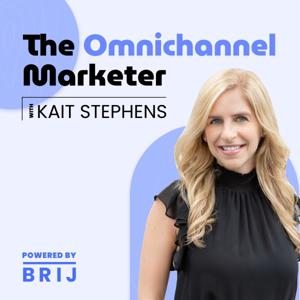
The Omnichannel Marketer

The Omnichannel Marketer

By Kait StephensBusinessMarketing
Download on the App Store

The Omnichannel Marketer episodes

  • How Rare Beauty Brands Drives Growth Through Omni-Channel

    In this episode, we meet Chris Hobson, President and CEO of Rare Beauty Brands.


    Rare Beauty scales challenger brands with expertise in innovation, marketing, and infrastructure across various channels. 


    In this episode, we discussed  retail, e-commerce, direct-to-consumer channels, and how to build and scale an omnichannel brand in the beauty industry.‍


    Topics covered

    • Omnichannel distribution strategy
    • Starting in luxury retailers
    • The rise of Korean beauty
    • Using retail for profitable trial
    • Impulse purchase price points
    • Importance of social  media content
    • Collaborations with influencers
    • Tips for sell-through across channels
    • Focus on product
    • Retail associates‍


    Takeaways

    • The company has since expanded internationally, partnering with distributors in different countries to reach a global audience.
    • The channel strategy has evolved over time, with a focus on expanding into new markets and reaching a wider customer base.
    • The brand decided to initially focus on the assisted sale channel to gain credibility and educate consumers about their product category.
    • Amazon is viewed as a place where consumers can learn about the brand and check ratings and reviews.
    • DTC (Direct-to-Consumer) channel is used strategically to engage with consumers and gain insights.
    • The different channels work together to reinforce each other and provide a seamless brand experience for customers.
    • While retailers may share high-level consumer information with the brand, there is a limitation to the depth of data they can access.
    • Building a successful business requires both online and offline presence


    Please let us know your thoughts about the episode!

    ‍

    Where to find Chris Hobson:

    Linkedin: https://www.linkedin.com/in/christopherhobson/ 

    ​Website: https://rarebeautybrands.com/ 

    ‍

    Where to find Kait Stephens:

    Linkedin: https://www.linkedin.com/in/kait-margraf-stephens/

    Website: www.brij.it 

    ‍

    SUBSCRIBE TO THE OMNICHANNEL MARKETER

    www.theomnichannelmarketer.com

    31 min
  • Going viral on Tiktok & TIktok's Role in Sales With Nadya Okamoto from August

    In this episode, we meet Nadya Okamoto, Co-Founder of August.

    August is a brand revolutionizing period care with their sustainable, transparent, bold and inclusive approach on period products.

    In this episode, we discussed category disruption, influencer marketing, and evolving from DTC to omnichannel.

    ‍

    Topics covered

    • Consumer experience
    • Product distribution
    • B2B approach in a DTC business
    • Initial launch
    • Customizable subscriptions
    • Omnichannel distribution
    • Retail launch
    • Gen z consumer
    • Social media purchase motivator
    • Organic channels
    • How we measure our communities?
    • Know and listen your community
    • Omnichannel impact
    • Stigmas

    ‍

    Takeaways

    • ‍Nadya started in the period space at age 16 focusing on ending period poverty and stigma, then found August with the goal of making products that are and work better.
    • They leverage omni-channel strategies for selling and combating period stigma, with Nadya emphasizing its broad impact across all aspects of the business.
    • Between Nadya’s TikTok profile and August’s they have over five and a half million followers across channels.
    • Launched in 400 Target doors in Marc, utilizing #AugustTarget with over 50 million views for visibility tracking.
    • August exclusively supplies periods products at WeWork, Equinox, and SoulCycle, working to ensure accessible period care in B2B settings.
    • August has a distinct Gen Z community measured by their members on Geneva, not followers.
    • August wants to be CPG brand that doesn't have to rely so heavily on paid and paid channels of marketing, they rather focus on the organic channels.
    • Nadya says that social platform is a way August has been able to drive in store purchase and sell through.
    • While August views TikTok as a top-of-funnel tool, they don't consider it a selling point due to stigma, as period care is not an allowed category on the platform.
    • Omnichannel support enables users to choose donation recipients and initiate a tampon tax back initiative with competitors.


    Please let us know your thoughts about the episode!

    ‍

    Where to find Nadya Okamoto:

    Linkedin: https://www.linkedin.com/in/nadyaokamoto/ 

    ​Website: https://www.itsaugust.co/ 

    ‍

    Where to find Kait Stephens:

    Linkedin: https://www.linkedin.com/in/kait-margraf-stephens/

    Website: www.brij.it 

    ‍

    SUBSCRIBE TO THE OMNICHANNEL MARKETER

    www.theomnichannelmarketer.com


    25 min
  • The DTC and Retail Flywheel with Benjamin White, Founder & CEO @ Recess

    In this episode, we meet Benjamin Witte from Recess. 


    Recess is a relaxation drink. Recess is spearheading the category, like how RedBull started the energy drink category.


    Category creation, evolving from digitally native to retail, the DTC & omnichannel flywheel, and the trade-offs with DTC and retail.


    Topics covered

    • Category creation
    • Brand building 
    • Distribution
    • Amazon
    • Merchandising


    Takeaways

    • Adaptogens and CBD are functional ingredients not to be confused with the relaxation category. 
    • Many brands are focused on the ingredients, whereas Recess is focused on the broader category and, marketing the lifestyle choice and connecting with people emotionally.
    • Recess aims to be what Redbull is for energy drinks for the relaxation drink category. Five years ago, it was a bet on relaxation. And now the category is growing rapidly. New entrants are good for business and market the category as a whole. 
    • The beverage industry is primarily focused on awareness marketing
    • New category marketing requires investment in awareness to educate the market
    • Recess used Facebook and Instagram to drive awareness and distribution (at a time when that was less common). 
    • Starting online helps you validate your product before investing further vs. building for retail, failing, and having to retool
    • Beverage is unique, and there is no other category that gets as much distribution. It has to be available everywhere. 
    • The one-two punch is telling the story well online and then being available everywhere. Doing that in a single geography makes a brand seem bigger than it is. 
    • Recess is one of the top 5 fastest growing beverage brands on Amazon. Ben believes Amazon can be an engine for most consumer brands. If you can make it profitable, there is a massive scale. Any investment there helps grow the larger business
    • Amazon’s a flywheel because when people see the product in stores, they want to order it online. In that sense, being in a store is also great marketing. 
    • This year is Recess’ first big year in retail, and went to all the major chains. On a small scale, they are testing sampling, field marketing, and events. 
    • Regarding merchandising, Recess has a platform approach. Its beverages are in the functional beverage set, its powders are in the supplements set, and its mocktails are in the alcohol alternative set. 
    • Recess is able to maintain its online business because of its high price point. It’s $2.99/can vs $.30/can for a La Croix. It also becomes a daily habit for people, and people subscribe to it, so the LTV is very high. Finally ranking high organically on Amazon brings the blended CAC down. 
    • To Ben, Omnichannel is the combination of online and offline distribution branding and distribution. 


    Please let us know your thoughts about the episode!


    Where to find Benjamin Witte:

    Linkedin: https://www.linkedin.com/in/benjaminwitte/

    ​Website: https://takearecess.com/ 


    Where to find Kait Stephens:

    Linkedin: https://www.linkedin.com/in/kait-margraf-stephens/

    Website: www.brij.it 


    SUBSCRIBE TO THE OMNICHANNEL MARKETER

    www.theomnichannelmarketer.com


    32 min
  • Category Disruption and Evolving from DTC to Retail with Gabi Lewis, Co-Founder of Magic Spoon

    In this episode, we meet Gabi Lewis, founder and CEO of Magic Spoon 


    Magic Spoon is a better-for-you cereal brand that is designed to taste like your favorite childhood cereals but low in sugar and high in protein.


    In this episode, we discussed category disruption, influencer marketing, and evolving from DTC to omnichannel. 


    Topics covered

    • Category Disruption
    • Consumer health trends
    • Influencer and affiliate marketing
    • Omnichannel distribution
    • Retail velocity
    • Consistency 
    • Measurement & incremental


    Takeaways

    • The cereal category became stagnant because it was dominated by three large companies that weren’t incentivized to innovate, and a large scale was needed to compete.
    • Magic’s Spoon's first round of investors we also affiliates who helped launch the brand, which allowed for a great launch without overreliance on Facebook ads. 
    • Magic Spoon moved to Amazon and retail because that’s where customers want to buy. Most customers don’t want to buy from a different website for every product they want.
    • Magic’s Spoon's first retailer was Target because of the overlap with their customer base and their history of helping to launch DTC brands. 
    • Few brands have cracked the code on how to use digital to drive retail velocity, but what Gabi has learned is that nothing drives retail velocity like the right product at the right price with the right placement and shelving
    • The benefit of being DTC first is that you can use a lot of learnings from your website and Meta ads to inform retail strategy. 
    • The benefit of cereal packaging is that its packaging has a lot of space and it acts as a billboard for your product
    • Understanding incrementality is a crucial lever to get into retail; Magic Spoon is 65% incremental to the cereal category, meaning that 65% of Magic Spoon customers aren’t buying other cereals
    • Influencer marketing changes when going to retail. The CTA evolves to “Buy in Sprouts,” or Target, etc. 


    Please let us know your thoughts about the episode!


    Where to find Gabi Lewis:

    Linkedin: https://www.linkedin.com/in/gabi-lewis-88483447/

    ​Website: www.magicspoon.com


    Where to find Kait Stephens:

    Linkedin: https://www.linkedin.com/in/kait-margraf-stephens/

    Website: www.brij.it 


    SUBSCRIBE TO THE OMNICHANNEL MARKETER

    www.theomnichannelmarketer.com


    9:30 - 14:00


    33 min
  • Steven Borrelli x Cuts

    In this episode, we meet Steven Borrelli, the CEO and founder CUTS Clothing. 

    CUTS is a clothing brand built for the sport of business. It started with t-shirts designed for the work setting and has since expanded to polos, pants, and jackets, and recently started a women's line. 

    In this episode, Steven shares the lessons he learned from launching a brand store. 

    ‍

    Topics covered

    • Channel distribution
    • Omnichannel purchase behavior
    • Brand store strategy
    • Omnichannel experience
    • Merchandising and inventory

    ‍

    Takeaways

    • CUTS started in DTC with paid acquisition via Google, Facebook, and influencers. Then expanded to Nordstrom and its own location in Soho, NY. 
    • Soho is CUTS most profitable digital advertising segment. The store acts a billboard. People walk by it and shop online. Or they buy in-store, and the 2nd purchase happens online.  
    • A store is an extension of the brand and easier to launch than a partnership with a big box retailer. And has fewer restrictions and formalities. 
    • People often want to shop for the first time in-store because they want to try clothes online and then become long-term online customers. 
    • Stores can be a venue for events and community activation, especially with celebrity and influencer collaborations.
    • Steven selected Soho because it a densely populated location with a high concentration of customers. 
    • The Soho store is a test case, but Steven de-risked via a 2.5-year lease (versus the 10-year standard).
    • Stores have their own Conversion Rate Optimization, e.g., if a clerk misses 2 customers per day it's a missed opportunity of $400k per year.
    • Measure your store like an e-commerce site. How many visited vs. purchased per day? AOV, New vs. returning. Capture phone number to build SMS list, etc.
    • Having a consistent experience is hard outside of your DTC and brand store. Steven often says no to wholesale inquiries, where CUTS can’t control the experience.
    • Merchandising is a learning curve. Steven learned not dedicate as much space to filler products vs. hero. Learning how to merchandise in-store can help you optimize your DTC experience and merchandising. 
    • There is a ton of nuance in the store layout and merchandise presentation. Ie. depth of racks, and placements of tables.  

    ‍

    Please let us know your thoughts about the episode!

    ‍

    Where to find Steven:

    Linkedin: https://www.linkedin.com/in/borrellisteven/

    ​Website: https://www.cutsclothing.com/

    ‍

    Where to find Kait Stephens:

    Linkedin: https://www.linkedin.com/in/kait-margraf-stephens/

    Website: www.brij.it 

    ‍

    SUBSCRIBE TO THE OMNICHANNEL MARKETER

    www.theomnichannelmarketer.com

    23 min
  • A Deep Dive into launching in Sephora with Colm Mackin from Act+Acre

    In this episode, we meet Colm Mackin, from Act+Acre 


    Act+Acre is a women’s scalp care brand. 


    In this episode, Colm shares a deep dive into how to have a successful launch in Sephora. 


    Topics covered

    • Scalp health
    • Customer education
    • Product Effectiveness
    • Retail distribution
    • Influencer marketing
    • Focus


    Takeaways

    • Scalp care (and other medical) products really need to work. Customers needs to see success in a few uses. 
    • Finding influencers was tricky because you need to find people with scalp issues and that were willing to share their story. Colm focused more on micro influencers were are more willing to share. 
    • Press is similar to influencers in that it requires outreach and finding people who resonate with your product or pitch for PR. 
    • As part of their Sephora launch, Act+Acre is touring 250 stores to talk to beauty associates and help them understand the products. Doing 1:1 training with associates in each store for 4-5 hours each visit
    • Colm gets weekly sales updates from each store every Sunday uploads the data to a special dashboard where he sees how stores are performing. If a store is underperforming, they will invest in it via brand ambassadors.
    • Act+Acre is a new category, so a north star for Colm has been to be obsessive about simplifying messaging 
    • Focus is critical. Too many brands try too many channels at once or jump around. It’s better to focus on 1-2 channels at time. 


    Please let us know your thoughts about the episode!


    Where to find Colm:

    Linkedin: https://www.linkedin.com/in/colm-mackin-7b1ab627/

    ​Website: https://actandacre.com/


    Where to find Kait Stephens:

    Linkedin: https://www.linkedin.com/in/kait-margraf-stephens/

    Website: www.brij.it 


    SUBSCRIBE TO THE OMNICHANNEL MARKETER

    www.theomnichannelmarketer.com

    29 min
  • Driving a Great Customer Experience, Retention, and Loyalty in Omnichannel with Eli Weiss

    In this episode, we meet Eli Weiss.

    Eli ran Customer Experience at Olipop and Jones Road and recently joined Yoto, as VP of Retention and Advocacy.


    In this episode, we shares his perspective on how to deliver an amazing customer experience in an omnichannel setting. 


    Topics covered

    • Omnichannel vs. DTC experience
    • Olipop and Jone’s Road’s omnichannel presence
    • The value of an omnichannel customer
    • Customer experience 
    • Impact of brand hype on customer purchase behavior


    Takeaways

    • In retail, discovery to purchase lifecycle can be very quick, i.e. you see something and buy it right away, whereas the online journey has many different touchpoints. 
    • Omnichannel for Olipop and Jones Road were very different because Olipop is primarily meant to be consumed cold after purchasing in retail, versus Jones Road, which was primarily DTC with a few of their own stores. 
    • The commonality of each brand's omnichannel approach is giving the customer the experience and journey that they want, vs. obvious attempts to sell which are cringeworthy.
    • You can learn a lot from looking at existing customers' omnichannel journey data. Eli did this via Peel Insights
    • Another way is to learn directly from the customer. Eli conducted 60 hour-long Zoom interviews to understand why shoppers cross from DTC to retail, and vice versa. 
    • Eli shares that Jones Road’s omnichannel customer was a substantially higher value than single-channel purchasers. 
    • Retail 1st customers often have higher LTV because they get sales assistance instore and figure out what they want to buy repeatedly. Brands should strive to replicate that experience online 
    • QR codes are not necessarily a repeat purchase mechanism but a customer journey mechanism.
    • Jones Road replicated some of that sales-assisted experience with quizzes. 
    • Education was also critical to make sure customers received the right product for them and knew how to use it
    • The shortcut for product education is having a “cool” product. Because Olipop’s strong branding, the bar to educate customers on product benefits at times was way lower. The hype got people excited to drink it. 
    • Olipop was very successful at marketing it as an indulgence product 
    • If you want to perfect your omnichannel presence, talk to customers about what they love and hate about your product
    • Customer experience is more than support; its the entire brand experience
    • The most important part of retention is acquiring the right customer
    • Customer experience could roll up to marketing or operations but should roll up to someone with empathy, humility, and curiosity
    • Most brands are sleeping on retention and CX


    Please let us know your thoughts about the episode!


    Where to find Eli:

    Linkedin: https://www.linkedin.com/in/eliweisss/

    ​Website: https://www.eliweisss.com/


    Where to find Kait Stephens:

    Linkedin: https://www.linkedin.com/in/kait-margraf-stephens/

    Website: www.brij.it 


    SUBSCRIBE TO THE OMNICHANNEL MARKETER

    www.theomnichannelmarketer.com

    26 min
  • From Ecommerce to Omnichannel Expansion and the Value of TV Ads with Jacob Zuppke, CEO of Whisker

    In this episode, we meet Jacob Zuppke, CEO of Whisper. 


    Whisker is the maker of high-end pet products that replace house chores. Its flagship product is  the Litter Robot, the #1 self-cleaning litter box for cats.


    In this episode, we discussed transitioning from DTC to a genuine omnichannel brand and the power of TV commercials. 


    Topics covered

    • Category building for new products
    • Channel expansion
    • Storytelling
    • Retailing
    • TV commercial strategy
    • How to get customers to upgrade


    Takeaways

    • When you are building a new category, no one is looking for you. You need to invest in building awareness.
    • New category products often start DTC because retailers don’t want to risk shelf space on an unknown product.
    • Move to Amazon when your category or brand has keyword search volume 
    • For a considered purchase, whether it's online or offline, you need to tell a compelling story
    • Great retail partnerships are where you can tell your store and merchandise well. In store, story can be communicated through packaging, in-store displays, and point of sale.
    • When you go into retail, you need to invest in ads for high-funnel awareness to drive in-store sales, allowing customers to choose where they want to buy.
    • If you are considering writing a TV commercial, read “From Poop to Gold” by the Harmon Brothers.
    • A good commercial can be used in any channel (Meta, YouTube, streaming), not just linear TV.
    • However, it may need to be designed or recut to work for different channels, i.e., what works on TikTok, won’t work on TV or Meta, etc. 
    • You get customers returning for your latest products by upgrading with value-added problem-solving features. 


    Please let us know your thoughts about the episode!


    Where to find Jacob:

    Linkedin: https://www.linkedin.com/in/jacobzuppke

    ​Website: https://www.whisker.com


    Where to find Kait Stephens:

    Linkedin: https://www.linkedin.com/in/kait-margraf-stephens/

    Website: www.brij.it 


    SUBSCRIBE TO THE OMNICHANNEL MARKETER

    www.theomnichannelmarketer.com

    29 min
  • Scaling a Modern Omnichannel Brand with Leslie Danford, CEO of Vitaminis

    Meet Leslie Danford, the founder of Vitaminis.

    ‍

    Vitaminis are nutritious, portable drink shots created to support healthy lifestyles.

    ‍

    In this episode, Leslie talks about scaling from DTC to Omnichannel and how to bridge the gap btw offline and online.

    Topics

    • Direct-to-consumer launch
    • Omnichannel distribution
    • Launching retail and Amazon
    • Bridging the gap between online & offline
    • Sampling strategy
    • Email marketing

    Takeaways

    • Retail brings scale to a CPG brand but is challenging bc you lose connection with the buyer
    • Getting into retail is is a step in the right in direction, but you need to drive retail velocity to stay.
    • The days of ROI-positive online-only CPG are over. 
    • Retail only is hard bc some consumers want to learn about you online, see reviews, and desire subscription options.
    • Brands need to be online AND in retail to survive, it’s cost-effective and what shoppers want. 
    • In-person events are a great way to drive email list growth; Leslie uses a QR code activation at her sample stations and requires an email for the free sample!
    • Email is a great reminder for people that educational content is more sustainable than running offers and sales all the time. 
    • Brand experience goes beyond social, email, DTC, and retail. For some brands it can include functional experts. For Vitaminis, this gut doctor, wellness coaches, and nutritionists (vs. TikTok influencers). 
    • Sampling is a great way to discover your ideal customer profile. Small chains are a great place to launch sampling programs with lower barriers to entry than Walmart. 
    • Amazon is super convenient, but similar to retail, you have no clue who is buying.
    • Setbacks are a learning opportunity; Leslie completely formulated he reformulated Vitamins after getting negative feedback.


    Please let us know your thoughts about the episode!

    Where to find Leslie Danford:

    Linkedin: https://www.linkedin.com/in/leslie-danford/

    ​Website: https://vitaminisbrand.com/

    Where to find Kait Stephens:

    Linkedin: https://www.linkedin.com/in/kait-margraf-stephens/

    Website: www.brij.it 

    SUBSCRIBE TO THE OMNICHANNEL MARKETER

    www.theomnichannelmarketer.com

    24 min
  • Strategies for Building a Seamless Omnichannel Brand ft. Minesh Patel of Eczema Honey & Nigel Thomas of Alpha Inbound

    Meet Minesh Patel, CEO of Eczema Honey and Nigel Thomas, CEO of Alpha Inbound


    Eczema Honey is a skincare solution brand for people suffering eczema and sensitive skin. Alpha inbound is a digital marketing agency that specializes in health & wellness brands.


    In this episode,  we dive into the relationship between brands and agencies, pitching to Walmart, and navigating the transition from DTC to Omnichannel.


    Topics

    • Minesh & Nigel’s founder stories
    • Brand x agency relationships
    • Pitching to Walmart
    • Preparing for retail
    • Merchandising
    • Omnichannel marketing


    Takeaways

    • The best products are born of personal pain
    • The best agency relationship comes from a passion for your product and family-like closeness
    • Bringing your agency to a pitch is a winning play - shows the retailer how dedicated you are and it’s great intel for the agency to build and optimize campaigns
    • Omnichannel is meeting your customers where they are or want to shop
    • Put your best selling products forward when moving into retail, but customize the assortment to the retailer, i.e. a $30 cream will sell in Ulta Beauty not Walmart
    • If you are launching multiple products, try to have a “brand shop” display with all of your products merchandised together, so they don’t get lost between other products. 
    • New brands should check out the Walmart Start brand accelerator 
    • Big retailers love brand with digital savvy because they can mobile digital audiences to stores
    • Talking to local store managers about the questions customers ask can help you build great customer journeys that drive online social media grazers to stores
    • When moving into retail, brand awareness becomes very important; people won’t grab you off the shelf if they don’t know you
    • Getting into Walmart is the easy part, getting sales volume up and staying there is the hard part


    Please let us know your thoughts about the episode!

    Where to find Minesh Patel:
    Linkedin: https://www.linkedin.com/in/mineshdpatel/​
    Website: https://eczemahoneyco.com/

    Where to find Nigel Thomas:
    LinkedIn: https://www.linkedin.com/in/nigelthomas-ai/
    Website: https://www.alphainbound.com/

    Where to find Kait Stephens:
    Linkedin: https://www.linkedin.com/in/kait-margraf-stephens/
    Website: www.brij.it 

    SUBSCRIBE TO THE OMNICHANNEL MARKETER
    www.theomnichannelmarketer.com

    42 min

About The Omnichannel Marketer

From the publisher's feed

The Omnichannel Marketer Show - hosted by Kait Stephens - is frank discussion about what it takes to build a consumer brand, create a seamless omnichannel experience, and drive revenue and customer…

More shows like The Omnichannel Marketer

The Daily by The New York Times

The Daily

111,868 Listeners

My First Million by Hubspot Media

My First Million

2,648 Listeners

The Mel Robbins Podcast by Mel Robbins

The Mel Robbins Podcast

19,271 Listeners