
Sign up to save your podcasts
Or



Sarah Tellefsen met Dave when he was a Marine recruiter in Fond du Lac. Two weeks after their wedding, he deployed. Then he deployed again. Camp Pendleton, Hawaii, Quantico, back to Pendleton, Twentynine Palms. You might remember Dave from Episode 1. This is the other side of that story.
Every time they moved, Sarah asked herself the same question: what can I do while I'm here? In Hawaii, she finished a master's in counseling. At Quantico, she started volunteering, doing budget counseling with Marines and sailors. That's how she became an Accredited Financial Counselor. Now she works with veterans and their families, helping them get a handle on money.
We talk about what military spouses carry that nobody sees, the transition home, and the worry she doesn't always say out loud. Then we get practical. I tell her about the $12,000 truck I bought the minute I got home from Afghanistan. She explains emergency funds, the debt snowball and the avalanche, why you should take your card off every app, and the two words she texts back when a client wants to make a big purchase: "Tell me more."
Her one piece of advice: ask for help sooner. Don't wait.
If you're a veteran, a military spouse, or anyone who's never opened the bill because you were afraid of what was inside, this one is for you.
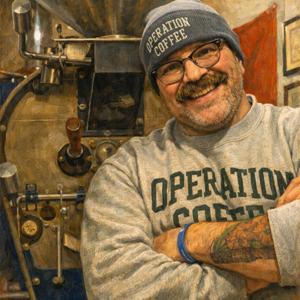
Recorded in the roasting room at Operation Coffee in Kaukauna, Wisconsin.
Coffee. Conversation. Connection.
3 Most.
Mike Helwig was a pastor for twenty years. He served a small parish in Grand Island, Nebraska, then spent fifteen years at Crown of Life in Hubertus. After that he taught high schoolers at Lakeside Lutheran through the pandemic. Somewhere along the way he got an itch he couldn't shake. He wanted to understand the mental health side of the people he was caring for. So he went back to school and became a counselor. That's how we met. I was one of his clients, and I came in very leery of counselors. What got me was that he actually cared. This year Mike launched Camp Courage and wrote Camp Courage: A Field Manual. It's built on four "cabins": your faith, your mental and emotional health, your body, and the people in your life. We walk through all four. We talk about reading your Bible on paper, why a hobby should be a little hard, why filling the bird feeder feels so good, and his sister's line that stuck with him: "Everything's therapy." We also get into the 2 a.m. phone call. Pastors, police officers, nurses and small business owners all feel like they have to be everything for everybody. Mike's answer, which his own therapist gave him, is that some things can wait till Tuesday. If you're a pastor, a first responder, or anyone who feels like they have to hold it all together, this one is for you.
Episode page: https://operationcoffee.com/pages/podcast-ep5-mike-helwig?utm_source=spotify&utm_medium=podcast&utm_campaign=ep5-mike-helwig
Camp Courage: A Field Manual: https://www.amazon.com/dp/1969818301
If you are struggling, call or text 988. Veterans and service members, press 1.
Recorded in the roasting room at Operation Coffee in Kaukauna, Wisconsin. Coffee. Conversation. Connection. 3 Most.
Most people around here have seen the homecoming. The hangar at Appleton, the flags, the water cannon salute. That's about ten minutes of something that takes a year.
Diane MacDonald is the Executive Director of Missions of Honor and Old Glory Honor Flight. She and her husband started Old Glory in 2009 after watching a story about an honor flight on TV on a Sunday afternoon. By Monday he had the paperwork. They formed the nonprofit in July and flew their first group of World War II veterans to Washington in October — which meant raising seventy thousand dollars in about three months, with no government money, ever.
Seventeen years later it's Pearl Harbor survivors going back to Pearl Harbor. Vietnam veterans going back to Vietnam. Sixty-eight World War II veterans to Normandy for the 80th anniversary of D-Day. And the Freedom to Liberty retreat, where Global War on Terrorism veterans go to New York City — because Ground Zero is our memorial — for four days built around mental health, with counselors and a chaplain along.
We talk about Chuck, the World War II veteran she was paired with on that very first flight, who left home at 17 and never talked about any of it. We talk about the veteran who walked up to her at the 9/11 Memorial Museum and said, "You saved a life today." We talk about why so many veterans say let the other guy go first — including me — and what she says back to that.
And Diane says something in the middle of this I haven't been able to put down: not every veteran needs counseling, and not everybody has a mental health problem, but everybody can use a friend.
If you've been told you should apply and you keep not applying, this one is for you. It's your turn.
Get on the wait list or become a Guardian: https://missionsofhonor.org
Recorded in the roasting room at Operation Coffee in Kaukauna, Wisconsin.
Coffee. Conversation. Connection.
3 Most.
First solo episode.
In 2017 I was living in Madison, fixing grinder sewage pumps, and the company went under. I'd bought a house a couple months before that. It was right around Memorial Day, which is already a hard week for me, and I had no idea what I was going to do next.
A case manager asked me what I liked to do. I said, sarcastically, that I liked to drink coffee because at that point I didn't like doing anything. She said, well, do something with that. I bought a popcorn popper from Goodwill and started from there.
A little while after that I ended up at Semper Fi Odyssey, a week-long course in the hills of Pennsylvania. That's where I met people who are still in my life today. And that's where something happened that I'm never going to forget. A guy there got word that his friend had ended his own life. I still picture his face. I still remember the table he was sitting at. He said he just wished he could have been there.
That's the moment that molded what Operation Coffee is. I don't want people to make that decision. And I don't want the people who love them to hurt like that man hurt.
This one is me talking about why the business exists, why I finally started a podcast after being against it for years, and what I'm hoping this show does. If it helps one person, that's the goal.
Recorded in the roasting room at Operation Coffee in Kaukauna, Wisconsin.
Coffee. Conversation. Connection.
3 Most.
This episode talks about suicide. If you're struggling, you can call or text 988 in the U.S. — Veterans and service members, press 1.
Ask a police officer who they talk to after a bad call, and most of them will tell you nobody.
Tyler Van Handel is a police officer here in the Fox Valley. He sat down in the roasting room with Sam for an hour to talk about the things first responders carry home, and what it takes to build a life where you actually have somebody to call.
Sam and Tyler get into the idea of a fire team — in the military, the four guys you run every maneuver with. In the civilian world it's four or five people at different ages and different stages of life, the ones you call when the crisis comes. Because it is coming. Building one takes years, and most people don't start until they need it.
They also talk about mentoring, about being honest with yourself, and about how much of this work is just refusing to do it alone.
Tyler's Hold My Coffee moment goes back to his grandma and her instant coffee — the constant on good days, bad days, and everything in between. Now it's the first sip after a scene that left him frozen to the bone, and the cup he makes for his wife every morning before work.
Recorded in the roasting room at Operation Coffee in Kaukauna, Wisconsin.
Coffee. Conversation. Connection.
David Tellefsen spent his career in the Marine Corps and retired as a First Sergeant. Now he's the Veteran Service Officer for Fond du Lac County and this conversation is about the road between those two things.
We talked about the part nobody warns you about: what happens when you take off the uniform. The struggle of transitioning out. Losing the mission, and finding a new one in helping other veterans.
We got honest about something a lot of us carry. In the Corps, you learn not to get too attached — because getting attached means getting hurt. So you leave, and you keep people at arm's length. David and I talked about how hard it is to let people back in, and why it matters that you do.
If you're a veteran: reach out to your County Veteran Service Officer. That's what they're there for. You don't have to figure this out alone. And it's OK to let people in.
Grab a cup and sit with us. — Sam
Operation Coffee: Coffee. Conversation. Connection.
Welcome to the Operation Coffee Podcast, Where every conversation starts with a cup of coffee. In this first episode, I share why I started this and what you can expect when you pull up a chair. Each episode, I sit down with someone and ask about their "Hold My Coffee" moment: the person, the event, or the turning point that shaped who they are. We also will sit down with veterans and non veterans alike to get different perspectives about different subject matters around the veteran community.
3 Most,
Sam
From the publisher's feed