
Sign up to save your podcasts
Or



A better title, a larger salary, more independence, or more time with the people you care about: success can mean different things, even to the same person at different stages of life.
In this episode, Suneet Singal explores how to identify the expectations inside your goals without dismissing ambition or the practical importance of income. Through clear hypothetical examples, you will compare an impressive opportunity with the ordinary days it would create, distinguish your preferences from borrowed expectations, and consider the responsibilities that shape a workable choice.
The episode introduces a Success in Practice exercise for translating broad values into observable conditions. It also explains why a values list cannot choose a job for you or settle every disagreement within a household. Leave with a personal definition of enough for one decision and a better question to ask about the opportunity you are considering.
Listener takeaways
Exercise: Success in Practice
Learn more:https://www.suneetsingal.net
When you feel stuck, it is easy to jump straight to a dramatic solution: quit the job, move cities, enrol in a course, or start again. This opening episode of The Opportunity Notebook asks a more useful first question: what decision is actually in front of you?
Suneet Singal walks through a clearly hypothetical career dilemma to separate observations, interpretations, and possible actions. You will learn how to identify the people affected, distinguish a real deadline from a feeling of urgency, and write a decision that is specific enough to investigate.
The episode also examines situations in which gathering more information becomes avoidance, and why a carefully framed choice still cannot remove uncertainty. Finish with a practical Decision Sentence exercise that turns a broad worry into a manageable next step. No previous episodes or special materials are needed; a notebook or a simple voice note will do.
Listener takeaways
Exercise: The Decision Sentence
Learn more:https://www.suneetsingal.net
When work becomes difficult, the choice can seem to narrow to two options: accept everything as it is or leave immediately. This episode explores how to investigate other possibilities without assuming that every workplace can or should be repaired.
Suneet Singal uses clearly hypothetical examples to examine changes in duties, schedules, reporting relationships, internal opportunities, and the timing of an external move. Learn how to turn a general complaint into a bounded proposal that explains the problem, the requested change, and how it could be reviewed.
The episode also considers unequal bargaining power, a manager's refusal, and the risk of turning a temporary arrangement into an indefinite promise. The Change One Part exercise helps you identify the component that matters most and prepare a practical next conversation. Where a situation involves safety, discrimination, or legal rights, relevant specialist support remains essential.
Listener takeaways
Exercise: Change One Part
Explore more from Suneet Singal: https://www.suneetsingal.net
An attractive opportunity can have costs that never appear in its headline: travel, preparation, unpredictable hours, displaced commitments, or a promise made on someone else's behalf. Suneet Singal examines how to compare those costs without treating every worthwhile challenge as something to avoid.
A clearly hypothetical course decision provides a worked example of money, time, payment timing, and the activities that would need to move. A second example explores why a higher salary still needs to be considered alongside the actual job and benefits.
The episode distinguishes an expense from an uncertain risk and looks at the cost of continuing with the current arrangement. Finish with the Full Commitment Check, a practical exercise for identifying what an opportunity requires, what is still unknown, and whether a smaller or differently timed version could work. The discussion is educational and does not provide individualized financial advice.
Listener takeaways
Exercise: The Full Commitment Check
Learn more: https://www.suneetsingal.net
From the publisher's feed
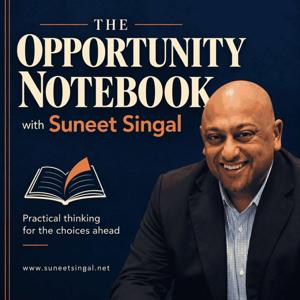
Career changes, new skills, competing commitments, and opportunities that are difficult to judge: the choices ahead rarely come with complete information. In The Opportunity Notebook, Suneet Singal examines one practical decision in each episode, using research, worked examples, and questions you can apply to your own circumstances. Expect a clear explanation, an honest look at the trade-offs, and one useful step to try. The first season explores how to compare opportunities, check claims, demonstrate skills, and make commitments that fit the life you actually lead. Examples are hypothetical unless explicitly identified otherwise. Each episode stands on its own and includes an exercise you can revisit at your own pace.
Explore more from Suneet Singal: https://www.suneetsingal.net