
Sign up to save your podcasts
Or

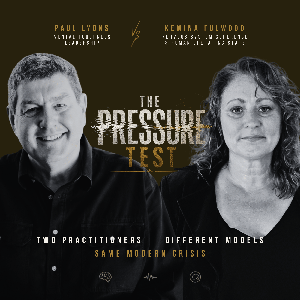


What happens to trust when every brand sounds like it has the perfect answer?
In this episode of The Pressure Test, Kemina Fulwood and Paul Lyons explore why polished AI content can make people trust brands less. AI can help us find the words. But it goes deeper than that - we look into what happens when we hand over the judgement, point of view and the awkward details that make a story believable, is there anything left for people to trust?
We delve into the need to sound certain before we feel ready, the line between “fake it till you make it” and pretending to be someone you’re not and how even our messy moments can become a performance when vulnerability is part of the marketing plan.
What makes you trust a brand less these days? Can you put your finger on the moment it happens?
Tell us in the comments.
More from The Pressure Test at https://pressuretest.live
#ThePressureTest #AIContent #BrandTrust
The War Between Efficiency and Humanity
Technology was supposed to give us time back. Why does every minute we save become room for another task?
In The War Between Efficiency and Humanity, Kemina Fulwood and Paul Lyons explore what productivity culture is costing us, at work and beyond.
Where is the room to make mistakes, laugh, think things through and enjoy the life we’re working so hard to create?
We discuss:
• When efficiency removes the breathing room people need.
• Why faster decisions aren’t always better decisions.
• How constant busyness can become avoidance.
• Perfectionism and the space we need to learn.
• Identity, achievement and the question of “enough”.
• What leaders can do to protect humanity alongside performance.
Think about the last thing that saved you an hour at work. Where did that hour go? And did you get any of it back?
Watch more episodes of The Pressure Test:
https://pressuretest.live/
Explore Kemina’s work at The Coherence Lab:
https://coherencelaboratory.com/
#ThePressureTest #Leadership #ProductivityCulture
The old model of male leadership - stoic, decisive, unshakeable - is being dismantled faster than anything's replacing it, and a lot of men in leadership are left without a script that still works. Paul, who built a career inside that older model, makes the case for what's actually worth keeping from it. Kemina argues the crisis isn't that the old model broke - it's that nobody taught the nervous system underneath it a different way to feel safe. What does leadership actually look like once the old armour comes off?
Psychological safety became one of the most quoted ideas in modern leadership, and one of the most misunderstood. It was meant to make it safe to speak up, take risks and admit mistakes. In plenty of teams it has drifted into something else: dodging hard conversations, softening every piece of feedback, and treating discomfort as proof something has gone wrong. Paul argues high standards and psychological safety were always meant to travel together, and too many leaders have kept one and quietly dropped the other. Kemina argues safety is a nervous system state, not a policy, and a team that never gets to feel tension never learns it can survive it. So is it building stronger teams, or more fragile ones?
Get rid of the hierarchy and you get rid of the friction - that's the pitch behind flat structures and the death of the org chart. Instead, plenty of "flat" companies have just made the hierarchy invisible: influence and pressure still flow somewhere, just without a title attached to absorb it. Paul argues structure is what protects people from chaos, not what causes it. Kemina argues the nervous system reads ambiguity as threat regardless of what the org chart says - and an invisible hierarchy is often more dysregulating than an honest one. Who's actually holding the pressure when nobody's officially in charge of it?
The tools got smarter, faster, cheaper - and leadership anxiety didn't go away, it went up. Everyone blames the technology. But AI didn't invent uncertainty, obsolescence, or the fear of becoming replaceable - it just made them impossible to keep ignoring. Paul and Kemina go looking for what was already broken before the machines showed up.
The hard-driving, always-certain, emotionally unavailable leader is losing its grip on the boardroom. Is this progress or just rebranding? What actually replaces it - and is the replacement any more honest about how pressure and power really work on humans?
Rest has been medicalised, optimised, gamified - and still nobody's actually doing it. Performance culture treats recovery as a productivity strategy. But rest isn't a protocol. It's a physiological state that most high performers have lost access to. Who's responsible for fixing that?
AI was supposed to free up human capacity. Instead, exhaustion in senior leadership is at a recorded high. If it's not the volume of work, what is it? The ambiguity, the identity threat, the nervous system cost of constant recalibration - this episode goes after the real answer.
Mental toughness has become a cornerstone of leadership development - but is it building genuine capability or just better suppression? Paul defends the model he's built a career on. Kemina challenges what the nervous system does when you override its signals. The disagreement gets uncomfortable. That's exactly the point.