
Sign up to save your podcasts
Or



Psychological safety became one of the most quoted ideas in modern leadership, and one of the most misunderstood. It was meant to make it safe to speak up, take risks and admit mistakes. In plenty of teams it has drifted into something else: dodging hard conversations, softening every piece of feedback, and treating discomfort as proof something has gone wrong. Paul argues high standards and psychological safety were always meant to travel together, and too many leaders have kept one and quietly dropped the other. Kemina argues safety is a nervous system state, not a policy, and a team that never gets to feel tension never learns it can survive it. So is it building stronger teams, or more fragile ones?
Get rid of the hierarchy and you get rid of the friction - that's the pitch behind flat structures and the death of the org chart. Instead, plenty of "flat" companies have just made the hierarchy invisible: influence and pressure still flow somewhere, just without a title attached to absorb it. Paul argues structure is what protects people from chaos, not what causes it. Kemina argues the nervous system reads ambiguity as threat regardless of what the org chart says - and an invisible hierarchy is often more dysregulating than an honest one. Who's actually holding the pressure when nobody's officially in charge of it?
The tools got smarter, faster, cheaper - and leadership anxiety didn't go away, it went up. Everyone blames the technology. But AI didn't invent uncertainty, obsolescence, or the fear of becoming replaceable - it just made them impossible to keep ignoring. Paul and Kemina go looking for what was already broken before the machines showed up.
The hard-driving, always-certain, emotionally unavailable leader is losing its grip on the boardroom. Is this progress or just rebranding? What actually replaces it - and is the replacement any more honest about how pressure and power really work on humans?
Rest has been medicalised, optimised, gamified - and still nobody's actually doing it. Performance culture treats recovery as a productivity strategy. But rest isn't a protocol. It's a physiological state that most high performers have lost access to. Who's responsible for fixing that?
AI was supposed to free up human capacity. Instead, exhaustion in senior leadership is at a recorded high. If it's not the volume of work, what is it? The ambiguity, the identity threat, the nervous system cost of constant recalibration - this episode goes after the real answer.
Mental toughness has become a cornerstone of leadership development - but is it building genuine capability or just better suppression? Paul defends the model he's built a career on. Kemina challenges what the nervous system does when you override its signals. The disagreement gets uncomfortable. That's exactly the point.
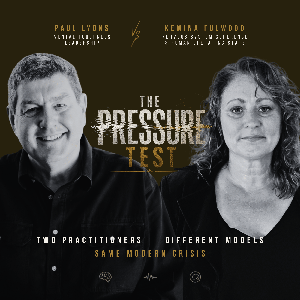
Two practitioners. Different models. Same modern crisis.
Paul Lyons says pressure is the making of leaders and mental toughness is trainable. Most leaders just haven't been taught to build the right kind of hard.
Kemina Fulwood says that's treating a biology problem like a mindset problem. If the nervous system is running in chronic threat, no amount of toughness lands. Real performance starts in the body, not the boardroom.
Every episode, we take a topic reshaping modern leadership - burnout, AI anxiety, executive exhaustion, identity collapse and put it under real pressure. Two models. One territory. No easy answers.
This isn't leadership advice. It's leadership stress-tested in real time.
The Pressure Test. New episodes fortnightly.
From the publisher's feed
Two practitioners. Different models. Same modern crisis.
Most leadership models haven't caught up.
Every episode we take a hot topic - AI anxiety, burnout,…
Two practitioners. One territory. No easy answers.
Sometimes Paul and Kemina agree. Often they don't. That tension is the point. This isn't leadership advice. It's leadership stress-tested in real time.