
Sign up to save your podcasts
Or



Today the History of the Germans is honoured to host David Crowther, doyen of the guild of podcasters and host of the most excellent History of England Podcast.
Wycliffe's writings were to prove controversial and proved an interesting early echo of the Reformation. They heavily influenced the view of Jan Hus and the movement in Bohemia. And his ability to develop and present those views owed a lot to Oxford University, and its desire to protect intellectual debate and investigation.
Enjoy
“They will roast a goose now, but after one hundred years they will hear a swan sing, and him they will have to endure.” These were allegedly the last words of a certain Jan Hus whose surname meant goose and who was burned at the stake on July 6, 1415.
Almost exactly one hundred years later a spiritually tormented monk, frightened by a vengeful God who sought to damn him, was assigned to teach the book of Romans at the new university of Wittenberg. And 2 years later this monk by the name of Martin Luther did (or probably did not) nail his 95 theses on the door of the Castle Church of that same town.
As far as prophecies go, this must be one of the most accurate, assuming it was indeed true. But it wasn’t just the foretelling of the next reformer that makes the trial of Jan Hus such a fascinating account. So much is foreshadowed in this tale, it is almost uncanny. The railing against indulgences, the wealth of the clergy, the pope, a promise of safe conduct, a trial, villains and archvillains, accusations upon accusations, defiance in the face of certain death and then the big difference to the diet of Worms, actual death. Have a listen, it is fun.
The music for the show is Flute Sonata in E-flat major, H.545 by Carl Phillip Emmanuel Bach (or some claim it as BWV 1031 Johann Sebastian Bach) performed and arranged by Michel Rondeau under Common Creative Licence 3.0.
As always:
Homepage with maps, photos, transcripts and blog: www.historyofthegermans.com
If you wish to support the show go to: Support • History of the Germans Podcast
Facebook: @HOTGPod
Threads: @history_of_the_germans_podcast
Bluesky: @hotgpod.bsky.social
Instagram: history_of_the_germans
Twitter: @germanshistory
To make it easier for you to share the podcast, I have created separate playlists for some of the seasons that are set up as individual podcasts. they have the exact same episodes as in the History of the Germans, but they may be a helpful device for those who want to concentrate on only one season.
So far I have:
The Ottonians
Salian Emperors and Investiture Controversy
Fredrick Barbarossa and Early Hohenstaufen
Frederick II Stupor Mundi
Saxony and Eastward Expansion
The Hanseatic League
The Teutonic Knights
The Holy Roman Empire 1250-1356
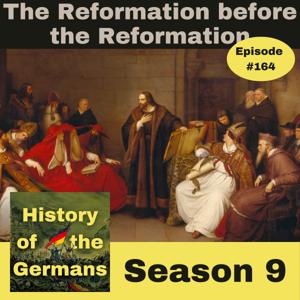
The Reformation before the Reformation
We have talked about church reform for almost four years, the council of Constance talked about church reform for about the same amount of time and Luther will talk and write about church reform until he did no longer believe that the church could be reformed.
But what is church reform. Or more specifically, what did the delegates in Constance mean when they debated church reform, why did they fail to implement much even though they held off electing a pope and the voting system was set up to favour of the national churches and against central papal authority.
All this we will discuss in this episode plus we will hear some angelic voices that made even the most hardnosed church politician kneel in prayer.
The music for the show is Flute Sonata in E-flat major, H.545 by Carl Phillip Emmanuel Bach (or some claim it as BWV 1031 Johann Sebastian Bach) performed and arranged by Michel Rondeau under Common Creative Licence 3.0.
As always:
Homepage with maps, photos, transcripts and blog: www.historyofthegermans.com
If you wish to support the show go to: Support • History of the Germans Podcast
Facebook: @HOTGPod
Threads: @history_of_the_germans_podcast
Bluesky: @hotgpod.bsky.social
Instagram: history_of_the_germans
Twitter: @germanshistory
To make it easier for you to share the podcast, I have created separate playlists for some of the seasons that are set up as individual podcasts. they have the exact same episodes as in the History of the Germans, but they may be a helpful device for those who want to concentrate on only one season.
So far I have:
The Ottonians
Salian Emperors and Investiture Controversy
Fredrick Barbarossa and Early Hohenstaufen
Frederick II Stupor Mundi
Saxony and Eastward Expansion
The Hanseatic League
The Teutonic Knights
The Holy Roman Empire 1250-1356
The Reformation before the Reformation
In November 1414 30,000 academics and aristocrats, bishops, blacksmiths and bakers, cardinals, counts and chefs, doctors, dancers and diplomats, princes, prelates and public girls descended on a town in Southern Germany built to house 6 to 8,000 people. They planned to stay a few weeks, 2-3 months max. But 3 and a half years later most of them were still there.
What did they get up to? The great tentpole events, the trial of John XXIII, the burning of Jan Hus and the election of Martin V is what the council of Constance is remembered for, but what about all that time in between?
This world event was so much more than a papal election and the trial of a heretic. For 3 years Constance became a never-ending G20 summit, the greatest academic conference of the Middle Ages, a permanent imperial diet and the centre of the catholic church. Everybody who was anybody was there either in the flesh or had at least sent a delegation.
Issues and concerns were brought before the council that still plague people today. Is it ever right to kill a tyrant, and if so, when can it be justified? What rights should be guaranteed for indigenous groups, in this case Pagans, and how should their dignity be protected? Other attendees sought justice for crimes committed against them or their families in a world where political murder had become commonplace. Others still demanded their reward for years of service, making the house of Hohenzollern the margraves of Brandenburg.
Living cheek by jowl in tiny Constance the leading minds from across Europe, from the ancient universities of Paris, Oxford and Bologna as well as from the newly founded seats of learning in Krakow, Prague, Heidelberg and Vienna shared their ideas, opinions, books and discoveries, paving the way for the intellectual shift we call the Renaissance.
Enough, me thinks to provide 30 minutes of great historical entertainment….
The music for the show is Flute Sonata in E-flat major, H.545 by Carl Phillip Emmanuel Bach (or some claim it as BWV 1031 Johann Sebastian Bach) performed and arranged by Michel Rondeau under Common Creative Licence 3.0.
As always:
Homepage with maps, photos, transcripts and blog: www.historyofthegermans.com
If you wish to support the show go to: Support • History of the Germans Podcast
Facebook: @HOTGPod
Threads: @history_of_the_germans_podcast
Bluesky: @hotgpod.bsky.social
Instagram: history_of_the_germans
Twitter: @germanshistory
To make it easier for you to share the podcast, I have created separate playlists for some of the seasons that are set up as individual podcasts. they have the exact same episodes as in the History of the Germans, but they may be a helpful device for those who want to concentrate on only one season.
So far I have:
The Ottonians
Salian Emperors and Investiture Controversy
Fredrick Barbarossa and Early Hohenstaufen
Frederick II Stupor Mundi
Saxony and Eastward Expansion
The Hanseatic League
The Teutonic Knights
The Holy Roman Empire 1250-1356
The Reformation before the Reformation
The Council of Constance marked a pivotal moment in the history of the Catholic Church and the history of Europe in general.
One issue on the agenda was the ongoing schism that the council of Pisa had failed to resolve. Another the reform of the increasingly corrupt clergy all the way up to the pope himself. And then there were a number of individual questions this gathering of thousands had to address.
Whilst all these were crucial questions, the way the council constituted itself foreshadowed a fundamental change in the way European saw themselves.
This part 1 deals with the establishment of the council and the removal of the popes, most importantly the pope who had convened the council on the first place, John XXIII and his counterpart, the emperor Sigismund.
“Master Jan Hus, preacher of the Holy Scriptures from the chapel of Bethlehem, was also present at this council, who in his preaching continuously criticized and exposed the hypocrisy, pride, miserliness, fornication, simony, and other sins of the clergy, in order to bring the priesthood back to the apostolic life. He was immensely hated by these pestiferous clerics.”
This is how Laurence of Brezova introduced the great reformer and Czech national hero Jan Hus in his 15th century chronicle of the Hussite uprising.
Why should we care about the trials and tribulations of another holy man railing against corrupt prelates and the subsequent “quarrel in a faraway country, between people of whom we know nothing”.
Well, that quote itself should be reason enough. It is from Neville Chamberlain speech of September 27, 1938 weighing the importance of protecting Czechoslovakia against an expansionist Nazi Germany.
But Jan Hus is interesting beyond his status as a towering figure in Czech history. When he came to Prague in 1390 he was just another ambitious young man from a modest background who wanted to rise up in the world on the back of intelligence and hard work. But by the time he leaves for his fate at the Council of Constance in 1414 he has been excommunicated, exiled and unwillingly or willingly be come he face of a brewing revolt against king and clergy. This is a story about collapsing certainties and emerging truths, about individual beliefs and institutional order. About what the community of the faithful is supposed to be and who is in and who is out. And its tentacles reach deep into the next centuries…
The music for the show is Flute Sonata in E-flat major, H.545 by Carl Phillip Emmanuel Bach (or some claim it as BWV 1031 Johann Sebastian Bach) performed and arranged by Michel Rondeau under Common Creative Licence 3.0.
As always:
Homepage with maps, photos, transcripts and blog: www.historyofthegermans.com
If you wish to support the show go to: Support • History of the Germans Podcast
Facebook: @HOTGPod
Threads: @history_of_the_germans_podcast
Bluesky: @hotgpod.bsky.social
Instagram: history_of_the_germans
Twitter: @germanshistory
To make it easier for you to share the podcast, I have created separate playlists for some of the seasons that are set up as individual podcasts. they have the exact same episodes as in the History of the Germans, but they may be a helpful device for those who want to concentrate on only one season.
So far I have:
The Ottonians
Salian Emperors and Investiture Controversy
Fredrick Barbarossa and Early Hohenstaufen
Frederick II Stupor Mundi
Saxony and Eastward Expansion
The Hanseatic League
The Teutonic Knights
The Holy Roman Empire 1250-1356
The Reformation before the Reformation
The late 14th and early 15th century was a period of upheaval, the certainties of the Middle Ages, that the pope ruled the world and that knights were invincible were crumbling away, the long period of economic growth, of eastward expansion and conversion of the pagans made way for war, plague and famine. The church was split in half and the Ottomans were coming.
This was an age that called forth larger-than-life characters: Joan of Arc, fierce and holy; Henry Bolingbroke, seizing a throne; Jadwiga and Jogaila, uniting kingdoms; the audacious Gian Galeazzo Visconti and fiery Cola di Rienzo; the ever-scheming John the Fearless and Jacob van Artevelde; the tragic Ines de Castro and the unflinching Jan Žižka.
Into this glittering and turbulent lineup steps a man whose reputation has not exactly been polished by time. Despised in his kingdoms of Hungary and Bohemia and even Constance, the city that owes him so much, decided to remember him as a fat naked crowned guy with skinny arms and legs, worn-out face, forked beard and disproportionate genitalia balancing on the hand of a nine-meter-tall sex worker. No, I am not making this up.
Sigismund, because that was his name, was a true enigma of the late Middle Ages. He had inherited his father’s charm and ruthless cunning, his knack for negotiating compromise in impossible situations, and his unshakeable belief in his role as the head of Christendom. But what he hadn’t inherited was his father’s performative piety, his zeal for relics, his asceticism—or his wealth.
Instead, Sigismund was left with a volatile mix of ambition, enormous self-confidence, a lust for life, and, crucially, a chronic shortage of funds. Yet despite his flaws, he took on Christendom’s two greatest crises—the schism and the Ottoman threat—and in doing so, managed to create a third…This is his backstory.
The music for the show is Flute Sonata in E-flat major, H.545 by Carl Phillip Emmanuel Bach (or some claim it as BWV 1031 Johann Sebastian Bach) performed and arranged by Michel Rondeau under Common Creative Licence 3.0.
As always:
Homepage with maps, photos, transcripts and blog: www.historyofthegermans.com
If you wish to support the show go to: Support • History of the Germans Podcast
Facebook: @HOTGPod
Threads: @history_of_the_germans_podcast
Bluesky: @hotgpod.bsky.social
Instagram: history_of_the_germans
Twitter: @germanshistory
To make it easier for you to share the podcast, I have created separate playlists for some of the seasons that are set up as individual podcasts. they have the exact same episodes as in the History of the Germans, but they may be a helpful device for those who want to concentrate on only one season.
So far I have:
The Ottonians
Salian Emperors and Investiture Controversy
Fredrick Barbarossa and Early Hohenstaufen
Frederick II Stupor Mundi
Saxony and Eastward Expansion
The Hanseatic League
The Teutonic Knights
The Holy Roman Empire 1250-1356
The Reformation before the Reformation
This week we delve into the transformative period of the Ottomans from Osman to the Battle of Nicopolis. It highlights how Osman, the son of an Anatolian warlord, laid the foundations for what would become one of the world's greatest empires, despite starting as just one of many Turkic beys in a tumultuous landscape. The narrative explores the cultural and military strategies that enabled the Ottomans to expand, emphasizing their approach of gradual assimilation and religious tolerance as they conquered predominantly Christian lands. The episode also recounts the dramatic Battle of Nicopolis in 1396, where a coalition of European knights faced the formidable Ottoman forces, leading to a catastrophic defeat for the crusaders. As the episode unfolds, it illustrates the lasting impact of these events on the geopolitical landscape of Europe and the Ottoman Empire's rise as a dominant power in the centuries to follow.
The music for the show is Flute Sonata in E-flat major, H.545 by Carl Phillip Emmanuel Bach (or some claim it as BWV 1031 Johann Sebastian Bach) performed and arranged by Michel Rondeau under Common Creative Licence 3.0.
As always:
Homepage with maps, photos, transcripts and blog: www.historyofthegermans.com
If you wish to support the show go to: Support • History of the Germans Podcast
Facebook: @HOTGPod
Threads: @history_of_the_germans_podcast
Bluesky: @hotgpod.bsky.social
Instagram: history_of_the_germans
Twitter: @germanshistory
To make it easier for you to share the podcast, I have created separate playlists for some of the seasons that are set up as individual podcasts. they have the exact same episodes as in the History of the Germans, but they may be a helpful device for those who want to concentrate on only one season.
So far I have:
The Ottonians
Salian Emperors and Investiture Controversy
Fredrick Barbarossa and Early Hohenstaufen
Frederick II Stupor Mundi
Saxony and Eastward Expansion
The Hanseatic League
The Teutonic Knights
The Holy Roman Empire 1250-1356
The Reformation before the Reformation
When the Great Western Schism was finally resolved at Pisa and Constance, Christendom rejoiced.
Or so we have been told. But was it really such a devastating, catastrophic event that left the papacy mortally wounded, so impaired that it crumbled when next the power of the pope “to bind and to loosen” was questioned? Or was it just an affair, a temporary misunderstanding created by some drafting error in canon law that prevented the removal of an incapacitated pope?
Me thinks that is worth investigating even if it means diving deep into theology and canon law. But do not worry we will also do a spot of fiscal policy just to lighten things up a bit.
The music for the show is Flute Sonata in E-flat major, H.545 by Carl Phillip Emmanuel Bach (or some claim it as BWV 1031 Johann Sebastian Bach) performed and arranged by Michel Rondeau under Common Creative Licence 3.0.
As always:
Homepage with maps, photos, transcripts and blog: www.historyofthegermans.com
If you wish to support the show go to: Support • History of the Germans Podcast
Facebook: @HOTGPod
Threads: @history_of_the_germans_podcast
Bluesky: @hotgpod.bsky.social
Instagram: history_of_the_germans
Twitter: @germanshistory
To make it easier for you to share the podcast, I have created separate playlists for some of the seasons that are set up as individual podcasts. they have the exact same episodes as in the History of the Germans, but they may be a helpful device for those who want to concentrate on only one season.
So far I have:
The Ottonians
Salian Emperors and Investiture Controversy
Fredrick Barbarossa and Early Hohenstaufen
Frederick II Stupor Mundi
Saxony and Eastward Expansion
The Hanseatic League
The Teutonic Knights
The Holy Roman Empire 1250-1356
The Reformation before the Reformation
If you are a longstanding listener to the History of the Germans, you will already know that sometime in the late 14th century the catholic church broke apart into 2 and then 3 different obediences, three popes residing in different places and being recognised by different nations.
But what you may not know is how exactly this had happened. Why did the exact self-same cardinals elect one pope in April 1378 and another one 4 months later? Who was taking the lead in attempts to resolve the crisis and why did all these attempts fail for 40 years? How far did they go in forcing the various papal contenders to come to the negotiation table. How ridiculous were the popes’ attempts to wiggle out of that…
All that we will look into this week in part 1 of the story of the Great Western Schism.
The music for the show is Flute Sonata in E-flat major, H.545 by Carl Phillip Emmanuel Bach (or some claim it as BWV 1031 Johann Sebastian Bach) performed and arranged by Michel Rondeau under Common Creative Licence 3.0.
As always:
Homepage with maps, photos, transcripts and blog: www.historyofthegermans.com
If you wish to support the show go to: Support • History of the Germans Podcast
Facebook: @HOTGPod
Threads: @history_of_the_germans_podcast
Bluesky: @hotgpod.bsky.social
Instagram: history_of_the_germans
Twitter: @germanshistory
To make it easier for you to share the podcast, I have created separate playlists for some of the seasons that are set up as individual podcasts. they have the exact same episodes as in the History of the Germans, but they may be a helpful device for those who want to concentrate on only one season.
So far I have:
The Ottonians
Salian Emperors and Investiture Controversy
Fredrick Barbarossa and Early Hohenstaufen
Frederick II Stupor Mundi
Saxony and Eastward Expansion
The Hanseatic League
The Teutonic Knights
The Holy Roman Empire 1250-1356
The Reformation before the Reformation
From the publisher's feed

15,573 Listeners
473 Listeners
5 Listeners
7 Listeners
5 Listeners
7 Listeners
16 Listeners
0 Listeners

0 Listeners